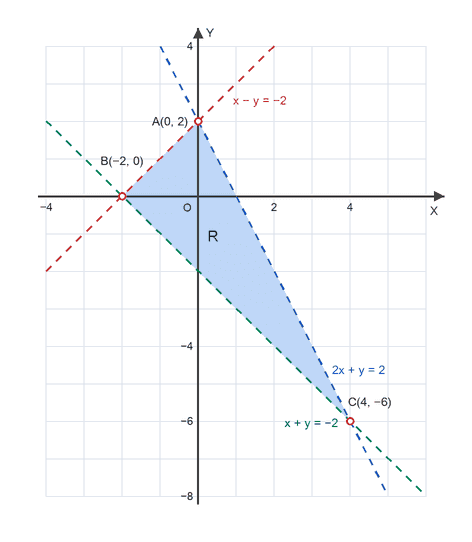
Question 413 marksMedium
Graph the solution set of the following system in a coordinate plane.
Confirming your payment
Sign up now and get 250 free tokens.
Inequalities · Question 41 of 92
Graph the solution set of the following system in a coordinate plane.
Solution:
Concept: To graph a linear inequality such as , first replace the inequality sign by an equals sign and draw the boundary line . Draw it solid when the sign is or (points on the line are included) and dashed when the sign is or (points on the line are not included). Then test one point that is not on the line, usually the origin : if the point satisfies the inequality, the solution is the side of the line containing that point; if not, it is the other side. The solution set of a system is the region common to all these half-planes.
Step 1 — Draw the boundary line of .
Replacing the inequality sign by an equals sign gives the boundary line .
Two points on this line are shown in the table.
The sign is strict, so points on the line do not satisfy the inequality and the line is drawn dashed.
Step 2 — Decide which side of to shade.
Test the point , which is not on this line, in :
This is true, so the solution of is the side of the line that contains this point: the half-plane on the origin side (below-left) of the line .
Step 3 — Draw the boundary line of .
Replacing the inequality sign by an equals sign gives the boundary line .
Two points on this line are shown in the table.
The sign is strict, so points on the line do not satisfy the inequality and the line is drawn dashed.
Step 4 — Decide which side of to shade.
Test the point , which is not on this line, in :
This is true, so the solution of is the side of the line that contains this point: the half-plane on the origin side (below-right) of the line .
Step 5 — Draw the boundary line of .
Replacing the inequality sign by an equals sign gives the boundary line .
Two points on this line are shown in the table.
The sign is strict, so points on the line do not satisfy the inequality and the line is drawn dashed.
Step 6 — Decide which side of to shade.
Test the point , which is not on this line, in :
This is true, so the solution of is the side of the line that contains this point: the half-plane on the origin side (above-right) of the line .
Step 7 — Find the corners where the lines meet.
Solve these two equations together:
Adding the two equations,
and then , so the corner is .
Solve these two equations together:
Adding the two equations,
and then , so the corner is .
Solve these two equations together:
Subtracting the second from the first,
and then , so and the corner is .
Step 8 — Describe the common region.
All three half-planes contain the origin, and they overlap in the triangle . All three sides lie on dashed lines, so no point of the sides, and none of the vertices, is included: the solution set is the inside of the triangle only.
Step 9 — Check with a point inside the region.
Take the point from the shaded region and test every inequality:
All the inequalities hold, so the shading is correct.
Therefore, the solution set is the interior of the triangle with vertices , and ; all three sides and vertices are excluded.
In the graph, the shaded region R is the solution set. A solid line belongs to the solution set, a dashed line does not, and a hollow dot marks a corner point that is not included.