Confirming your payment

Skip to content

Sign up now and get .

Opening your dashboard

Class 11 Maths Chapter 19: Limits Solutions

127 textbook questions with step-by-step answers, free to read, for ISC 2026-27.

AI Tutor

Get talked through Ch 19, not just shown the answer

Reading a finished solution is not the same as being able to do it. The AI tutor takes one question at a time and works it with you, in your own words, until you can.

  • Ask it out loud, in your own words
  • It gives you the next step, not the answer
  • Stuck on part (ii)? Start there
Ch 19 solutions

127 questions with solutions

3 marks · Mixed difficulty

The first 11 solutions are on this page. This chapter is a long one, so the rest open on their own page to keep this one quick to load.

  1. 1

    Question 1

    Show that lim⁡x→2∣x−2∣x−2\lim_{x \to 2} \dfrac{|x - 2|}{x - 2} does not exist.

    Medium
    3 marks
    Solve with AI
    Written solution

    Solution:

    Concept: The limit lim⁡x→af(x)\lim_{x \to a} f(x) exists only when the left-hand limit (L.H.L.) lim⁡x→a−f(x)\lim_{x \to a^-} f(x) and the right-hand limit (R.H.L.) lim⁡x→a+f(x)\lim_{x \to a^+} f(x) both exist as finite numbers and are equal; their common value is the limit. To find the L.H.L. we put x=a−hx = a - h, and to find the R.H.L. we put x=a+hx = a + h, where h>0h > 0 and h→0h \to 0. The value f(a)f(a) itself plays no part.

    Step 1 — Find the left-hand limit. We put x=2−hx = 2 - h, where h>0h > 0 and h→0h \to 0; then x−2=−hx - 2 = -h is negative, so ∣x−2∣=h|x - 2| = h:

    lim⁡x→2−∣x−2∣x−2=lim⁡h→0+∣−h∣−h=lim⁡h→0+h−h=−1\begin{aligned} \lim_{x \to 2^-} \dfrac{|x - 2|}{x - 2} &= \lim_{h \to 0^+} \dfrac{|-h|}{-h} \\ &= \lim_{h \to 0^+} \dfrac{h}{-h} \\ &= -1 \end{aligned}

    Step 2 — Find the right-hand limit. We put x=2+hx = 2 + h, where h>0h > 0 and h→0h \to 0; now x−2=hx - 2 = h is positive, so ∣x−2∣=h|x - 2| = h:

    lim⁡x→2+∣x−2∣x−2=lim⁡h→0+∣h∣h=lim⁡h→0+hh=1\begin{aligned} \lim_{x \to 2^+} \dfrac{|x - 2|}{x - 2} &= \lim_{h \to 0^+} \dfrac{|h|}{h} \\ &= \lim_{h \to 0^+} \dfrac{h}{h} \\ &= 1 \end{aligned}

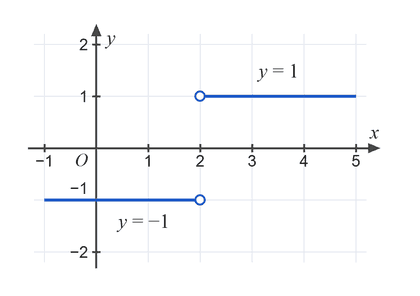
    Step 3 — Compare the two one-sided limits. The graph shows the function: it equals −1-1 everywhere to the left of 22 and 11 everywhere to the right of 22, so it jumps at x=2x = 2 (open dots, because the function is not defined at x=2x = 2).

    Class 11 Maths Limits

    The L.H.L. is −1-1 and the R.H.L. is 11. They are not equal, so the limit at x=2x = 2 cannot exist.

    Therefore, since L.H.L. =−1= -1 and R.H.L. =1= 1 are unequal, lim⁡x→2∣x−2∣x−2\lim_{x \to 2} \dfrac{|x - 2|}{x - 2} does not exist.

  2. 2

    Question 2

    Show that lim⁡x→π2tan⁡x\lim_{x \to \frac{\pi}{2}} \tan x does not exist.

    Medium
    3 marks
    Solve with AI
    Written solution

    Solution:

    Concept: The limit lim⁡x→af(x)\lim_{x \to a} f(x) exists only when the left-hand limit (L.H.L.) lim⁡x→a−f(x)\lim_{x \to a^-} f(x) and the right-hand limit (R.H.L.) lim⁡x→a+f(x)\lim_{x \to a^+} f(x) both exist as finite numbers and are equal; their common value is the limit. To find the L.H.L. we put x=a−hx = a - h, and to find the R.H.L. we put x=a+hx = a + h, where h>0h > 0 and h→0h \to 0. The value f(a)f(a) itself plays no part.

    Step 1 — Find the left-hand limit. We put x=π2−hx = \dfrac{\pi}{2} - h, where h>0h > 0 and h→0h \to 0, and use tan⁡(π2−h)=cot⁡h\tan\left(\dfrac{\pi}{2} - h\right) = \cot h:

    lim⁡x→π2−tan⁡x=lim⁡h→0+tan⁡(π2−h)=lim⁡h→0+cot⁡h\begin{aligned} \lim_{x \to \frac{\pi}{2}^-} \tan x &= \lim_{h \to 0^+} \tan\left(\dfrac{\pi}{2} - h\right) \\ &= \lim_{h \to 0^+} \cot h \end{aligned}

    As h→0+h \to 0^+, cos⁡h→1\cos h \to 1 and sin⁡h→0\sin h \to 0 through positive values, so cot⁡h=cos⁡hsin⁡h\cot h = \dfrac{\cos h}{\sin h} grows without bound:

    lim⁡x→π2−tan⁡x=+∞\lim_{x \to \frac{\pi}{2}^-} \tan x = +\infty

    Step 2 — Find the right-hand limit. We put x=π2+hx = \dfrac{\pi}{2} + h, where h>0h > 0 and h→0h \to 0, and use tan⁡(π2+h)=−cot⁡h\tan\left(\dfrac{\pi}{2} + h\right) = -\cot h:

    lim⁡x→π2+tan⁡x=lim⁡h→0+(−cot⁡h)=−∞\begin{aligned} \lim_{x \to \frac{\pi}{2}^+} \tan x &= \lim_{h \to 0^+} \left(-\cot h\right) \\ &= -\infty \end{aligned}

    Step 3 — Draw the conclusion. The graph of y=tan⁡xy = \tan x shows the two branches running off upwards and downwards on either side of the dashed line x=π2x = \dfrac{\pi}{2}.

    Class 11 Maths Limits

    Neither one-sided limit is a finite number, and they are not even equal (one is +∞+\infty, the other −∞-\infty), so the limit does not exist.

    Therefore, since lim⁡x→π2−tan⁡x=+∞\lim_{x \to \frac{\pi}{2}^-} \tan x = +\infty and lim⁡x→π2+tan⁡x=−∞\lim_{x \to \frac{\pi}{2}^+} \tan x = -\infty, lim⁡x→π2tan⁡x\lim_{x \to \frac{\pi}{2}} \tan x does not exist.

  3. 3

    Question 3

    If

    f(x)={x2+4for x<2x3for x>2f(x) = \begin{cases} x^2 + 4 & \text{for } x < 2 \\ x^3 & \text{for } x > 2 \end{cases}

    find lim⁡x→2f(x)\lim_{x \to 2} f(x).

    Easy
    3 marks
    Solve with AI
    Written solution

    Solution:

    Concept: The limit lim⁡x→af(x)\lim_{x \to a} f(x) exists only when the left-hand limit (L.H.L.) lim⁡x→a−f(x)\lim_{x \to a^-} f(x) and the right-hand limit (R.H.L.) lim⁡x→a+f(x)\lim_{x \to a^+} f(x) both exist as finite numbers and are equal; their common value is the limit. To find the L.H.L. we put x=a−hx = a - h, and to find the R.H.L. we put x=a+hx = a + h, where h>0h > 0 and h→0h \to 0. The value f(a)f(a) itself plays no part.

    Step 1 — Find the left-hand limit. For x<2x < 2 the rule is f(x)=x2+4f(x) = x^2 + 4, which is a polynomial, so we may put x=2x = 2 in it:

    lim⁡x→2−f(x)=lim⁡x→2−(x2+4)=22+4=8\begin{aligned} \lim_{x \to 2^-} f(x) &= \lim_{x \to 2^-} (x^2 + 4) \\ &= 2^2 + 4 \\ &= 8 \end{aligned}

    Step 2 — Find the right-hand limit. For x>2x > 2 the rule is f(x)=x3f(x) = x^3:

    lim⁡x→2+f(x)=lim⁡x→2+x3=23=8\begin{aligned} \lim_{x \to 2^+} f(x) &= \lim_{x \to 2^+} x^3 \\ &= 2^3 \\ &= 8 \end{aligned}

    Step 3 — Compare the one-sided limits. Both one-sided limits equal 88. The graph shows both pieces running into the same point (2,8)(2, 8); the dot there is open because f(2)f(2) is not defined, which does not matter for the limit.

    Class 11 Maths Limits

    Therefore, both one-sided limits equal 88, so lim⁡x→2f(x)=8\lim_{x \to 2} f(x) = 8.

  4. 4

    Question 4

    If

    f(x)={x∣x∣for x≠00for x=0f(x) = \begin{cases} \dfrac{x}{|x|} & \text{for } x \neq 0 \\ 0 & \text{for } x = 0 \end{cases}

    find lim⁡x→0f(x)\lim_{x \to 0} f(x).

    Easy
    3 marks
    Solve with AI
    Written solution

    Solution:

    Concept: The limit lim⁡x→af(x)\lim_{x \to a} f(x) exists only when the left-hand limit (L.H.L.) lim⁡x→a−f(x)\lim_{x \to a^-} f(x) and the right-hand limit (R.H.L.) lim⁡x→a+f(x)\lim_{x \to a^+} f(x) both exist as finite numbers and are equal; their common value is the limit. To find the L.H.L. we put x=a−hx = a - h, and to find the R.H.L. we put x=a+hx = a + h, where h>0h > 0 and h→0h \to 0. The value f(a)f(a) itself plays no part.

    Step 1 — Find the left-hand limit. We put x=−hx = -h, where h>0h > 0 and h→0h \to 0; then ∣x∣=h|x| = h:

    lim⁡x→0−f(x)=lim⁡h→0+−h∣−h∣=lim⁡h→0+−hh=−1\begin{aligned} \lim_{x \to 0^-} f(x) &= \lim_{h \to 0^+} \dfrac{-h}{|-h|} \\ &= \lim_{h \to 0^+} \dfrac{-h}{h} \\ &= -1 \end{aligned}

    Step 2 — Find the right-hand limit. We put x=hx = h; then ∣x∣=h|x| = h:

    lim⁡x→0+f(x)=lim⁡h→0+hh=1\begin{aligned} \lim_{x \to 0^+} f(x) &= \lim_{h \to 0^+} \dfrac{h}{h} \\ &= 1 \end{aligned}

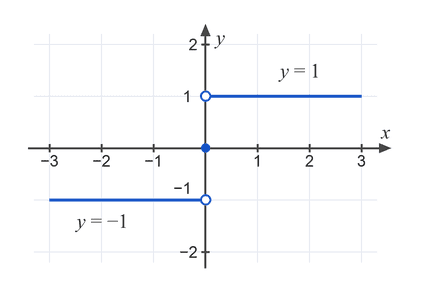
    Step 3 — Compare the one-sided limits. The graph shows y=−1y = -1 to the left of 00, y=1y = 1 to the right of 00, and the single point f(0)=0f(0) = 0 (filled dot at the origin).

    Class 11 Maths Limits

    The L.H.L. −1-1 and the R.H.L. 11 are unequal, so the limit does not exist. The given value f(0)=0f(0) = 0 cannot change this, because a limit never uses the value at the point itself.

    Therefore, lim⁡x→0f(x)\lim_{x \to 0} f(x) does not exist (L.H.L. =−1= -1, R.H.L. =1= 1).

  5. 5

    Question 5

    Does lim⁡x→0f(x)\lim_{x \to 0} f(x) exist if

    f(x)={x,when x<00,when x=0x2,when x>0f(x) = \begin{cases} x, & \text{when } x < 0 \\ 0, & \text{when } x = 0 \\ x^2, & \text{when } x > 0 \end{cases}
    Easy
    3 marks
    Solve with AI
    Written solution

    Solution:

    Concept: The limit lim⁡x→af(x)\lim_{x \to a} f(x) exists only when the left-hand limit (L.H.L.) lim⁡x→a−f(x)\lim_{x \to a^-} f(x) and the right-hand limit (R.H.L.) lim⁡x→a+f(x)\lim_{x \to a^+} f(x) both exist as finite numbers and are equal; their common value is the limit. To find the L.H.L. we put x=a−hx = a - h, and to find the R.H.L. we put x=a+hx = a + h, where h>0h > 0 and h→0h \to 0. The value f(a)f(a) itself plays no part.

    Step 1 — Find the left-hand limit. For x<0x < 0 the rule is f(x)=xf(x) = x, so we put x=−hx = -h with h>0h > 0, h→0h \to 0:

    lim⁡x→0−f(x)=lim⁡h→0+(−h)=0\begin{aligned} \lim_{x \to 0^-} f(x) &= \lim_{h \to 0^+} (-h) \\ &= 0 \end{aligned}

    Step 2 — Find the right-hand limit. For x>0x > 0 the rule is f(x)=x2f(x) = x^2, so we put x=hx = h:

    lim⁡x→0+f(x)=lim⁡h→0+h2=0\begin{aligned} \lim_{x \to 0^+} f(x) &= \lim_{h \to 0^+} h^2 \\ &= 0 \end{aligned}

    Step 3 — Compare the one-sided limits. Both one-sided limits are 00. The graph shows the line y=xy = x and the curve y=x2y = x^2 meeting at the origin, where f(0)=0f(0) = 0 (filled dot).

    Class 11 Maths Limits

    Therefore, yes: both one-sided limits are 00, so lim⁡x→0f(x)\lim_{x \to 0} f(x) exists and equals 00.

  6. 6

    Question 6

    Show that lim⁡x→01x\lim_{x \to 0} \dfrac{1}{x} does not exist.

    Easy
    3 marks
    Solve with AI
    Written solution

    Solution:

    Concept: The limit lim⁡x→af(x)\lim_{x \to a} f(x) exists only when the left-hand limit (L.H.L.) lim⁡x→a−f(x)\lim_{x \to a^-} f(x) and the right-hand limit (R.H.L.) lim⁡x→a+f(x)\lim_{x \to a^+} f(x) both exist as finite numbers and are equal; their common value is the limit. To find the L.H.L. we put x=a−hx = a - h, and to find the R.H.L. we put x=a+hx = a + h, where h>0h > 0 and h→0h \to 0. The value f(a)f(a) itself plays no part.

    Step 1 — Find the left-hand limit. We put x=−hx = -h, where h>0h > 0 and h→0h \to 0:

    lim⁡x→0−1x=lim⁡h→0+1−h\begin{aligned} \lim_{x \to 0^-} \dfrac{1}{x} &= \lim_{h \to 0^+} \dfrac{1}{-h} \end{aligned}

    As hh becomes smaller, 1h\dfrac{1}{h} becomes larger without bound (for example, h=0.001h = 0.001 gives 10001000). The fraction 1−h\dfrac{1}{-h} is the negative of this number, so it falls below every negative number:

    lim⁡x→0−1x=−∞\lim_{x \to 0^-} \dfrac{1}{x} = -\infty

    Step 2 — Find the right-hand limit. We put x=hx = h:

    lim⁡x→0+1x=lim⁡h→0+1h=+∞\begin{aligned} \lim_{x \to 0^+} \dfrac{1}{x} &= \lim_{h \to 0^+} \dfrac{1}{h} \\ &= +\infty \end{aligned}

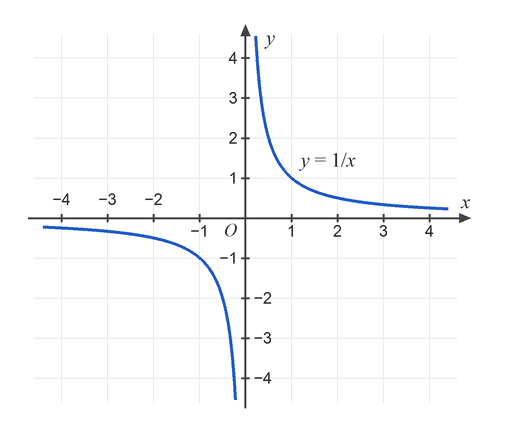
    Step 3 — Draw the conclusion. The graph of y=1xy = \dfrac{1}{x} shows the right branch shooting up and the left branch shooting down as xx approaches 00.

    Class 11 Maths Limits

    Neither one-sided limit is a finite number, and they differ, so the limit does not exist.

    Therefore, since lim⁡x→0−1x=−∞\lim_{x \to 0^-} \dfrac{1}{x} = -\infty and lim⁡x→0+1x=+∞\lim_{x \to 0^+} \dfrac{1}{x} = +\infty, lim⁡x→01x\lim_{x \to 0} \dfrac{1}{x} does not exist.

  7. 7

    Question 7

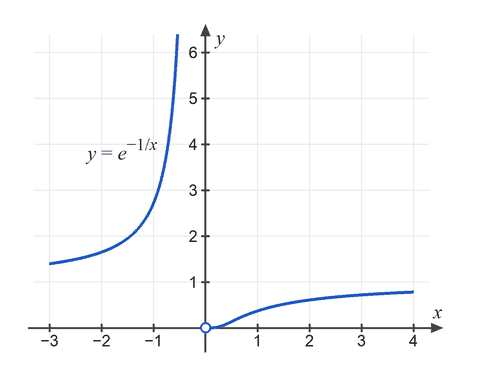
    Show that lim⁡x→0e−1/x\lim_{x \to 0} e^{-1/x} does not exist.

    Medium
    3 marks
    Solve with AI
    Written solution

    Solution:

    Concept: The limit lim⁡x→af(x)\lim_{x \to a} f(x) exists only when the left-hand limit (L.H.L.) lim⁡x→a−f(x)\lim_{x \to a^-} f(x) and the right-hand limit (R.H.L.) lim⁡x→a+f(x)\lim_{x \to a^+} f(x) both exist as finite numbers and are equal; their common value is the limit. To find the L.H.L. we put x=a−hx = a - h, and to find the R.H.L. we put x=a+hx = a + h, where h>0h > 0 and h→0h \to 0. The value f(a)f(a) itself plays no part.

    Step 1 — Find the left-hand limit. We put x=−hx = -h, where h>0h > 0 and h→0h \to 0; then −1x=1h-\dfrac{1}{x} = \dfrac{1}{h}:

    lim⁡x→0−e−1/x=lim⁡h→0+e1/h\begin{aligned} \lim_{x \to 0^-} e^{-1/x} &= \lim_{h \to 0^+} e^{1/h} \end{aligned}

    As h→0+h \to 0^+, the power 1h→+∞\dfrac{1}{h} \to +\infty, and ete^{t} grows without bound as t→+∞t \to +\infty (because e>1e > 1), so

    lim⁡x→0−e−1/x=+∞\lim_{x \to 0^-} e^{-1/x} = +\infty

    Step 2 — Find the right-hand limit. We put x=hx = h; then −1x=−1h-\dfrac{1}{x} = -\dfrac{1}{h}:

    lim⁡x→0+e−1/x=lim⁡h→0+1e1/h\begin{aligned} \lim_{x \to 0^+} e^{-1/x} &= \lim_{h \to 0^+} \dfrac{1}{e^{1/h}} \end{aligned}

    The denominator e1/he^{1/h} grows without bound, so the fraction tends to 00:

    lim⁡x→0+e−1/x=0\lim_{x \to 0^+} e^{-1/x} = 0

    Step 3 — Draw the conclusion. The graph shows the left branch rising without bound and the right branch starting from the open dot at the origin.
    Class 11 Maths Limits

    The L.H.L. is not a finite number, so it cannot equal the R.H.L. 00, and the limit does not exist.

    Therefore, since lim⁡x→0−e−1/x=+∞\lim_{x \to 0^-} e^{-1/x} = +\infty and lim⁡x→0+e−1/x=0\lim_{x \to 0^+} e^{-1/x} = 0, lim⁡x→0e−1/x\lim_{x \to 0} e^{-1/x} does not exist.

  8. 8

    Question 8

    Show that lim⁡x→0sin⁡1x\lim_{x \to 0} \sin \dfrac{1}{x} does not exist.

    Medium
    3 marks
    Solve with AI
    Written solution

    Solution:

    Concept: The limit lim⁡x→af(x)\lim_{x \to a} f(x) exists only when the left-hand limit (L.H.L.) lim⁡x→a−f(x)\lim_{x \to a^-} f(x) and the right-hand limit (R.H.L.) lim⁡x→a+f(x)\lim_{x \to a^+} f(x) both exist as finite numbers and are equal; their common value is the limit. To find the L.H.L. we put x=a−hx = a - h, and to find the R.H.L. we put x=a+hx = a + h, where h>0h > 0 and h→0h \to 0. The value f(a)f(a) itself plays no part.

    Key idea: If a one-sided limit equals LL, then f(x)f(x) must come close to that single number LL for every choice of xx close to aa on that side. So if two lists of xx-values, both tending to aa from the same side, give two different values of ff, that one-sided limit does not exist.

    Step 1 — See what happens to 1x\dfrac{1}{x}. As x→0+x \to 0^+, the number 1x\dfrac{1}{x} grows without bound, so sin⁡1x\sin \dfrac{1}{x} runs through complete swings from −1-1 to 11 again and again, faster and faster.

    Step 2 — Choose points where the function is 00. We take the numbers x=1nπx = \dfrac{1}{n\pi}, where nn is any positive integer; these xx are positive and tend to 00, and at each of them

    sin⁡1x=sin⁡(nπ)=0\begin{aligned} \sin \dfrac{1}{x} &= \sin (n\pi) \\ &= 0 \end{aligned}

    Step 3 — Choose points where the function is 11. We take the numbers x=12nπ+π2x = \dfrac{1}{2n\pi + \frac{\pi}{2}}, where nn is any positive integer; these xx are also positive and tend to 00, and at each of them

    sin⁡1x=sin⁡(2nπ+π2)=1\begin{aligned} \sin \dfrac{1}{x} &= \sin\left(2n\pi + \dfrac{\pi}{2}\right) \\ &= 1 \end{aligned}

    Step 4 — Conclude for the right-hand limit. Arbitrarily close to 00 on the right, the function takes the value 00 and also the value 11, so it does not settle down to one number, and lim⁡x→0+sin⁡1x\lim_{x \to 0^+} \sin \dfrac{1}{x} does not exist.

    Step 5 — Conclude for the left-hand limit. We now take the same points with a minus sign, x=−1nπx = -\dfrac{1}{n\pi} and x=−12nπ+π2x = -\dfrac{1}{2n\pi + \frac{\pi}{2}}; these are negative and tend to 00. Since sine is an odd function, sin⁡(−θ)=−sin⁡θ\sin(-\theta) = -\sin\theta, and so at these points the function takes the values below:

    sin⁡(−nπ)=−sin⁡(nπ)=0\begin{aligned} \sin(-n\pi) &= -\sin(n\pi) \\ &= 0 \end{aligned} sin⁡(−2nπ−π2)=−sin⁡(2nπ+π2)=−1\begin{aligned} \sin\left(-2n\pi - \dfrac{\pi}{2}\right) &= -\sin\left(2n\pi + \dfrac{\pi}{2}\right) \\ &= -1 \end{aligned}

    Arbitrarily close to 00 on the left, the function takes the value 00 and also the value −1-1, so lim⁡x→0−sin⁡1x\lim_{x \to 0^-} \sin \dfrac{1}{x} does not exist either. The graph shows these ever faster swings between −1-1 and 11 near x=0x = 0.

    Class 11 Maths Limits

    Note: The function oscillates between −1-1 and 11; it is bounded, but it never settles to one value. (In contrast, xsin⁡1x→0x \sin \dfrac{1}{x} \to 0, because the factor xx squeezes the swings to 00.)

    Therefore, neither one-sided limit exists, so lim⁡x→0sin⁡1x\lim_{x \to 0} \sin \dfrac{1}{x} does not exist.

  9. 9

    Question 9

    If ff is an even function, then prove that lim⁡x→0−f(x)=lim⁡x→0+f(x)\lim_{x \to 0^-} f(x) = \lim_{x \to 0^+} f(x), whenever they exist.

    Medium
    3 marks
    Solve with AI
    Written solution

    Solution:

    Concept: A function ff is even when f(−x)=f(x)f(-x) = f(x) for every xx in its domain; its graph is symmetric about the yy-axis. The left-hand limit at 00 is found by putting x=−hx = -h, and the right-hand limit by putting x=hx = h, where h>0h > 0 and h→0h \to 0.

    Step 1 — Write the left-hand limit with hh. We put x=−hx = -h, where h>0h > 0 and h→0h \to 0:

    lim⁡x→0−f(x)=lim⁡h→0+f(−h)\lim_{x \to 0^-} f(x) = \lim_{h \to 0^+} f(-h)

    Step 2 — Use the fact that ff is even. Since f(−h)=f(h)f(-h) = f(h) for every hh, the two limits below are limits of the same expression:

    lim⁡h→0+f(−h)=lim⁡h→0+f(h)\lim_{h \to 0^+} f(-h) = \lim_{h \to 0^+} f(h)

    Step 3 — Recognise the right-hand limit. Putting x=hx = h gives exactly the right-hand limit:

    lim⁡h→0+f(h)=lim⁡x→0+f(x)\lim_{h \to 0^+} f(h) = \lim_{x \to 0^+} f(x)

    Step 4 — Join the three results. Reading Steps 1 to 3 in order, the left-hand limit equals the right-hand limit whenever these limits exist. For example, for the even function f(x)=x2f(x) = x^2 both one-sided limits at 00 are 00.

    Therefore, for an even function ff, lim⁡x→0−f(x)=lim⁡x→0+f(x)\lim_{x \to 0^-} f(x) = \lim_{x \to 0^+} f(x) whenever they exist.

  10. 10

    Question 10

    For what values of pp does the lim⁡x→1f(x)\lim_{x \to 1} f(x) exist, where ff is defined by the rule

    f(x)={2px+3if x<11−px2if x>1f(x) = \begin{cases} 2px + 3 & \text{if } x < 1 \\ 1 - px^2 & \text{if } x > 1 \end{cases}
    Medium
    3 marks
    Solve with AI
    Written solution

    Solution:

    Concept: The limit lim⁡x→af(x)\lim_{x \to a} f(x) exists only when the left-hand limit (L.H.L.) lim⁡x→a−f(x)\lim_{x \to a^-} f(x) and the right-hand limit (R.H.L.) lim⁡x→a+f(x)\lim_{x \to a^+} f(x) both exist as finite numbers and are equal; their common value is the limit. To find the L.H.L. we put x=a−hx = a - h, and to find the R.H.L. we put x=a+hx = a + h, where h>0h > 0 and h→0h \to 0. The value f(a)f(a) itself plays no part.

    Step 1 — Find the left-hand limit. For x<1x < 1 the rule is f(x)=2px+3f(x) = 2px + 3, a polynomial in xx, so we put x=1x = 1:

    lim⁡x→1−f(x)=2p(1)+3=2p+3\begin{aligned} \lim_{x \to 1^-} f(x) &= 2p(1) + 3 \\ &= 2p + 3 \end{aligned}

    Step 2 — Find the right-hand limit. For x>1x > 1 the rule is f(x)=1−px2f(x) = 1 - px^2:

    lim⁡x→1+f(x)=1−p(1)2=1−p\begin{aligned} \lim_{x \to 1^+} f(x) &= 1 - p(1)^2 \\ &= 1 - p \end{aligned}

    Step 3 — Make the one-sided limits equal. The limit exists exactly when L.H.L. == R.H.L., so we solve:

    2p+3=1−p2p + 3 = 1 - p

    We collect the terms in pp on the left and the numbers on the right:

    3p=−23p = -2

    We divide both sides by 33:

    p=−23p = -\dfrac{2}{3}

    Step 4 — Check the value. We put p=−23p = -\dfrac{2}{3} into each one-sided limit:

    2p+3=2(−23)+3=53\begin{aligned} 2p + 3 &= 2\left(-\dfrac{2}{3}\right) + 3 \\ &= \dfrac{5}{3} \end{aligned} 1−p=1+23=53\begin{aligned} 1 - p &= 1 + \dfrac{2}{3} \\ &= \dfrac{5}{3} \end{aligned}

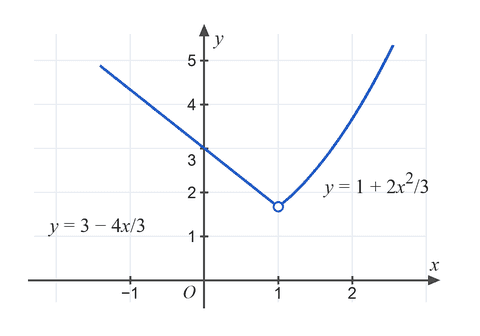
    Both are 53\dfrac{5}{3}, as they should be. The graph for this value of pp shows the line and the curve running into the same point (1,53)\left(1, \dfrac{5}{3}\right).

    Class 11 Maths Limits

    Therefore, lim⁡x→1f(x)\lim_{x \to 1} f(x) exists only for p=−23p = -\dfrac{2}{3} (and then the limit is 53\dfrac{5}{3}).

  11. 11

    Question 11

    Evaluate the following limit:

    lim⁡x→0(7x2−5x+1)\lim_{x \to 0} (7x^2 - 5x + 1)
    Easy
    3 marks
    Solve with AI
    Written solution

    Solution:

    Concept: By the theorems on limits, the limit of a sum, difference, product or quotient is the sum, difference, product or quotient of the limits (for a quotient, the limit of the denominator must not be 00). So for a polynomial, or a quotient of polynomials whose denominator is not 00 at x=ax = a, the limit is found simply by putting x=ax = a.

    Step 1 — Recognise the type of function. The expression 7x2−5x+17x^2 - 5x + 1 is a polynomial, so its limit as x→0x \to 0 is its value at x=0x = 0.

    Step 2 — Put x=0x = 0. We substitute 00 for xx in every term:

    lim⁡x→0(7x2−5x+1)=7(0)2−5(0)+1=1\begin{aligned} \lim_{x \to 0} (7x^2 - 5x + 1) &= 7(0)^2 - 5(0) + 1 \\ &= 1 \end{aligned}

    Therefore, lim⁡x→0(7x2−5x+1)=1\lim_{x \to 0} (7x^2 - 5x + 1) = 1.

  12. 12

    Question 12

    Evaluate the following limit:

    lim⁡x→1x−1x+1\lim_{x \to 1} \dfrac{x - 1}{x + 1}
    Easy
    3 marks
  13. 13

    Question 13

    Evaluate the following limit:

    lim⁡x→2x2+5x+62x2−3x\lim_{x \to 2} \dfrac{x^2 + 5x + 6}{2x^2 - 3x}
    Easy
    3 marks
  14. 14

    Question 14

    Evaluate the following limit:

    lim⁡x→0ax+bcx+d\lim_{x \to 0} \dfrac{ax + b}{cx + d}
    Easy
    3 marks
  15. 15

    Question 15

    Evaluate the following limit:

    lim⁡x→5+x−5∣x−5∣\lim_{x \to 5^+} \dfrac{x - 5}{|x - 5|}
    Easy
    3 marks
  16. 16

    Question 16

    Evaluate the following limit:

    lim⁡x→−5−x+5∣x+5∣\lim_{x \to -5^-} \dfrac{x + 5}{|x + 5|}
    Easy
    3 marks
  17. 17

    Question 17

    Evaluate the following limit:

    lim⁡x→5+(x−[x])\lim_{x \to 5^+} (x - [x])
    Easy
    3 marks
  18. 18

    Question 18

    Evaluate the following limit:

    lim⁡x→1−x2−1∣x−1∣\lim_{x \to 1^-} \dfrac{x^2 - 1}{|x - 1|}
    Easy
    3 marks
  19. 19

    Question 19

    Show that lim⁡x→2log⁡10{x6+(x2+1292)}=2\lim_{x \to 2} \log_{10} \left\{x^6 + \sqrt{(x^2 + 1292)}\right\} = 2.

    Easy
    3 marks
  20. 20

    Question 20

    Given that f(x)=4−7x(3x+4)f(x) = \dfrac{4 - 7x}{(3x + 4)}, l=lim⁡x→2f(x)l = \lim_{x \to 2} f(x) and m=lim⁡x→0f(x)m = \lim_{x \to 0} f(x), form the equation whose roots are 1l,1m\dfrac{1}{l}, \dfrac{1}{m}.

    Easy
    3 marks
  21. 21

    Question 21

    Evaluate the following limit:

    lim⁡x→−1x2−1x+1\lim_{x \to -1} \dfrac{x^2 - 1}{x + 1}
    Easy
    3 marks
  22. 22

    Question 22

    Evaluate the following limit:

    lim⁡x→1(2x−3)(x−1)2x2+x−3\lim_{x \to 1} \dfrac{(2x - 3)(x - 1)}{2x^2 + x - 3}
    Easy
    3 marks
  23. 23

    Question 23

    Evaluate the following limit:

    lim⁡x→−1(x−4)(x+1)x2+3x+2\lim_{x \to -1} \dfrac{(x - 4)(x + 1)}{x^2 + 3x + 2}
    Easy
    3 marks
  24. 24

    Question 24

    Evaluate the following limit:

    lim⁡x→124x2−12x−1\lim_{x \to \frac{1}{2}} \dfrac{4x^2 - 1}{2x - 1}
    Easy
    3 marks
  25. 25

    Question 25

    Evaluate the following limit:

    lim⁡x→27x2−11x−63x2−x−10\lim_{x \to 2} \dfrac{7x^2 - 11x - 6}{3x^2 - x - 10}
    Medium
    3 marks
  26. 26

    Question 26

    Evaluate the following limit:

    lim⁡x→2x2(x2−4)x−2\lim_{x \to 2} \dfrac{x^2(x^2 - 4)}{x - 2}
    Easy
    3 marks
  27. 27

    Question 27

    Evaluate the following limit:

    lim⁡x→2(x8−16x4−4+x2−9x−3)\lim_{x \to 2} \left(\dfrac{x^8 - 16}{x^4 - 4} + \dfrac{x^2 - 9}{x - 3}\right)
    Medium
    3 marks
  28. 28

    Question 28

    Evaluate the following limit:

    lim⁡x→2x3−8x−2\lim_{x \to 2} \dfrac{x^3 - 8}{x - 2}
    Easy
    3 marks
  29. 29

    Question 29

    Evaluate the following limit:

    lim⁡x→12(8x−32x−1−4x2+14x2−1)\lim_{x \to \frac{1}{2}} \left(\dfrac{8x - 3}{2x - 1} - \dfrac{4x^2 + 1}{4x^2 - 1}\right)
    Medium
    3 marks
  30. 30

    Question 30

    Evaluate the following limit:

    lim⁡x→3x3−8x2+452x2−3x−9\lim_{x \to 3} \dfrac{x^3 - 8x^2 + 45}{2x^2 - 3x - 9}
    Medium
    3 marks
  31. 31

    Question 31

    Evaluate the following limit:

    lim⁡x→3x3−6x−9x4−81\lim_{x \to 3} \dfrac{x^3 - 6x - 9}{x^4 - 81}
    Medium
    3 marks
  32. 32

    Question 32

    Evaluate the following limit:

    lim⁡x→2x4−4x2+3x2−8\lim_{x \to \sqrt{2}} \dfrac{x^4 - 4}{x^2 + 3x\sqrt{2} - 8}
    Medium
    3 marks
  33. 33

    Question 33

    Evaluate the following limit:

    lim⁡x→11−x−1/31−x−2/3\lim_{x \to 1} \dfrac{1 - x^{-1/3}}{1 - x^{-2/3}}
    Medium
    3 marks
  34. 34

    Question 34

    Evaluate the following limit:

    lim⁡x→2x−2x−2\lim_{x \to 2} \dfrac{x - 2}{\sqrt{x} - \sqrt{2}}
    Medium
    3 marks
  35. 35

    Question 35

    If lim⁡x→1x4−1x−1=lim⁡x→kx3−k3x2−k2\lim_{x \to 1} \dfrac{x^4 - 1}{x - 1} = \lim_{x \to k} \dfrac{x^3 - k^3}{x^2 - k^2}, find the value of kk.

    Medium
    3 marks
  36. 36

    Question 36

    Evaluate the following limit:

    lim⁡x→01+x−1x\lim_{x \to 0} \dfrac{\sqrt{1 + x} - 1}{x}
    Medium
    3 marks
  37. 37

    Question 37

    Evaluate the following limit:

    lim⁡x→ax−ax−a\lim_{x \to a} \dfrac{\sqrt{x} - \sqrt{a}}{x - a}
    Medium
    3 marks
  38. 38

    Question 38

    Evaluate the following limit:

    lim⁡x→43−(5+x)x−4\lim_{x \to 4} \dfrac{3 - \sqrt{(5 + x)}}{x - 4}
    Medium
    3 marks
  39. 39

    Question 39

    Evaluate the following limit:

    lim⁡x→0x+2−2x\lim_{x \to 0} \dfrac{\sqrt{x + 2} - \sqrt{2}}{x}
    Medium
    3 marks
  40. 40

    Question 40

    Evaluate the following limit:

    lim⁡x→0x(1+x)−1\lim_{x \to 0} \dfrac{x}{\sqrt{(1 + x)} - 1}
    Medium
    3 marks
  41. 41

    Question 41

    Evaluate the following limit:

    lim⁡x→01+x−1−x2x\lim_{x \to 0} \dfrac{\sqrt{1 + x} - \sqrt{1 - x}}{2x}
    Medium
    3 marks
  42. 42

    Question 42

    Evaluate the following limit:

    lim⁡x→1(x2−1)+(x−1)(x2−1)\lim_{x \to 1} \dfrac{\sqrt{(x^2 - 1)} + \sqrt{(x - 1)}}{\sqrt{(x^2 - 1)}}

    [Hint. Given limit =lim⁡x→1(1+1(x+1))= \lim_{x \to 1} \left(1 + \dfrac{1}{\sqrt{(x + 1)}}\right)]

    Medium
    3 marks
  43. 43

    Question 43

    Evaluate the following limit:

    lim⁡x→0(1+x+x2)−1x\lim_{x \to 0} \dfrac{\sqrt{(1 + x + x^2)} - 1}{x}
    Medium
    3 marks
  44. 44

    Question 44

    Evaluate the following limit:

    lim⁡x→0(1+x3)−(1−x3)x2\lim_{x \to 0} \dfrac{\sqrt{(1 + x^3)} - \sqrt{(1 - x^3)}}{x^2}
    Medium
    3 marks
  45. 45

    Question 45

    Evaluate the following limit:

    lim⁡x→1xn−1x−1\lim_{x \to 1} \dfrac{x^{n} - 1}{x - 1}
    Easy
    3 marks
  46. 46

    Question 46

    Evaluate the following limit:

    lim⁡x→3x5−243x2−9\lim_{x \to 3} \dfrac{x^{5} - 243}{x^{2} - 9}
    Easy
    3 marks
  47. 47

    Question 47

    Evaluate the following limit:

    lim⁡x→0(1+x)n−1x\lim_{x \to 0} \dfrac{(1 + x)^{n} - 1}{x}
    Easy
    3 marks
  48. 48

    Question 48

    Evaluate the following limit:

    lim⁡x→1xm−1xn−1\lim_{x \to 1} \dfrac{x^{m} - 1}{x^{n} - 1}
    Easy
    3 marks
  49. 49

    Question 49

    Evaluate the following limit:

    lim⁡x→5x4−625x3−125\lim_{x \to 5} \dfrac{x^{4} - 625}{x^{3} - 125}
    Easy
    3 marks
  50. 50

    Question 50

    Evaluate the following limit:

    lim⁡x→2x10−1024x5−32\lim_{x \to 2} \dfrac{x^{10} - 1024}{x^{5} - 32}
    Easy
    3 marks
  51. 51

    Question 51

    Evaluate the following limit:

    lim⁡x→9x3/2−27x−9\lim_{x \to 9} \dfrac{x^{3/2} - 27}{x - 9}
    Easy
    3 marks
  52. 52

    Question 52

    Evaluate the following limit:

    lim⁡x→axx−aax−a\lim_{x \to a} \dfrac{x\sqrt{x} - a\sqrt{a}}{x - a}
    Easy
    3 marks
  53. 53

    Question 53

    Evaluate the following limit:

    lim⁡x→a(x+2)3/2−(a+2)3/2x−a\lim_{x \to a} \dfrac{(x + 2)^{3/2} - (a + 2)^{3/2}}{x - a}
    Easy
    3 marks
  54. 54

    Question 54

    If lim⁡x→−ax9+a9x+a=9\lim\limits_{x \to -a} \dfrac{x^{9} + a^{9}}{x + a} = 9, find all possible values of aa.

    Medium
    3 marks
  55. 55

    Question 55

    If lim⁡x→ax5−a5x−a=405\lim\limits_{x \to a} \dfrac{x^{5} - a^{5}}{x - a} = 405, find all possible values of aa.

    Medium
    3 marks
  56. 56

    Question 56

    If lim⁡x→ax9−a9x−a=9\lim\limits_{x \to a} \dfrac{x^{9} - a^{9}}{x - a} = 9, find all possible values of aa.

    Medium
    3 marks
  57. 57

    Question 57

    Prove that lim⁡x→01+x3−1−x3x=23\lim\limits_{x \to 0} \dfrac{\sqrt[3]{1 + x} - \sqrt[3]{1 - x}}{x} = \dfrac{2}{3}.

    Medium
    3 marks
  58. 58

    Question 58

    Evaluate the following limit:

    lim⁡x→∞4x−32x+7\lim_{x \to \infty} \dfrac{4x - 3}{2x + 7}
    Easy
    3 marks
  59. 59

    Question 59

    Evaluate the following limit:

    lim⁡x→∞3x2+2x−5x2+5x+1\lim_{x \to \infty} \dfrac{3x^{2} + 2x - 5}{x^{2} + 5x + 1}
    Easy
    3 marks
  60. 60

    Question 60

    Evaluate the following limit:

    lim⁡x→∞x3+6x2+1x4+3\lim_{x \to \infty} \dfrac{x^{3} + 6x^{2} + 1}{x^{4} + 3}
    Easy
    3 marks
  61. 61

    Question 61

    Evaluate the following limit:

    lim⁡x→∞3x3+x2−1x2−x+7\lim_{x \to \infty} \dfrac{3x^{3} + x^{2} - 1}{x^{2} - x + 7}
    Easy
    3 marks
  62. 62

    Question 62

    Evaluate the following limit:

    lim⁡x→∞5x−64x2+9\lim_{x \to \infty} \dfrac{5x - 6}{\sqrt{4x^{2} + 9}}
    Easy
    3 marks
  63. 63

    Question 63

    Evaluate the following limit:

    lim⁡x→∞3x2−1−2x2−14x+3\lim_{x \to \infty} \dfrac{\sqrt{3x^{2} - 1} - \sqrt{2x^{2} - 1}}{4x + 3}
    Medium
    3 marks
  64. 64

    Question 64

    Evaluate the following limit:

    lim⁡x→∞x(x+c−x)\lim_{x \to \infty} \sqrt{x}\left(\sqrt{x + c} - \sqrt{x}\right)
    Medium
    3 marks
  65. 65

    Question 65

    Evaluate the following limit:

    lim⁡x→∞(x2+x+1−x2+1)\lim_{x \to \infty} \left(\sqrt{x^{2} + x + 1} - \sqrt{x^{2} + 1}\right)
    Medium
    3 marks
  66. 66

    Question 66

    Evaluate the following limit:

    lim⁡n→∞1+2+3+⋯+nn2(or lim⁡n→∞Σnn2)\lim_{n \to \infty} \dfrac{1 + 2 + 3 + \cdots + n}{n^{2}} \quad \left(\text{or } \lim_{n \to \infty} \dfrac{\Sigma n}{n^{2}}\right)
    Easy
    3 marks
  67. 67

    Question 67

    Evaluate the following limit:

    lim⁡n→∞Σn3n4\lim_{n \to \infty} \dfrac{\Sigma n^{3}}{n^{4}}
    Easy
    3 marks
  68. 68

    Question 68

    Evaluate the following limit:

    lim⁡x→0sin⁡2xx\lim_{x \to 0} \dfrac{\sin 2x}{x}
    Easy
    3 marks
  69. 69

    Question 69

    Evaluate the following limit:

    lim⁡x→0tan⁡2xx\lim_{x \to 0} \dfrac{\tan 2x}{x}
    Easy
    3 marks
  70. 70

    Question 70

    Evaluate the following limit:

    lim⁡x→0tan⁡12x3x\lim_{x \to 0} \dfrac{\tan \frac{1}{2}x}{3x}
    Easy
    3 marks
  71. 71

    Question 71

    Evaluate the following limit:

    lim⁡x→0sin⁡25xsin⁡15x\lim_{x \to 0} \dfrac{\sin^{2} 5x}{\sin 15x}
    Easy
    3 marks
  72. 72

    Question 72

    Evaluate the following limit:

    lim⁡x→0sin⁡axsin⁡bx\lim_{x \to 0} \dfrac{\sin ax}{\sin bx}
    Easy
    3 marks
  73. 73

    Question 73

    Evaluate the following limit:

    lim⁡x→0sin⁡2axsin⁡2bx\lim_{x \to 0} \dfrac{\sin^{2} ax}{\sin^{2} bx}
    Easy
    3 marks
  74. 74

    Question 74

    Evaluate the following limit:

    lim⁡x→0sin⁡23xx2\lim_{x \to 0} \dfrac{\sin^{2} 3x}{x^{2}}
    Easy
    3 marks
  75. 75

    Question 75

    Evaluate the following limit:

    lim⁡x→0tan⁡axtan⁡bx\lim_{x \to 0} \dfrac{\tan ax}{\tan bx}
    Easy
    3 marks
  76. 76

    Question 76

    Evaluate the following limit:

    lim⁡x→0sin⁡2x2x\lim_{x \to 0} \dfrac{\sin^{2} x}{2x}
    Easy
    3 marks
  77. 77

    Question 77

    Evaluate the following limit:

    lim⁡x→0sin⁡x2x\lim_{x \to 0} \dfrac{\sin x^{2}}{x}
    Easy
    3 marks
  78. 78

    Question 78

    Evaluate the following limit:

    lim⁡x→0sin⁡3aθsin⁡2bθ\lim_{x \to 0} \dfrac{\sin^{3} a\theta}{\sin^{2} b\theta}
    Easy
    3 marks
  79. 79

    Question 79

    Evaluate the following limit:

    lim⁡x→0sin⁡2x+sin⁡6xsin⁡5x−sin⁡3x\lim_{x \to 0} \dfrac{\sin 2x + \sin 6x}{\sin 5x - \sin 3x}
    Easy
    3 marks
  80. 80

    Question 80

    Evaluate the following limit:

    lim⁡x→0cos⁡mx−cos⁡nxx2\lim_{x \to 0} \dfrac{\cos mx - \cos nx}{x^{2}}
    Medium
    3 marks
  81. 81

    Question 81

    Evaluate the following limit:

    lim⁡x→02sin⁡23xx2\lim_{x \to 0} \dfrac{2\sin^{2} 3x}{x^{2}}

    Hint: lim⁡x→018(sin⁡3x3x)2\lim\limits_{x \to 0} 18\left(\dfrac{\sin 3x}{3x}\right)^{2}

    Easy
    3 marks
  82. 82

    Question 82

    Evaluate the following limit:

    lim⁡x→01−cos⁡2xx\lim_{x \to 0} \dfrac{1 - \cos 2x}{x}
    Easy
    3 marks
  83. 83

    Question 83

    Evaluate the following limit:

    lim⁡x→01−cos⁡4xx2\lim_{x \to 0} \dfrac{1 - \cos 4x}{x^{2}}
    Easy
    3 marks
  84. 84

    Question 84

    Evaluate the following limit:

    lim⁡x→01−cos⁡mx1−cos⁡nx\lim_{x \to 0} \dfrac{1 - \cos mx}{1 - \cos nx}
    Medium
    3 marks
  85. 85

    Question 85

    Evaluate the following limit:

    lim⁡x→0cos⁡Ax−cos⁡Bxx2\lim_{x \to 0} \dfrac{\cos Ax - \cos Bx}{x^{2}}
    Medium
    3 marks
  86. 86

    Question 86

    Evaluate the following limit:

    lim⁡x→03sin⁡x−sin⁡3xx3\lim_{x \to 0} \dfrac{3\sin x - \sin 3x}{x^{3}}
    Medium
    3 marks
  87. 87

    Question 87

    Evaluate the following limit:

    lim⁡x→0sin⁡3xcos⁡2xsin⁡2x\lim_{x \to 0} \dfrac{\sin 3x \cos 2x}{\sin 2x}
    Easy
    3 marks
  88. 88

    Question 88

    Evaluate the following limit:

    lim⁡x→0x21−cos⁡x\lim_{x \to 0} \dfrac{x^{2}}{1 - \cos x}
    Easy
    3 marks
  89. 89

    Question 89

    Evaluate the following limit:

    lim⁡x→0sin⁡3x−sin⁡xsin⁡x\lim_{x \to 0} \dfrac{\sin 3x - \sin x}{\sin x}
    Easy
    3 marks
  90. 90

    Question 90

    Evaluate the following limit:

    lim⁡x→π1+cos⁡xx−π\lim_{x \to \pi} \dfrac{1 + \cos x}{x - \pi}
    Medium
    3 marks
  91. 91

    Question 91

    Evaluate the following limit:

    lim⁡x→π21+cos⁡2x(π−2x)2\lim_{x \to \frac{\pi}{2}} \dfrac{1 + \cos 2x}{(\pi - 2x)^{2}}
    Medium
    3 marks
  92. 92

    Question 92

    Evaluate the following limit:

    lim⁡x→π21−sin⁡x(π2−x)2\lim_{x \to \frac{\pi}{2}} \dfrac{1 - \sin x}{\left(\dfrac{\pi}{2} - x\right)^{2}}
    Medium
    3 marks
  93. 93

    Question 93

    Evaluate the following limit:

    lim⁡x→π2cos⁡xπ2−x\lim_{x \to \frac{\pi}{2}} \dfrac{\cos x}{\dfrac{\pi}{2} - x}
    Easy
    3 marks
  94. 94

    Question 94

    Evaluate the following limit:

    lim⁡x→π21−sin⁡x(π−2x)2\lim_{x \to \frac{\pi}{2}} \dfrac{1 - \sin x}{(\pi - 2x)^{2}}
    Medium
    3 marks
  95. 95

    Question 95

    Evaluate the following limit:

    lim⁡x→π1−sin⁡x2(π−x)2\lim_{x \to \pi} \dfrac{1 - \sin\dfrac{x}{2}}{(\pi - x)^{2}}
    Medium
    3 marks
  96. 96

    Question 96

    Evaluate the following limit:

    lim⁡x→11−1xsin⁡π(x−1)\lim_{x \to 1} \dfrac{1 - \dfrac{1}{x}}{\sin \pi(x - 1)}
    Medium
    3 marks
  97. 97

    Question 97

    Evaluate the following limit:

    lim⁡x→asin⁡x−sin⁡ax−a\lim_{x \to a} \dfrac{\sin x - \sin a}{\sqrt{x} - \sqrt{a}}
    Medium
    3 marks
  98. 98

    Question 98

    Evaluate the following limit:

    lim⁡x→π1+sec⁡3xtan⁡2x\lim_{x \to \pi} \dfrac{1 + \sec^{3} x}{\tan^{2} x}
    Medium
    3 marks
  99. 99

    Question 99

    Evaluate the following limits:

    (i)

    lim⁡x→0e4x−1x\lim_{x \to 0} \dfrac{e^{4x} - 1}{x}

    (ii)

    lim⁡x→03x−1x\lim_{x \to 0} \dfrac{3^{x} - 1}{x}

    (iii)

    lim⁡x→0ex−x−1x\lim_{x \to 0} \dfrac{e^{x} - x - 1}{x}
    Easy
    3 marks
  100. 100

    Question 100

    Evaluate the following limits:

    (i)

    lim⁡x→0x(ex−1)1−cos⁡2x\lim_{x \to 0} \dfrac{x(e^{x} - 1)}{1 - \cos 2x}

    (ii)

    lim⁡x→0x(2x−1)1−cos⁡x\lim_{x \to 0} \dfrac{x(2^{x} - 1)}{1 - \cos x}

    (iii)

    lim⁡x→0ex−sin⁡x−1x\lim_{x \to 0} \dfrac{e^{x} - \sin x - 1}{x}

    (iv)

    lim⁡x→0ex\lim_{x \to 0} e^{x}
    Medium
    3 marks
  101. 101

    Question 101

    Evaluate the following limits:

    (i)

    lim⁡x→0eax−ebxx\lim_{x \to 0} \dfrac{e^{ax} - e^{bx}}{x}

    (ii)

    lim⁡x→π2esin⁡x−1sin⁡x\lim_{x \to \frac{\pi}{2}} \dfrac{e^{\sin x} - 1}{\sin x}

    (iii)

    lim⁡x→2ex−e2x−2\lim_{x \to 2} \dfrac{e^{x} - e^{2}}{x - 2}

    (iv)

    lim⁡x→1ex−ex−1\lim_{x \to 1} \dfrac{e^{x} - e}{x - 1}
    Medium
    3 marks
  102. 102

    Question 102

    Evaluate the following limit:

    lim⁡x→1e−x−e−1x−1\lim_{x \to 1} \dfrac{e^{-x} - e^{-1}}{x - 1}
    Medium
    3 marks
  103. 103

    Question 103

    Evaluate the following limit:

    lim⁡x→03x−11+x−1\lim_{x \to 0} \dfrac{3^{x} - 1}{\sqrt{1 + x} - 1}
    Medium
    3 marks
  104. 104

    Question 104

    Evaluate the following limit:

    lim⁡x→1x1x−1\lim_{x \to 1} x^{\frac{1}{x - 1}}
    Medium
    3 marks
  105. 105

    Question 105

    Evaluate the following limit:

    lim⁡x→0(1+sin⁡x)cot⁡x\lim_{x \to 0} (1 + \sin x)^{\cot x}
    Medium
    3 marks
  106. 106

    Question 106

    Evaluate the following limit:

    lim⁡x→08x−2xx\lim_{x \to 0} \dfrac{8^{x} - 2^{x}}{x}
    Easy
    3 marks
  107. 107

    Question 107

    Evaluate the following limit:

    lim⁡x→0ax−bxsin⁡x\lim_{x \to 0} \dfrac{a^{x} - b^{x}}{\sin x}
    Medium
    3 marks
  108. 108

    Question 108

    Evaluate the following limit:

    lim⁡x→0asin⁡x−1sin⁡x\lim_{x \to 0} \dfrac{a^{\sin x} - 1}{\sin x}
    Easy
    3 marks
  109. 109

    Question 109

    Evaluate the following limit:

    lim⁡x→032x−23xx\lim_{x \to 0} \dfrac{3^{2x} - 2^{3x}}{x}
    Easy
    3 marks
  110. 110

    Question 110

    Evaluate the following limit:

    lim⁡x→1x−1log⁡ex\lim_{x \to 1} \dfrac{x - 1}{\log_e x}
    Easy
    3 marks
  111. 111

    Question 111

    Evaluate the following limit:

    lim⁡x→0ex+e−x−2x2\lim_{x \to 0} \dfrac{e^{x} + e^{-x} - 2}{x^{2}}
    Medium
    3 marks
  112. 112

    Question 112

    Evaluate the following limit:

    lim⁡x→5log⁡x−log⁡5x−5\lim_{x \to 5} \dfrac{\log x - \log 5}{x - 5}
    Easy
    3 marks
  113. 113

    Question 113

    Evaluate the following limit:

    lim⁡x→1ex−11−cos⁡x\lim_{x \to 1} \dfrac{e^{x} - 1}{\sqrt{1 - \cos x}}
    Medium
    3 marks
  114. 114

    Question 114

    Evaluate the following limits:

    (i)

    lim⁡n→∞(1+2n)2n\lim_{n \to \infty} \left(1 + \dfrac{2}{n}\right)^{2n}

    (ii)

    lim⁡x→∞[1+1a+bx]c+dx\lim_{x \to \infty} \left[1 + \dfrac{1}{a + bx}\right]^{c + dx}

    (iii)

    lim⁡x→0(1+ax)bx\lim_{x \to 0} (1 + ax)^{\frac{b}{x}}

    Hint. lim⁡n→∞[(1+2n)n2]4=e4\lim\limits_{n \to \infty} \left[\left(1 + \dfrac{2}{n}\right)^{\frac{n}{2}}\right]^{4} = e^{4}

    Medium
    3 marks
  115. 115

    Question 115

    Evaluate the following limits:

    (i)

    lim⁡x→∞(x+6x+1)x+4\lim_{x \to \infty} \left(\dfrac{x + 6}{x + 1}\right)^{x + 4}

    (ii)

    lim⁡x→∞(x−1x+1)x\lim_{x \to \infty} \left(\dfrac{x - 1}{x + 1}\right)^{x}

    (iii)

    lim⁡x→0(1+5x21+3x2)1x2\lim_{x \to 0} \left(\dfrac{1 + 5x^{2}}{1 + 3x^{2}}\right)^{\frac{1}{x^{2}}}
    Medium
    3 marks
  116. 116

    Question 116

    Evaluate the following limits:

    (i)

    lim⁡x→0eax−1sin⁡x\lim_{x \to 0} \dfrac{e^{ax} - 1}{\sin x}

    (ii)

    lim⁡x→0ex2−1sin⁡x2\lim_{x \to 0} \dfrac{e^{x^{2}} - 1}{\sin x^{2}}

    (iii)

    lim⁡x→032x−123x−1\lim_{x \to 0} \dfrac{3^{2x} - 1}{2^{3x} - 1}

    (iv)

    lim⁡x→1sin⁡(ex−1)log⁡x\lim_{x \to 1} \dfrac{\sin(e^{x} - 1)}{\log x}

    Hint. Part (iv) is of the type of solved Example 23 (iii).

    Medium
    3 marks
  117. 117

    Question 117

    Evaluate:

    lim⁡x→0log⁡(a+x)−log⁡(a−x)x,a>0\lim_{x \to 0} \dfrac{\log(a + x) - \log(a - x)}{x}, \quad a > 0
    Medium
    3 marks
  118. 118

    Question 118

    Evaluate the following limit:

    lim⁡x→0(1+x)m−1(1+x)n−1\lim_{x \to 0} \dfrac{(1 + x)^{m} - 1}{(1 + x)^{n} - 1}
    Easy
    3 marks
  119. 119

    Question 119

    Evaluate the following limit:

    lim⁡x→alog⁡x−log⁡ax−a\lim_{x \to a} \dfrac{\log x - \log a}{x - a}
    Easy
    3 marks
  120. 120

    Question 120

    Evaluate the following limit:

    lim⁡x→axa−aaax−aa\lim_{x \to a} \dfrac{x^{a} - a^{a}}{a^{x} - a^{a}}
    Medium
    3 marks
  121. 121

    Question 121

    Evaluate the following limit:

    lim⁡x→π/6sin⁡(x−π6)32−cos⁡x\lim_{x \to \pi/6} \dfrac{\sin\left(x - \dfrac{\pi}{6}\right)}{\dfrac{\sqrt{3}}{2} - \cos x}
    Medium
    3 marks
  122. 122

    Question 122

    Evaluate the following limit:

    lim⁡x→atan⁡x−tan⁡asin⁡a−sin⁡x\lim_{x \to a} \dfrac{\tan x - \tan a}{\sin a - \sin x}
    Medium
    3 marks
  123. 123

    Question 123

    Evaluate the following limit:

    lim⁡x→43−5+xx−4\lim_{x \to 4} \dfrac{3 - \sqrt{5 + x}}{x - 4}
    Easy
    3 marks
  124. 124

    Question 124

    Evaluate the following limit:

    lim⁡x→aax−1bx−1\lim_{x \to a} \dfrac{a^{x} - 1}{b^{x} - 1}
    Medium
    3 marks
  125. 125

    Question 125

    Evaluate the following limit:

    lim⁡θ→π21−sin⁡θcos⁡θ\lim_{\theta \to \frac{\pi}{2}} \dfrac{1 - \sin\theta}{\cos\theta}
    Easy
    3 marks
  126. 126

    Question 126

    Evaluate the following limit:

    lim⁡x→∞x2x\lim_{x \to \infty} \dfrac{x}{2^{x}}
    Medium
    3 marks
  127. 127

    Question 127

    Evaluate the following limit:

    lim⁡x→π21−sin⁡xxcos⁡x\lim_{x \to \frac{\pi}{2}} \dfrac{1 - \sin x}{x\cos x}
    Medium
    3 marks
Inside Ch 19

What Class 11 Maths Ch 19 covers

The sections of the chapter, in the order the book takes them. Every question above comes from one of these.

  1. 01Concept and Definition of a Limit
  2. 02Theorems on Limits and Useful Expansions
  3. 03Algebraic Limits
  4. 04Limits at Infinity and Infinite Limits
  5. 05Trigonometric Limits
  6. 06Exponential and Logarithmic Limits
Common questions

Class 11 Maths Ch 19 questions students ask

How many questions are there in Class 11 Maths Ch 19?

127 questions. Every one is solved step by step on this page.

Are these Class 11 Maths solutions free?

Yes. Every question and its full working is free to read, with no account needed.

Can I download the Class 11 Maths Ch 19 solutions as a PDF?

There is no PDF to download. Every solution is on this page instead, which means it is searchable, always the current syllabus, and readable on a phone. Use your browser's print option if you want it on paper.