
Opening your dashboard
Class 11 Maths Chapter 19 Limits: Competency-Based Questions (CBQ)
40 questions on Chapter 19, each worked through on its own page with the AI tutor. Class 11 Maths, ICSE 2026-27.
40 questions
1–5 marks · Mixed difficulty
- 13 marks
Question 1
Competency: Interpretation & Analysis
A shopping-mall car park charges ₹30 for the first hour or part of an hour, and ₹20 for each further hour or part of an hour, for stays of up to hours. So a stay of exactly hour costs ₹30 and a stay of hour minutes costs ₹50. Let be the charge, in rupees, for a stay of hours, where . The graph of is shown below; a filled dot marks a point on the graph and an open dot marks a point that is not on it. (Hypothetical data.)
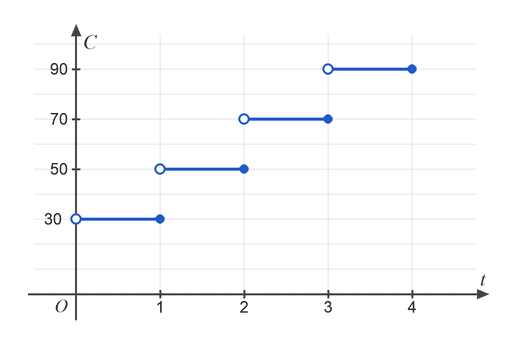
(a) Find , and .
(b) Decide whether exists, and find .
(c) Find every number with for which does not exist, and explain why.
- 21 mark
Question 2
Competency: Interpretation
A patient is given an injection of a medicine at and a second injection at , where is the time in hours. The graph shows the concentration of the medicine in the blood, in mg/L, for ; a filled dot marks a point on the graph and an open dot marks a point that is not on it. (Hypothetical data.)
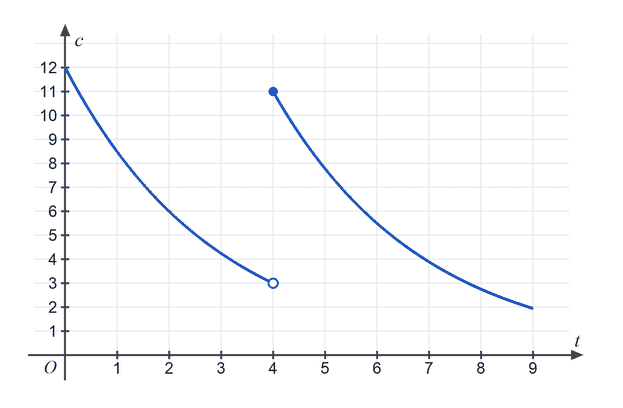
Which statement about the graph near is correct?
- 31 mark
Question 3
Competency: Analysis & Evaluation
Aman uses a calculator in radian mode to work out for four values of : , , and . Each time the calculator shows .
Assertion (A): .
Reason (R): for every integer .
- 44 marks
Question 4
Competency: Application
A steel block is a cube. At its edge is cm and its volume is cm³, where . When the block is heated to , each edge becomes cm, where per is the linear expansion coefficient of steel. (Hypothetical data.)
(a) Let be the volume at . Show that .
(b) Let be the area of one face at , and . Find .
(c) A steel block has a volume of cm³ at . Use part (a) to estimate the increase in its volume when it is heated to , and compare with the exact increase.
- 51 mark
Question 5
Competency: Application
Taking the radius of the earth as km and the acceleration due to gravity at the surface as m s⁻², the acceleration due to gravity at a height of km above the surface, in m s⁻², is
Close to the surface, the fall in per kilometre of height is . What is the value of this limit, in m s⁻² per km?
- 61 mark
Question 6
Competency: Analysis
Assertion (A): .
Reason (R): The quotient theorem, which says that the limit of is the limit of divided by the limit of , may be used only when the limit of is not zero.
- 74 marks
Question 7
Competency: Application & Analysis
The time period of a simple pendulum of length metres is seconds. A clockmaker is adjusting a pendulum of length m and wants to know how much the period changes for each metre of change in length close to . (Hypothetical data.)
(a) Show that .
(b) By rationalising, find , correct to three decimal places, and state its unit.
(c) Use part (b) to estimate the change in the period when the pendulum is lengthened by cm, and compare with the exact change.
- 81 mark
Question 8
Competency: Application
A spherical balloon is being blown up. When its radius is cm, its volume is cm³. The rate at which the volume grows per centimetre of radius, at the moment when the radius is cm, is . (Hypothetical data.) What is this rate?
- 91 mark
Question 9
Competency: Analysis & Evaluation
Assertion (A): .
Reason (R): Differentiating the numerator and the denominator separately (L'Hospital's rule) shows that equals .
- 104 marks
Question 10
Competency: Application & Analysis
Take the earth to be a sphere of radius km. From a point km above sea level, the straight-line distance to the horizon (the point where the line of sight just touches the sea) is km. A traveller standing on a beach has eyes m above sea level. (Hypothetical data.)
(a) Show that , and find .
(b) Hence estimate the distance to the horizon for the traveller.
(c) A guidebook uses the approximation . Find as an exact surd.
- 114 marks
Question 11
Competency: Application & Analysis
A factory makes LED bulbs. Each month it pays a fixed cost of ₹40,000, ₹45 for the materials and labour of each bulb, and supervision and storage costs of ₹ when it makes bulbs. So its total monthly cost, in rupees, is , and the average cost per bulb is . (Hypothetical data.)
(a) Find the average cost per bulb in a month when bulbs are made.
(b) Find , and explain what it tells the manager.
(c) Show that decreases as increases, and find the least monthly output for which the average cost is at most ₹49 per bulb.
- 121 mark
Question 12
Competency: Application
A convex lens of focal length cm forms a real image of an object placed cm in front of it, where . (Hypothetical data.) The image is cm behind the lens, where
The object is moved slowly towards the lens, so that decreases towards . What happens to ?
- 131 mark
Question 13
Competency: Analysis
Assertion (A): .
Reason (R): , and as .
- 144 marks
Question 14
Competency: Application & Analysis
The lamp of a lighthouse is m above sea level. A boat is m from the foot of the lighthouse, measured along the sea, so the straight-line distance from the lamp to the boat is m. (Hypothetical data.)
(a) Show that , and say what this means for a boat far out at sea.
(b) Find .
(c) Hence estimate for a boat m from the foot of the lighthouse, and compare with the exact value.
- 151 mark
Question 15
Competency: Analysis
Assertion (A): ; that is, becomes larger than any fixed number once is close enough to , on either side.
Reason (R): for every , and as .
- 164 marks
Question 16
Competency: Application & Analysis
In a single-slit diffraction experiment, each point of the screen is described by a number ; the centre of the pattern has . For , the intensity of light at the point is units; the formula cannot be used at itself. (Hypothetical data.)
(a) Find , and explain how it gives the intensity at the centre.
(b) Find , and find .
(c) Find , and say what it tells you about the intensity just beside the dark point .
- 171 mark
Question 17
Competency: Application
The minute hand of a wall clock is cm long. In minutes it turns through an angle of radians, so for the straight-line distance between the positions of its tip at noon and minutes after noon is cm. (Hypothetical data.) What is , in cm per minute?
- 181 mark
Question 18
Competency: Analysis
is the centre of a circle of radius , and and are points on the circle with radians, where .

Assertion (A): As , the ratio of the area of triangle to the area of sector tends to .
Reason (R): .
- 194 marks
Question 19
Competency: Application
A railway curve is an arc of a circle of radius m. To check it, surveyors stretch a straight chord between two points on the rail and measure the mid-ordinate: the gap between the middle of the chord and the rail. If the chord subtends an angle at the centre of the circle, the half-chord is m and the mid-ordinate is m. (Hypothetical data.)
(a) Show that .
(b) Hence estimate the mid-ordinate, in millimetres, for a chord m long, and compare with the exact value.
(c) Find , where the arc is the part of the rail between the ends of the chord.
- 204 marks
Question 20
Competency: Application & Analysis
A skydiver steps out of a hot-air balloon that is not moving. Until the parachute opens, the skydiver's downward speed seconds later, in m s⁻¹, is modelled by
(Hypothetical data.)
(a) Find . This value is called the skydiver's terminal speed.
(b) Find , and explain its meaning.
(c) Show that for every , so that in this model the skydiver never actually reaches the terminal speed.
- 211 mark
Question 21
Competency: Application
The population of a town grows by every year. The number of years it takes to double is
where is the natural logarithm. Town planners use the "rule of ", , which comes from the value of . What is this limit?
- 221 mark
Question 22
Competency: Analysis & Evaluation
Assertion (A): .
Reason (R): For , the value of increases as increases.
- 231 mark
Question 23
Competency: Analysis
A cup of tea is left in a room at . Its temperature minutes later is degrees Celsius. (Hypothetical data.)
Assertion (A): .
Reason (R): The temperature of the tea reaches exactly at some finite time .
- 244 marks
Question 24
Competency: Application & Analysis
After a tablet is swallowed, the concentration of a medicine in the blood hours later, in mg/L, is modelled by
where (per hour) measures how fast the tablet is absorbed and per hour measures how fast the body removes the medicine; the formula needs . (Hypothetical data.)
(a) Explain why the formula cannot be used when , and show that for each fixed .
(b) Using L'Hospital's rule, find , and say what it means.
(c) When , the concentration is taken to be . Find it hours after the tablet is taken, correct to two decimal places.
- 251 mark
Question 25
Competency: Application
A gas expands from volume to volume . If the expansion is adiabatic, the work done by the gas is
where is the ratio of the specific heats of the gas and J. (Hypothetical data.) As this expansion approaches an isothermal one. What is ? (Here is the natural logarithm.)
- 261 mark
Question 26
Competency: Analysis
An egg incubator on a poultry farm is meant to stay close to . Its data logger records the temperature , in , hours after midnight, but no formula for is known. From the record, an engineer finds the limit below. (Hypothetical data.)
What is ?
- 271 mark
Question 27
Competency: Application
A soft spring of stiffness N/m is joined end to end with a second spring of stiffness N/m. Together they stretch like a single spring of stiffness
(Hypothetical data.) A student keeps replacing the second spring with stiffer and stiffer springs, so that . What value does approach?
- 281 mark
Question 28
Competency: Analysis
A bicycle tyre of radius rolls along a straight, level road without slipping. A speck of mud on the outermost part of the tyre touches the road at the start. After the tyre has turned through radians, the speck is ahead of its starting point and above the road.
Just after the start, as , what happens to the ratio , and in which direction does the speck begin to move?
- 291 mark
Question 29
Competency: Analysis & Evaluation
Kabir types the function into a calculator. For the calculator shows “Math ERROR”.
Assertion (A): does not exist.
Reason (R): Whether exists, and its value, depend only on the values of for close to with ; the value need not even be defined.
- 301 mark
Question 30
Competency: Analysis & Evaluation
Neha works out on a calculator and gets about . Here is the natural logarithm, .
Assertion (A): .
Reason (R): For values of close to , is approximately equal to , because .
- 311 mark
Question 31
Competency: Understanding
Before evaluating limits, Tanvi sorts them by the form they take when the limiting value is put in straight away. Here is the natural logarithm. Which one of the following limits is not of an indeterminate form?
- 322 marks
Question 32
Competency: Analysis
An electronics student studies a signal , in volts, defined for every . The signal is odd: for every . A recording shows that . (Hypothetical data.)
(a) Find .
(b) Does exist? State the only value of the right-hand limit for which the limit at of an odd function can exist.
- 332 marks
Question 33
Competency: Evaluation & Creativity
Riya writes: “When the numerator and the denominator of a fraction both tend to , the limit of the fraction is always , because .”
(a) Find and , and use them to show that Riya's claim is false.
(b) Make up a fraction whose numerator and denominator both tend to as but whose limit as is , and check your example.
- 342 marks
Question 34
Competency: Evaluation
Sameer evaluates as follows.
- Line 1: .
- Line 2: So the fraction is .
- Line 3: Putting gives , which he takes as , so he writes the limit as .
(a) Which line is wrong, and why?
(b) Find the correct value of the limit.
- 352 marks
Question 35
Competency: Application
The Moon is about km from the Earth. Seen from the Earth, its disc spans an angle of about radian. If is the distance to the centre of the Moon, the Moon's diameter is . For small angles, astronomers often use the simpler rule .
(a) Show that , and explain why this supports the rule for small .
(b) Use the rule to estimate the diameter of the Moon, to the nearest kilometre.
- 363 marks
Question 36
Competency: Application & Analysis
The price of a two-wheeler is ₹80,000. Each year the price rises by a fraction of the price at the start of that year ( means a rise), so after years the price is rupees. A dealer quickly estimates it as rupees. (Hypothetical data.)
(a) Expand by the binomial theorem, and show that .
(b) Hence estimate, for , by how many rupees the dealer's figure falls short of the true price after years.
(c) Find the exact shortfall, and explain the small difference between it and your estimate.
- 373 marks
Question 37
Competency: Application & Analysis
A battery pack of eight V cells in series has an e.m.f. of V and an internal resistance of . When it is joined to a load of resistance ohms, the current is amperes and the power delivered to the load is watts. (Hypothetical data.)
(a) Find and .
(b) Find , and explain what it tells you about for a large load resistance.
(c) Find and . The power turned into heat inside the pack is watts; find its limit as , and explain why joining the terminals by a plain wire ( close to ) is dangerous, even though the load then receives almost no power.
- 383 marks
Question 38
Competency: Analysis
A quiz app has questions in its bank. Each day it picks one question at random; every question is equally likely to be picked, whatever was picked on earlier days. Over days, the probability that one particular question is never picked is
(a) Find and , the second correct to four decimal places.
(b) Using , find , correct to four decimal places.
(c) If the app runs for days instead, the probability becomes . Find , and say what it means for a bank of questions.
- 394 marks
Question 39
Competency: Application & Analysis
A water tank is a cylinder of radius metres and length m lying on its side. The figure shows its cross-section, with centre ; the water surface meets the circle at and , and radians, where . The area of the water's cross-section is m², and the depth of the water is m. (Hypothetical data.)
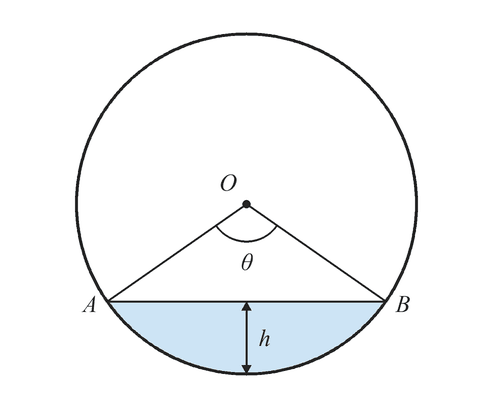
(a) Using the expansion of , find .
(b) Find .
(c) Hence show that . For a tank with , use this to estimate the volume of water, in litres, when the depth is cm.
- 405 marks
Question 40
Competency: Analysis & Evaluation
A city launches a parking-payment app for shops. The table shows the number of shops , in thousands, using the app months after the launch. (Hypothetical data.)
(months) (thousands) Two analysts suggest models for .
- Model I:
- Model II:
Use , , and .
(a) Find and , and say what each model predicts for the long run.
(b) Use the table to decide which model fits the data better.
(c) The company will call the market “settled” once is less than thousand below the model's long-run value. Show that , and find, for each model, the least whole number of months after which the market is settled. Comment on your answers.