
Question 73 marksMedium
Show that does not exist.
Confirming your payment
Sign up now and get 250 free tokens.
Limits · Question 7 of 127
Show that does not exist.
Solution:
Concept: The limit exists only when the left-hand limit (L.H.L.) and the right-hand limit (R.H.L.) both exist as finite numbers and are equal; their common value is the limit. To find the L.H.L. we put , and to find the R.H.L. we put , where and . The value itself plays no part.
Step 1 — Find the left-hand limit. We put , where and ; then :
As , the power , and grows without bound as (because ), so
Step 2 — Find the right-hand limit. We put ; then :
The denominator grows without bound, so the fraction tends to :
Step 3 — Draw the conclusion. The graph shows the left branch rising without bound and the right branch starting from the open dot at the origin.
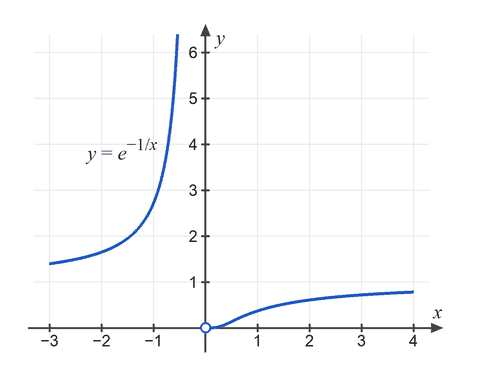
The L.H.L. is not a finite number, so it cannot equal the R.H.L. , and the limit does not exist.
Therefore, since and , does not exist.