
Question 13 marksMedium
Show that does not exist.
Confirming your payment
Sign up now and get 250 free tokens.
Limits · Question 1 of 127
Show that does not exist.
Solution:
Concept: The limit exists only when the left-hand limit (L.H.L.) and the right-hand limit (R.H.L.) both exist as finite numbers and are equal; their common value is the limit. To find the L.H.L. we put , and to find the R.H.L. we put , where and . The value itself plays no part.
Step 1 — Find the left-hand limit. We put , where and ; then is negative, so :
Step 2 — Find the right-hand limit. We put , where and ; now is positive, so :
Step 3 — Compare the two one-sided limits. The graph shows the function: it equals everywhere to the left of and everywhere to the right of , so it jumps at (open dots, because the function is not defined at ).
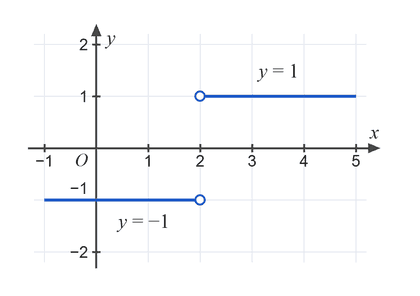
The L.H.L. is and the R.H.L. is . They are not equal, so the limit at cannot exist.
Therefore, since L.H.L. and R.H.L. are unequal, does not exist.