
Opening your dashboard
Class 11 Chemistry Chapter 11: s-Block Elements Solutions
271 textbook questions with step-by-step answers, free to read, for ISC 2026-27.
Get talked through Ch 11, not just shown the answer
Reading a finished solution is not the same as being able to do it. The AI tutor takes one question at a time and works it with you, in your own words, until you can.
- Ask it out loud, in your own words
- It gives you the next step, not the answer
- Stuck on part (ii)? Start there
271 questions with solutions
1–5 marks · Mixed difficulty
The first 47 solutions are on this page. This chapter is a long one, so the rest open on their own page to keep this one quick to load.
- 11 mark
Question 1
Crude common salt is hygroscopic because of the impurities of:
Solve with AIAnswer
(A) and
- Correct
(B) and
(C) and
(D) and
Answer: (B) Calcium chloride and magnesium chloride
Key idea: A hygroscopic (here, deliquescent) substance takes up water vapour from the air. Pure sodium chloride does not do this, but salt made by evaporating sea water carries small amounts of calcium chloride and magnesium chloride, which are strongly deliquescent.
Step 1 — Recall what is in crude salt. Sea salt contains, besides , small amounts of , , and , because these salts are also dissolved in sea water.
Step 2 — Pick out the salts that absorb moisture. Calcium chloride and magnesium chloride absorb so much water vapour that they become damp and even dissolve in it; that is why crude salt becomes wet in the rainy season.
Step 3 — Explain how purification removes the problem. When pure is crystallised (for example by passing HCl gas into a saturated solution), these chlorides stay in solution, so table salt made this way stays dry.
Why the other options are wrong:
- (A) Calcium sulphate and magnesium sulphate are present in crude salt in small amounts, but there they are present as hydrated crystals (gypsum, Epsom salt) that do not pick up moisture and turn damp.
- (C) Bromide makes up only about 0.2 % of the salts dissolved in sea water, and most of it stays behind in the mother liquor (bittern) when common salt crystallises, so crude salt holds far too little calcium or magnesium bromide to make it damp.
- (D) Calcium and magnesium hydrogencarbonates exist only in solution; they are not left behind as solids when the salt crystallises.
Therefore, crude common salt is hygroscopic because of and .
- 21 mark
Question 2
The strongest reducing agent among the following is:
Solve with AIAnswer
- Correct
(A) K
(B) Na
(C) Al
(D) Mg
Answer: (A) K (potassium)
Key idea: A reducing agent gives away electrons. In water, the strength of a metal as a reducing agent is measured by its standard electrode potential : the more negative this value, the more easily the metal loses electrons and the stronger the reducing agent.
Step 1 — Write the standard electrode potentials. These are the accepted values for the four metals.
- K: V
- Na: V
- Mg: V
- Al: V
Step 2 — Pick the most negative value. Potassium has the most negative potential, so it loses its electron most readily.
Step 3 — Link this to its position. Potassium is an alkali metal below sodium; its outer 4s electron is farther from the nucleus and is lost more easily than sodium's 3s electron.
Why the other options are wrong:
- (B) Sodium is a strong reducing agent, but its ( V) is less negative than that of potassium.
- (C) Aluminium has to lose three electrons and its ( V) is the least negative of the four, so it is the weakest reducing agent here.
- (D) Magnesium ( V) is weaker than both alkali metals.
Therefore, potassium is the strongest reducing agent among these.
- 31 mark
Question 3
Alkali metals are powerful reducing agents because:
Solve with AIAnswer
(A) these are metals
(B) these are monovalent
(C) their ionic radii are large
- Correct
(D) their ionisation potentials are low
Answer: (D) Their ionisation potentials are low
Key idea: A reducing agent works by losing electrons. The energy needed to remove the outermost electron from an atom is its ionisation potential (ionisation enthalpy). The lower it is, the more easily the atom gives up the electron.
Step 1 — Look at the electron arrangement. Every alkali metal has a single electron () outside a noble-gas core. This electron is far from the nucleus and well shielded by the inner electrons.
Step 2 — Connect this to ionisation potential. Because the electron is held so weakly, the first ionisation enthalpies of the alkali metals are the lowest in their periods (for example 496 kJ mol⁻¹ for Na against 1251 kJ mol⁻¹ for Cl in the same period).
Step 3 — Conclude. Since the electron is lost so easily, the metals readily reduce other substances: happens with little energy input.
Watch out: In water, lithium is the strongest reducing agent of the group even though its ionisation enthalpy is the highest, because the very small ion releases a very large hydration enthalpy.
Why the other options are wrong:
- (A) Being a metal does not by itself make a substance a powerful reducing agent; gold and silver are metals that are very weak reducing agents.
- (B) Valency does not decide strength; silver also forms a +1 ion, yet it is a weak reducing agent.
- (C) The size of the ions formed is not the cause; the small ion comes from lithium, which is actually the strongest reducing agent of the group in water.
Therefore, alkali metals are powerful reducing agents because their ionisation potentials are low.
- 41 mark
Question 4
Which of the following chlorides gives a violet colour in the flame test?
Solve with AIAnswer
(A)
(B)
- Correct
(C)
(D) None of these
Answer: (C)
Key idea: In a flame test the heat of the flame excites the loosely held outer electron of the metal ion to a higher energy level. When the electron falls back it gives out light of a particular wavelength, and this colours the flame. Each alkali metal has its own characteristic colour.
Step 1 — Recall the flame colours. The usual colours are:
- lithium: crimson red
- sodium: golden yellow
- potassium: violet (lilac)
Step 2 — Match the violet colour. The violet (lilac) flame belongs to potassium, so potassium chloride is the compound that gives it.
Why the other options are wrong:
- (A) Sodium chloride gives a golden-yellow flame (the bright 589 nm line of sodium).
- (B) Lithium chloride gives a crimson-red flame.
- (D) "None of these" cannot be right, because potassium chloride does give a violet flame.
Therefore, gives a violet colour in the flame test.
- 51 mark
Question 5
The yellow light used for illumination is:
Solve with AIAnswer
(A) mercury vapour lamp
- Correct
(B) sodium gas lamp
(C) neon gas lamp
(D) none of these
Answer: (B) Sodium gas lamp (the sodium vapour lamp)
Key idea: When sodium atoms are excited by an electric discharge, their outer electron returns to the ground state with emission of intense yellow light of wavelength about 589 nm, the same colour seen in the sodium flame test.
Step 1 — Identify the lamp. Street lamps that give a yellow glow contain sodium vapour; the discharge excites the sodium atoms, which then emit their yellow light.
Step 2 — See why it is used. A low-pressure sodium lamp turns a large share of its electrical energy into yellow light, a colour to which the eye is quite sensitive, so it gives a lot of light for the electricity used. For this reason sodium lamps were widely used for street lighting, although since the 2010s most new street lights have been LED lamps.
Why the other options are wrong:
- (A) A mercury vapour lamp gives bluish-white light, not yellow light.
- (C) A neon lamp glows orange-red.
- (D) "None of these" is wrong, because the sodium lamp is the yellow lamp.
Therefore, the yellow light used for illumination comes from the sodium (vapour) lamp.
- 61 mark
Question 6
A colourless salt colours a bunsen flame golden yellow and also turns moistened litmus paper blue. The salt is:
Solve with AIAnswer
- Correct
(A)
(B)
(C)
(D) .
Answer: (A)
Key idea: Two tests are given. The golden-yellow flame shows that the salt contains sodium. Turning red litmus blue shows that its solution is alkaline, which happens when the salt comes from a strong base and a weak acid.
Step 1 — Use the flame test. A golden-yellow flame is given only by sodium compounds among the options, so the salt is or .
Step 2 — Use the litmus test. Sodium carbonate is the salt of the weak acid and the strong base . In water its carbonate ions take a proton from water and leave hydroxide ions, so the solution is alkaline.
Sodium chloride comes from a strong acid and a strong base, so its solution is neutral and does not change litmus.
Step 3 — Check the colour. Sodium carbonate is a white (colourless) solid, which fits the description.
Why the other options are wrong:
- (B) Sodium chloride gives the golden-yellow flame, but its solution is neutral, so it does not turn red litmus blue.
- (C) Copper(II) hydroxide is a blue solid, not colourless, it is insoluble in water, and copper gives a bluish-green flame.
- (D) Potassium carbonate is alkaline in water, but potassium gives a violet (lilac) flame, not a golden-yellow one.
Therefore, the salt is sodium carbonate, .
- 71 mark
Question 7
The outermost electron is most loosely held in:
Solve with AIAnswer
(A) Li
(B) Na
(C) K
- Correct
(D) Rb
Answer: (D) Rb (rubidium)
Key idea: How firmly the outermost electron is held is measured by the first ionisation enthalpy. Down group 1 each element adds a new shell, so the outer electron is farther from the nucleus and better shielded by the inner electrons, and it is held more loosely.
Step 1 — Write the first ionisation enthalpies. These are the accepted values in kJ mol⁻¹.
- Li: 520
- Na: 496
- K: 419
- Rb: 403
Step 2 — Pick the lowest value. Rubidium needs the least energy to lose its 5s electron, so that electron is held most loosely.
Why the other options are wrong:
- (A) Lithium's 2s electron is closest to the nucleus, so it is held most firmly of the four (520 kJ mol⁻¹).
- (B) Sodium's 3s electron (496 kJ mol⁻¹) is held more firmly than rubidium's 5s electron.
- (C) Potassium's 4s electron (419 kJ mol⁻¹) is still held a little more firmly than rubidium's.
Therefore, the outermost electron is most loosely held in rubidium.
- 81 mark
Question 8
Which of the following metals is kept wrapped in paraffin wax?
Solve with AIAnswer
- Correct
(A) Li
(B) Na
(C) Cs
(D) K
Answer: (A) Li (lithium)
Key idea: Alkali metals react quickly with oxygen and moisture in air, so they are kept away from air. Sodium and potassium are stored under kerosene, which works only when the metal is denser than kerosene and sinks into it.
Step 1 — Compare the densities. The densities in g cm⁻³ are about 0.53 for Li, 0.97 for Na, 0.86 for K and 1.93 for Cs, while kerosene is about 0.8.
Step 2 — See what happens to lithium. Lithium is the lightest metal (0.53 g cm⁻³), so it floats on kerosene and its top surface would stay exposed to air.
Step 3 — Conclude how it is stored. For this reason lithium is wrapped in paraffin wax (or kept in petroleum jelly), which seals it off from air and moisture.
Why the other options are wrong:
- (B) Sodium is denser than kerosene, so it sinks and is simply kept under kerosene.
- (C) Caesium is much denser than kerosene; being extremely reactive, it is usually kept in sealed glass ampoules under argon or in vacuum.
- (D) Potassium is denser than kerosene and is stored under it (or under dry paraffin oil).
Therefore, lithium is the metal kept wrapped in paraffin wax.
- 91 mark
Question 9
Sodium metal is kept under :
Solve with AIAnswer
- Correct
(A) kerosene oil
(B) alcohol
(C) water
(D) acids
Answer: (A) Kerosene oil
Key idea: Sodium is a very reactive metal. It tarnishes quickly in air and reacts with moisture, so it must be stored in a liquid that does not react with it and keeps air out.
Step 1 — Find a liquid that does not react. Kerosene is a mixture of hydrocarbons; it contains no oxygen, no O–H groups and no water, so sodium does not react with it.
Step 2 — Check that sodium stays covered. Sodium (0.97 g cm⁻³) is denser than kerosene (about 0.8 g cm⁻³), so it sinks and stays completely covered.
Why the other options are wrong:
- (B) Alcohol reacts with sodium, giving sodium ethoxide and hydrogen gas, for example .
- (C) Water reacts vigorously with sodium, giving sodium hydroxide and hydrogen, which can catch fire: .
- (D) Acids react even more violently with sodium, liberating hydrogen.
Therefore, sodium metal is kept under kerosene oil.
- 101 mark
Question 10
Alkali metal are generally prepared by:
Solve with AIAnswer
(A) reduction of metal oxides with carbon.
- Correct
(B) electrolysis of their anhydrous molten halides.
(C) reduction of halides with .
(D) reduction of corresponding oxide with powdered Al.
Answer: (B) Electrolysis of their anhydrous molten halides
Key idea: Alkali metals are themselves among the strongest reducing agents. So no common chemical reducing agent can take their compounds back to the metal, and the strong "push" of electrolysis is needed.
Step 1 — Rule out chemical reduction. Carbon, hydrogen and aluminium cannot be used as a simple, general way to free the alkali metals from their compounds. The alkali metals hold on to oxygen and the halogens very strongly, and the few chemical routes that do work need very high temperatures, a vacuum or special apparatus.
Step 2 — Explain why the halide must be molten and dry. If an aqueous solution were electrolysed, water would be reduced at the cathode instead of the metal ion, giving hydrogen. So the dry (anhydrous) halide is melted, and the metal ions are reduced at the cathode. For sodium, for example:
Step 3 — Give an example. Sodium is made in the Downs cell by electrolysing molten sodium chloride (mixed with calcium chloride to lower the melting point); sodium collects at the cathode and chlorine at the anode.
Why the other options are wrong:
- (A) Carbon reduces alkali metal compounds only at very high temperatures (above about 1000 °C), where the metal comes off as a vapour that tends to react again with the carbon monoxide as it cools (with potassium it forms explosive compounds), so this old method is no longer used.
- (C) Hydrogen does not reduce alkali metal halides; instead, the hot metals combine with hydrogen to form ionic hydrides such as .
- (D) Aluminium can take oxygen from some alkali metal oxides when strongly heated in a vacuum, where the volatile metal distils off, but this suits only special cases, so it is not the general method of preparation.
Note: a few heavier alkali metals (K, Rb, Cs) are also made by reducing their chlorides with sodium or calcium at high temperature, but electrolysis of the molten halide is the general method.
Therefore, alkali metals are generally prepared by electrolysis of their anhydrous molten halides.
- 111 mark
Question 11
The element with atomic number 55 belongs to:
Solve with AIAnswer
- Correct
(A) s- block
(B) p- block
(C) d- block
(D) f- block
Answer: (A) s-block
Key idea: The block of an element is decided by the subshell that receives its last (differentiating) electron. If the last electron enters an orbital, the element is in the s-block.
Step 1 — Write the configuration. Xenon, the noble gas before element 55, has 54 electrons, so element 55 has one electron beyond the xenon core.
That electron goes into the 6s orbital, so the configuration is .
Step 2 — Identify the block. The last electron has entered an s orbital, so the element is in the s-block. With one s-electron it is in group 1: it is caesium (Cs), an alkali metal.
Why the other options are wrong:
- (B) p-block elements have their last electron in an orbital (); element 55 has no 6p electron.
- (C) d-block elements are filling an subshell; the 5d subshell of element 55 is empty.
- (D) f-block elements are filling a 4f or 5f subshell; the 4f subshell of element 55 is still empty.
Therefore, the element with atomic number 55 (caesium) belongs to the s-block.
- 121 mark
Question 12
Which of the following statements is false for alkali metals?
Solve with AIAnswer
(A) ion is exceptionally small.
- Correct
(B) Na is amphoteric in nature.
(C) Li is the strongest reducing agent.
(D) All alkali metals give blue solution in liquid .
Answer: (B) Na is amphoteric in nature
Key idea: An amphoteric substance reacts both as an acid and as a base (like or ). Alkali metals are the most electropositive metals; their oxides and hydroxides are strongly basic, never acidic.
Step 1 — Test statement (B). Sodium forms and , which are strong bases; they neutralise acids but do not react with bases as acids do. So calling sodium amphoteric is false.
Step 2 — Check statement (A). The ion has only the 1s² shell, so it is very small (ionic radius about 76 pm). This is true.
Step 3 — Check statement (C). In aqueous solution lithium has the most negative standard electrode potential of the group ( V), because the tiny ion releases a very large hydration enthalpy. So lithium is the strongest reducing agent, which is true.
Step 4 — Check statement (D). All alkali metals dissolve in liquid ammonia to give blue solutions, the colour coming from ammoniated (solvated) electrons. This is true for dilute solutions.
Why the other options are wrong:
- (A) This statement is true, since is the smallest alkali metal ion, so it is not the false one.
- (C) This statement is true in aqueous solution, as explained in Step 3.
- (D) This statement is true: the dilute solutions of all alkali metals in liquid ammonia are blue.
Therefore, the false statement is that sodium is amphoteric in nature.
- 131 mark
Question 13
Pure is prepared by saturating a cold saturated solution of common salt in water with HCl gas. The principle used is:
Solve with AIAnswer
(A) dilution law principle
(B) displacement law
- Correct
(C) common ion effect
(D) fractional distillation
Answer: (C) Common ion effect
Key idea: The common ion effect is the decrease in the solubility (or ionisation) of an electrolyte when another electrolyte supplying one of the same ions is added. A salt crystallises out when the product of its ion concentrations becomes greater than its solubility product.
Step 1 — Write what is present. A saturated solution of common salt contains and ions in equilibrium with solid salt.
Step 2 — See what HCl gas adds. Hydrogen chloride dissolves and ionises completely, adding a large amount of — the ion common to both compounds.
Step 3 — Apply the common ion effect. The extra chloride raises above the solubility product of , so pure sodium chloride crystallises out. The more soluble impurities such as and stay in solution.
Why the other options are wrong:
- (A) Ostwald's dilution law relates the degree of ionisation of a weak electrolyte to its dilution; no weak electrolyte or dilution is involved here.
- (B) No element or ion displaces another here; the salt that separates is the same that was dissolved.
- (D) Fractional distillation separates liquids by their boiling points; nothing is distilled in this method.
Therefore, the principle used is the common ion effect.
- 141 mark
Question 14
Which of the following nitrates does not give brown coloured gas?
Solve with AIAnswer
(A)
- Correct
(B)
(C)
(D)
Answer: (B)
Key idea: The brown gas given off by some nitrates on heating is nitrogen dioxide, . On ordinary strong heating, the nitrates of the alkali metals Na to Cs decompose to the nitrite and oxygen (both colourless), while lithium nitrate and the nitrates of heavy metals decompose further and give .
Step 1 — Heat potassium nitrate. It gives potassium nitrite and oxygen, and neither of these is coloured.
Step 2 — Compare lithium nitrate. Lithium behaves differently from the other alkali metals: its nitrate decomposes to the oxide and gives brown .
Step 3 — Compare the two heavy-metal nitrates. Lead nitrate and silver nitrate also release brown .
Why the other options are wrong:
- (A) Lithium nitrate gives brown , as shown in Step 2; this is one of the ways lithium differs from the rest of group 1.
- (C) Lead nitrate gives brown (it is the usual laboratory source of the gas).
- (D) Silver nitrate gives brown and leaves silver metal.
Therefore, is the nitrate that does not give a brown gas.
- 151 mark
Question 15
Stable oxide is obtained by heating the carbonate of:
Solve with AIAnswer
- Correct
(A) Li
(B) Na
(C) K
(D) Rb
Answer: (A) Li (lithium)
Key idea: The carbonates of Na, K, Rb and Cs are stable to heat. Lithium carbonate is the exception: the very small ion has a high polarising power; it distorts the large carbonate ion and helps it break into the oxide ion and carbon dioxide. The small and ions also form a very stable lattice in .
Step 1 — Write the decomposition. On heating, lithium carbonate gives lithium oxide and carbon dioxide.
Step 2 — Compare the other carbonates. The large Na⁺, K⁺ and Rb⁺ ions polarise the carbonate ion much less, so their carbonates melt without decomposing at ordinary heating temperatures.
Why the other options are wrong:
- (B) Sodium carbonate does not decompose on ordinary heating; it only melts (at about 850 °C).
- (C) Potassium carbonate is even more stable to heat than sodium carbonate.
- (D) Rubidium carbonate is more stable still, since thermal stability of the carbonates increases down the group.
Therefore, a stable oxide is obtained by heating lithium carbonate.
- 161 mark
Question 16
Which carbonate gives on heating as well as on treating with acids?
Solve with AIAnswer
(A)
(B)
(C)
- Correct
(D)
Answer: (D)
Key idea: Every carbonate gives carbon dioxide with an acid. Among the alkali metal carbonates, only lithium carbonate also decomposes on heating, because the small, highly polarising ion weakens the carbonate ion.
Step 1 — Write the reaction with an acid. Like any carbonate, lithium carbonate reacts with hydrochloric acid and gives carbon dioxide.
Step 2 — Write the reaction on heating. Lithium carbonate also breaks down when heated, giving off carbon dioxide.
Step 3 — Compare the other carbonates. Sodium, potassium and rubidium carbonates give with acids but do not decompose on ordinary heating.
Why the other options are wrong:
- (A) Sodium carbonate gives with acids, but it is stable to heat.
- (B) Potassium carbonate gives with acids, but it does not decompose on heating.
- (C) Rubidium carbonate is even more stable to heat, so it gives only with acids.
Therefore, lithium carbonate gives both on heating and with acids.
- 171 mark
Question 17
The correct formula of hypo is:
Solve with AIAnswer
(A)
(B)
(C)
- Correct
(D)
Answer: (D)
Key idea: The name "hypo" is the common name of the crystals of sodium thiosulphate used in photography (to dissolve unexposed silver halide) and in iodine titrations. The crystals contain five molecules of water of crystallisation.
Step 1 — Name the compound. Hypo is sodium thiosulphate pentahydrate.
Step 2 — Write its formula. One formula unit of carries five water molecules, so the formula is , with molar mass 248 g mol⁻¹.
Why the other options are wrong:
- (A) is anhydrous sodium thiosulphate; the hypo crystals contain water of crystallisation.
- (B) A monohydrate has one water molecule; hypo crystals contain five.
- (C) A tetrahydrate has four water molecules; hypo crystals contain five.
Therefore, the correct formula of hypo is .
- 181 mark
Question 18
The reaction: is called
Solve with AIAnswer
- Correct
(A) Spring's reaction
(B) Friedel-Craft's reaction
(C) Blanc Reduction
(D) Solvay reaction
Answer: (A) Spring's reaction
Key idea: Sodium thiosulphate can be made by passing iodine into a solution containing sodium sulphide and sodium sulphite. This preparation of thiosulphate is known as Spring's reaction.
Step 1 — Read the reaction. Iodine oxidises the sulphide ion and the sulphite ion together, and the two sulphur atoms join to form the thiosulphate ion, while iodine is reduced to iodide.
Step 2 — Check the balance. There are 4 Na, 2 S, 3 O and 2 I atoms on each side, so the equation is balanced.
Step 3 — Name the reaction. This method of preparing sodium thiosulphate is Spring's reaction.
Why the other options are wrong:
- (B) The Friedel–Crafts reaction is the alkylation or acylation of benzene using a catalyst such as anhydrous ; it has nothing to do with thiosulphate.
- (C) The (Bouveault–)Blanc reduction converts an ester into alcohols using sodium and ethanol; no thiosulphate is formed.
- (D) The Solvay process makes sodium carbonate from sodium chloride, ammonia and carbon dioxide.
Therefore, the reaction is called Spring's reaction.
- 191 mark
Question 19
A white solid reacts with dil. HCl to give colourless gas that decolourises aqueous solution. The solid is most likely to be:
Solve with AIAnswer
(A)
(B)
(C)
- Correct
(D) .
Answer: (D)
Key idea: A colourless gas that decolourises bromine water must be a reducing gas. Sulphur dioxide is such a gas: it reduces orange bromine to colourless bromide ions.
Step 1 — Find which solid gives a reducing gas with acid. Sodium thiosulphate reacts with dilute hydrochloric acid to give sulphur dioxide, together with a pale-yellow precipitate of sulphur.
Step 2 — Show how the gas decolourises bromine water. Sulphur dioxide reduces bromine to hydrobromic acid and is itself oxidised to sulphuric acid, so the orange colour disappears.
Why the other options are wrong:
- (A) Sodium carbonate gives carbon dioxide, which is colourless but is not a reducing agent, so it does not decolourise bromine water.
- (B) Sodium chloride does not react with dilute hydrochloric acid, so no gas is given off.
- (C) Sodium acetate forms acetic acid with hydrochloric acid; the acid stays in solution, so no gas is given off.
Therefore, the white solid is most likely sodium thiosulphate, .
- 201 mark
Question 20
The reaction of with sodium thiosulphate () gives:
Solve with AIAnswer
(A)
(B)
(C)
- Correct
(D) Sodium tetrathionate
Answer: (D) Sodium tetrathionate
Key idea: Iodine is a mild oxidising agent. It oxidises thiosulphate ions () to tetrathionate ions () and is itself reduced to iodide. This is the reaction used in iodometric titrations.
Step 1 — Write the equation. Two thiosulphate ions each lose one electron, and the two joined ions form one tetrathionate ion.
Step 2 — Check the change in oxidation state. The average oxidation number of sulphur rises from +2 in to +2.5 in , while iodine falls from 0 to −1. So thiosulphate is oxidised and iodine is reduced.
Why the other options are wrong:
- (A) Sodium sulphide would need sulphur to be reduced to −2, but iodine is an oxidising agent, so it cannot reduce thiosulphate.
- (B) Sulphite (S at +4) is not formed; iodine is too mild to oxidise sulphur that far, and stops at tetrathionate.
- (C) Sulphate (S at +6) is formed by stronger oxidising agents such as chlorine, not by iodine.
Therefore, iodine reacts with sodium thiosulphate to give sodium tetrathionate, .
- 211 mark
Question 21
Aqueous solution of alkali metal carbonate () is alkaline due to:
Solve with AIAnswer
(A) hydrolysis of and ions
(B) hydrolysis of ions
- Correct
(C) hydrolysis of ions
(D) None of these
Answer: (C) Hydrolysis of ions
Key idea: Salt hydrolysis is the reaction of an ion of a salt with water. An alkali metal carbonate is the salt of a strong base (MOH) and a weak acid (). Only the ion of the weak partner, the carbonate ion, reacts with water.
Step 1 — Look at the cation. The ion comes from a strong base, so it has no tendency to take from water; it stays as a hydrated ion and does not hydrolyse.
Step 2 — Look at the anion. The ion is the conjugate base of the weak acid , so it takes a proton from water and leaves hydroxide ions behind.
Step 3 — Conclude. The extra ions make , so the solution is alkaline (pH above 7).
Why the other options are wrong:
- (A) The alkali metal cation does not hydrolyse, as explained in Step 1; only the carbonate ion does.
- (B) The ion does not hydrolyse either, and the question is about carbonates of all the alkali metals, not only sodium.
- (D) "None of these" is wrong, because hydrolysis of the carbonate ion fully explains the alkalinity.
Therefore, the solution is alkaline because of hydrolysis of ions.
- 221 mark
Question 22
Which of the following sets has atomic numbers of alkali metals?
Solve with AIAnswer
(A) 1, 12, 30, 4, 62
- Correct
(B) 37, 19, 3, 55
(C) 9, 17, 35, 23
(D) 12, 20, 56, 88
Answer: (B) 37, 19, 3, 55
Key idea: The alkali metals are the group 1 elements after hydrogen: lithium (3), sodium (11), potassium (19), rubidium (37), caesium (55) and francium (87). Each has one electron beyond a noble-gas core, so its atomic number is one more than that of a noble gas (2, 10, 18, 36, 54, 86).
Step 1 — Test each number in set (B). We compare each number with the noble gas just before it.
- 37 = 36 + 1: rubidium
- 19 = 18 + 1: potassium
- 3 = 2 + 1: lithium
- 55 = 54 + 1: caesium
Step 2 — Conclude. Every number in set (B) belongs to an alkali metal.
Why the other options are wrong:
- (A) 1 is hydrogen (a non-metal), 12 is magnesium, 30 is zinc, 4 is beryllium and 62 is samarium, so none is an alkali metal.
- (C) 9, 17 and 35 are the halogens fluorine, chlorine and bromine, and 23 is vanadium.
- (D) 12, 20, 56 and 88 are magnesium, calcium, barium and radium, the alkaline earth metals of group 2.
Note: option (B) is printed as 37, 19, 3, 35; 35 is bromine, so the last number is a misprint for 55 (caesium).
Therefore, set (B), 37, 19, 3 and 55, gives the atomic numbers of alkali metals.
- 231 mark
Question 23
Alkali metals are chemically similar because
Solve with AIAnswer
(A) their valence shell electrons are equally energetic.
(B) their outermost electrons have the same principal quantum number.
- Correct
(C) their valence shell electronic configuration is the same.
(D) their atomicity is one.
Answer: (C) Their valence shell electronic configuration is the same
Key idea: The chemical properties of an element depend mainly on its outer (valence) electrons. Elements with the same type of valence configuration form similar ions and similar compounds.
Step 1 — Write the valence configurations. Every alkali metal has a single s-electron outside a noble-gas core.
- Li:
- Na:
- K:
- Rb:
- Cs:
Step 2 — Link this to their chemistry. Because each loses this one electron to form an ion with a noble-gas configuration, all of them show the +1 oxidation state, form similar ionic compounds (MCl, MOH, ) and act as strong reducing agents.
Why the other options are wrong:
- (A) Their valence electrons are not equally energetic; the first ionisation enthalpy falls from 520 kJ mol⁻¹ for Li to 376 kJ mol⁻¹ for Cs.
- (B) The principal quantum number of the outer electron is different for each element: 2 for Li, 3 for Na, up to 6 for Cs.
- (D) The vapours of the alkali metals do consist mainly of single atoms, but so do those of the noble gases and of many other metals, so this cannot explain the chemical similarity of group 1.
Therefore, the alkali metals are chemically similar because their valence shell electronic configuration () is the same.
- 241 mark
Question 24
In alkali metals family, caesium should be:
Solve with AIAnswer
(A) the least ionisable
(B) more electropositive than Fr.
(C) the lightest of all alkali metals
- Correct
(D) having low melting and boiling points.
Answer: (D) Having low melting and boiling points
Key idea: Down group 1 the atoms become larger, so the single valence electron is shared by a larger kernel and the metallic bonding becomes weaker. As a result the melting and boiling points fall from lithium to caesium.
Step 1 — Recall the melting points. The melting points (°C) fall steadily down the group.
- Li: 181
- Na: 98
- K: 63
- Rb: 39
- Cs: 28
Step 2 — Apply this to caesium. Caesium melts at about 28 °C, just above room temperature, and boils at about 671 °C, the lowest values among the stable alkali metals. So statement (D) is correct.
Why the other options are wrong:
- (A) Caesium is the most easily ionised of the stable alkali metals (first ionisation enthalpy about 376 kJ mol⁻¹), so it is not the least ionisable.
- (B) By the simple group trend francium, lying below caesium, would be expected to be the more electropositive element, which is what this option denies. In fact, the measured first ionisation enthalpy of francium (about 393 kJ mol⁻¹) is slightly higher than that of caesium, so the comparison is a close one and not a safe basis for an answer.
- (C) Caesium is the heaviest stable alkali metal (atomic mass about 133); lithium is the lightest.
Note: caesium is often called the most electropositive element, because francium is very rare and radioactive and its ionisation enthalpy is slightly higher than that of caesium; option (D) is the clearly correct statement.
Therefore, caesium has low melting and boiling points.
- 251 mark
Question 25
Which electronic configuration corresponds to least ionisation energy?
Solve with AIAnswer
(A)
(B)
(C)
- Correct
(D)
Answer: (D)
Key idea: Ionisation energy is the energy needed to remove the outermost electron from an isolated gaseous atom. An electron alone in a new shell, outside a complete noble-gas core, is far from the nucleus and well shielded, so it is removed most easily.
Step 1 — Identify each element. We count the electrons in each configuration.
- (A) 7 electrons: nitrogen
- (B) 9 electrons: fluorine
- (C) 10 electrons: neon
- (D) 11 electrons: sodium
Step 2 — Compare their ionisation enthalpies. The accepted first ionisation enthalpies (kJ mol⁻¹) are N 1402, F 1681, Ne 2081 and Na 496.
Step 3 — Pick the lowest. Sodium, with its lone 3s electron, has by far the lowest value.
Why the other options are wrong:
- (A) Nitrogen's electron is in the 2p subshell, close to the nucleus, and its half-filled 2p³ is extra stable (1402 kJ mol⁻¹).
- (B) Fluorine has a high nuclear charge pulling on its 2p electrons (1681 kJ mol⁻¹).
- (C) Neon has a complete octet, the most stable arrangement, so it has the highest value here (2081 kJ mol⁻¹).
Therefore, (sodium) has the least ionisation energy.
- 261 mark
Question 26
Which is correct statement for ?
Solve with AIAnswer
(A) It is a covalent compound
(B) It contains and ions
- Correct
(C) It contains and ion
(D) It contains , and molecule.
Answer: (C) It contains and ions
Key idea: Caesium has only one valence electron, so in its ordinary compounds it forms the ion. A formula such as is therefore a polyhalide: the three bromine atoms together carry one negative charge as the tribromide ion, .
Step 1 — Fix the charge on caesium. Removing a second electron from caesium would mean breaking into its stable xenon core, which needs far too much energy, so caesium is +1.
Step 2 — Find the anion. With , the three bromine atoms must carry a total charge of −1. A bromide ion combines with a bromine molecule to give the linear tribromide ion.
Step 3 — Describe the compound. is an ionic solid made of and ions; the large ion is good at stabilising the large ion in a crystal.
Why the other options are wrong:
- (A) It is ionic, made of and ions, not a covalent molecule (only the bonds inside the ion are covalent).
- (B) Caesium never forms a +3 ion, because that would need two electrons to be pulled out of its xenon core.
- (D) The unit is bonded to inside the single ion; there is no separate molecule in the crystal.
Therefore, contains and ions.
- 271 mark
Question 27
Which statement is false in case of alkali metals?
Solve with AIAnswer
(A) Lithium is the strongest reducing agent
- Correct
(B) Sodium is amphoteric in nature
(C) ion is exceptionally small
(D) All alkali metals give blue colour in liquid ammonia.
Answer: (B) Sodium is amphoteric in nature
Key idea: An amphoteric substance can behave both as an acid and as a base. Alkali metals are strongly electropositive, and their oxides and hydroxides are strong bases with no acidic character.
Step 1 — Test statement (B). Sodium gives and , which react with acids but not with bases as acids do, so sodium is not amphoteric. This statement is false.
Step 2 — Check statement (A). In water lithium has the most negative electrode potential of the group ( V), because the small ion has a very high hydration enthalpy. So it is the strongest reducing agent, which is true.
Step 3 — Check statements (C) and (D). The ion has only one shell, so it is very small (about 76 pm), which is true. Dilute solutions of all alkali metals in liquid ammonia are blue because of ammoniated electrons, which is also true.
Why the other options are wrong:
- (A) This statement is true for aqueous solution, so it is not the false statement.
- (C) This statement is true: is the smallest ion of the group.
- (D) This statement is true: dilute solutions of all alkali metals in liquid ammonia are blue.
Therefore, the false statement is that sodium is amphoteric in nature.
- 281 mark
Question 28
Sodium nitrate decomposes above 800°C to give.
Solve with AIAnswer
(A)
- Correct
(B)
(C)
(D) .
Answer: (B) (oxygen)
Key idea: Sodium nitrate breaks down in two stages. On strong heating it first loses oxygen and forms sodium nitrite; at still higher temperatures (above about 800 °C) the nitrite breaks down as well. Lithium nitrate behaves differently: like heavy-metal nitrates, it gives the oxide, brown and oxygen.
Step 1 — Write the first stage. On strong heating, sodium nitrate loses oxygen and forms sodium nitrite.
Step 2 — Check the balance of the first stage. Both sides contain 2 Na, 2 N and 6 O atoms.
Step 3 — Write the overall change above 800 °C. At the temperature named in the stem the nitrite also breaks down, so in the textbook equation the overall change gives sodium oxide, nitrogen and oxygen.
Step 4 — Check the balance of the overall change. Both sides contain 4 Na, 4 N and 12 O atoms.
Step 5 — Pick the keyed product. Oxygen is given off at both stages, so it is the product that heating sodium nitrate always gives; this is option (B).
Why the other options are wrong:
- (A) Nitrogen is formed only in the second stage, when the nitrite breaks down above about 800 °C, so at the stated temperature it is also a product. It is not the keyed answer because oxygen is the product formed at both stages.
- (C) Brown is the typical product of lithium nitrate and of heavy-metal nitrates such as ; sodium nitrate gives the nitrite and oxygen first, and sodium oxide, nitrogen and oxygen on stronger heating.
- (D) Sodium oxide, like nitrogen, is formed only in the second stage above about 800 °C, so at the stated temperature it is also a product. It is not the keyed answer because the first stage gives sodium nitrite, not the oxide, while oxygen forms at both stages.
Note: at the temperature named in the stem, nitrogen and sodium oxide are also products, so options (A) and (D) are also correct; the printed key, oxygen, is kept.
Therefore, sodium nitrate gives oxygen, , on heating (above about 800 °C sodium oxide and nitrogen form as well).
- 291 mark
Question 29
Which is maximum reactive towards water?
Solve with AIAnswer
(A) Li
(B) K
(C) Na
- Correct
(D) Rb
Answer: (D) Rb (rubidium)
Key idea: Alkali metals react with water to give the hydroxide and hydrogen. The reaction becomes more vigorous down the group, because the larger atoms lose their outer electron more easily and have lower melting points, so the metal melts and exposes a fresh surface.
Step 1 — Write the general reaction. Every alkali metal gives its hydroxide and hydrogen with water.
Step 2 — Compare the four metals. Lithium reacts gently, sodium vigorously, potassium catches fire, and rubidium reacts explosively. Rubidium has the lowest first ionisation enthalpy of the four (403 kJ mol⁻¹) and the lowest melting point (39 °C).
Why the other options are wrong:
- (A) Lithium reacts the most slowly of the four, because it has a high melting point and its small atom holds its electron firmly.
- (B) Potassium reacts strongly enough to set the hydrogen on fire, but less violently than rubidium.
- (C) Sodium reacts vigorously but less so than potassium and rubidium.
Therefore, rubidium is the most reactive towards water.
- 301 mark
Question 30
The electronic configuration of a metal M is . The formula of its oxide would be:
Solve with AIAnswer
(A) MO
- Correct
(B)
(C)
(D)
Answer: (B)
Key idea: A metal with one electron in its outermost shell loses that electron to form an ion (valency 1). Oxide ions carry a charge of −2, so two ions are needed for each ion.
Step 1 — Identify the metal. The configuration has 11 electrons, so M is sodium, with one valence electron in 3s.
Step 2 — Write the ion. Losing the 3s electron gives , which has the neon configuration.
Step 3 — Balance the charges. Two +1 ions balance one −2 oxide ion, so the formula is (that is, ).
Why the other options are wrong:
- (A) MO is the oxide formula of a metal forming a +2 ion, such as magnesium ().
- (C) fits a metal forming a +3 ion, such as aluminium ().
- (D) would need a +4 metal ion, or a superoxide (); superoxides are typical of K, Rb and Cs, and the normal oxide of sodium is .
Note: the configuration is printed as ; "sp²" is a misprint for , since an electron enters 3s only after is complete.
Therefore, the formula of the oxide is .
- 311 mark
Question 31
Lithium shows diagonal relationship with
Solve with AIAnswer
- Correct
(A) Magnesium
(B) Beryllium
(C) Aluminium
(D) Boron.
Answer: (A) Magnesium
Key idea: A diagonal relationship is the similarity between an element of period 2 and the element one group to the right in period 3 (Li–Mg, Be–Al, B–Si). Moving right increases charge density, while moving down decreases it, so the two diagonal neighbours have similar ionic size and polarising power.
Step 1 — Locate lithium. Lithium is in period 2, group 1, so its diagonal neighbour is in period 3, group 2: magnesium.
Step 2 — Give the evidence. (about 76 pm) and (about 72 pm) are similar in size. Like magnesium, lithium forms a normal oxide on burning, combines directly with nitrogen to form a nitride (, like ), and has a carbonate that decomposes on heating.
Why the other options are wrong:
- (B) Beryllium is lithium's neighbour in the same period (period 2), not its diagonal partner; beryllium itself shows a diagonal relationship with aluminium.
- (C) Aluminium is the diagonal partner of beryllium, not of lithium.
- (D) Boron is in period 2 as well, and its diagonal partner is silicon.
Therefore, lithium shows a diagonal relationship with magnesium.
- 321 mark
Question 32
Sodium gives blue colour in solution. This blue colour is due to
Solve with AIAnswer
(A) ammoniated
(B) ammoniated
- Correct
(C) ammoniated
(D) / pair.
Answer: (C) Ammoniated electrons
Key idea: When an alkali metal dissolves in liquid ammonia, each atom gives up its valence electron. Both the metal ion and the electron become surrounded by ammonia molecules (ammoniated or solvated).
Step 1 — Find the coloured species. The ammoniated electron sits in a cavity formed by ammonia molecules. It absorbs light in the red and near-infrared region of the spectrum, so the transmitted light, and hence the solution, appears blue.
Step 2 — See that the colour does not depend on the metal. All alkali metals give the same blue colour in dilute solution, which shows that the colour comes from the electron, which they share, and not from the metal ion.
Why the other options are wrong:
- (A) Ammoniated ions are present, but they are colourless, just like hydrated ions in water.
- (B) This option repeats option (A); ammoniated ions are colourless.
- (D) Ion pairs of and sodide () ions are not what gives the blue colour of the dilute solution.
Note: options (A) and (B) are printed identically.
Therefore, the blue colour is due to ammoniated electrons.
- 331 mark
Question 33
In view of their low ionization energies, the alkali metals are
Solve with AIAnswer
(A) Weak oxidising agents
- Correct
(B) Strong reducing agents
(C) Strong oxidising agent
(D) Weak reducing agents.
Answer: (B) Strong reducing agents
Key idea: A reducing agent gives electrons to another substance, and an oxidising agent takes them. An atom with a low ionisation energy gives up its outer electron easily.
Step 1 — Apply the low ionisation energy. The alkali metals have the lowest ionisation enthalpies in their periods, so they lose their single electron very easily.
Step 2 — Name the behaviour. A substance that loses electrons so easily reduces other substances, so the alkali metals are strong reducing agents.
Why the other options are wrong:
- (A) An oxidising agent must gain electrons; alkali metals have a strong tendency to lose them, so they show practically no oxidising action at all.
- (C) Strong oxidising agents (such as fluorine) have a strong tendency to gain electrons, which is the opposite of the alkali metals.
- (D) Losing electrons easily makes them strong, not weak, reducing agents.
Therefore, because of their low ionisation energies, the alkali metals are strong reducing agents.
- 341 mark
Question 34
In Solvay process of manufacture of , the by-products are
Solve with AIAnswer
(A) , CaO
(B) CaO,
- Correct
(C) , ,
(D) , .
Answer: (C) , ,
Key idea: In the Solvay (ammonia–soda) process, brine saturated with ammonia is carbonated to precipitate sodium hydrogencarbonate, which is heated to give sodium carbonate. Carbon dioxide and ammonia come out of the later steps and are fed back in; calcium chloride is left over.
Step 1 — Write the main reactions. First, ammonia, carbon dioxide and water give ammonium hydrogencarbonate, which reacts with brine to precipitate sodium hydrogencarbonate.
Step 2 — Make the product. Heating sodium hydrogencarbonate gives sodium carbonate and releases carbon dioxide.
Step 3 — Recover ammonia. Limestone is heated to give carbon dioxide and quicklime; the slaked lime then releases ammonia from ammonium chloride and leaves calcium chloride.
Step 4 — Pick out the by-products. Carbon dioxide (Steps 2 and 3) and ammonia (Step 3) come out of the process and are recycled, while calcium chloride is the waste by-product. Option (C) lists exactly these.
Why the other options are wrong:
- (A) Ammonium chloride and quicklime are intermediates used up inside the plant (quicklime is slaked and then frees ammonia from ammonium chloride), so neither leaves as a by-product.
- (B) Sodium carbonate is the main product of the process, not a by-product.
- (D) This option also names sodium carbonate, the main product, as a by-product.
Therefore, the by-products of the Solvay process are , and (the last two being recycled).
- 351 mark
Question 35
Crystalline sodium chloride is a bad conductor of electricity because
Solve with AIAnswer
(A) It contains only molecules
(B) It does not possess ions
- Correct
(C) The ions present in it are not free to move
(D) It contains free molecules.
Answer: (C) The ions present in it are not free to move
Key idea: An electric current is a flow of charged particles. In an ionic compound the charge carriers are ions, and they carry current only when they can move.
Step 1 — Describe solid sodium chloride. Crystalline is a lattice of and ions held in fixed positions by strong electrostatic forces.
Step 2 — Explain the poor conduction. Because the ions can only vibrate about their fixed positions, no charge can flow, so the solid is a bad conductor.
Step 3 — Contrast with the melt or solution. When the salt is melted or dissolved in water, the ions become free to move, and the liquid conducts electricity.
Why the other options are wrong:
- (A) Sodium chloride is made of ions, not molecules; there are no separate NaCl molecules in the crystal.
- (B) It is made entirely of and ions, so this option denies the true nature of the crystal.
- (D) There are no molecules, free or otherwise, in the crystal; the poor conduction comes from fixed ions.
Therefore, crystalline sodium chloride conducts poorly because its ions are not free to move.
- 361 mark
Question 36
Sodium metal reacts with at high temperature to give a sodium compound X. X reacts with carbon dioxide in water to form Y. Y is ______
Solve with AIAnswer
(A)
(B)
- Correct
(C)
(D)
Answer: (C)
Key idea: At high temperature sodium attacks alumina and forms a sodium compound that is basic. Carbon dioxide is an acidic oxide, so in water it turns any such basic sodium compound into sodium carbonate.
Step 1 — Find X. Hot sodium reacts with alumina to form sodium aluminate, , and some aluminium is set free.
Step 2 — Find Y. Carbon dioxide in water (carbonic acid) decomposes sodium aluminate. It precipitates aluminium hydroxide and leaves sodium carbonate in solution.
Step 3 — Check that Y does not depend on the exact X. If X were taken as sodium oxide, it would also give sodium carbonate, since dissolves to form , which absorbs carbon dioxide.
So in every case Y is sodium carbonate.
Why the other options are wrong:
- (A) Sodium peroxide is made by burning sodium in excess oxygen; it is not formed from carbon dioxide and water.
- (B) Sodium oxide cannot be Y, because in water it turns into , which then absorbs carbon dioxide to form the carbonate.
- (D) Sodium aluminate is X, the compound that carbon dioxide breaks down, so it cannot be the product Y.
Therefore, Y is sodium carbonate, .
- 371 mark
Question 37
Aqueous sodium hydroxide reacts with white phosphorus to form phosphine and
Solve with AIAnswer
- Correct
(A)
(B)
(C)
(D)
Answer: (A) (sodium hypophosphite)
Key idea: When white phosphorus is warmed with concentrated sodium hydroxide solution, it disproportionates: part of the phosphorus (oxidation state 0) is reduced to phosphine (−3) and part is oxidised to the hypophosphite ion (+1).
Step 1 — Write the balanced equation. The reaction is carried out in an inert atmosphere, because phosphine catches fire in air.
Step 2 — Check the electron balance. One phosphorus atom goes from 0 to −3 (gains 3 electrons), while three phosphorus atoms each go from 0 to +1 (lose 3 electrons in all), so the electrons balance.
Why the other options are wrong:
- (B) Phosphorus pentoxide is an acidic oxide; in sodium hydroxide solution it would at once be neutralised, so it cannot be a product here.
- (C) The product is sodium hypophosphite, with phosphorus at +1; in phosphorus would be +3, and phosphorous acid is only dibasic, so its normal sodium salt is in any case.
- (D) Phosphorus trioxide is also an acidic oxide that would react with the alkali, so it is not left as a product.
Therefore, white phosphorus and aqueous sodium hydroxide give phosphine and .
- 381 mark
Question 38
When sodium is treated with sufficient oxygen/air, the product obtained is
Solve with AIAnswer
(A)
- Correct
(B)
(C)
(D) NaO.
Answer: (B) (sodium peroxide)
Key idea: On burning in excess air, the alkali metals form different oxides: lithium mainly forms the monoxide , sodium the peroxide , and potassium, rubidium and caesium the superoxides , , . The larger the cation, the better it stabilises the larger anion.
Step 1 — Write the reaction for sodium. With plenty of oxygen, sodium burns with a yellow flame to form sodium peroxide.
Step 2 — Name the anion. Sodium peroxide contains the peroxide ion, , with an O–O single bond.
Why the other options are wrong:
- (A) Sodium monoxide forms when the oxygen supply is limited; with sufficient oxygen, the peroxide is the main product.
- (C) Sodium superoxide is not formed when sodium burns in air; it is made only under special conditions, such as heating sodium peroxide with oxygen at high pressure. Superoxides are the normal burning products of K, Rb and Cs.
- (D) "NaO" would need sodium in the +2 state, which sodium does not show; no such compound exists.
Therefore, sodium burnt in sufficient oxygen gives sodium peroxide, .
- 391 mark
Question 39
What is the reaction occurring at the anode in Down's process for the extraction of sodium?
Solve with AIAnswer
(A)
(B)
- Correct
(C)
(D)
Answer: (C) Chloride ions are oxidised to chlorine,
Key idea: In the Downs process, molten sodium chloride (mixed with calcium chloride to lower its melting point to about 600 °C) is electrolysed. Oxidation always takes place at the anode, and reduction at the cathode.
Step 1 — Find the ions present. The melt contains and ions; there is no water and no hydroxide.
Step 2 — Write the anode reaction. At the graphite anode the chloride ions give up electrons and chlorine gas is released.
Step 3 — Write the cathode reaction for comparison. At the iron cathode the sodium ions gain electrons and molten sodium collects.
Why the other options are wrong:
- (A) Oxidation of to oxygen happens at the anode when fused sodium hydroxide is electrolysed (Castner's process), not in the Downs cell, which contains no hydroxide.
- (B) This is a reduction, which takes place at the cathode, not at the anode.
- (D) This is only the dissociation of sodium hydroxide into ions; no electrons are transferred, so it is not an electrode reaction at all.
Note: option (C) is printed as "2Cl → Cl₂ + 2e⁻"; the charge on the chloride ion has been restored.
Therefore, the anode reaction in the Downs process is .
- 401 mark
Question 40
In organic reactions, sodium in liquid ammonia is used as ______
Solve with AIAnswer
- Correct
(A) Reducing agent
(B) Hydrolysing agent
(C) Oxidising agent
(D) Precipitating agent
Answer: (A) Reducing agent
Key idea: Sodium dissolves in liquid ammonia to give ammoniated sodium ions and ammoniated electrons. These free electrons are easily given to other molecules, so the solution is a powerful reducing agent.
Step 1 — Explain the reducing power. The ammoniated electrons can be added to organic molecules, which are then protonated, so the molecules gain hydrogen, that is, they are reduced.
Step 2 — Give examples. Sodium in liquid ammonia reduces alkynes to trans-alkenes and, in the Birch reduction, benzene rings to 1,4-cyclohexadienes.
Why the other options are wrong:
- (B) Hydrolysis means splitting by water; the medium here is dry liquid ammonia, and the solution acts through its electrons, not as a hydrolysing agent.
- (C) The solution gives electrons away, which is the opposite of oxidation.
- (D) The solution is not used to bring down a precipitate; it is used to reduce dissolved organic compounds.
Therefore, sodium in liquid ammonia is used as a reducing agent.
- 411 mark
Question 41
What are the products formed when undergoes decomposition?
Solve with AIAnswer
(A) + CO
(B) + CO
- Correct
(C) +
(D) + CO.
Answer: (C) +
Key idea: When a carbonate decomposes on heating, the carbonate ion simply splits into an oxide ion and carbon dioxide; no element changes its oxidation state. Lithium carbonate is the only alkali metal carbonate that does this on ordinary heating, because the small ion strongly polarises the carbonate ion.
Step 1 — Split the carbonate ion. One ion gives one ion and one molecule.
Step 2 — Write the balanced equation. The two ions stay with the oxide ion as lithium oxide.
Step 3 — Check the balance. There are 2 Li, 1 C and 3 O on each side.
Why the other options are wrong:
- (A) This would need carbon to be reduced from +4 to +2 and oxygen to be oxidised to the peroxide state; heating a carbonate does not change oxidation states, and lithium does not form a peroxide readily.
- (B) + CO contains only 2 oxygen atoms, while has 3, so the equation cannot be balanced.
- (D) + CO has only one lithium atom against two in , and lithium does not form a stable superoxide.
Therefore, lithium carbonate decomposes to and .
- 421 mark
Question 42
Which one of the following metallic hydroxides does not dissolve in sodium hydroxide solution?
Solve with AIAnswer
(A)
(B)
- Correct
(C)
(D) .
Answer: (C)
Key idea: A hydroxide dissolves in sodium hydroxide solution only if it is amphoteric, that is, if it can also act as an acid and form a soluble salt with the alkali. Hydroxides of Al, Zn and Pb are amphoteric; iron(III) hydroxide is basic.
Step 1 — Show the amphoteric hydroxides dissolving. Each forms a soluble sodium salt (an aluminate, plumbite or zincate).
Step 2 — Consider iron(III) hydroxide. Iron(III) hydroxide is a basic hydroxide; it dissolves in acids but practically does not dissolve in sodium hydroxide solution. This is why it stays behind as a reddish-brown precipitate when excess alkali is added in qualitative analysis.
Why the other options are wrong:
- (A) Aluminium hydroxide dissolves in sodium hydroxide, forming sodium aluminate.
- (B) Lead(II) hydroxide dissolves in sodium hydroxide, forming sodium plumbite.
- (D) Zinc hydroxide dissolves in sodium hydroxide, forming sodium zincate.
Therefore, does not dissolve in sodium hydroxide solution.
- 431 mark
Question 43
An aqueous solution of sodium carbonate is alkaline because sodium carbonate is a salt of
Solve with AIAnswer
(A) Weak acid and weak base
(B) Strong acid and weak base
- Correct
(C) Weak acid and strong base
(D) Strong acid and strong base.
Answer: (C) Weak acid and strong base
Key idea: A salt of a weak acid and a strong base gives an alkaline solution, because the anion of the weak acid reacts with water (hydrolyses) and produces hydroxide ions.
Step 1 — Find the parent acid and base. Sodium carbonate comes from carbonic acid, , which is a weak acid, and sodium hydroxide, , which is a strong base.
Step 2 — Show the hydrolysis. The carbonate ion takes a proton from water and leaves hydroxide ions.
Step 3 — Conclude. The excess of makes the solution alkaline.
Why the other options are wrong:
- (A) The parent base of sodium carbonate is sodium hydroxide, which is a strong base, not a weak one. (For a true weak acid–weak base salt the pH depends on how the strengths of the acid and the base compare; ammonium acetate, for example, gives a nearly neutral solution.)
- (B) A salt of a strong acid and a weak base (such as ammonium chloride) gives an acidic solution.
- (D) A salt of a strong acid and a strong base (such as sodium chloride) gives a neutral solution.
Therefore, sodium carbonate solution is alkaline because it is a salt of a weak acid and a strong base.
- 441 mark
Question 44
Which of the following has lowest melting point?
Solve with AIAnswer
(A) Li
(B) Na
(C) K
- Correct
(D) Cs.
Answer: (D) Cs (caesium)
Key idea: The alkali metals are held together by metallic bonding between the cations and the sea of valence electrons. Each atom gives only one electron, and as the atoms get larger down the group, this bonding gets weaker, so the melting point falls.
Step 1 — Recall the melting points. The melting points (°C) of the four metals are:
- Li: 181
- Na: 98
- K: 63
- Cs: 28
Step 2 — Pick the lowest. Caesium, the largest atom of the four, has the weakest metallic bonding and the lowest melting point (about 28 °C).
Why the other options are wrong:
- (A) Lithium has the smallest atom and the strongest metallic bonding, so it has the highest melting point of the four.
- (B) Sodium melts at about 98 °C, much higher than caesium.
- (C) Potassium melts at about 63 °C, still higher than caesium.
Therefore, caesium has the lowest melting point.
- 451 mark
Question 45
When is added to water, the solution is basic because it contains a significant concentration of
Solve with AIAnswer
(A)
(B)
- Correct
(C)
(D) .
Answer: (C)
Key idea: A solution is basic when it contains more hydroxide ions than hydrogen ions. Potassium oxide is a basic oxide: its oxide ion, , is a very strong base that cannot exist in water, so it takes a proton from water at once.
Step 1 — Write the reaction. Potassium oxide dissolves in water to give potassium hydroxide.
Step 2 — Show what happens to the oxide ion. Each oxide ion takes a proton from a water molecule, so it gives two hydroxide ions.
Step 3 — Conclude. The solution therefore contains a large concentration of ions, which makes it strongly basic.
Why the other options are wrong:
- (A) The peroxide ion is present in peroxides such as ; is a normal oxide and contains , which becomes in water.
- (B) There is no ion; oxygen gains at most two electrons to reach a noble-gas configuration.
- (D) ions are present, but they are neutral in their effect on pH (they come from a strong base and do not hydrolyse), so they do not make the solution basic.
Therefore, the solution is basic because it contains a significant concentration of ions.
- 461 mark
Question 46
Which of the following has the least ionization potential?
Solve with AIAnswer
- Correct
(A) Li
(B) He
(C) N
(D) Zn.
Answer: (A) Li (lithium)
Key idea: The ionisation potential (first ionisation enthalpy) is the energy needed to remove the most loosely held electron. An alkali metal, with one electron outside a noble-gas core, has the lowest value in its period.
Step 1 — Write the first ionisation enthalpies. These are the accepted values in kJ mol⁻¹.
- Li: 520
- Zn: 906
- N: 1402
- He: 2372
Step 2 — Pick the lowest. Lithium's single 2s electron is shielded by the 1s² pair and is lost most easily, so lithium has the least ionisation potential.
Why the other options are wrong:
- (B) Helium has a completely filled 1s² shell held by a nuclear charge of +2, so it has the highest ionisation enthalpy of all elements.
- (C) Nitrogen's electron is in the 2p subshell with a nuclear charge of +7, and its half-filled 2p³ arrangement is extra stable.
- (D) Zinc has a completely filled configuration and a fairly high effective nuclear charge, so its value (906 kJ mol⁻¹) is well above lithium's.
Therefore, lithium has the least ionisation potential.
- 471 mark
Question 47
In electrolysis of when Pt electrode is taken then is liberated at cathode while with Hg cathode it forms sodium amalgam. The reason for this is
Solve with AIAnswer
(A) Hg is more inert than Pt
- Correct
(B) More voltage is required to reduce at Hg than at Pt
(C) Na is dissolved in Hg while it does not dissolve in Pt
(D) Concentration of ions is larger when Pt electrode is taken.
Answer: (B) More voltage is required to reduce at Hg than at Pt
Key idea: Hydrogen is released at different electrodes with very different ease. The extra voltage needed beyond the theoretical value is called the overvoltage (overpotential). Hydrogen has a very low overvoltage at platinum but a very high overvoltage at mercury.
Step 1 — Explain the platinum cathode. At a platinum cathode, water (H⁺) is reduced far more easily than ( of is −2.71 V), so hydrogen is liberated.
Step 2 — Explain the mercury cathode. At a mercury cathode the high hydrogen overvoltage makes the release of hydrogen much harder, so ions are discharged instead, as in the Castner–Kellner cell.
Step 3 — Conclude. The sodium formed dissolves in the mercury as sodium amalgam; the deciding factor is the much larger voltage needed to reduce at mercury.
Why the other options are wrong:
- (A) Mercury is not more inert than platinum; platinum is the more noble metal. Inertness does not explain the change of product.
- (C) Sodium does dissolve in mercury, and forming the amalgam helps sodium to be discharged, but this would not happen at all if hydrogen could be released as freely at mercury as at platinum; the main reason is the high hydrogen overvoltage at mercury.
- (D) The concentration of ions is fixed by the solution, not by the electrode material, so it is the same with either cathode.
Note: amalgam formation (option C) is a true contributing factor; the standard explanation, used here, is the hydrogen overvoltage at mercury.
Therefore, the reason is that more voltage is required to reduce at mercury than at platinum.
- 481 mark
Question 48
Aqueous solution is electrolysed using platinum electrodes. What is the product formed at cathode?
- 491 mark
Question 49
Smallest among these species is
- 501 mark
Question 50
Which one of the following reactions is not associated with the Solvay process of the manufacture of .
- 511 mark
Question 51
The statement (s) not correct about lithium is (are)
(a) Lithium is least reactive of all alkali metals.
(b) It is the weakest reducing agent among all alkali metals
(c) It forms no acetylides with acetylene.
(d) is a white crystalline solid.
- 521 mark
Question 52
Highly pure dilute solution of sodium in liquid ammonia
(a) shows blue colour
(b) exhibits electrical conductivity
(c) produces sodium amide
(d) produces hydrogen gas.
- 531 mark
Question 53
An aqueous solution of sodium sulphate is electrolysed using inert electrodes. The products at the cathode and anode are respectively
- 541 mark
Question 54
Aqueous solution of KI dissolves to form . Which of the following statements is (are) true?
(a) The solution contains and ions.
(b) The solution contains and ions.
(c) The solution is violet in colour.
(d) In , behaves as Lewis acid and as Lewis base.
- 551 mark
Question 55
A solution of sodium metal in liquid ammonia is strongly reducing due to the presence of
- 561 mark
Question 56
Sodium sulphate is soluble in water but barium sulphate is sparingly soluble because
- 571 mark
Question 57
Sodium nitrate decomposes above 800°C to give
- 581 mark
Question 58
Alkali metal iodide(s) aqueous solution(s) of which can dissolve to form is (are)
(a) K
(b) Na
(c) Rb
(d) Cs.
- 591 mark
Question 59
The pair of compounds which cannot exist together is
- 601 mark
Question 60
The pair of compounds which cannot exist together in aqueous solution are
(a) and
(b) and
(c) and
(d) and .
- 611 mark
Question 61
Compound(s) of Na insoluble in water at room temperature is (are)
(a) Glauber's salt
(b) zeolite
(c) sodium hexacyanoferrate
(d) sodium hexahydroxoantimonate.
- 621 mark
Question 62
Molecular formula of Glauber's salt is
- 631 mark
Question 63
Which of the following statements is correct for ?
- 641 mark
Question 64
The colour of the solution of alkali metal in ammonia can be
(a) blue
(b) violet
(c) bronze like
(d) red.
- 651 mark
Question 65
Among , , and , unpaired electron is present in
- 661 mark
Question 66
The metallic lustre exhibited by sodium is explained by
- 671 mark
Question 67
Alkali metals are characterised by
(a) Good conductor of heat and electricity
(b) High oxidation potential
(c) High melting point
(d) Solubility in liquid ammonia.
- 681 mark
Question 68
Nitrogen dioxide cannot be prepared by heating
- 691 mark
Question 69
The pair of compounds which cannot exist together in solution is
- 701 mark
Question 70
Molten sodium chloride conducts electricity due to the presence of
- 711 mark
Question 71
Which of the following statements about alkali metals is true?
- 721 mark
Question 72
Which of the following imparts violet colouration to the Bunsen burner non-luminous flame?
- 731 mark
Question 73
The reaction of alkali metals (M) given below shows that these metals are:
- 741 mark
Question 74
Alkali metals do not show an oxidation state of +2 because of their:
- 751 mark
Question 75
Calcium forms chiefly ionic compounds because
(a) the valence electrons are poorly bound to the nucleus.
(b) its electronegativity is very high
(c) its ionisation energy is very low.
(d) the polarisability of cation is high.
- 761 mark
Question 76
The lightest metal known is:
- 771 mark
Question 77
The metallic lustre exhibited by sodium is explained by the presence of:
- 781 mark
Question 78
Which of the following increases in magnitude as the atomic number of alkali metals increases:
- 791 mark
Question 79
Which of the following statement about the isolation of alkali metals is true:
- 801 mark
Question 80
Molten NaCl conducts electricity due to the presence of:
- 811 mark
Question 81
The salt added to table salt (NaCl) to make it flow freely in rainy season is:
- 821 mark
Question 82
The carbonate of which metal is insoluble in water:
- 831 mark
Question 83
, on heating, gives:
- 841 mark
Question 84
Which of the following compounds is used in gunpowder:
- 851 mark
Question 85
is called:
- 861 mark
Question 86
Chile Salt petre is the ore of:
(a)
(b)
(c) Na
(d) Mg
- 871 mark
Question 87
Chile salt petre is:
- 881 mark
Question 88
Nitrogen dioxide () cannot be obtained by heating:
- 891 mark
Question 89
is used in photography to:
- 901 mark
Question 90
The solubility of AgBr in hypo solution is due to the formation of:
- 911 mark
Question 91
Colour of solution is discharged by shaking with aqueous solution of:
(a)
(b)
(c)
(d) Sodium thiosulphate
- 921 mark
Question 92
On heating gives:
- 931 mark
Question 93
Na and K metals never occur free in nature, because:
- 941 mark
Question 94
Alkali metals displace hydrogen from water forming bases (MOH) due to the reason that:
- 951 mark
Question 95
NaCl imparts golden yellow colour to the Bunsen flame. This can be interpreted due to:
- 961 mark
Question 96
Which is the most reactive?
- 971 mark
Question 97
The electronic configuration of four elements are given below. Which element has the highest metallic character?
- 981 mark
Question 98
Alkali metals in each period have:
- 991 mark
Question 99
Alkali metals never occur free in nature, because:
- 1001 mark
Question 100
Which of the following is known as fusion mixture?
- 1011 mark
Question 101
Select the correct statement.
- 1021 mark
Question 102
The gas evolved on heating is:
- 1031 mark
Question 103
Which carbonate is the least stable?
- 1041 mark
Question 104
Which of the following is called pearl ash?
- 1051 mark
Question 105
Which of the following alkali metals is the most abundant in nature?
- 1061 mark
Question 106
Which of the following electronic configurations in the outermost two shells is characteristic of alkali metals.
- 1071 mark
Question 107
The metallic sodium dissolves in liquid ammonia to form deep blue coloured solution. The deep blue colour is due to the formation of:
- 1081 mark
Question 108
(potassium super oxide) is used in oxygen cylinders in space and submarines because it
- 1091 mark
Question 109
The ionic mobility of alkali metal ions in aqueous solution is maximum for
- 1101 mark
Question 110
The sequence of ionic mobility in aqueous solution is:
- 1111 mark
Question 111
The alkali metals form salt-like hydrides by the direct synthesis at elevated temperature. The thermal stability of these hydrides decreases in which of the following orders?
- 1121 mark
Question 112
The correct order of the mobility of the alkali metal ions in aqueous solutions is
- 1131 mark
Question 113
In crystals of which one of the following ionic compounds would you expect maximum distance between centres of cations and anions?
- 1141 mark
Question 114
Which one of the following properties of alkali metals increases in magnitude as the atomic number rises?
- 1151 mark
Question 115
Sodium is made by the electrolysis of a molten mixture of about 40% NaCl and 60% because
- 1161 mark
Question 116
In which of the following processes, fused sodium hydroxide is electrolysed at a 330°C temperature for extraction of sodium?
- 1171 mark
Question 117
Aqueous solution of sodium carbonate absorbs NO and to give
- 1181 mark
Question 118
Which of the following is known as fusion mixture?
- 1191 mark
Question 119
Washing soda has formula
- 1201 mark
Question 120
Which of the following has largest size?
- 1211 mark
Question 121
Compared with the alkaline earth metals, the alkali metals exhibit
- 1221 mark
Question 122
A compound of calcium (X) is used in sugar industry for the purification of sugar. When (X) is exposed to an oxy-hydrogen flame, it becomes incandescent and starts emitting white light. On treatment with CO₂ it forms a compound which can be decomposed at very high temperature to give back (X). (X) is:
- 1231 mark
Question 123
Which of the following is baryta water:
- 1241 mark
Question 124
On strong heating gypsum gives.
- 1251 mark
Question 125
Calcium is extracted by the electrolysis of:
- 1261 mark
Question 126
Which of the following statement is not correct for anhydrous ?
- 1271 mark
Question 127
is soluble in water while the fluorides of other alkaline earth metals are insoluble because of:
- 1281 mark
Question 128
Which of the following hydroxides is the weakest base?
- 1291 mark
Question 129
Which of the following reacts with water to liberate ?
(a)
(b)
(c)
(d)
- 1301 mark
Question 130
and are soluble in acetone because of:
- 1311 mark
Question 131
Which of the following is the least soluble in water?
- 1321 mark
Question 132
Which of the following is used as barium meal for the diagnosis of ulcers by X-rays?
- 1331 mark
Question 133
Which of the following represents Baryta?
- 1341 mark
Question 134
Lithopone used as a white pigment is a mixture of:
- 1351 mark
Question 135
Which of the following is used for taking X-ray spectra of digestive system?
- 1361 mark
Question 136
Which of the following has the largest value of solubility product?
- 1371 mark
Question 137
Which of the following elements does not form ionic hydride?
- 1381 mark
Question 138
Which of the following hydrides cannot be prepared by the direct combination of the metal and .
- 1391 mark
Question 139
Which of the following is not dissolved by dil. HCl
- 1401 mark
Question 140
To a clear solution of a compound (X), a solution of is added and a heavy white ppt. is formed which does not dissolve in dil. HCl. The compound (X) is:
- 1411 mark
Question 141
Gypsum (), on heating to about 120°C, forms Plaster of Paris which has chemical composition represented by:
- 1421 mark
Question 142
Amongst the following hydroxides, the one which has the lowest value of at ordinary temperature is:
- 1431 mark
Question 143
The right order of the solubility of sulphates of alkaline earth metals is:
- 1441 mark
Question 144
Which of the following hydroxides is the weakest base?
- 1451 mark
Question 145
The solubility of sulphates of alkaline earth metals decrease down the group from Be to Ba, because
- 1461 mark
Question 146
Which of the following is the weakest base?
- 1471 mark
Question 147
Identify the correct statement
- 1481 mark
Question 148
Which of the following hydroxides is the strongest base?
- 1491 mark
Question 149
Which of the following hydroxides is amphoteric in nature?
- 1501 mark
Question 150
Select the correct statement.
- 1511 mark
Question 151
Be is:
- 1521 mark
Question 152
Which of the following does not exist in the solid state?
- 1531 mark
Question 153
Which of the following sulphates is least soluble in water?
- 1541 mark
Question 154
Which of the following has the largest value of ?
- 1551 mark
Question 155
Plaster of Paris in contact with water sets into a hard mass. The composition of hard mass is:
- 1561 mark
Question 156
Which of the following is the strongest base?
- 1571 mark
Question 157
Which of the following metals does not form ionic hydride?
- 1581 mark
Question 158
A metal (X) is prepared by the electrolysis of its fused chloride. It reacts with to form a colourless solid which is released on treatment with . The metal is:
- 1591 mark
Question 159
Electronic configuration of calcium atom may be written as:
- 1601 mark
Question 160
If is passed in excess into lime water, the milkiness first formed disappears due to:
- 1611 mark
Question 161
Pick up the wrong statement.
- 1621 mark
Question 162
A metal M readily forms its sulphate which is water-soluble. It forms its oxide MO which becomes inert on heating. It forms an insoluble hydroxide which is soluble in NaOH solution. Then M is
- 1631 mark
Question 163
The solubility of carbonates decreases down the magnesium group due to a decrease in
- 1641 mark
Question 164
Which one of the following process will produce hard water?
- 1651 mark
Question 165
The substance not likely to contain is
- 1661 mark
Question 166
In curing cement plasters, water is sprinkled from time to time. This helps in
- 1671 mark
Question 167
One mole of magnesium nitride on reaction with an excess of water gives
- 1681 mark
Question 168
Which of the following oxides is not expected to react with sodium hydroxide?
- 1691 mark
Question 169
A solid compound 'X' on heating gives CO₂ gas and a residue. The residue mixed with water forms 'Y'. On passing an excess of CO₂ through 'Y' in water, a clear solution 'Z', is obtained. On boiling 'Z', a compound 'X' is reformed. The compound 'X' is
- 1701 mark
Question 170
Identify the correct statement
- 1711 mark
Question 171
Which of the following statement is false?
- 1721 mark
Question 172
Which one of the following has minimum value of cation/anion ratio.
- 1731 mark
Question 173
Electronic configuration of calcium atom can be written as
- 1741 mark
Question 174
All the following substances react with water. The pair that gives the same gaseous product is
- 1751 mark
Question 175
Which of the following metal ions plays an important role in muscle contraction?
- 1761 mark
Question 176
Calcium is obtained by the
- 1771 mark
Question 177
For two ionic solids CaO and KI, identify the wrong statement amongst the following:
- 1781 mark
Question 178
Which one is the correct statement with reference to solubility of in water?
- 1791 mark
Question 179
A nuclide of an alkaline earth metal undergoes radioactive decay by emission of the α-particles in succession. The group of the periodic table to which the resulting daughter element would belong is
- 1801 mark
Question 180
The correct order of increasing thermal stability of , , and is
- 1811 mark
Question 181
In which of the following the hydration energy is higher than the lattice energy?
- 1821 mark
Question 182
Which of the following atoms will have the smallest size?
- 1831 mark
Question 183
Magnesium decomposes water at ______ K while calcium can decompose it even in ______.
- 1841 mark
Question 184
Lithium is found to occur in the ashes of plants such as ______.
- 1851 mark
Question 185
Lithium is softer than ______ but harder than other alkali metals.
- 1861 mark
Question 186
On passing through a concentrated aqueous solution of , ______ is formed.
- 1871 mark
Question 187
Kieserite is an ore of ______ and has the composition ______.
- 1881 mark
Question 188
The greenish black product obtained from the rotary kiln during the manufacture of cement is called ______.
- 1891 mark
Question 189
Radioactive alkali metal is ______ and its outer electronic configuration is ______.
- 1901 mark
Question 190
The alkali metal which gives golden yellow colour in the flame test is ______.
- 1911 mark
Question 191
Li, Na and K react with dioxygen giving ______, ______ and ______ respectively.
- 1921 mark
Question 192
The bicarbonate of alkali metal which does not exist in the solid state is ______.
- 1931 mark
Question 193
The general electronic configuration of s-block elements is ______.
- 1941 mark
Question 194
The highest oxidation state exhibited by s-block elements is equal to ______.
- 1951 mark
Question 195
The atomic and ionic radii of alkali metals ______ on moving down the group.
- 1961 mark
Question 196
The tendency of alkali metal cations to undergo hydration ______ in going from to .
- 1971 mark
Question 197
Lithium compounds impart ______ colour to the flame.
- 1981 mark
Question 198
Alkali metals are kept under ______ because they are highly ______ and get ______ when exposed to air.
- 1991 mark
Question 199
The oxide of alkaline earth which is covalent and insoluble in water is ______.
- 2001 mark
Question 200
Plaster of Paris is obtained by heating ______ at ______ and its formula is ______.
- 2011 mark
Question 201
The major constituent of cement is ______.
- 2021 mark
Question 202
is ______ soluble than in water.
- 2031 mark
Question 203
Sodium gives a ______ coloured flame, whereas potassium gives a ______ coloured flame during the flame test.
- 2041 mark
Question 204
The formula of the ore sylvine is ______.
- 2051 mark
Question 205
The solution of sodium in liquid ammonia is ______ in colour due to the presence of ______.
- 2061 mark
Question 206
Sodium-lead alloy is used in the preparation of ______ which is used as an ______ compound to improve the quality of petrol.
- 2071 mark
Question 207
The formula of dolomite is ______.
- 2081 mark
Question 208
Lithium and Mg show ______.
- 2091 mark
Question 209
Sodium carbonate is prepared by ______ and its formula is ______.
- 2101 mark
Question 210
The alkaline earth metal which shows coordination number four in its complexes is ______.
- 2111 mark
Question 211
Magnesium burns in air forming ______ and ______.
- 2121 mark
Question 212
Contrast the action of heat on the following and explain your answer.
(i) and
(ii) and
- 2131 mark
Question 213
Why does the solubility of alkaline earth metal hydroxides in water increase down the group?
- 2141 mark
Question 214
Compare the alkali metals with alkaline earth metals with regard to the basicity of their hydroxides.
OR
The hydroxides of alkaline earth metals are relatively less basic than the hydroxides of the corresponding alkali metals of the same period. Explain.
- 2151 mark
Question 215
Why is paramagnetic?
- 2161 mark
Question 216
What happens when Na metal is strongly heated in and the product is treated with ?
- 2171 mark
Question 217
The E° for / is +1.36, for / is +0.53, for /Ag is +0.79, /Na is −2.71 and for /Li is −3.04 V. Arrange the following species in decreasing order of reducing strength.
- 2181 mark
Question 218
What happens when anhydrous is heated with excess of metallic potassium?
- 2191 mark
Question 219
What is the oxidation state of K in ?
- 2201 mark
Question 220
Find out the oxidation state of sodium in .
- 2211 mark
Question 221
Why are alkali metals not found in nature?
- 2221 mark
Question 222
Calculate heat of hydration, of (aq).
- 2231 mark
Question 223
An element of group 2 forms covalent oxide which is amphoteric in nature and dissolves in water to give an amphoteric hydroxide. Identify the element and write chemical reactions of the hydroxide of the element with an alkali and an acid.
- 2241 mark
Question 224
Complete the following:
(i)
(ii)
(iii)
(iv)
(v)
- 2251 mark
Question 225
What is dead burnt plaster?
- 2261 mark
Question 226
Chlorination of calcium hydroxide produces bleaching powder. Write its chemical equation.
- 2271 mark
Question 227
What is the formula of gypsum? What happens when it is heated?
- 2281 mark
Question 228
What is the formula of Plaster of Paris?
- 2291 mark
Question 229
Give the chemical formula of dolomite and carnallite.
- 2301 mark
Question 230
What is quick lime? What happens when we add water to it?
- 2311 mark
Question 231
What is Epsom salt? What is the action of heat on it?
- 2322 marks
Question 232
What happens when the following are heated?
(i) Hydrated magnesium chloride
(ii) Hydrated magnesium chloride in presence of .
- 2332 marks
Question 233
Hydrated magnesium chloride cannot be dehydrated by heating. Explain why?
OR
Explain why dehydration of hydrated magnesium chloride is done in presence of HCl gas.
- 2342 marks
Question 234
Give chemical equations involved in the isolation of from sea water.
- 2352 marks
Question 235
Alkali metals are obtained by the electrolysis of their molten salt and not by the electrolysis of their aqueous solution. Explain.
- 2362 marks
Question 236
State the reasons for the following.
(i) The addition of to solution produces white precipitate but no precipitate is formed if it contains .
(ii) The addition of NaOH to a solution of produces a white precipitate which dissolves on further addition of NaOH.
- 2372 marks
Question 237
What happens when:
(i) Excess of NaOH solution is added slowly to solution.
(ii) Excess of solution is added to solution.
(iii) ZnO is treated with excess of NaOH solution.
- 2382 marks
Question 238
The inside surface of a glass bottle containing NaOH becomes dull. Explain why?
- 2392 marks
Question 239
On exposure to air, NaOH becomes liquid and after sometime it changes to white powder. Explain.
- 2402 marks
Question 240
An aqueous solution of becomes colourless on adding excess of NaOH solution. Explain.
- 2412 marks
Question 241
Although and both are insoluble in water, NaOH is used to separate them from each other. Explain.
- 2422 marks
Question 242
Standard solution of NaOH cannot be prepared by direct weighing. Explain why?
OR
NaOH cannot be kept in atmosphere. Explain why?
- 2432 marks
Question 243
How is calcium metal extracted.
- 2442 marks
Question 244
Explain why alkaline earth metal salts are diamagnetic in nature?
- 2452 marks
Question 245
How will you prepare the following? Give chemical equations also.
(i) Bleaching powder from .
(ii) from
(iii) from
(iv) Anhydrous magnesium chloride () from hydrated magnesium chloride ()
(v) Plaster of Paris from gypsum.
- 2462 marks
Question 246
In the manufacture of Mg by carbon reduction of MgO, the product is cooled in the stream of inert gas. Explain why?
- 2472 marks
Question 247
A piece of burning Mg keeps on burning in a jar of sulphur dioxide.
- 2482 marks
Question 248
What happens when Mg is burnt in air and the products are treated with water?
- 2492 marks
Question 249
Why the electric cookers have a coating of MgO on their surface?
- 2502 marks
Question 250
How will you prepare anhydrous magnesium chloride () from hydrated magnesium chloride ()
- 2512 marks
Question 251
Why are potassium and caesium, rather than lithium used in photoelectric cells?
- 2525 marks
Question 252
Solvay process used for the manufacture of can be represented by the following scheme.
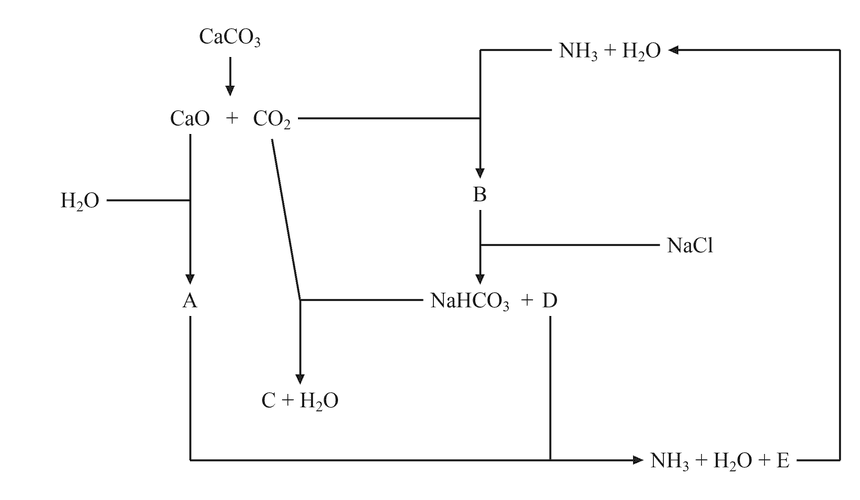
Identify A, B, C, D and E.
- 2535 marks
Question 253
is made by Solvay process but the same process cannot be extended to the manufacture of . Explain.
- 2545 marks
Question 254
Write balanced equations for the reaction between caustic soda and
(a) Zn
(b)
(c) Phosphorus
(d) Arsenious oxide ()
(e)
(f) solution
(g) solution.
- 2555 marks
Question 255
Solution of alkali metals in liq. are blue coloured, conducting, paramagnetic and has reducing nature. Explain.
- 2565 marks
Question 256
From the reaction given below, identify (A), (B), (C) and (D) and give their formulae. A (aq) + Zn → B (g), A (aq) + (C) , A (aq) + → D (g)
- 2575 marks
Question 257
A certain compound (X) imparts a golden yellow flame and shows the following reactions:
(i) Zn powder when boiled with a conc solution of (X) dissolves and gas is evolved.
(ii) When aqueous solution of (X) is added to an aqueous solution of , a white precipitate is obtained first which dissolves in excess of solution of (X).
Identify (X) and write equations of reactions at steps (i) and (ii).
- 2585 marks
Question 258
What is the action of heat on the following compounds of alkali metals :
(i) carbonates
(ii) Bicarbonates
(iii) Nitrates
(iv) Hydroxides.
- 2595 marks
Question 259
Alkali metals and their salts impart colour to the flame. Explain.
OR
Explain why alkali metals produce different colours in the flame?
- 2605 marks
Question 260
What is the action of water on the following?
(i) calcium nitride
(ii) calcium cyanamide
(iii) beryllium carbide
(iv) calcium carbide
(v) hydrolith.
- 2615 marks
Question 261
Write the name and formula of the compound having the following property or use.
(i) Compounds of Ca (a) used in setting fractured bones (b) used for the production of acetylene () (c) used as a fertiliser (d) which on treatment with gives (e) used as a portable source of filling balloons (f) used as a germicide (g) which when heated in oxycoal gas flame gives lime light.
(ii) Compounds of Mg (a) used as a cement for joining cracked teeth. (b) used as drying agent (c) used as a purgative in medicines.
- 2625 marks
Question 262
Write the chemical formula of the following:
(i) Beryl
(ii) Magnesite
(iii) Kieserite
(iv) Witherite
(v) Celestine
(vi) Epsom salt
(vii) Chrysoberyl
(viii) Barytes or heavy spar
(ix) Strontianite
(x) Eleanor spar
(xi) Quick lime
(xii) Slaked lime
(xiii) Anhydrone
(xiv) Baryta water
(xv) Marble or lime stone
(xvi) Anhydrite
(xvii) Gypsum
(xviii) Plaster of Paris
(xxi) Sorel cement
(xxii) Bleaching powder
(xxiii) Milk of magnesia
(xxiv) Schonite.
- 2635 marks
Question 263
What happens when:
(i) reacts with NaOH
(ii) Mg is burnt in air and the products are treated with water.
(iii) Water is added to and the resulting gas is passed through dil. containing .
(iv) is passed through lime water.
(v) is passed through lime water
(vi) reacts with slaked lime under different conditions.
- 2645 marks
Question 264
Explain why in aqueous solution is more readily formed than MgCl.
OR
Explain why in aqueous solution is more stable than MgCl.
OR
Explain why in aqueous solution exists while MgCl does not.
- 2655 marks
Question 265
MgO is used for lining of steel making furnaces. Explain why?
- 2665 marks
Question 266
when reacted with water gives off but HCl is not obtained from on reaction with water at room temperature.
- 2675 marks
Question 267
Give a comparative study of the hydrides of alkali metals and alkaline earth metals.
- 2685 marks
Question 268
Compare the following properties of alkaline earth metals with those of alkali metals
(i) Atomic and ionic radii
(ii) Density and hardness
(iii) Melting and boiling points
(iv) First ionisation energy
(v) Second ionisation energy
(vi) Number of molecules of water of crystallisation in crystalline salts
(vii) Reducing power
(viii) Solubility of salts.
- 2695 marks
Question 269
Explain the mechanism of setting and hardening of plaster of Paris.
- 2705 marks
Question 270
How can magnesium be extracted from (i) magnesite ore (ii) sea water.
- 2715 marks
Question 271
The solubility of carbonates of alkali metals increases while that of alkaline earth metals decreases when we move from top to bottom in their respective groups. Explain why.
What Class 11 Chemistry Ch 11 covers
The sections of the chapter, in the order the book takes them. Every question above comes from one of these.
- 01General Characteristics of Group 1 Elements
- 02Anomalous Behaviour of Lithium and Diagonal Relationship
- 03Important Compounds of Sodium
- 04Biological Importance of Sodium and Potassium
- 05General Characteristics of Group 2 Elements
- 06Anomalous Behaviour of Beryllium
More ways to study this chapter
The same chapter asked three other ways. Practise it, revise it, and see what the board has set on Ch 11 before.
Class 11 Chemistry Ch 11 questions students ask
How many questions are there in Class 11 Chemistry Ch 11?
271 questions. Every one is solved step by step on this page.
Are these Class 11 Chemistry solutions free?
Yes. Every question and its full working is free to read, with no account needed.
Can I download the Class 11 Chemistry Ch 11 solutions as a PDF?
There is no PDF to download. Every solution is on this page instead, which means it is searchable, always the current syllabus, and readable on a phone. Use your browser's print option if you want it on paper.