
Opening your dashboard
Class 11 Chemistry Chapter 11 s-Block Elements: Practice Questions
146 questions on Chapter 11, each worked through on its own page with the AI tutor. Class 11 Chemistry, ICSE 2026-27.
146 questions
1–4 marks · Mixed difficulty
- 11 mark
Question 1
The first four ionisation enthalpies of an s-block element X are 419, 3052, 4420 and 5877 kJ mol⁻¹. What is the formula of the sulphate of X?
- 21 mark
Question 2
The first ionisation enthalpy falls from 496 kJ mol⁻¹ for sodium (Z = 11) to 419 kJ mol⁻¹ for potassium (Z = 19), even though the nuclear charge rises by 8 units. Which statement best explains the fall?
- 32 marks
Question 3
Potassium permanganate, , forms purple crystals and potassium dichromate, , forms orange crystals, yet potassium chloride, KCl, is white.
(a) Use the electronic configuration of the ion to explain why this ion itself is colourless.
(b) State where the colours of and come from.
- 41 mark
Question 4
A teacher drops 0.23 g of sodium into water, and the solution formed is then made up to 100 mL in a volumetric flask. (Hypothetical data.) What is the concentration of sodium hydroxide in this solution? (Na = 23)
- 53 marks
Question 5
Sodium compounds colour a flame yellow because excited sodium atoms emit light of wavelength 589 nm.
(a) Calculate the energy of one photon of this light.
(b) Calculate the energy carried by one mole of these photons, in kJ mol⁻¹.
(c) The first ionisation enthalpy of sodium is 496 kJ mol⁻¹. Compare it with your answer to (b), and state what happens to the outer electron of a sodium atom in the flame.
(h = 6.626 × 10⁻³⁴ J s, c = 3.00 × 10⁸ m s⁻¹, N_A = 6.022 × 10²³ mol⁻¹)
- 61 mark
Question 6
Lithium is used for the negative electrode of light-weight batteries, where each atom gives up one electron: . What is the largest charge that 1.00 g of lithium can deliver? (Li = 6.94 g mol⁻¹, F = 96 500 C mol⁻¹)
- 73 marks
Question 7
Lithium hydride and sodium hydride both react with water to give hydrogen gas.
(a) Write the balanced equation for the reaction of lithium hydride with water.
(b) Calculate the volume of hydrogen at STP given by 1.00 g of each hydride.
(c) State which hydride is the better source of hydrogen per gram, and why.
(Li = 7, Na = 23, H = 1; take the molar volume at STP as 22.4 L mol⁻¹)
- 84 marks
Question 8
The standard electrode potential of lithium (−3.04 V) is more negative than that of sodium (−2.71 V), although lithium has the higher first ionisation enthalpy. The change can be split into three steps. Their enthalpy changes, in kJ mol⁻¹, are given below.
Step Li Na Sublimation: M(s) → M(g) +159 +107 Ionisation: M(g) → M⁺(g) + e⁻ +520 +496 Hydration: M⁺(g) → M⁺(aq) −520 −406 (a) Calculate the enthalpy change for for each metal.
(b) Use your answers to explain why lithium has the more negative electrode potential, and name the step that is responsible.
- 92 marks
Question 9
The table gives the metallic radius of lithium, sodium and magnesium and the ionic radius of their usual ions.
Property Li Na Mg Metallic radius / pm 152 186 160 Ionic radius / pm 76 (Li⁺) 102 (Na⁺) 72 (Mg²⁺) Use these data to explain why lithium resembles magnesium, the element diagonally to its right in the next period, in many of its properties, and give one example of the resemblance.
- 101 mark
Question 10
A sample of 4.80 g of lithium hydroxide is heated strongly until its mass stops changing. (Hypothetical data.) What is the mass of the residue? (Li = 7, O = 16, H = 1)
- 112 marks
Question 11
The ion (radius 76 pm) is much smaller than the ion (radius 102 pm). A simple model in which ions are hard charged spheres therefore predicts that lithium chloride should melt at a higher temperature than sodium chloride. In fact LiCl melts at 605 °C and NaCl at 801 °C. Explain this observation.
- 123 marks
Question 12
A 2.10 g strip of lithium is heated in a stream of dry nitrogen until all of it has reacted. (Hypothetical data.)
(a) Write the equation for the reaction and calculate the mass of lithium nitride formed.
(b) The product is then added to excess water. Write the equation and calculate the volume of ammonia, at STP, that is given off.
(Li = 7, N = 14; take the molar volume at STP as 22.4 L mol⁻¹)
- 133 marks
Question 13
Lithium has the most negative standard electrode potential of the alkali metals (−3.04 V, against −2.71 V for sodium). Yet a small piece of lithium fizzes steadily on water, while a piece of sodium of the same size melts into a ball and darts about, and potassium bursts into flame.
(a) State what the electrode potential tells us, and what it does not tell us, about the reaction of a metal with water.
(b) Give two reasons why lithium reacts with water more slowly than sodium does.
- 141 mark
Question 14
Four aqueous solutions, each of concentration 0.10 mol L⁻¹ at 25 °C, are made from , , and NaCl. Which is the correct decreasing order of their pH?
- 152 marks
Question 15
Baking soda, , used on its own in a cake makes the cake rise but often leaves a bitter, soapy taste. Baking powder avoids this because it also contains a solid acid, potassium hydrogen tartrate ().
(a) Write the equation for the change when baking soda alone is heated in the oven, and explain the bitter taste.
(b) Write the equation for the reaction of baking soda with potassium hydrogen tartrate, and explain why this removes the problem.
- 161 mark
Question 16
A student heats 2.86 g of crystals of a sodium carbonate hydrate, , to constant mass. (Hypothetical data.) The anhydrous residue weighs 1.06 g. What is the value of x? (Na = 23, C = 12, O = 16, H = 1)
- 171 mark
Question 17
Some drain cleaners contain sodium hydroxide flakes mixed with aluminium granules. With water, the aluminium reacts:
A dose of the cleaner contains 0.54 g of aluminium. (Hypothetical data.) What volume of hydrogen at STP does this aluminium release? (Al = 27; take the molar volume at STP as 22.4 L mol⁻¹)
- 183 marks
Question 18
Normal saline, used in hospital drips, is a 0.90 % (w/v) solution of sodium chloride: it contains 0.90 g of NaCl in every 100 mL.
(a) Calculate the mass of NaCl in a 500 mL drip bag.
(b) Calculate the molar concentration of NaCl. (Na = 23.0, Cl = 35.5)
(c) The osmolarity of blood plasma is about 290 mOsm L⁻¹. Estimate the osmolarity of normal saline, counting each NaCl as two ions, and explain why a drip must have nearly the same value as blood.
- 193 marks
Question 19
A soap maker heats 1.00 kg of fat with caustic soda. (Hypothetical data.) Taking the fat to be glyceryl tristearate (molar mass 890 g mol⁻¹), the reaction is:
(a) Calculate the mass of sodium hydroxide needed.
(b) Calculate the mass of soap, sodium stearate (molar mass 306 g mol⁻¹), formed.
(c) Calculate the mass of glycerol (molar mass 92 g mol⁻¹) formed, and check that mass is conserved.
(NaOH = 40 g mol⁻¹)
- 204 marks
Question 20
A student is given 10.0 g of a mixture of sodium hydrogencarbonate and sodium carbonate. (Hypothetical data.) When the mixture is heated to constant mass, its mass falls by 3.10 g.
(a) Write the equation for the change that causes the loss in mass.
(b) Calculate the mass of in the mixture.
(c) Calculate the percentage of in the original mixture and the mass of the final residue.
(Na = 23, H = 1, C = 12, O = 16)
- 214 marks
Question 21
Modern chlor-alkali plants make sodium hydroxide by electrolysing brine in membrane cells. The anode and cathode compartments are separated by a membrane that lets ions pass through but largely stops and ions.
(a) Write the reactions at the anode and at the cathode, and the overall equation.
(b) A plant produces 71.0 tonnes of chlorine a day. (Hypothetical data.) Calculate the masses of sodium hydroxide and hydrogen it produces each day. (Na = 23, O = 16, H = 1, Cl = 35.5)
(c) Give one reason why the chlorine must be kept away from the sodium hydroxide, and one reason why it must be kept away from the hydrogen.
- 221 mark
Question 22
When a nerve cell fires, the electrical potential across its membrane rises quickly from about −70 mV to about +30 mV. Which movement of ions causes this rise?
- 231 mark
Question 23
The World Health Organization advises adults to keep their sodium intake below 2 g per day. If all of this sodium is taken as sodium chloride, what is the largest mass of salt an adult should eat in a day? (Na = 23.0, Cl = 35.5)
- 243 marks
Question 24
The sodium–potassium pump in a cell membrane uses the energy of one ATP molecule in each cycle to move 3 ions out of the cell and 2 ions into it. Inside a typical cell, is about 12 mmol L⁻¹ and about 140 mmol L⁻¹; outside the cell the values are about 145 and 5 mmol L⁻¹.
(a) Explain why the pump needs energy from ATP.
(b) Find the net charge carried across the membrane in one cycle, and its direction.
(c) The pumps of one cell run 5.0 × 10⁶ cycles per second. (Hypothetical data.) Calculate the number of ions pumped out per second and the net electric current this produces. (Charge on one ion = 1.60 × 10⁻¹⁹ C)
- 254 marks
Question 25
The oral rehydration salts (ORS) recommended by the World Health Organization for treating dehydration from diarrhoea contain, in each litre of solution, 2.6 g of sodium chloride, 1.5 g of potassium chloride, 2.9 g of trisodium citrate dihydrate () and 13.5 g of glucose.
(a) Calculate the concentration of ions in mmol L⁻¹.
(b) Calculate the concentration of ions in mmol L⁻¹.
(c) Estimate the total osmolarity of the solution, counting each ion and each glucose molecule as one particle.
(d) Explain why potassium is included in ORS.
(Molar masses in g mol⁻¹: NaCl 58.5, KCl 74.5, 294, glucose 180)
- 261 mark
Question 26
A fireworks maker wants a shell that bursts with a bright green colour. Which one of the following salts should be packed into it to give the green light?
- 271 mark
Question 27
The first and second ionisation enthalpies of magnesium are 738 kJ mol⁻¹ and 1451 kJ mol⁻¹. How much energy is needed to convert 1.20 g of gaseous magnesium atoms completely into gaseous ions? (Mg = 24)
- 284 marks
Question 28
A student drops 0.400 g of clean calcium turnings into 200 mL of water at 20 °C. (Hypothetical data.) The metal fizzes steadily until it has all reacted, and the liquid turns milky. The solubility of calcium hydroxide at 20 °C is about 1.7 g L⁻¹. (Ca = 40, O = 16, H = 1; molar volume of a gas at S.T.P. = 22.4 L)
(a) Write the balanced equation for the reaction.
(b) Calculate the volume of hydrogen formed, measured at S.T.P.
(c) Calculate the mass of calcium hydroxide formed.
(d) Use your answer to (c) to explain why the liquid turns milky.
- 293 marks
Question 29
A 3.28 g sample of anhydrous calcium nitrate is heated strongly until its mass stops changing. (Ca = 40, N = 14, O = 16; molar volume of a gas at S.T.P. = 22.4 L)
(a) Write the balanced equation for the decomposition.
(b) Calculate the total volume of gas given off, measured at S.T.P.
(c) On heating, sodium nitrate gives off only oxygen and leaves sodium nitrite. Explain why calcium nitrate behaves differently.
- 303 marks
Question 30
Titanium metal is made by heating titanium(IV) chloride vapour with molten magnesium at about 850 °C in an atmosphere of argon:
(Ti = 48, Mg = 24)
(a) Which property of magnesium, typical of the group 2 metals, makes this reaction work?
(b) Calculate the mass of magnesium needed to make 1.00 kg of titanium.
(c) Why is the reaction carried out under argon and not in air?
- 311 mark
Question 31
A water-testing laboratory treats 25.0 mL of a sample with excess barium chloride solution to find its sulphate content. (Hypothetical data.) The white precipitate of barium sulphate is filtered, washed and dried, and it weighs 0.466 g. What is the concentration of sulphate ions in the sample? (Ba = 137, S = 32, O = 16)
- 323 marks
Question 32
A 0.274 g piece of a metal M from group 2 reacts completely with excess dilute hydrochloric acid, giving 44.8 mL of hydrogen measured at S.T.P. (Hypothetical data.) (Molar volume of a gas at S.T.P. = 22.4 L; Mg = 24, Ca = 40, Sr = 88, Ba = 137)
(a) Write a general equation for the reaction and calculate the amount, in moles, of hydrogen formed.
(b) Calculate the molar mass of M and identify the metal.
(c) A student suggests that M might be an alkali metal instead. Show by calculation that no alkali metal fits the data. (Li = 7, Na = 23, K = 39, Rb = 85.5, Cs = 133)
- 331 mark
Question 33
Which one of the following observations would distinguish a piece of beryllium from a piece of magnesium?
- 341 mark
Question 34
Consider the following statements about beryllium and aluminium, which show a diagonal relationship.
P. Both metals are rendered passive by concentrated nitric acid, because a protective oxide film forms on them.
Q. Both anhydrous chlorides are electron-deficient covalent compounds that act as Lewis acids.
R. Both metals form stable fluoro-complex anions, and .
S. In their hydrated ions, both metal ions are surrounded by six water molecules.
Which of these statements are correct?
- 352 marks
Question 35
Anhydrous beryllium chloride dissolves readily in dry diethyl ether, , forming the compound .
(a) Explain why a molecule behaves as a Lewis acid.
(b) State the hybridisation of beryllium and the arrangement of atoms around it in the ether compound.
- 363 marks
Question 36
Solutions of beryllium chloride and magnesium chloride of the same concentration are prepared in water. The solution turns blue litmus red, but the solution hardly changes the colour of litmus.
(a) Write the formula of the hydrated beryllium ion and explain why it contains only four water molecules.
(b) Write an equation to show why the beryllium chloride solution is acidic.
(c) Explain why the hydrated ion makes its solution far less acidic.
- 373 marks
Question 37
Molten magnesium chloride conducts electricity well, but molten beryllium chloride is a very poor conductor. Beryllium metal can be made by electrolysing molten to which sodium chloride has been added, so that the melt contains plenty of ions. (E°: /Be = −1.85 V; /Na = −2.71 V)
(a) Explain why molten conducts electricity so much more poorly than molten .
(b) Explain why beryllium, and not sodium, is deposited at the cathode, and write the cathode half-equation.
(c) Name the product formed at the anode and write its half-equation.
- 381 mark
Question 38
Ammonia gas made in the laboratory is moist. Which one of the following is used to dry it?
- 391 mark
Question 39
A wall is plastered with a paste of slaked lime, sand and water. Over the next few weeks the plaster slowly becomes hard. Which change is mainly responsible for the hardening?
- 402 marks
Question 40
A stoppered flask holds clear lime water, a saturated solution of calcium hydroxide made at 20 °C. When the closed flask is warmed to about 80 °C, the solution turns cloudy, and it becomes clear again on cooling.
(a) Name the white solid that appears, and give one reason why it cannot be calcium carbonate.
(b) Explain why the solid appears on warming.
- 414 marks
Question 41
A lime kiln is charged with 5.00 tonnes of limestone that contains 90.0 % calcium carbonate by mass; the rest does not change on heating. (Hypothetical data.) The limestone is heated to about 1100 K until all the calcium carbonate has decomposed. (Ca = 40, C = 12, O = 16; 1 tonne = 10⁶ g; molar volume of a gas at S.T.P. = 22.4 L)
(a) Write the equation for the reaction in the kiln.
(b) Calculate the mass of quicklime formed.
(c) Calculate the volume of carbon dioxide given off, measured at S.T.P.
(d) Explain why the carbon dioxide must be removed from the kiln as fast as it forms.
- 421 mark
Question 42
A builder slakes 2.80 kg of quicklime by adding water to it. (Hypothetical data.) For the reaction , . How much heat is given out? (Ca = 40, O = 16)
- 433 marks
Question 43
A farmer's field has acidic soil. The farmer plans to spread slaked lime on it and, on the same day, to apply ammonium sulphate fertiliser.
(a) Write an ionic equation to show how slaked lime raises the pH of the soil.
(b) Write a balanced equation for the reaction between slaked lime and ammonium sulphate.
(c) Use your answer to (b) to advise the farmer, giving a reason.
- 443 marks
Question 44
An antacid tablet contains 500 mg of calcium carbonate as its active ingredient. (Hypothetical data.) Stomach acid may be taken as hydrochloric acid of concentration 0.100 mol L⁻¹. (Ca = 40, C = 12, O = 16; molar volume of a gas at S.T.P. = 22.4 L)
(a) Write the balanced equation for the reaction of calcium carbonate with hydrochloric acid.
(b) Calculate the volume of stomach acid that one tablet can neutralise.
(c) Calculate the volume of carbon dioxide, measured at S.T.P., that one tablet releases, and state one effect this gas can have on the person.
- 454 marks
Question 45
A 1.720 g sample of pure gypsum, , is heated slowly from room temperature to 400 °C while its mass is recorded. (Hypothetical data.) The graph below shows how the mass changes; the mass axis starts at 1.30 g.
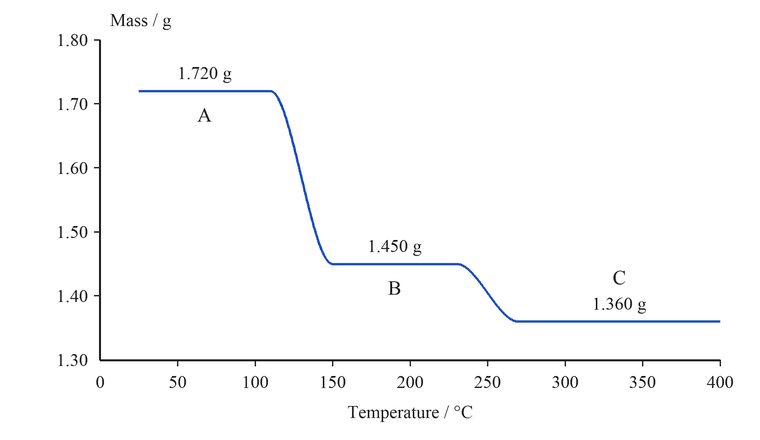
The mass stays at 1.720 g (plateau A), then falls to a steady 1.450 g (plateau B) and finally to 1.360 g (plateau C). (Ca = 40, S = 32, O = 16, H = 1)
(a) Calculate the mass of calcium sulphate hemihydrate, , and the mass of anhydrous calcium sulphate, , that 1.720 g of gypsum would give.
(b) Hence identify the solids on plateaus B and C, and state which plateau corresponds to plaster of Paris.
(c) Calculate the mass of water that 14.5 g of plaster of Paris takes up when it sets back into gypsum.
- 463 marks
Question 46
A cement works tests two batches of clinker, X and Y. (Hypothetical data.) For good Portland cement, the mass ratio of silica to alumina () should be between 2.5 and 4, and the mass ratio of lime to the total of silica, alumina and iron(III) oxide () should be as close as possible to 2. The main oxides in the two batches are:
Oxide X (% by mass) Y (% by mass) 61.0 63.0 21.0 22.0 9.0 6.0 3.0 3.5 (a) Calculate the two ratios for batch X.
(b) Calculate the two ratios for batch Y.
(c) Which batch is the better cement? Give a reason.
- 471 mark
Question 47
Strontium-90, a radioactive isotope released in nuclear accidents, can reach people through milk from cows that graze on contaminated grass. Why does it remain a health hazard in the body for many years?
- 481 mark
Question 48
Consider the following statements about calcium and magnesium in the adult human body.
P. About 99 % of the body's calcium is in the bones and teeth.
Q. The calcium level of blood plasma is held close to 100 mg L⁻¹.
R. Once calcium is laid down in bone, it is never exchanged with the blood again.
S. The body contains more magnesium than calcium.
Which of these statements are correct?
- 493 marks
Question 49
In a tomato crop grown on poor sandy soil, the older (lower) leaves turn yellow between the veins while the veins stay green. In another field, the youngest leaves are distorted and the tomatoes develop dark, sunken patches at their tips (blossom-end rot), although the older leaves look healthy.
(a) Which nutrient is lacking in the first field? Explain the yellowing in terms of the chemistry of the leaf.
(b) Why do the older leaves show this deficiency first?
(c) Which nutrient is lacking in the second field, and why are the young, growing parts the ones affected?
- 503 marks
Question 50
Bone and tooth mineral is mainly hydroxyapatite, . An adult human body contains about 1.2 kg of calcium, about 99 % of which is in the bones and teeth. (Ca = 40, P = 31, O = 16, H = 1)
(a) Calculate the percentage by mass of calcium in hydroxyapatite.
(b) Estimate the mass of hydroxyapatite that holds the calcium of the bones and teeth.
(c) Fluoride ions from toothpaste can replace the hydroxide ions in tooth enamel. Name the compound formed and explain why it protects the teeth.
- 511 mark
Question 51
Based on lattice energy and other considerations, which one of the following alkali metal chlorides is expected to have the highest melting point?
- 521 mark
Question 52
Which one of the following will react most vigorously with water?
- 531 mark
Question 53
Fire extinguishers contain and which one of the following?
(a) and
(b)
(c)
(d)
- 541 mark
Question 54
The first ionisation potential of Na is 5.1 eV. The value of electron gain enthalpy of will be
- 551 mark
Question 55
The solubility order for alkali metal fluoride in water is:
- 561 mark
Question 56
Which of the following statements about is not correct?
(a) It is diamagnetic in nature
(b) It is derivative of
(c) oxidises to in acid medium
(d) It is the super oxide of sodium
- 571 mark
Question 57
Which of the alkaline earth metal halides given below is essentially covalent in nature?
- 581 mark
Question 58
Which one of the following is an oxide?
- 591 mark
Question 59
Lithium aluminium hydride reacts with silicon tetrachloride to form:
- 601 mark
Question 60
Sodium metal on dissolution in liquid ammonia gives a deep blue solution due to the formation of:
- 611 mark
Question 61
The correct order of conductivity of ions in water is
- 621 mark
Question 62
A metal on combustion in excess of air forms X. X upon hydrolysis with water yields and along with another product. The metal is:
- 631 mark
Question 63
The correct statement(s) among P to R with respect to potassium ions that are abundant within the cell fluids is/are:
P. They activate many enzymes
Q. They participate in the oxidation of glucose to produce ATP
R. Along with sodium ions, they are responsible for the transmission of nerve signals
- 641 mark
Question 64
The metal that forms nitride by reacting directly with of air, is:
- 651 mark
Question 65
The INCORRECT statement is:
- 661 mark
Question 66
A hydrated solid X on heating, initially gives a monohydrated compound Y. Y upon heating above 373 K leads to an anhydrous white powder Z. X and Z, respectively, are:
- 671 mark
Question 67
On combustion of Li, Na and K in excess of air, the major oxides formed, respectively, are:
- 681 mark
Question 68
Two elements A and B have similar chemical properties. They don't form solid hydrogen carbonates, but react with nitrogen to form nitrides A and B, respectively, are:
- 691 mark
Question 69
Match List-I with List-II:
List-I (Salt) List-II (Flame colour wavelength) P. LiCl (i) 455.5 nm Q. NaCl (ii) 670.8 nm R. RbCl (iii) 780.0 nm S. CsCl (iv) 589.2 nm Choose the correct answer from the options given below:
- 701 mark
Question 70
Given below are two statements, one is labelled as Assertion A and the other is labelled as Reason R.
Assertion A: Lithium salts are hydrated.
Reason R: Lithium has higher polarising power than other alkali metal group members.
In the light of the above statement, choose the most appropriate answer from the options given below:
- 711 mark
Question 71
Choose the correct statement from the following:
- 721 mark
Question 72
Match List-I with List-II:
List-I (Elements) List-II (Properties) P. Li (i) Poor water solubility of salt Q. Na (ii) Most abundant element in cell fluid R. K (iii) Bicarbonate salt used in fire extinguisher S. Cs (iv) Carbonate salt decomposes easily on heating Choose the correct answer from the options given below:
- 731 mark
Question 73
Metallic sodium does not react normally with:
- 741 mark
Question 74
Among the following, number of metal/s which can be used as electrodes in the photoelectric cell is ________. (Integer answer)
P. Li
Q. Na
R. Rb
S. Cs
- 751 mark
Question 75
Lithium nitrate and sodium nitrate, when heated separately, respectively, give:
- 761 mark
Question 76
Which of the following statement is incorrect?
- 771 mark
Question 77
Given below are two statements: one is labelled as Assertion A and the other is labelled as Reason R.
Assertion A: LiF is sparingly soluble in water.
Reason R: The ionic radius of ion is smallest among its group members, hence it has least hydration enthalpy.
In the light of the above statements, choose the most appropriate answer from the options given below:
- 781 mark
Question 78
Choose the correct order of density of the alkali metals:
- 791 mark
Question 79
Correct statement about alkali metal oxides is:
- 801 mark
Question 80
Match the List-I with List-II:
List-I (Metal) List-II (Emitted light wavelength (nm)) P. Li (i) 670.8 Q. Na (ii) 589.2 R. Rb (iii) 780.0 S. Cs (iv) 455.5 Choose the most appropriate answer from the options given below:
- 811 mark
Question 81
Which of the following statements are correct?
P. Both LiCl and are soluble in ethanol.
Q. The oxides and MgO combine with excess of oxygen to give superoxide.
R. LiF is less soluble in water than other alkali metal fluorides.
S. is more soluble in water than other alkali metal oxides.
Choose the most appropriate answer from the options given below:
- 821 mark
Question 82
Statement I: An alloy of lithium and magnesium is used to make aircraft plates.
Statement II: The magnesium ions are important for cell-membrane integrity.
In the light of the above statements, choose the correct answer from the options given below:
- 831 mark
Question 83
Amongst baking soda, caustic soda and washing soda carbonate anion is present in:
- 841 mark
Question 84
In the industrial production of which of the following, molecular hydrogen is obtained as a by-product?
- 851 mark
Question 85
Which one of the following compounds is used as a chemical in certain type of fire extinguishers?
- 861 mark
Question 86
Which of the following on thermal decomposition yields a basic as well as acidic oxide?
- 871 mark
Question 87
Which one of the following alkaline earth metal sulphates has its hydration enthalpy greater than its lattice enthalpy?
- 881 mark
Question 88
The correct order of thermal stability of hydroxides is:
- 891 mark
Question 89
The correct order of the solubility of alkaline-earth metal sulphates in water is:
- 901 mark
Question 90
The commercial name for calcium oxide is:
- 911 mark
Question 91
The correct sequence of thermal stability of the following carbonates is:
- 921 mark
Question 92
The alloy used in the construction of aircrafts is:
- 931 mark
Question 93
Magnesium powder burns in air to give:
- 941 mark
Question 94
The structures of beryllium chloride in the solid state and vapour phase, respectively, are:
- 951 mark
Question 95
The covalent alkaline earth metal halide (X = Cl, Br, I) is:
- 961 mark
Question 96
The metal used for making X-ray tube window is:
- 971 mark
Question 97
The alkaline earth metal nitrate that does not crystallise with water molecules, is:
- 981 mark
Question 98
Match the following items in column-I with the corresponding items in column-II:
Column-I Column-II P. (i) Portland cement ingredient Q. (ii) Castner-Kellner process R. NaOH (iii) Solvay process S. (iv) Temporary hardness - 991 mark
Question 99
Among the sulphates of alkaline earth metals, the solubilities of and in water, respectively, are:
- 1001 mark
Question 100
An alkaline earth metal 'M' readily forms water soluble sulphate and water insoluble hydroxide. Its oxide MO is very stable to heat and does not have rock-salt structure. M is:
- 1011 mark
Question 101
Among the statements P to S, the correct ones are:
P. Lithium has the highest hydration enthalpy among the alkali metals.
Q. Lithium chloride is insoluble in pyridine.
R. Lithium cannot form ethynide upon its reaction with ethyne.
S. Both lithium and magnesium react slowly with .
- 1021 mark
Question 102
A metal (A) on heating in nitrogen gas gives compound B. B on treatment with gives a colourless gas which when passed through solution gives a dark blue-violet coloured solution. A and B respectively are:
- 1031 mark
Question 103
Match the following compounds (Column-I) with their uses (Column-II):
Column-I Column-II P. (i) casts of statues Q. NaCl (ii) white wash R. (iii) antacid S. (iv) washing soda preparation - 1041 mark
Question 104
When gypsum is heated to 393 K, it forms:
- 1051 mark
Question 105
Number of amphoteric compound among the following is ________.
P. BeO
Q. BaO
R.
S.
- 1061 mark
Question 106
Given below are two Statements: One is labelled as Assertion A and the other is labelled as Reason R:
Assertion A: During the boiling of water having temporary hardness, is converted to .
Reason R: The solubility product of is greater than that of .
In the light of the above statements, choose the most appropriate answer from the options given below:
(a) Both A and R are true but R is NOT the correct explanation of A.
(b) A is true but R is false.
(c) Both A and R are true and R is the correct explanation of A.
(d) A is false but R is true.
- 1071 mark
Question 107
Calgon is used for water treatment. Which of the following statement is NOT true about Calgon?
- 1081 mark
Question 108
Match List-I with List-II:
List-I (Elements) List-II (Properties) P. Ba (i) Organic solvent soluble compounds Q. Ca (ii) Outer electronic configuration 6s² R. Li (iii) Oxalate insoluble in water S. Na (iv) Formation of very strong monoacidic base Choose the correct answer from the options given below:
- 1091 mark
Question 109
Given below are two statements:
Statement I: The chlorides of Be and Al have Cl-bridged structure. Both are soluble in organic solvents and act as Lewis bases.
Statement II: Hydroxides of Be and Al dissolve in excess alkali to give beryllate and aluminate ions.
In the light of the above statements, choose the correct answer from the options given below.
- 1101 mark
Question 110
The correct order of density is
- 1111 mark
Question 111
s-block element which cannot be qualitatively confirmed by the flame test is
- 1121 mark
Question 112
Which one of the following alkaline earth metal ions has the highest ionic mobility in its aqueous solution?
- 1131 mark
Question 113
Portland cement contains 'X' to enhance the setting time. What is 'X'?
- 1141 mark
Question 114
Reaction of with gives:
P.
Q.
R. LiH
S. LiCl
T.
Choose the correct answer from options given below:
- 1151 mark
Question 115
Addition of to produces:
- 1161 mark
Question 116
reacts with to give
(a) Be + +
(b) Be + + LiCl + HCl
(c) + LiCl +
(d) +
- 1171 mark
Question 117
BeO reacts with HF in presence of ammonia to give [A] which on thermal decomposition produces [B] and ammonium fluoride. Oxidation state of Be in [A] is ________.
- 1181 mark
Question 118
Which one of the following compounds is a peroxide?
- 1191 mark
Question 119
Which one of the alkali metals, forms only, the normal oxide, on heating in air?
- 1201 mark
Question 120
The ease of adsorption of the hydrated alkali metal ions on an ion-exchange resin follows the order:
- 1211 mark
Question 121
In the replacement reaction
The reaction will be most favourable if M happens to be:
- 1221 mark
Question 122
In Castner-Kellner cell for production of sodium hydroxide:
- 1231 mark
Question 123
The function of “Sodium pump” is a biological process operation in each and every cell of all animals. Which of the following biologically important ions is also a constituent of this pump:
- 1241 mark
Question 124
Ionic mobility of which of the following alkali metal ions is lowest when aqueous solution of their salts are put under an electric field?
- 1251 mark
Question 125
Which of the alkali metal chloride (MCl) forms its dihydrate salt () easily?
- 1261 mark
Question 126
Crude sodium chloride obtained by crystallisation of brine solution does not contain
- 1271 mark
Question 127
The following metal ion activates many enzymes, participates in the oxidation of glucose to produce ATP and with Na, is responsible for the transmission of nerve signals.
- 1281 mark
Question 128
HCl was passed through a solution of , and NaCl. Which of the following compound(s) crystallise(s)?
- 1291 mark
Question 129
Identify the incorrect statement from the following:
- 1301 mark
Question 130
Match List-I with List-II.
List-I List-II P. Li (i) absorbent for carbon dioxide Q. Na (ii) electrochemical cells R. KOH (iii) coolant in fast breeder reactors S. Cs (iv) photoelectric cell Choose the correct answer from the options given below:
- 1311 mark
Question 131
Which of the following alkaline earth metal sulphates has hydration enthalpy higher than the lattice enthalpy?
- 1321 mark
Question 132
Property of the alkaline earth metals that increases with their atomic number
- 1331 mark
Question 133
The compound A on heating gives a colourless gas and a residue that is dissolved in water to obtain B. Excess of is bubbled through aqueous solution B, C is formed which is recovered in the solid form. Solid C on gentle heating gives back A. The compound is
- 1341 mark
Question 134
Which of the following compounds has the lowest melting point?
- 1351 mark
Question 135
Which one of the following is present as an active ingredient in bleaching powder for bleaching action?
- 1361 mark
Question 136
Match List-I with List-II for the compositions of substances and select the correct answer using the code given below the lists:
List-I (Substances) List-II (Composition) (1) Plaster of paris (i) (2) Epsomite (ii) (3) Kieserite (iii) (4) Gypsum (iv) (v) - 1371 mark
Question 137
Solubility of the alkaline earth's metal sulphates in water decreases in the sequence:
- 1381 mark
Question 138
On heating which of the following releases most easily?
- 1391 mark
Question 139
In context with beryllium, which one of the following statements is incorrect?
- 1401 mark
Question 140
Which of the following statements is false?
- 1411 mark
Question 141
Which of the following is an amphoteric hydroxide?
- 1421 mark
Question 142
Enzymes that utilize ATP in phosphate transfer require an alkaline earth metal (M) as the cofactor, M is:
- 1431 mark
Question 143
Which of the following oxides is most acidic in nature?
- 1441 mark
Question 144
Among , , , the order of ionic character is
- 1451 mark
Question 145
The structures of beryllium chloride in solid state and vapour phase, are:
- 1461 mark
Question 146
Among the following alkaline earth metal halides, one which is covalent and soluble in organic solvents is: