
Question 454 marksMedium
A 1.720 g sample of pure gypsum, , is heated slowly from room temperature to 400 °C while its mass is recorded. (Hypothetical data.) The graph below shows how the mass changes; the mass axis starts at 1.30 g.
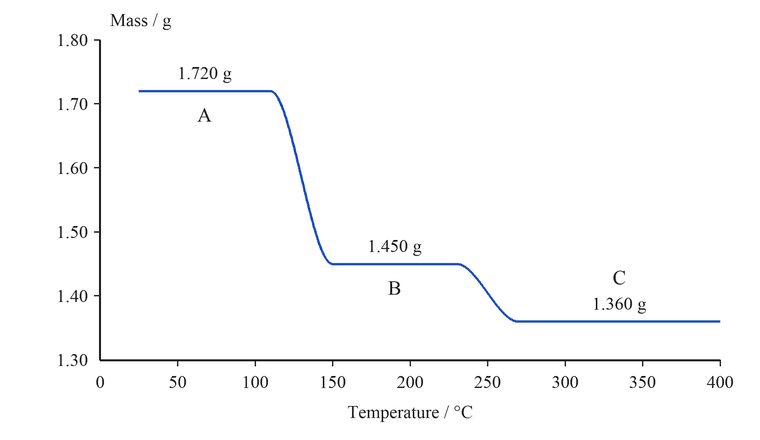
The mass stays at 1.720 g (plateau A), then falls to a steady 1.450 g (plateau B) and finally to 1.360 g (plateau C). (Ca = 40, S = 32, O = 16, H = 1)
(a) Calculate the mass of calcium sulphate hemihydrate, , and the mass of anhydrous calcium sulphate, , that 1.720 g of gypsum would give.
(b) Hence identify the solids on plateaus B and C, and state which plateau corresponds to plaster of Paris.
(c) Calculate the mass of water that 14.5 g of plaster of Paris takes up when it sets back into gypsum.