
Question 2525 marksMedium
Solvay process used for the manufacture of can be represented by the following scheme.
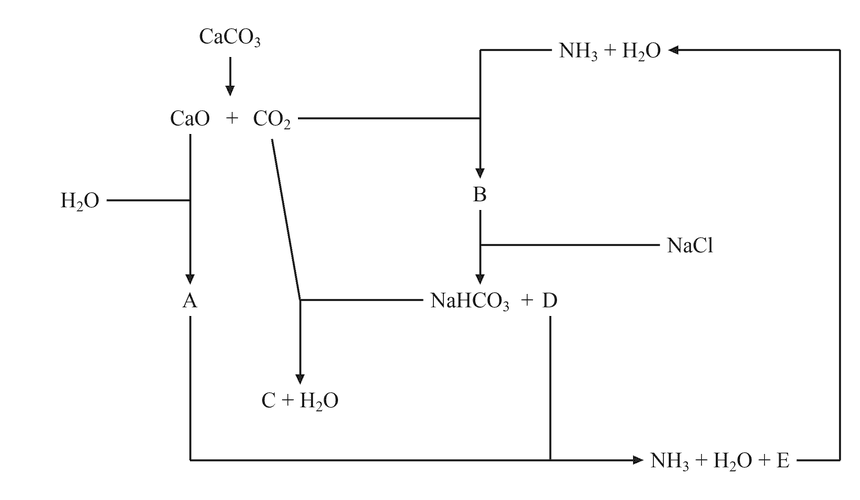
Identify A, B, C, D and E.
Confirming your payment
Sign up now and get 250 free tokens.
s-Block Elements · Question 252 of 271
Solvay process used for the manufacture of can be represented by the following scheme.
Identify A, B, C, D and E.
Solution:
Key idea: In the Solvay (ammonia–soda) process, brine saturated with ammonia is carbonated. Ammonium hydrogencarbonate is formed and reacts with sodium chloride to give sodium hydrogencarbonate, which is only sparingly soluble in the cold brine and precipitates. Heating it gives sodium carbonate. The comes from limestone, and the lime from the same limestone is used to recover the ammonia, so the only waste product is calcium chloride.
Step 1 — Follow the limestone. Heating limestone gives quick lime and carbon dioxide (the start of the scheme).
Quick lime is slaked with water, so A is slaked lime, calcium hydroxide.
Step 2 — Identify B. The carbon dioxide meets ammonia and water (ammoniacal brine) in the carbonating tower, so B is ammonium hydrogencarbonate.
Step 3 — Identify D. Ammonium hydrogencarbonate reacts with the sodium chloride of the brine. Sodium hydrogencarbonate precipitates and ammonium chloride stays in solution, so D is ammonium chloride.
Step 4 — Identify C. The filtered sodium hydrogencarbonate is heated (calcined). It gives water, carbon dioxide (sent back to the carbonating tower, the line back to in the scheme) and C, sodium carbonate.
Step 5 — Identify E. The ammonium chloride solution is heated with the slaked lime A. Ammonia is set free and returned to the start (the arrow back to ), and E is calcium chloride, the by-product of the process.
The completed scheme is shown below.
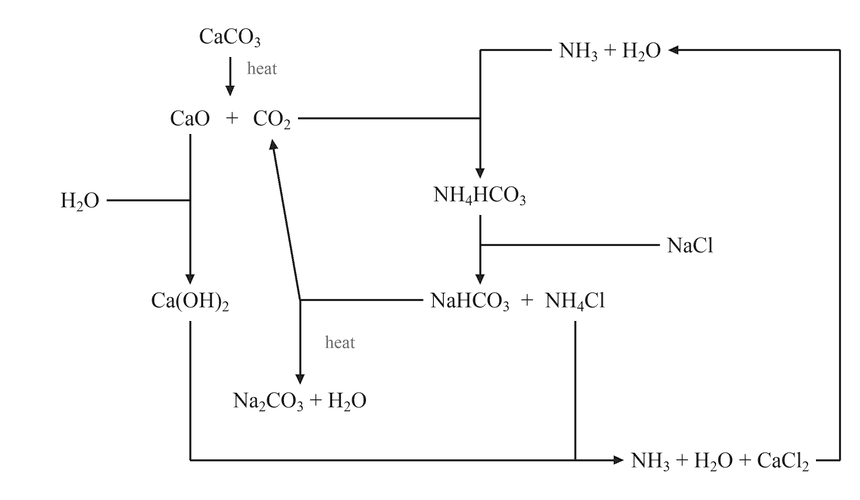
Therefore, A = (slaked lime), B = (ammonium hydrogencarbonate), C = (sodium carbonate), D = (ammonium chloride) and E = (calcium chloride).