
Opening your dashboard
Class 11 Chemistry Chapter 10: Hydrogen Solutions
95 textbook questions with step-by-step answers, free to read, for ISC 2026-27.
Get talked through Ch 10, not just shown the answer
Reading a finished solution is not the same as being able to do it. The AI tutor takes one question at a time and works it with you, in your own words, until you can.
- Ask it out loud, in your own words
- It gives you the next step, not the answer
- Stuck on part (ii)? Start there
95 questions with solutions
1–5 marks · Mixed difficulty
The first 36 solutions are on this page. This chapter is a long one, so the rest open on their own page to keep this one quick to load.
- 11 mark
Question 1
Hydrogen resembles halogens in many respects for which several factors are responsible. Of the following factors which one is most important in this respect?
Solve with AIAnswer
(A) Its tendency to lose an electron to form a cation.
- Correct
(B) Its tendency to gain a single electron in its valence shell to attain stable electronic configuration.
(C) Its low negative electron gain enthalpy value.
(D) Its small size.
Answer: (B) its tendency to gain one electron to reach a stable electronic configuration
Key idea: Hydrogen has the configuration ; it is one electron short of the stable helium configuration . The halogens () are likewise one electron short of the next noble gas. This shared "one electron short" feature is the root of the resemblance.
Step 1 — Compare the electron arrangements. Hydrogen needs one electron to fill its shell, and a halogen such as chlorine needs one electron to complete its octet.
Step 2 — See what follows from it. Because both gain one electron, both form uni-negative ions ( in , in ), both exist as diatomic molecules (, ) held by one covalent bond, and both form many covalent compounds such as and .
Step 3 — Pick the most important factor. All these likenesses come from the tendency to gain a single electron, so that is the main factor.
Why the other options are wrong:
- (A) Losing one electron to form a cation is how hydrogen resembles the alkali metals, not the halogens.
- (C) Hydrogen's electron gain enthalpy (about −73 kJ mol⁻¹) is much less negative than that of the halogens (about −349 kJ mol⁻¹ for chlorine), so this is a point of difference, not of resemblance.
- (D) Hydrogen's very small size is a feature of its own that makes it differ from both families; the halogen atoms are far larger.
Therefore, the tendency of hydrogen to gain one electron and reach a stable configuration is the most important factor.
- 21 mark
Question 2
Why does ion always get associated with other atoms or molecules?
Solve with AIAnswer
(A) Ionisation enthalpy of hydrogen resembles that of alkali metals.
(B) Its reactivity is similar to halogens.
(C) It resembles both alkali metals and halogens.
- Correct
(D) Loss of an electron from hydrogen atom results in a nucleus of very small size as compared to other atoms or ions. Due to small size, it cannot exist free.
Answer: (D) the bare proton is extremely small, so it cannot exist free
Key idea: When a hydrogen atom loses its only electron, nothing is left but the nucleus, a single proton. Its radius is only about pm, roughly times smaller than that of an ordinary atom or ion (about 50–200 pm), so its charge density is enormous.
Step 1 — Find what really is. Removing the electron leaves a bare proton with no electron cloud around it.
Step 2 — Explain why it cannot stay alone. A tiny particle carrying a full positive charge pulls very strongly on the electron clouds of any nearby atom or molecule, so it attaches at once.
Step 3 — See the result in water. In water the proton is always bound to a water molecule as the hydronium ion, , which is itself further hydrated.
Why the other options are wrong:
- (A) The ionisation enthalpy of hydrogen (1312 kJ mol⁻¹) is far higher than that of the alkali metals (520 kJ mol⁻¹ for lithium), so the statement itself is false.
- (B) Hydrogen's reactivity being halogen-like does not explain why the cation cannot exist on its own.
- (C) Hydrogen does resemble both families in some ways, but a resemblance does not explain why the bare ion attaches to other species; the tiny size does.
Therefore, the H⁺ ion always attaches to other atoms or molecules because the bare proton is extremely small and cannot exist on its own in a solution or a compound.
- 31 mark
Question 3
Metal hydrides are ionic, covalent or molecular in nature. Among LiH, NaH, KH, RbH, CsH, the correct order of increasing ionic character is
Solve with AIAnswer
(A)
- Correct
(B)
(C)
(D)
Answer: (B)
Key idea: A metal hydride is more ionic when the metal gives up its electron more easily, that is, when the metal is more electropositive. Down group 1 the atoms get larger, the outer electron is held less tightly and the metals become more electropositive.
Step 1 — Arrange the metals by electropositive character. Going down the group from Li to Cs, the ionisation enthalpy falls, so the electropositive character rises in the order Li < Na < K < Rb < Cs.
Step 2 — Link this to ionic character. A more electropositive metal transfers its electron to hydrogen more completely, giving a more ionic M⁺H⁻ bond. The small ion also distorts (polarises) the large ion the most, so has the most covalent character.
Step 3 — Write the order. The ionic character therefore increases steadily from to .
Why the other options are wrong:
- (A) This is written as a decreasing sequence and puts between and , which does not follow the group order.
- (C) This places above and above , which breaks the steady rise down the group.
- (D) This is a jumbled sequence; it puts at the top and below , contrary to the trend.
Therefore, the order of increasing ionic character is LiH < NaH < KH < RbH < CsH.
- 41 mark
Question 4
Which of the following hydrides is electron-precise hydride?
Solve with AIAnswer
(A)
(B)
(C)
- Correct
(D)
Answer: (D)
Key idea: Molecular (covalent) hydrides are grouped by the electrons on the central atom. Electron-deficient hydrides have too few electrons for normal two-electron bonds (group 13, e.g. ); electron-precise hydrides have exactly enough for their bonds with no lone pairs left over (group 14, e.g. ); electron-rich hydrides have lone pairs left over (groups 15–17, e.g. , , ).
Step 1 — Count the electrons in methane. Carbon has 4 valence electrons and forms 4 C–H bonds, so all its electrons are used in bonding and no lone pair remains.
Step 2 — Classify it. A hydride whose central atom uses exactly all its valence electrons in two-electron bonds is electron-precise, so is electron-precise. It is tetrahedral.
Why the other options are wrong:
- (A) Diborane has only 12 valence electrons, but its 8 bonds would need 16 in normal two-electron bonds, so it is electron-deficient.
- (B) In ammonia, nitrogen uses 3 of its 5 valence electrons in N–H bonds and keeps 1 lone pair, so it is electron-rich.
- (C) In water, oxygen uses 2 of its 6 valence electrons in O–H bonds and keeps 2 lone pairs, so it is electron-rich.
Therefore, CH₄ is the electron-precise hydride.
- 51 mark
Question 5
Radioactive elements emit , and -rays and are characterised by their half-lives. The radioactive isotope of hydrogen is
Solve with AIAnswer
(A) Protium
(B) Deuterium
- Correct
(C) Tritium
(D) Hydronium
Answer: (C) Tritium
Key idea: Hydrogen has three isotopes: protium (, no neutron), deuterium ( or D, one neutron) and tritium ( or T, two neutrons). Only tritium has an unstable nucleus.
Step 1 — Look at the neutron-to-proton balance. Tritium has two neutrons with one proton; this nucleus is unstable and changes by giving out a β-particle.
Step 2 — Write the change. A neutron in tritium turns into a proton, so tritium becomes helium-3 with a half-life of about 12.3 years.
Why the other options are wrong:
- (A) Protium, the common isotope (about 99.98 % of natural hydrogen), has a stable nucleus.
- (B) Deuterium also has a stable nucleus; it is present in natural hydrogen at about 0.0156 %.
- (D) Hydronium, , is an ion formed when a proton joins a water molecule; it is not an isotope at all.
Therefore, tritium is the radioactive isotope of hydrogen.
- 61 mark
Question 6
Consider the reactions
P:
Q:
Which of the following statements is correct about with reference to these reactions? Hydrogen peroxide is ______.
Solve with AIAnswer
(A) an oxidising agent in both P and Q
- Correct
(B) an oxidising agent in P and reducing agent in Q
(C) a reducing agent in P and oxidising agent in Q
(D) a reducing agent in both P and Q
Answer: (B) an oxidising agent in P and a reducing agent in Q
Key idea: In oxygen has the oxidation state −1. It can fall to −2 (in ), so acts as an oxidising agent, or rise to 0 (in ), so it acts as a reducing agent. The species it acts on tells us which role it plays.
Step 1 — Track the oxidation states in P. Iodine goes from −1 in HI to 0 in , so iodide is oxidised. Oxygen of goes from −1 to −2 in water, so is reduced and is the oxidising agent.
Step 2 — Track the oxidation states in Q. Chlorine goes from +1 in HOCl to −1 in , so HOCl is reduced. Oxygen of goes from −1 to 0 in , so is oxidised and is the reducing agent.
Step 3 — Combine the two results. Hydrogen peroxide oxidises HI in P and reduces HOCl in Q.
Why the other options are wrong:
- (A) In Q the peroxide oxygen rises from −1 to 0 and is released as , so is the reducing agent there, not the oxidising agent.
- (C) This swaps the two roles: in P iodide is oxidised by the peroxide, and in Q the peroxide is oxidised by HOCl.
- (D) In P the peroxide oxygen falls from −1 to −2, so is the oxidising agent there.
Therefore, H₂O₂ is an oxidising agent in P and a reducing agent in Q.
- 71 mark
Question 7
The oxide that gives on treatment with dilute is
Solve with AIAnswer
(A)
- Correct
(B)
(C)
(D)
Answer: (B)
Key idea: Only a true peroxide, which contains the peroxide ion (O–O, oxygen in the −1 state), gives with a dilute acid. The acid simply supplies ions to the ion.
Step 1 — Identify the peroxide. Barium peroxide, , is , a true peroxide; the hydrated form is used.
Step 2 — Write the reaction. Cold dilute sulphuric acid removes the barium as insoluble barium sulphate, which is filtered off, leaving in solution.
Why the other options are wrong:
- (A) is lead(IV) oxide, with two ions; it has no O–O bond, so it cannot give with dilute acid.
- (C) is manganese(IV) oxide, also a dioxide with oxygen in the −2 state and no peroxide link.
- (D) is titanium(IV) oxide, a very stable dioxide with no peroxide link, and it is barely attacked by dilute acid.
Therefore, BaO₂·8H₂O gives H₂O₂ with dilute sulphuric acid.
- 81 mark
Question 8
Which of the following equations depict the oxidising nature of ?
Solve with AIAnswer
(A)
(B)
- Correct
(C)
(D)
Answer: (C) the reaction of iodide ions with in acid
Key idea: Hydrogen peroxide, , shows oxidising nature when it takes electrons from another species and its oxygen falls from −1 to −2 (it becomes or ). It shows reducing nature when its oxygen rises from −1 to 0 and is given off.
Step 1 — Check reaction (C). Iodine changes from −1 in to 0 in , so iodide is oxidised. The peroxide oxygen goes from −1 to −2 in water, so is the oxidising agent.
Step 2 — Note the sign of oxidising nature. No is formed in this reaction; the peroxide oxygen ends up in water.
Why the other options are wrong:
- (A) Manganese falls from +7 in to +2, so permanganate is reduced; is oxidised to and acts as a reducing agent.
- (B) Iron falls from +3 to +2, so is reduced; gives off and acts as a reducing agent.
- (D) Iodine falls from +7 in to +5 in , so periodate is reduced; releases and acts as a reducing agent.
Therefore, the reaction 2I⁻ + 2H⁺ + H₂O₂ → I₂ + 2H₂O shows the oxidising nature of H₂O₂.
- 91 mark
Question 9
Which of the following equation depicts reducing nature of ?
Solve with AIAnswer
(A)
- Correct
(B)
(C)
(D)
Answer: (B) the reaction of iodine with in alkali
Key idea: Hydrogen peroxide, , acts as a reducing agent when it gives electrons to another species; its oxygen rises from −1 to 0 and is given off. When its oxygen falls to −2 instead, it is acting as an oxidising agent.
Step 1 — Check reaction (B). Iodine changes from 0 in to −1 in , so iodine is reduced. The peroxide oxygen rises from −1 to 0 in , so is oxidised and is the reducing agent.
Step 2 — Check the balance. Both sides carry a charge of −2 and the atoms balance, so the equation is correct.
Why the other options are wrong:
- (A) Iron rises from +2 in to +3 in , so the complex is oxidised; is the oxidising agent here.
- (C) Manganese rises from +2 to +4 (it separates as ; the option writes it in short as ), so is oxidised; the peroxide oxygen falls to −2 in , so is the oxidising agent.
- (D) Sulphur rises from −2 in to +6 in , so the sulphide is oxidised; is the oxidising agent (this reaction is used to restore blackened lead paintings).
Therefore, the reaction I₂ + H₂O₂ + 2OH⁻ → 2I⁻ + 2H₂O + O₂ shows the reducing nature of H₂O₂.
- 101 mark
Question 10
Hydrogen peroxide is
Solve with AIAnswer
(A) an oxidising agent
(B) a reducing agent
- Correct
(C) both an oxidising and a reducing agent
(D) neither oxidising nor reducing agent
Answer: (C) both an oxidising and a reducing agent
Key idea: The oxidation state of oxygen in is −1, which lies between −2 (as in ) and 0 (as in ). An element in an intermediate oxidation state can either gain or lose electrons.
Step 1 — See how it can oxidise. Oxygen can fall from −1 to −2, so can take electrons and act as an oxidising agent, as with iodide ions in acid.
Step 2 — See how it can reduce. Oxygen can rise from −1 to 0, so can give electrons and act as a reducing agent, as with acidified permanganate.
Why the other options are wrong:
- (A) It is an oxidising agent, but this option leaves out its reducing action shown in Step 2.
- (B) It is a reducing agent, but this option leaves out its oxidising action shown in Step 1.
- (D) Both kinds of reaction are well known, so it is certainly not inactive in redox reactions.
Therefore, hydrogen peroxide acts both as an oxidising agent and as a reducing agent.
- 111 mark
Question 11
Which of the following reactions increases production of dihydrogen from synthesis gas?
Solve with AIAnswer
(A)
(B)
- Correct
(C)
(D)
Answer: (C) the water-gas shift reaction of CO with steam at 673 K
Key idea: Synthesis gas (syngas) is a mixture of and . Its hydrogen content is raised by the water-gas shift reaction: the in the mixture is made to react with steam over a catalyst (iron chromate) at about 673 K, turning into and producing more .
Step 1 — Write the shift reaction. Each mole of that reacts with steam gives one more mole of hydrogen.
Step 2 — Remove the by-product. The formed is then taken out of the gas, leaving hydrogen. Older textbooks describe scrubbing it with sodium arsenite solution; because arsenic compounds are toxic, modern plants absorb the in amine or hot potassium carbonate solutions, or remove it by pressure-swing adsorption.
Why the other options are wrong:
- (A) This is the steam reforming of methane; it makes syngas from a hydrocarbon and steam, but it does not act on syngas.
- (B) This makes water gas by passing steam over red-hot coke; again it produces syngas rather than raising the hydrogen in it.
- (D) This is steam reforming of ethane, another way of making syngas from a hydrocarbon.
Therefore, the water-gas shift reaction, CO + H₂O → CO₂ + H₂, increases the production of dihydrogen from synthesis gas.
- 121 mark
Question 12
When sodium peroxide is treated with dilute sulphuric acid, we get ______.
Solve with AIAnswer
(A) sodium sulphate and water
(B) sodium sulphate and oxygen
(C) sodium sulphate, hydrogen and oxygen
- Correct
(D) sodium sulphate and hydrogen peroxide
Answer: (D) sodium sulphate and hydrogen peroxide
Key idea: Sodium peroxide, , contains the peroxide ion . A cold dilute acid gives this ion two protons, forming ; no oxidation or reduction happens.
Step 1 — Write the reaction. The acid swaps its ions for ions, giving the sodium salt and hydrogen peroxide.
Step 2 — Keep it cold. The acid is added to ice-cold peroxide so that the formed does not decompose.
Why the other options are wrong:
- (A) Water and no peroxide would be the products only if the peroxide oxygen were reduced, and no reducing agent is present.
- (B) Oxygen appears only if the formed later decomposes (for example on heating); the direct products in cold acid are the salt and .
- (C) Nothing here can reduce to hydrogen gas, so is not formed.
Therefore, sodium peroxide and dilute sulphuric acid give sodium sulphate and hydrogen peroxide.
- 131 mark
Question 13
Hydrogen peroxide is obtained by the electrolysis of ______.
Solve with AIAnswer
(A) water
- Correct
(B) sulphuric acid
(C) hydrochloric acid
(D) fused sodium peroxide
Answer: (B) sulphuric acid
Key idea: About 50 % sulphuric acid is electrolysed at high current density. Hydrogensulphate ions are oxidised at the anode to peroxodisulphuric acid, , which is then hydrolysed with water to give .
Step 1 — Write the anode reaction. Two hydrogensulphate ions lose two electrons and join through an O–O link.
Step 2 — Hydrolyse the product. Peroxodisulphuric acid reacts with water to give back sulphuric acid and hydrogen peroxide, which is distilled off under reduced pressure.
Step 3 — Note today's method. This electrolytic route was once the main source of ; most of it is now made by the autoxidation of 2-ethylanthraquinol.
Why the other options are wrong:
- (A) Electrolysis of (acidified) water gives hydrogen at the cathode and oxygen at the anode, not .
- (C) Electrolysis of hydrochloric acid gives hydrogen and chlorine.
- (D) Sodium peroxide gives when treated with a cold dilute acid, not by electrolysis.
Therefore, hydrogen peroxide is obtained by the electrolysis of sulphuric acid.
- 141 mark
Question 14
Which of the following reactions is an example of use of water gas in the synthesis of other compounds?
Solve with AIAnswer
(A)
(B)
(C)
- Correct
(D)
Answer: (D) the making of methanol from CO and H₂
Key idea: Water gas (syngas) is a mixture of and . It is a starting material for making other compounds, the best known being methanol, in which and combine in the ratio 1 : 2.
Step 1 — Write the reaction. One mole of carbon monoxide combines with two moles of hydrogen over a catalyst to give methanol.
Step 2 — See why this is a synthesis. Both gases of water gas are used up and a new compound, methanol, is built from them.
Note: The cobalt catalyst is the one named in option (D). In industry today methanol is made over a copper–zinc oxide catalyst () at about 500–550 K and 50–100 atm; the first methanol plants (from the 1920s) used a zinc oxide–chromium(III) oxide catalyst at much higher pressure.
Why the other options are wrong:
- (A) This is the steam reforming of methane; it makes water gas from methane rather than using water gas.
- (B) This is the water-gas shift reaction; it turns the of water gas into more hydrogen and to raise the hydrogen yield, rather than building a new product from water gas.
- (C) This is the steam reforming of hydrocarbons in general; it also makes water gas rather than using it.
Therefore, the reaction CO + 2H₂ → CH₃OH is an example of the use of water gas to make another compound.
- 151 mark
Question 15
Which of the following ions will cause hardness in water sample?
Solve with AIAnswer
- Correct
(A)
(B)
(C)
(D)
Answer: (A)
Key idea: Water is hard when it contains dissolved calcium and magnesium salts. These ions react with soap (sodium stearate) to form an insoluble scum, so the water does not lather easily.
Step 1 — Write the reaction with soap. Calcium ions take the stearate ions out of solution as insoluble calcium stearate.
Step 2 — Pick the ion. Of the ions given, only forms an insoluble salt with soap, so it causes hardness.
Why the other options are wrong:
- (B) Sodium stearate is itself the soluble soap, so ions do not precipitate soap.
- (C) is an anion; it does not react with soap. Chlorides make water permanently hard only when they are calcium or magnesium chlorides, and then it is the metal ion that causes the hardness.
- (D) Potassium stearate is soluble too (it is a soft soap), so ions do not cause hardness.
Therefore, Ca²⁺ ions cause hardness in water.
- 161 mark
Question 16
Which of the following compounds is used for water softening?
(a)
(b)
(c)
(d)
Solve with AIWritten solution
Solution:
Key idea: Water is softened by removing (or locking up) its calcium and magnesium ions. Calgon, sodium hexametaphosphate , holds these ions in soluble complexes. Trisodium phosphate, , removes them as an insoluble phosphate precipitate.
Step 1 — Check option (c). is Calgon. Textbooks picture it as giving two free ions and the complex anion in water; this anion exchanges sodium ions for calcium ions and keeps them in solution as a complex, so they no longer react with soap.
Step 2 — Check option (b). Trisodium phosphate is also used to soften water (for example in boiler water and some cleaning powders). It precipitates calcium as calcium phosphate, which settles out as a sludge.
Step 3 — Check option (a). Calcium phosphate is the insoluble precipitate formed in Step 2; it contains calcium and cannot remove calcium ions from water.
Step 4 — Check option (d). Disodium hydrogenphosphate is mainly used as a buffer and a food additive; in boiler-water treatment it is mixed with trisodium phosphate to control the alkalinity. On its own it precipitates calcium far less completely, because calcium hydrogenphosphate is more soluble than calcium phosphate, so it is not used as a softener in its own right.
Calgon, option (c), is the softener named in this chapter's water-softening methods, and trisodium phosphate, option (b), also softens water by precipitation.
Note: More than one of the given options is correct here, so this item is answered as a short question that names every correct option.
Therefore, Na₆P₆O₁₈ (Calgon), option (c), is used for water softening, and Na₃PO₄, option (b), is also used, so (b) and (c) are both correct.
- 171 mark
Question 17
Elements of which of the following group(s) of periodic table do not form hydrides.
Solve with AIAnswer
- Correct
(A) Groups 7, 8, 9
(B) Group 13
(C) Groups 15, 16, 17
(D) Group 14
Answer: (A) Groups 7, 8, 9
Key idea: Most elements form hydrides, but the d-block metals of groups 7, 8 and 9 do not form hydrides under ordinary conditions. This break in the periodic table is called the hydride gap. In group 6, only chromium forms a hydride (CrH).
Step 1 — Recall the hydride gap. Metals such as Mn, Fe, Co and their heavier partners in groups 7, 8 and 9 do not combine with hydrogen to give stable hydrides under ordinary conditions.
Step 2 — Compare with the other groups. The groups named in the other options all form well-known hydrides, listed below.
Why the other options are wrong:
- (B) Group 13 forms hydrides such as diborane and (electron-deficient hydrides).
- (C) Groups 15, 16 and 17 form , , and their heavier analogues (electron-rich hydrides).
- (D) Group 14 forms , , and the others (electron-precise hydrides).
Therefore, the elements of groups 7, 8 and 9 do not form hydrides.
- 181 mark
Question 18
Only one element of ______ forms hydride.
Solve with AIAnswer
- Correct
(A) group 6
(B) group 7
(C) group 8
(D) group 9
Answer: (A) group 6
Key idea: Groups 7, 8 and 9 of the d-block form no hydrides under ordinary conditions (the hydride gap). In group 6, just one element, chromium, forms a hydride, CrH.
Step 1 — Look at group 6. Of chromium, molybdenum and tungsten, only chromium forms a hydride, so "only one element" fits group 6.
Step 2 — Look at groups 7, 8 and 9. No element of these groups forms a hydride under ordinary conditions, so for them the number is zero, not one.
Why the other options are wrong:
- (B) Group 7 (Mn, Tc, Re) lies in the hydride gap, so none of its elements forms a hydride.
- (C) Group 8 (Fe, Ru, Os) also lies in the hydride gap.
- (D) Group 9 (Co, Rh, Ir) also lies in the hydride gap.
Therefore, only one element of group 6 (chromium) forms a hydride.
- 191 mark
Question 19
Which of the following statements are not true for hydrogen?
(a) It exists as diatomic molecule.
(b) It has one electron in the outermost shell.
(c) It can lose an electron to form a cation which can freely exist.
(d) It forms a large number of ionic compounds by losing an electron.
Solve with AIWritten solution
Solution:
Key idea: Hydrogen () is a diatomic gas with one valence electron. Losing that electron leaves a bare proton, which is so small that it cannot exist on its own in a solution or a compound, and most hydrogen compounds are covalent.
Step 1 — Check statement (a). Elemental hydrogen is made of molecules held by one covalent bond, so (a) is true.
Step 2 — Check statement (b). Hydrogen has the configuration , one electron in its only (outermost) shell, so (b) is true.
Step 3 — Check statement (c). Losing its electron leaves a bare proton of tiny size; it attaches at once to other atoms or molecules (for example as in water), so in solutions and compounds it never exists freely. Statement (c) is not true.
Step 4 — Check statement (d). Because of its high ionisation enthalpy (1312 kJ mol⁻¹), hydrogen forms mostly covalent compounds by sharing its electron; it does not form a large number of ionic compounds by losing it. Statement (d) is not true.
Note: More than one of the given options is correct here, so this item is answered as a short question that names every correct option.
Therefore, statements (c) and (d) are not true for hydrogen, so the answer is (c) and (d).
- 201 mark
Question 20
Dihydrogen can be prepared on commercial scale by different methods. In its preparation by the action of steam on hydrocarbons, a mixture of CO and gas is formed. It is known as ______.
(a) Water gas
(b) Syngas
(c) Producer gas
(d) Industrial gas
Solve with AIWritten solution
Solution:
Key idea: The mixture of carbon monoxide and hydrogen made by the action of steam on hydrocarbons or on coke is called water gas. Because it is used to synthesise methanol and many hydrocarbons, it is also called synthesis gas or syngas.
Step 1 — Write the reaction. Steam and methane react over nickel at 1270 K to give the CO–H₂ mixture.
Step 2 — Name the mixture. A CO + mixture is water gas, and the same mixture is called syngas, so options (a) and (b) both name it.
Step 3 — Check option (c). Producer gas is a mixture of CO and , made by passing air over red-hot coke, so it is a different gas.
Step 4 — Check option (d). "Industrial gas" is not the name of this mixture.
Note: more than one of the given options is correct here, so this item is answered as a short question that names every correct option.
Therefore, the CO + H₂ mixture is known as water gas and also as syngas, so the answer is (a) and (b).
- 211 mark
Question 21
Which of the following statement(s) is/are correct in the case of heavy water?
(a) Heavy water is used as a moderator in nuclear reactor.
(b) Heavy water is more effective as solvent than ordinary water.
(c) Heavy water is more associated than ordinary water.
(d) Heavy water has lower boiling point than ordinary water.
Solve with AIWritten solution
Solution:
Key idea: Heavy water, , has the same structure as , but deuterium is twice as heavy as protium. Its hydrogen (deuterium) bonds are slightly stronger, so it is more associated, and it boils at 101.4 °C instead of 100 °C.
Step 1 — Check statement (a). slows down fast neutrons by collisions while absorbing very few of them, so it is used as a moderator in nuclear reactors. Statement (a) is correct.
Step 2 — Check statement (b). Ionic substances such as common salt dissolve less in than in , so heavy water is a less effective solvent. Statement (b) is incorrect.
Step 3 — Check statement (c). Deuterium bonds between molecules are slightly stronger than hydrogen bonds in water, so the molecules are more associated; this is why has a higher boiling point, melting point (3.8 °C) and viscosity. Statement (c) is correct.
Step 4 — Check statement (d). Heavy water boils at 101.4 °C, which is higher than 100 °C, so statement (d) is incorrect.
Note: more than one of the given options is correct here, so this item is answered as a short question that names every correct option.
Therefore, statements (a) and (c) are correct for heavy water, so the answer is (a) and (c).
- 221 mark
Question 22
Which of the following statements about hydrogen are correct?
(a) Hydrogen has three isotopes of which protium is the most common.
(b) Hydrogen never acts as cation in ionic salts.
(c) Hydrogen ion, , exists freely in solution.
(d) Dihydrogen does not act as a reducing agent.
Solve with AIWritten solution
Solution:
Key idea: Hydrogen has three isotopes, protium, deuterium and tritium. A bare ion is only a proton, so small that it always attaches to other species. Dihydrogen is a good reducing agent.
Step 1 — Check statement (a). The isotopes are protium, deuterium and tritium, and protium makes up about 99.98 % of natural hydrogen, so (a) is correct.
Step 2 — Check statement (b). A bare proton is never found as the cation of an ionic salt, because it cannot exist on its own; where hydrogen appears in a cation it is always bound to something else, as in or . So (b) is correct.
Step 3 — Check statement (c). In water the proton is always attached to water molecules as (and further hydrated), so does not exist freely. Statement (c) is incorrect.
Step 4 — Check statement (d). Dihydrogen reduces many metal oxides on heating, for example copper(II) oxide to copper, so it is a reducing agent. Statement (d) is incorrect.
Note: more than one of the given options is correct here, so this item is answered as a short question that names every correct option.
Therefore, statements (a) and (b) are correct, so the answer is (a) and (b).
- 231 mark
Question 23
Some of the properties of water are described below. Which of them is/are not correct?
(a) Water is known to be a universal solvent.
(b) Hydrogen bonding is present to a large extent in liquid water.
(c) There is no hydrogen bonding in the frozen state of water.
(d) Frozen water is heavier than liquid water.
Solve with AIWritten solution
Solution:
Key idea: Water molecules are polar and form hydrogen bonds. In ice every molecule is hydrogen-bonded to four others in an open cage, which is why ice is less dense than liquid water.
Step 1 — Check statement (a). Water dissolves a very wide range of ionic and polar substances because of its high polarity and dielectric constant, so it is called the universal solvent (it does not dissolve everything, but the name is standard). Statement (a) is correct.
Step 2 — Check statement (b). Liquid water is extensively hydrogen-bonded, which explains its high boiling point and high heat of vaporisation. Statement (b) is correct.
Step 3 — Check statement (c). In ice hydrogen bonding is at its most complete: every molecule is hydrogen-bonded to four neighbours. Statement (c) is not correct.
Step 4 — Check statement (d). Because of its open hydrogen-bonded structure, ice (about 0.917 g cm⁻³ at 0 °C) is less dense than liquid water (about 1.000 g cm⁻³), so ice floats. Statement (d) is not correct.
Note: more than one of the given options is correct here, so this item is answered as a short question that names every correct option.
Therefore, statements (c) and (d) are not correct, so the answer is (c) and (d).
- 241 mark
Question 24
Hardness of water may be temporary or permanent. Permanent hardness is due to the presence of
(a) Chlorides of Ca and Mg in water
(b) Sulphates of Ca and Mg in water
(c) Hydrogen carbonates of Ca and Mg in water
(d) Carbonates of alkali metals in water
Solve with AIWritten solution
Solution:
Key idea: Temporary hardness is caused by the hydrogencarbonates of calcium and magnesium; it is removed by boiling. Permanent hardness is caused by their soluble chlorides and sulphates, which boiling does not remove.
Step 1 — Check options (a) and (b). , , and stay dissolved when the water is boiled, so they cause permanent hardness. Both (a) and (b) are correct.
Step 2 — Check option (c). Calcium and magnesium hydrogencarbonates break down on boiling, so they cause only temporary hardness.
Step 3 — Check option (d). Alkali metal ions such as and do not precipitate soap; in fact sodium carbonate (washing soda) is used to remove hardness.
Note: more than one of the given options is correct here, so this item is answered as a short question that names every correct option.
Therefore, permanent hardness is due to the chlorides and sulphates of calcium and magnesium, so the answer is (a) and (b).
- 251 mark
Question 25
Which of the following statements is correct?
(a) Elements of group 15 form electron deficient hydrides.
(b) All elements of group 14 form electron precise hydrides.
(c) Electron precise hydrides have tetrahedral geometries.
(d) Electron rich hydrides can act as Lewis acids.
Solve with AIWritten solution
Solution:
Key idea: Molecular hydrides are classed by the electrons around the central atom: electron-deficient (group 13, too few electrons for normal bonds), electron-precise (group 14, exactly enough, no lone pairs) and electron-rich (groups 15–17, lone pairs left over).
Step 1 — Check statement (a). Group 15 hydrides such as have a lone pair on the central atom, so they are electron-rich, not electron-deficient. Statement (a) is incorrect.
Step 2 — Check statement (b). All group 14 elements form hydrides of formula (, , , and the very unstable ), in which the four valence electrons are used in four bonds. Statement (b) is correct.
Step 3 — Check statement (c). With four bond pairs and no lone pair, the VSEPR shape of is tetrahedral. Statement (c) is correct.
Step 4 — Check statement (d). Electron-rich hydrides have lone pairs to donate, so they act as Lewis bases, not Lewis acids. Statement (d) is incorrect.
Note: more than one of the given options is correct here, so this item is answered as a short question that names every correct option.
Therefore, statements (b) and (c) are correct, so the answer is (b) and (c).
- 261 mark
Question 26
Which of the following statements is correct?
(a) Hydrides of group 13 act as Lewis acids.
(b) Hydrides of group 14 are electron deficient hydrides.
(c) Hydrides of group 14 act as Lewis acids.
(d) Hydrides of group 15 act as Lewis bases.
Solve with AIWritten solution
Solution:
Key idea: A Lewis acid accepts an electron pair and a Lewis base donates one. Electron-deficient hydrides (group 13) are Lewis acids, electron-precise hydrides (group 14) are neither, and electron-rich hydrides (groups 15–17) are Lewis bases.
Step 1 — Check statement (a). Group 13 hydrides such as are short of electrons and readily accept electron pairs, for example from ammonia or hydride ions, so they act as Lewis acids. Statement (a) is correct.
Step 2 — Check statement (b). Group 14 hydrides such as use exactly all their valence electrons in bonds, so they are electron-precise, not electron-deficient. Statement (b) is incorrect.
Step 3 — Check statement (c). Being electron-precise, group 14 hydrides have no vacant orbital to accept a pair and no lone pair to give, so they do not act as Lewis acids. Statement (c) is incorrect.
Step 4 — Check statement (d). Group 15 hydrides such as have a lone pair on the central atom, which they donate, so they act as Lewis bases. Statement (d) is correct.
Note: more than one of the given options is correct here, so this item is answered as a short question that names every correct option.
Therefore, statements (a) and (d) are correct, so the answer is (a) and (d).
- 271 mark
Question 27
Which of the following statements is correct?
(a) Metallic hydrides are deficient of hydrogen.
(b) Metallic hydrides conduct heat and electricity.
(c) Ionic hydrides do not conduct electricity in solid state.
(d) Ionic hydrides are very good conductors of electricity in solid state.
Solve with AIWritten solution
Solution:
Key idea: Metallic (interstitial) hydrides are formed by many d- and f-block metals; hydrogen fills some of the gaps in the metal lattice, so they are often non-stoichiometric and keep metallic properties. Ionic (saline) hydrides such as are crystalline solids made of ions that are fixed in place in the solid.
Step 1 — Check statement (a). Metallic hydrides are often non-stoichiometric and deficient in hydrogen, for example and . Statement (a) is correct.
Step 2 — Check statement (b). The metal lattice and its free electrons are kept, so metallic hydrides conduct heat and electricity, though less well than the parent metal. Statement (b) is correct.
Step 3 — Check statement (c). In a solid ionic hydride the ions are locked in the crystal and cannot move, so it does not conduct electricity. Statement (c) is correct.
Step 4 — Check statement (d). This is the opposite of Step 3: ionic hydrides conduct only when molten, when hydrogen is given off at the anode. Statement (d) is incorrect.
Note: more than one of the given options is correct here, so this item is answered as a short question that names every correct option.
Therefore, statements (a), (b) and (c) are correct, so the answer is (a), (b) and (c).
- 281 mark
Question 28
When a substance A reacts with water, it produces a combustible gas B and a solution of substance C in water. When another substance D reacts with this solution of C, also produces the same gas B on warming but D can produce gas B on reaction with dilute sulphuric acid at room temperature. A imparts a deep golden yellow colour to a smokeless flame of Bunsen burner. A, B, C and D respectively are
Solve with AIAnswer
- Correct
(A) Na, , NaOH, Zn
(B) K, , KOH, Al
(C) Ca, , , Sn
(D) , , , Fe
Answer: (A) Na, , NaOH, Zn
Key idea: A golden yellow flame colour is the test for sodium. Active metals give hydrogen with water, and amphoteric metals such as zinc give hydrogen both with warm alkali and with dilute acid.
Step 1 — Identify A from the flame test. A deep golden yellow flame shows that A contains sodium, so A is sodium metal.
Step 2 — Identify B and C. Sodium reacts with water to give hydrogen, a combustible gas (B), and sodium hydroxide solution (C).
Step 3 — Identify D. Zinc gives hydrogen when warmed with sodium hydroxide solution (forming sodium zincate) and also with dilute sulphuric acid at room temperature, so D is zinc.
Why the other options are wrong:
- (B) Potassium colours the flame lilac (violet), not golden yellow.
- (C) Calcium colours the flame brick red, not golden yellow.
- (D) Calcium carbide gives acetylene with water and calcium compounds colour the flame brick red; iron also gives hydrogen, not acetylene, with dilute acid.
Therefore, A, B, C and D are Na, H₂, NaOH and Zn respectively.
- 291 mark
Question 29
Which one of the following pairs of substances on reaction will not evolve gas?
Solve with AIAnswer
(A) Iron and (aqueous)
(B) Iron and steam
- Correct
(C) Copper and HCl (aqueous)
(D) Sodium and ethyl alcohol
Answer: (C) copper and dilute HCl
Key idea: A metal displaces hydrogen from an acid only if it lies above hydrogen in the activity (electrochemical) series. Copper lies below hydrogen ( of is +0.34 V), so it cannot reduce ions to hydrogen.
Step 1 — Place copper in the activity series. Copper is less reactive than hydrogen, so with dilute hydrochloric acid no reaction takes place and no hydrogen is given off.
Step 2 — Check the other pairs. Each of the other pairs does give hydrogen, as shown below.
Why the other options are wrong:
- (A) Iron lies above hydrogen and displaces it from dilute sulphuric acid: .
- (B) Red-hot iron reacts with steam to give the magnetic oxide and hydrogen: .
- (D) Sodium reacts with ethanol to give sodium ethoxide and hydrogen: .
Therefore, copper and dilute hydrochloric acid do not evolve hydrogen gas.
- 301 mark
Question 30
The hydride ion, , is a stronger base than the hydroxide ion, . Which one of the following reactions will occur if sodium hydride (NaH) is dissolved in water?
Solve with AIAnswer
(A)
- Correct
(B)
(C)
(D) No reaction
Answer: (B)
Key idea: A stronger base takes a proton from the conjugate acid of a weaker base. Since is a stronger base than , it pulls a proton off a water molecule, leaving and forming .
Step 1 — Show the proton transfer. The hydride ion takes a proton from water; the proton and the hydride ion join to form a hydrogen molecule.
Step 2 — Write the full reaction. With the sodium ions included, sodium hydride reacts vigorously with water to give sodium hydroxide and hydrogen gas.
Why the other options are wrong:
- (A) No stable "" ion exists; the hydride ion removes a proton from water rather than adding on to the whole molecule.
- (C) Free ions cannot form alongside the strongly basic and ions, and a reaction in solution does not release free electrons; the real product is .
- (D) Sodium hydride reacts vigorously with water, so "no reaction" is wrong.
Therefore, the reaction H⁻ + H₂O → OH⁻ + H₂ occurs when sodium hydride is dissolved in water.
- 311 mark
Question 31
The ionization of hydrogen atom would give rise to
Solve with AIAnswer
(A) Hydride ion
(B) hydronium ion
- Correct
(C) Proton
(D) hydroxyl ion
Answer: (C) Proton
Key idea: Ionisation means removing an electron from an atom. A hydrogen atom has one proton and one electron, so removing the electron leaves only the nucleus.
Step 1 — Write the change. The hydrogen atom loses its only electron, and this needs 1312 kJ mol⁻¹.
Step 2 — Name the product. The ion formed is just the hydrogen nucleus, a proton.
Why the other options are wrong:
- (A) The hydride ion, , forms when a hydrogen atom gains an electron, which is the opposite of ionisation.
- (B) The hydronium ion, , forms only when a proton joins a water molecule; it is not the direct product of ionising a hydrogen atom.
- (D) The hydroxyl ion, , contains oxygen and cannot come from a hydrogen atom alone.
Therefore, ionisation of a hydrogen atom gives a proton.
- 321 mark
Question 32
Which of the following groups of ions makes the water hard?
Solve with AIAnswer
(A) Sodium and bicarbonate
- Correct
(B) Magnesium and chloride
(C) Potassium and sulphate
(D) Ammonium and chloride.
Answer: (B) Magnesium and chloride
Key idea: Hardness of water is caused by dissolved calcium and magnesium ions, which form an insoluble scum with soap. The anion present (hydrogencarbonate, chloride or sulphate) decides only whether the hardness is temporary or permanent.
Step 1 — Look for calcium or magnesium. Only option (B) contains a hardness-causing metal ion, .
Step 2 — Decide the type of hardness. Magnesium chloride is not removed by boiling, so this pair causes permanent hardness.
Why the other options are wrong:
- (A) Sodium hydrogencarbonate does not cause hardness, because ions do not precipitate soap.
- (C) Potassium sulphate does not cause hardness, because ions form a soluble soap.
- (D) Ammonium chloride does not cause hardness, because ions do not form an insoluble scum with soap.
Therefore, magnesium and chloride ions make water hard.
- 331 mark
Question 33
The dielectric constant of is 80. The electrostatic force of attraction between and will be
Solve with AIAnswer
(A) reduced to 1/40 in water than in air
- Correct
(B) reduced to 1/80 in water than in air
(C) will be increased to 80 in water than in air
(D) will remain unchanged.
Answer: (B) reduced to 1/80 in water than in air
Key idea: By Coulomb's law, the force between two charges and a distance apart in a medium of dielectric constant is . Air has , so the force in a medium is the force in air divided by .
Step 1 — Write the ratio of the forces. For the same ions at the same distance, everything cancels except the dielectric constants.
Step 2 — Put in the value for water. The dielectric constant of water is 80.
Step 3 — Explain the use of this. Because water weakens the attraction between and eighty times, the ions separate easily, which is why water dissolves ionic compounds so well.
Why the other options are wrong:
- (A) A factor of 1/40 would need a dielectric constant of 40, half the value of water.
- (C) A dielectric medium weakens the force between charges; it never increases it.
- (D) The force would stay unchanged only in a medium with , such as air or vacuum.
Therefore, the force of attraction between Na⁺ and Cl⁻ is reduced to 1/80 of its value in air.
- 341 mark
Question 34
At its melting point, ice is lighter than water because
Solve with AIAnswer
(A) molecules are more closely packed in solid state
- Correct
(B) Ice crystals have hollow hexagonal arrangement of molecules.
(C) On melting of ice the molecule shrinks in size
(D) Ice forms mostly heavy water on first melting.
Answer: (B) ice crystals have a hollow hexagonal arrangement of molecules
Key idea: In ice each water molecule is hydrogen-bonded to four others arranged tetrahedrally. This builds an open, cage-like hexagonal structure with much empty space, so a given mass of ice takes up more volume than the same mass of liquid water.
Step 1 — Picture the structure of ice. The hydrogen bonds hold the molecules at fixed angles and distances, which leaves open hexagonal channels between them, as in the figure.
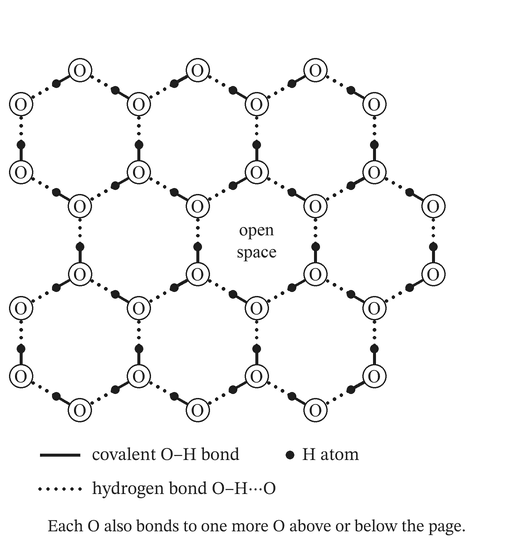
Step 2 — See what happens on melting. When ice melts, some hydrogen bonds break, the open cage partly collapses and the molecules move closer together. So water at 0 °C is denser than ice; water expands by about 9 % when it freezes.
Step 3 — Compare the densities. Ice has a density of about 0.917 g cm⁻³ and water at 0 °C about 1.000 g cm⁻³, so ice floats on water.
Why the other options are wrong:
- (A) The molecules are less closely packed in ice, not more; closer packing would make ice heavier than water.
- (C) The size of a water molecule does not change on melting; only the spacing between the molecules changes.
- (D) Melting ice gives ordinary water; deuterium makes up only about 0.016 % of the hydrogen in natural water, and melting does not change this.
Therefore, ice is lighter than water at its melting point because its crystals have an open (hollow) hexagonal arrangement of H₂O molecules.
- 351 mark
Question 35
Calgon used as a water softener is
Solve with AIAnswer
- Correct
(A)
(B)
(C)
(D)
Answer: (A)
Key idea: Calgon is sodium hexametaphosphate, , built from six metaphosphate units (). Textbooks picture it as giving two free ions and the complex anion in water, so its standard formula is written .
Step 1 — Check the charges of the complex anion. Four ions inside (+4) and six units (−6) give a charge of −2, balanced by the two sodium ions outside the bracket.
Step 2 — See how it softens water. The complex anion swaps its sodium ions for calcium (or magnesium) ions, which stay locked in a soluble complex and can no longer react with soap.
Note: Commercial sodium hexametaphosphate is really a glassy mixture of sodium polyphosphates (mostly long chains); the formula is the simple textbook way of showing how it holds calcium and magnesium ions in solution.
Why the other options are wrong:
- (B) This has the same overall composition, , but writes the complex ion as ; the standard formula of Calgon puts four sodium ions inside the bracket and two outside, so (B) is not the accepted way of writing it.
- (C) This is built from phosphate () units, not metaphosphate, and its charges do not balance: would carry −11, not −4.
- (D) This also uses units; would carry −16, which four outside ions cannot balance.
Therefore, Calgon is Na₂[Na₄(PO₃)₆].
- 361 mark
Question 36
When is oxidised, the product is
Solve with AIAnswer
(A)
- Correct
(B)
(C)
(D)
Answer: (B)
Key idea: Oxygen in is in the −1 state. When is oxidised (that is, when it acts as a reducing agent), its oxygen loses electrons and rises to the 0 state, which is dioxygen.
Step 1 — Write the oxidation half-reaction. Each molecule gives up two electrons and two protons and is released as .
Step 2 — Check the oxidation state. Oxygen goes from −1 in to 0 in , which is a loss of electrons, that is, oxidation.
Why the other options are wrong:
- (A) In oxygen is −2, lower than −1, so it is the product when is reduced in alkaline solution.
- (C) The superoxide ion (oxygen −½) is not the product of oxidising in its usual reactions; is.
- (D) is formed when loses a proton to a base; oxygen stays at −1, so this is an acid–base change, not oxidation.
Therefore, when H₂O₂ is oxidised the product is O₂.
- 371 mark
Question 37
The volume strength of 1.5 N solution is
- 381 mark
Question 38
The O—O—H bond angle in is
- 391 mark
Question 39
Which of the following is the true structure of ?
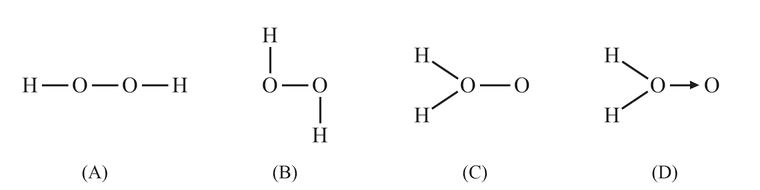
- 401 mark
Question 40
The reaction of with is an example of ______ reaction
- 411 mark
Question 41
The nucleus of deuterium has ______ proton and ______ neutron.
- 421 mark
Question 42
can be prepared from ______.
- 431 mark
Question 43
Ortho and para hydrogen differ from each other in ______.
- 441 mark
Question 44
O.S. of O-atom in molecule is ______.
- 451 mark
Question 45
Strength of 20 volume of is ______.
- 461 mark
Question 46
The electrolysis of molten sodium hydride liberates hydrogen gas at the ______.
- 471 mark
Question 47
The radioactive isotope of hydrogen is called ______ and its nucleus contains ______ proton and ______ neutrons.
- 481 mark
Question 48
Hydrogen gas is liberated by the action of aluminium with concentrated solution of ______.
- 491 mark
Question 49
Hardness of water is due to the presence of ______, ______ and ______ of calcium and magnesium.
- 501 mark
Question 50
Calgon is the trade name of ______.
- 511 mark
Question 51
Heavy water is used as a ______ in nuclear reactors.
- 521 mark
Question 52
Hydrogen peroxide is manufactured by autoxidation of ______.
- 531 mark
Question 53
Hydrogen peroxide is ______ in nature and acts as an ______ as well as a ______ agent both in ______ and ______ media.
- 541 mark
Question 54
Bleaching action of is due to its ______ nature.
- 551 mark
Question 55
A mixture of hydrazine hydrate and ______ with a copper (II) catalyst is used as a rocket propellant.
- 561 mark
Question 56
Name the classes of hydrides to which , and belong.
- 571 mark
Question 57
Why is water molecule polar?
- 581 mark
Question 58
Why is hydrogen peroxide stored in wax-lined bottles?
- 591 mark
Question 59
Atomic hydrogen combines with almost all elements but molecular hydrogen does not. Explain.
- 601 mark
Question 60
If same mass of liquid water and a piece of ice is taken, then why is the density of ice less than that of liquid water?
- 611 mark
Question 61
Write redox reaction between fluorine and water.
- 621 mark
Question 62
An acidic solution of hydrogen peroxide behaves as an oxidising as well as reducing agent. Illustrate it with the help of a chemical equation.
- 631 mark
Question 63
What is demineralized water? How is it obtained?
- 641 mark
Question 64
What is hydride gap?
- 651 mark
Question 65
What is the chemical composition of zeolite?
- 661 mark
Question 66
Write two uses of interstitial hydrides.
- 671 mark
Question 67
Explain why oxide ion is called a hard ion?
- 681 mark
Question 68
What do you mean by 15 volume solution?
- 691 mark
Question 69
Complete the following reaction:
(i) +
(ii) +
- 701 mark
Question 70
Is it possible to remove completely by boiling the temporary hardness due to ?
- 712 marks
Question 71
Would you expect the hydrides of N, O and F to have lower boiling points than hydrides of their subsequent group members? Give reasons.
- 722 marks
Question 72
Why does hard water not form lather with soap?
- 732 marks
Question 73
Hydrogen generally forms covalent compounds. Give reasons.
- 742 marks
Question 74
What is meant by the term auto-protolysis of water?
- 752 marks
Question 75
Calculate the amount of present in 10 mL of 25 volume solution.
- 762 marks
Question 76
Calculate the molarity strength of solution marked ‘30 volume’.
- 772 marks
Question 77
A sample of hard water is allowed to pass through an anion exchanger. Will it produce lather with soap easily?
- 782 marks
Question 78
Which isotope of hydrogen
(i) does not contain neutrons,
(ii) contains equal number of protons and neutrons,
(iii) is radioactive.
- 792 marks
Question 79
Write the structures of two complex metal hydrides which are used as reducing agent in organic synthesis.
- 802 marks
Question 80
What is syngas? Why is it called so?
- 812 marks
Question 81
What is understood by hydrogenation?
- 822 marks
Question 82
What is hydrolith? How is it prepared?
- 832 marks
Question 83
Why is dihydrogen not preferred in balloons these days?
- 842 marks
Question 84
Ionic hydrides are frequently used to remove traces of water from organic compounds. What is underlying basis of this process?
- 855 marks
Question 85
How many hydrogen bonded water molecule(s) are associated in ?
- 865 marks
Question 86
Calculate the strength of 10 volume hydrogen peroxide solution.
- 875 marks
Question 87
Comment upon the reactions of dihydrogen with (i) chlorine, (ii) sodium and (iii) copper (II) oxide.
- 885 marks
Question 88
Name one reaction in which water acts (i) as an oxidising agent and (ii) as a reducing agent.
- 895 marks
Question 89
Calculate the strength of 5 volume solution.
- 905 marks
Question 90
Explain the following:
(a) Hydrogen is not prepared by action of concentrated sulphuric acid on zinc.
(b) A solution of ferric chloride is unaffected when hydrogen is bubbled through it, but gets reduced when zinc is added to the same acidified solution.
- 915 marks
Question 91
Name one example of a reaction in which dihydrogen acts (i) as an oxidising agent and (ii) as a reducing agent.
- 925 marks
Question 92
10 mL of a given solution of contains 0.91 g of . Express its strength in volume.
- 935 marks
Question 93
What mass of hydrogen peroxide will be present in 2 litres of a 5 molar solution? Calculate the mass of oxygen which will be liberated by the decomposition of 200 mL of this solution.
- 945 marks
Question 94
(a) Give an example each of an ionic hydride and a covalent hydride.
(b) Is it correct to say that hydrogen can behave as a metal? State the conditions under which such behaviour can be possible.
- 955 marks
Question 95
(a) Presence of water is avoided in the preparation of from . Explain.
(b) Anhydrous is not used for preparing . Why?
What Class 11 Chemistry Ch 10 covers
The sections of the chapter, in the order the book takes them. Every question above comes from one of these.
- 01Position of Hydrogen in the Periodic Table
- 02Dihydrogen: Preparation, Properties and Uses
- 03Isotopes of Hydrogen and Ortho–Para Hydrogen
- 04Hydrides
- 05Water: Structure and Properties
More ways to study this chapter
The same chapter asked three other ways. Practise it, revise it, and see what the board has set on Ch 10 before.
Class 11 Chemistry Ch 10 questions students ask
How many questions are there in Class 11 Chemistry Ch 10?
95 questions. Every one is solved step by step on this page.
Are these Class 11 Chemistry solutions free?
Yes. Every question and its full working is free to read, with no account needed.
Can I download the Class 11 Chemistry Ch 10 solutions as a PDF?
There is no PDF to download. Every solution is on this page instead, which means it is searchable, always the current syllabus, and readable on a phone. Use your browser's print option if you want it on paper.