
Opening your dashboard
Class 11 Chemistry Chapter 10 Hydrogen: Practice Questions
109 questions on Chapter 10, each worked through on its own page with the AI tutor. Class 11 Chemistry, ICSE 2026-27.
109 questions
1–4 marks · Mixed difficulty
- 11 mark
Question 1
The first ionisation enthalpies (in kJ mol⁻¹) of some elements are: H 1312, Li 520, Na 496, F 1681 and Cl 1251. Which conclusion about hydrogen is best supported by these values?
- 22 marks
Question 2
The electron gain enthalpy of hydrogen is −73 kJ mol⁻¹, while that of chlorine is −349 kJ mol⁻¹. Use these values to explain why hydrogen forms the hydride ion, , in ionic compounds only with the most electropositive metals, whereas chloride ions are formed with almost every metal.
- 33 marks
Question 3
Hydrogen is usually placed at the top of group 1, although it also resembles the halogens.
(a) Give one balanced equation in which hydrogen behaves like an alkali metal, and the matching equation for sodium.
(b) Give one balanced equation in which hydrogen behaves like a halogen, and the matching equation for chlorine.
(c) State one property of hydrogen's oxide that is unlike both families.
- 41 mark
Question 4
Consider these statements about the position of hydrogen in the periodic table.
P. The electronegativity of hydrogen (about 2.2) lies between those of the alkali metals (about 0.8–1.0) and those of the halogens (about 2.7–4.0).
Q. The covalent radius of a hydrogen atom is close to that of a lithium atom, because both elements head group 1.
R. Like the halogens, a hydrogen atom needs only one more electron to reach a noble gas configuration.
S. Like fluorine, hydrogen shows only negative oxidation states in its compounds.
The correct statements are
- 52 marks
Question 5
State the oxidation number of hydrogen in each of , HCl, and . In which of these compounds does hydrogen show the same oxidation state as a halogen in a metal halide?
- 61 mark
Question 6
In a hydrogen plant, methane is first reformed with steam, and all the carbon monoxide formed is then converted by the water-gas shift reaction. (Hypothetical data.) What is the greatest mass of dihydrogen that can be obtained from 8.0 kg of methane? (C = 12, H = 1)
- 73 marks
Question 7
1.30 g of granulated zinc is added to excess dilute sulphuric acid. (Hypothetical data.)
(a) Calculate the volume of dihydrogen formed, measured at 27 °C and 1.00 atm. (Zn = 65; R = 0.0821 L atm K⁻¹ mol⁻¹)
(b) Why is granulated (commercial) zinc used in the laboratory rather than very pure zinc?
- 81 mark
Question 8
The reaction releases about 572 kJ for every 2 mol of liquid water formed, yet a mixture of dihydrogen and dioxygen can be kept at room temperature for years with no noticeable reaction. The best explanation is that
- 93 marks
Question 9
Triolein, (molar mass 884 g mol⁻¹), is a fat found in olive oil, and each of its molecules contains three C=C double bonds. When heated with dihydrogen over a nickel catalyst, it is hydrogenated to the solid fat tristearin, . (Hypothetical data.) Calculate the mass of dihydrogen, and its volume at STP, needed to hydrogenate 1.00 kg of triolein completely. (H = 1; molar volume at STP = 22.4 L mol⁻¹)
- 101 mark
Question 10
Propene, , is heated with carbon monoxide and dihydrogen under pressure in the presence of a cobalt or rhodium catalyst (hydroformylation). The main organic product is
- 112 marks
Question 11
In an atomic hydrogen torch, a stream of dihydrogen is passed through an electric arc struck between two tungsten electrodes, and the gas stream is then directed onto a metal surface, which can reach about 4000 °C. Explain how this very high temperature is produced.
- 123 marks
Question 12
A mixture of 30 mL of dihydrogen and 20 mL of dioxygen is exploded by a spark in a strong closed tube, and the gases are then brought back to the starting temperature and pressure, at which the water formed is a liquid. (Hypothetical data.)
(a) Write the balanced equation for the reaction.
(b) Which gas is left over, and what is its volume?
(c) By how much has the volume of gas decreased?
- 131 mark
Question 13
Dry dihydrogen is passed over each of the following oxides heated strongly in a tube. Which oxide is NOT reduced to the metal?
- 141 mark
Question 14
Ordinary dihydrogen at room temperature is a mixture of ortho and para hydrogen. Which statement about it is correct?
- 153 marks
Question 15
Ortho and para hydrogen have the same chemical properties, but they differ in some physical properties such as specific heat and thermal conductivity.
(a) How do the two forms differ in their molecules?
(b) Why are their chemical properties the same?
(c) Liquid hydrogen made for rocket fuel is converted into the para form while it is being liquefied. Give a reason.
- 161 mark
Question 16
Tritium, the radioactive isotope of hydrogen, has a half-life of 12.3 years. What fraction of the tritium in a sealed sample is still present after 36.9 years?
- 172 marks
Question 17
Samples of dihydrogen, , and dideuterium, , are allowed to effuse through the same pinhole under the same conditions of temperature and pressure. Which gas effuses faster, and by what factor? (H = 1, D = 2)
- 183 marks
Question 18
Natural hydrogen contains 99.985 % protium (isotopic mass 1.00783 u) and 0.015 % deuterium (isotopic mass 2.01410 u) by number of atoms; the amount of tritium is negligible.
(a) Calculate the average atomic mass of natural hydrogen.
(b) How many times heavier is a deuterium atom than a protium atom? Use this to explain why the isotopes of hydrogen differ more in their physical properties and rates of reaction than the isotopes of any other element.
- 193 marks
Question 19
Diborane, , has the same formula type as ethane, , but it cannot have an ethane-like structure.
(a) How many valence electrons does a molecule have?
(b) An ethane-like structure has seven two-centre bonds. How many electrons would need for such a structure?
(c) Explain how the actual structure of diborane uses the electrons it has.
- 203 marks
Question 20
A palladium foil of mass 10.64 g absorbs dihydrogen at room temperature until its composition is . (Hypothetical data.) (Pd = 106.4 g mol⁻¹; density of palladium = 12.0 g cm⁻³; molar volume at STP = 22.4 L mol⁻¹)
(a) Calculate the volume of dihydrogen at STP absorbed by the foil.
(b) How many times its own volume of dihydrogen (at STP) has the palladium absorbed?
(c) Why is the formula of this hydride not a ratio of small whole numbers?
- 211 mark
Question 21
Which order correctly shows the DECREASING thermal stability of the hydrides of the group 16 elements?
- 222 marks
Question 22
Sodium hydride reacts with diborane in an ether solvent to give sodium borohydride, .
(a) Write the balanced equation for the reaction.
(b) Identify the Lewis acid and the Lewis base in this reaction, giving a reason for each.
- 231 mark
Question 23
Calcium hydride, , is a typical ionic (saline) hydride, but beryllium hydride is a covalent, polymeric solid, . The main reason for this difference is that
- 243 marks
Question 24
The electronic configurations of three elements X, Y and Z are:
X: 1s² 2s² 2p⁶ 3s² 3p⁶ 4s¹
Y: 1s² 2s² 2p⁶ 3s² 3p⁶ 3d¹⁰ 4s² 4p²
Z: 1s² 2s² 2p⁶ 3s² 3p⁵
For each element, write the formula of its simplest hydride, name the class of hydride it belongs to, and give one property that fits that class.
- 254 marks
Question 25
0.480 g of the hydride, MH, of an alkali metal M reacts completely with excess water, giving 448 mL of dihydrogen measured at STP. (Hypothetical data.) (Molar volume at STP = 22.4 L mol⁻¹; H = 1, O = 16)
(a) Write the general equation for the reaction of MH with water.
(b) Calculate the number of moles of dihydrogen formed.
(c) Find the molar mass of MH and identify the metal M.
(d) Calculate the mass of metal hydroxide formed in the solution.
- 261 mark
Question 26
When water at 0 °C is warmed to 4 °C, its volume decreases slightly; above 4 °C it expands like most liquids. Which statement best explains the decrease in volume between 0 °C and 4 °C?
- 273 marks
Question 27
Water reacts with many covalent compounds of non-metals; such reactions are called hydrolysis.
(a) Write balanced equations for the hydrolysis of silicon tetrachloride, , and of tetraphosphorus decaoxide, .
(b) Carbon tetrachloride does not react with water under ordinary conditions, although silicon tetrachloride reacts with it vigorously. Explain this difference.
- 281 mark
Question 28
In a water molecule the H–O–H bond angle is 104.5°, a little smaller than the tetrahedral angle of 109.5°, although the oxygen atom has four electron pairs in its valence shell. Which statement explains this?
- 292 marks
Question 29
Chlorine dissolves in water and reacts with it reversibly:
(a) Give the oxidation number of each atom in every species in this equation.
(b) Use your answer to decide whether water acts as an oxidising agent, a reducing agent or neither in this reaction, and name this type of redox reaction.
- 303 marks
Question 30
Pure water ionises very slightly:
At 25 °C the density of pure water is 0.997 g cm⁻³, its molar mass is 18.02 g mol⁻¹, and its ionic product is .
(a) Calculate the molar concentration of water molecules in pure water.
(b) Calculate the degree of ionisation, .
(c) Calculate the equilibrium constant , and explain why chemists use rather than K for water.
- 311 mark
Question 31
In ice, every water molecule is hydrogen-bonded to four neighbouring water molecules, as sketched in the figure: the centre molecule gives its two H atoms to neighbours 1 and 2, and accepts one H atom from each of neighbours 3 and 4. The dotted lines are hydrogen bonds. (H = 1, O = 16)
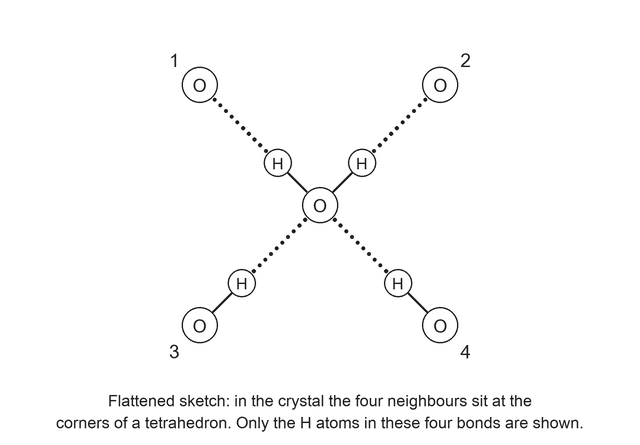
How many moles of hydrogen bonds are present in 18 g of ice?
- 323 marks
Question 32
The water in a school's 5000 L storage tank has a permanent hardness of 150 ppm, expressed as , caused by calcium chloride and magnesium sulphate. (Hypothetical data.) Take the density of the water as 1.00 kg L⁻¹. (H = 1, C = 12, O = 16, Na = 23, Ca = 40)
(a) Write equations for the reactions by which washing soda removes this hardness.
(b) Calculate the mass of anhydrous sodium carbonate needed to soften all the water in the tank.
(c) What mass of washing soda crystals, , would supply the same amount of sodium carbonate?
- 333 marks
Question 33
In Clark's method, temporary hardness is removed by adding a calculated amount of slaked lime, .
(a) Write balanced equations for the removal of calcium hydrogencarbonate and of magnesium hydrogencarbonate by this method.
(b) Explain why one mole of magnesium hydrogencarbonate needs two moles of slaked lime, whereas one mole of calcium hydrogencarbonate needs only one.
(c) Why must the lime not be added in excess?
- 341 mark
Question 34
Water containing magnesium chloride is unsuitable for high-pressure boilers, even after its temporary hardness has been removed. The main reason is that magnesium chloride:
- 351 mark
Question 35
Hard water containing , , and ions is passed through a sodium zeolite (permutit) softener. Compared with the water entering, the water that comes out:
- 364 marks
Question 36
A sample of hard water contains mol L⁻¹ of ions and mol L⁻¹ of ions; its only anions are and . (Hypothetical data.) The water is passed first through column X and then through column Y, each packed with an ion-exchange resin, as shown in the figure.
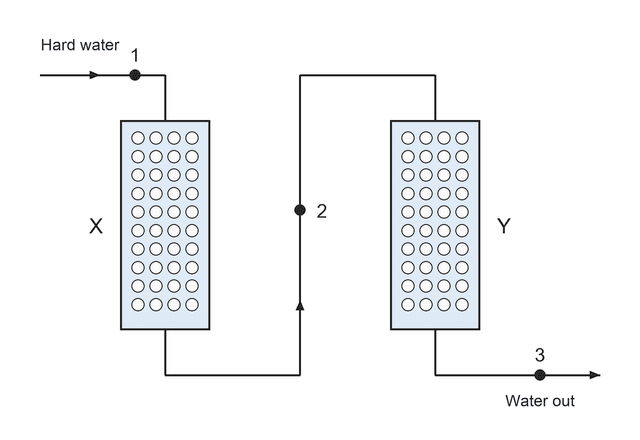
A student tests the water at points 1, 2 and 3:
Point pH Shaken with soap solution 1 7.0 scum forms, little lather 2 2.5 not tested 3 7.0 good lather (a) Identify the type of resin in column X and in column Y, giving the ion each one releases into the water.
(b) Write equations, using R for the resin framework, for the exchange of ions in X and of and ions in Y, and for the reaction that brings the pH back to 7.
(c) Show by calculation that a pH of about 2.5 at point 2 is what you would expect.
(d) How is each column regenerated when it is exhausted?
- 372 marks
Question 37
Rain water is soft, but water from a well dug in limestone rock is usually hard.
(a) Why is rain water soft?
(b) Rain water contains dissolved carbon dioxide. Write the equation for its reaction with limestone, and state which kind of hardness this produces.
- 384 marks
Question 38
Analysis of one litre of a well-water sample gives: 48 mg, 18 mg, 122 mg and 67.5 mg; no other ions are present in significant amounts. (Hypothetical data.) Take the mass of 1 L of the water as 1 kg, so that 1 mg L⁻¹ = 1 ppm. (H = 1, C = 12, O = 16, Mg = 24, Cl = 35.5, Ca = 40)
(a) Calculate the total hardness of the water in ppm of .
(b) On boiling, the hydrogencarbonate ions are removed as , and . Calculate the temporary hardness.
(c) Calculate the permanent hardness, and name the salts responsible for it.
(d) Check that the analysis is electrically balanced.
- 391 mark
Question 39
When a few drops of hydrogen peroxide are added to the dirty-green precipitate of iron(II) hydroxide in an alkaline mixture, the precipitate turns reddish-brown. Which equation correctly represents this change?
- 403 marks
Question 40
The following standard reduction potentials refer to acidic solution at 298 K:
(a) Write the oxidation and reduction half-reactions that take place when hydrogen peroxide decomposes, and add them to obtain the overall equation.
(b) Calculate for the decomposition and state whether it is spontaneous.
(c) A 3 % solution of hydrogen peroxide kept in a clean, dark bottle lasts for months, yet a pinch of manganese dioxide makes it fizz at once. Explain how both observations fit your answer to (b).
- 414 marks
Question 41
A hair-bleach solution of hydrogen peroxide is labelled "20 volume". (Hypothetical data.) To check it, 10.0 mL of the solution is diluted with water to 250 mL. Then 25.0 mL of the diluted solution is acidified and treated with excess potassium iodide; the iodine set free needs 17.85 mL of 0.200 M sodium thiosulphate solution. The reactions are:
Take the volume strength as the volume of oxygen at S.T.P. (22.4 L mol⁻¹) given by one volume of the solution. (H = 1, O = 16)
(a) Calculate the molarity of the diluted solution and of the original solution.
(b) Calculate the strength of the original solution in g L⁻¹.
(c) Calculate its volume strength, and say whether the label is correct.
- 421 mark
Question 42
In the final stage of concentrating hydrogen peroxide, the remaining water is removed by distilling the solution under reduced pressure rather than at atmospheric pressure. Why is the pressure reduced?
- 434 marks
Question 43
To measure the sulphur dioxide in the flue gas of a coal-fired boiler, 10.0 L of the gas (volume at S.T.P.) is bubbled slowly through dilute, neutral hydrogen peroxide solution, which turns all the sulphur dioxide into sulphuric acid. (Hypothetical data.) The acid formed needs 12.5 mL of 0.0100 M sodium hydroxide solution for neutralisation. Assume that no other gas in the sample forms an acid that reacts with the sodium hydroxide. (O = 16, S = 32)
(a) Write the equation for the reaction of sulphur dioxide with hydrogen peroxide, and state the role of hydrogen peroxide, giving the oxidation numbers that change.
(b) Write the equation for the neutralisation.
(c) Calculate the mass of sulphur dioxide in the sample and its concentration in mg m⁻³.
- 441 mark
Question 44
In the modern manufacture of hydrogen peroxide, 2-ethylanthraquinone is reduced by hydrogen (palladium catalyst) to 2-ethylanthraquinol, which is then oxidised by air back to 2-ethylanthraquinone, setting free hydrogen peroxide. Taking the whole cycle together, which substances are used up?
- 452 marks
Question 45
Two structures P and Q can be drawn for hydrogen peroxide, as shown in the figure. In P the molecule is planar, with the two O–H bonds pointing in opposite directions. In Q the molecule is non-planar: the O–O bond lies along the spine of a half-open book, with one O–H bond on each page.

Experiments show that hydrogen peroxide is a polar molecule; its dipole moment is not zero.
(a) Which structure agrees with this fact? Explain in terms of the O–H bond dipoles.
(b) Suggest why the two O–H bonds do not lie in the same plane.
- 461 mark
Question 46
Calcium hydride, , is an ionic hydride containing hydride ions, . When it is added to an excess of heavy water, a gas is evolved. The gas is mainly:
- 473 marks
Question 47
Heavy water is concentrated by the prolonged electrolysis of ordinary water containing a little alkali, in several stages.
(a) Why is the alkali added?
(b) Explain why the water left behind becomes richer in as the electrolysis goes on.
(c) The gases from each stage are burnt, and the water formed is returned to an earlier stage instead of being thrown away. Why?
- 483 marks
Question 48
In natural water, about 0.015 % of all hydrogen atoms (a fraction of ) are deuterium atoms. (Molar masses: = 18.0 g mol⁻¹, = 20.0 g mol⁻¹.)
(a) How many moles of deuterium atoms are present in 1.00 kg of ?
(b) Calculate the minimum mass of natural water, in tonnes, that must be processed to obtain 1.00 kg of , assuming that every deuterium atom is recovered.
(c) Why is the mass of water processed in practice much larger than this?
- 491 mark
Question 49
Ethanol, , is shaken with a large excess of heavy water, and the ethanol is then recovered. Which compound is mainly obtained?
- 503 marks
Question 50
At 25 °C the density of ordinary water is 0.997 g cm⁻³. The molar masses are = 18.02 g mol⁻¹ and = 20.03 g mol⁻¹.
(a) Assuming that one mole of takes up the same volume as one mole of , predict the density of heavy water at 25 °C.
(b) The measured density of heavy water at 25 °C is 1.104 g cm⁻³. By what percentage does your prediction differ from it?
(c) Explain why the molar volumes of the two liquids are so nearly equal.
- 511 mark
Question 51
Very pure hydrogen (99.9) can be made by which of the following processes?
(a) Reaction of methane with steam
(b) Mixing natural hydrocarbons of high molecular weight
(c) Electrolysis of water
(d) Reaction of salts like hydrides with water
- 521 mark
Question 52
The number of protons, electrons and neutrons in a molecule of heavy water are respectively
- 531 mark
Question 53
Hydrogen peroxide acts both as an oxidising and as a reducing agent depending upon the nature of the reacting species. In which of the following cases acts as a reducing agent in acid medium?
(a)
(b)
(c)
(d) KI
- 541 mark
Question 54
Which physical property of dihydrogen is wrong?
- 551 mark
Question 55
Permanent hardness in water cannot be cured by:
- 561 mark
Question 56
From the following statements regarding , choose the incorrect statement:
- 571 mark
Question 57
Which one of the following statements about water is FALSE?
- 581 mark
Question 58
Identify the incorrect statement regarding heavy water:
- 591 mark
Question 59
Hydrogen peroxide oxidises to in acidic medium but reduces to in alkaline medium. The other products formed are respectively:
- 601 mark
Question 60
The number of neutrons and electrons, respectively, present in the radioactive isotope of hydrogen is:
- 611 mark
Question 61
The metal that gives hydrogen gas upon treatment with both acid as well as base is:
- 621 mark
Question 62
The correct statements among P to S are:
P. saline hydrides produce gas when reacted with .
Q. reaction of with leads to .
R. and are electron-rich and electron-precise hydrides, respectively.
S. HF and are called as molecular hydrides.
- 631 mark
Question 63
The correct statements among P to S regarding as a fuel are:
P. It produces less pollutants than petrol.
Q. A cylinder of compressed dihydrogen weighs ~30 times more than a petrol tank producing the same amount of energy.
R. Dihydrogen is stored in tanks of metal alloys like .
S. On combustion, values of energy released per gram of liquid dihydrogen and LPG are 50 and 142 kJ, respectively.
- 641 mark
Question 64
NaH is an example of:
- 651 mark
Question 65
Among the following reactions of hydrogen with halogens, the one that requires a catalyst is:
- 661 mark
Question 66
The temporary hardness of a water sample is due to compound X. Boiling this sample converts X to compound Y. X and Y, respectively, are:
- 671 mark
Question 67
The synonym for water gas when used in the production of methanol is:
- 681 mark
Question 68
The number of water molecule(s) not coordinated to copper ion directly in , is:
- 691 mark
Question 69
100 mL of a water sample contains 0.81 g of calcium bicarbonate and 0.73 g of magnesium bicarbonate. The hardness of this water sample expressed in terms of equivalents of is: (molar mass of calcium bicarbonate is 162 g mol⁻¹ and magnesium bicarbonate is 146 g mol⁻¹)
- 701 mark
Question 70
The temporary hardness of water is due to:
- 711 mark
Question 71
The strength of 11.2 volume solution of is: [Given that molar mass of H = 1 g mol⁻¹ and O = 16 g mol⁻¹]
- 721 mark
Question 72
The chemical nature of hydrogen peroxide is:
- 731 mark
Question 73
Dihydrogen of high purity (>99.95%) is obtained through:
- 741 mark
Question 74
The equation that represents the water-gas shift reaction is:
- 751 mark
Question 75
5 g of zinc is treated separately with an excess of
P. dilute hydrochloric acid and
Q. aqueous sodium hydroxide.
The ratio of the volumes of evolved in these two reactions is :
- 761 mark
Question 76
Hydrogen has three isotopes P, Q and R. If the number of neutron(s) in P, Q and R respectively, are (x), (y) and (z), the sum of (x), (y) and (z) is:
- 771 mark
Question 77
The one that is NOT suitable for the removal of permanent hardness of water is:
- 781 mark
Question 78
The hardness of a water sample containing M expressed as equivalents (in ppm) is ______. (molar mass of is 120.37 g/mol)
- 791 mark
Question 79
Amongst the following, the form of water with the lowest ionic conductance at 298 K is:
- 801 mark
Question 80
In comparison to the zeolite process for the removal of permanent hardness, the synthetic resins method is:
- 811 mark
Question 81
Hydrogen peroxide, in the pure state, is:
- 821 mark
Question 82
The volume strength of 8.9 M solution calculated at 273 K and 1 atm is ______. (R = 0.0821 L atm K⁻¹ mol⁻¹) (rounded off to the nearest integer)
- 831 mark
Question 83
The strengths of 5.6 volume hydrogen peroxide (of density 1 g/mL) in terms of mass percentage and molarity (M), respectively, are:
(Take molar mass of hydrogen peroxide as 34 g/mol)
- 841 mark
Question 84
Among statements P–S, the correct ones are:
P. Decomposition of hydrogen peroxide gives dioxygen.
Q. Like hydrogen peroxide, compounds, such as , and when heated liberate dioxygen.
R. 2-Ethylanthraquinone is useful for the industrial preparation of hydrogen peroxide.
S. Hydrogen peroxide is used for the manufacture of sodium perborate.
- 851 mark
Question 85
Deuterium resembles hydrogen in properties but:
- 861 mark
Question 86
The single largest industrial application of dihydrogen is:
- 871 mark
Question 87
Which one of the following methods is most suitable for preparing deionized water?
- 881 mark
Question 88
The water having more dissolved is:
- 891 mark
Question 89
The functional groups that are responsible for the ion exchange property of cation and anion exchange resins, respectively, are
- 901 mark
Question 90
In basic medium, exhibits which of the following reactions?
P.
Q.
R.
Choose the most appropriate answer from the options given below.
- 911 mark
Question 91
The correct statements about are
P. used in the treatment of effluents.
Q. used as both oxidising and reducing agents.
R. the two hydroxyl groups lie in the same plane.
S. miscible with water.
Choose the correct answer from the options given below
- 921 mark
Question 92
High purity (>99.95%) dihydrogen is obtained by
- 931 mark
Question 93
Match List-I with List-II:
List-I List-II P. Sodium hydride (i) Lewis acid Q. Silane (ii) Saline hydride R. Vanadium hydride (iii) Molecular hydride S. Aluminium hydride (iv) Non-stoichiometric hydride - 941 mark
Question 94
The highest industrial consumption of molecular hydrogen is to produce compounds of element:
- 951 mark
Question 95
The metal salts formed during softening of hard water using Clark's method are:
- 961 mark
Question 96
Consider the following reaction:
The dihedral angle in product A in its solid phase at 110 K is:
- 971 mark
Question 97
Boiling of hard water is helpful in removing the temporary hardness by converting calcium hydrogen carbonate and magnesium hydrogen carbonate to
- 981 mark
Question 98
Given below are two statements:
Statement I: Hydrogen peroxide can act as an oxidising agent in both acidic and basic conditions.
Statement II: Density of hydrogen peroxide at 298 K is lower than that of .
In the light of the above statements. Choose the correct answer from the options given below:
- 991 mark
Question 99
Which of the following can be used to prevent the decomposition of ?
- 1001 mark
Question 100
The products obtained from a reaction of hydrogen peroxide and acidified potassium permanganate are
- 1011 mark
Question 101
The reaction of with potassium permanganate in acidic medium leads to the formation of mainly:
- 1021 mark
Question 102
Which one of the following reactions indicates the reducing ability of hydrogen peroxide in basic medium?
- 1031 mark
Question 103
Some statements about heavy water are given below:
P. Heavy water is used as a moderator in nuclear reactors.
Q. Heavy water is more associated than ordinary water.
R. Heavy water is more effective solvent than ordinary water.
Which of the above statements are correct?
- 1041 mark
Question 104
P.
Q.
Role of hydrogen peroxide in the above reactions is respectively
- 1051 mark
Question 105
Which of the following statements about hydrogen is incorrect?
(a) Hydrogen has three isotopes of which tritium is the most common.
(b) Hydrogen never acts as cation in ionic salts.
(c) Hydronium ion, exists freely in solution.
(d) Dihydrogen does not act as a reducing agent.
- 1061 mark
Question 106
The number of hydrogen bonded water molecule(s) associated with is
- 1071 mark
Question 107
The method used to remove temporary hardness of water is:
- 1081 mark
Question 108
Tritium, a radioactive isotope of hydrogen, emits which of the following particles?
- 1091 mark
Question 109
Match List-I with List-II
List-I (Hydrides) List-II (Nature) P. (i) Electron precise Q. (ii) Electron deficient R. (iii) Electron rich S. HF (iv) Ionic Choose the correct answer from the options given below: