
Question 571 markEasy
Why is water molecule polar?
Confirming your payment
Sign up now and get 250 free tokens.
Hydrogen · Question 57 of 95
Why is water molecule polar?
Solution:
Key idea: A molecule is polar when its bonds are polar and its shape does not let the bond dipoles cancel. Water has polar O–H bonds and a bent shape, so it has a net dipole moment.
Step 1 — Look at the O–H bond. Oxygen (Pauling electronegativity 3.44) is much more electronegative than hydrogen (2.20), so the shared electron pair in each O–H bond is pulled towards oxygen. Oxygen carries a partial negative charge () and each hydrogen a partial positive charge (), so each O–H bond is a polar bond with its own bond dipole.
Step 2 — Look at the shape. The O atom has two bond pairs and two lone pairs (sp³ hybridised), and the lone pairs push the bond pairs closer together. The molecule is therefore bent (V-shaped) with an H–O–H angle of about 104.5°, as the figure shows.
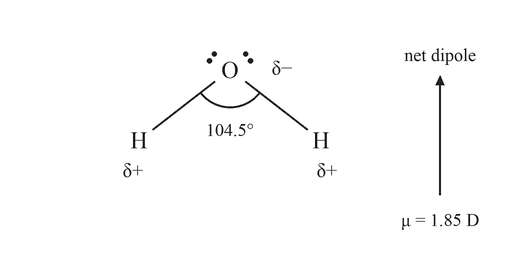
Step 3 — Add the two bond dipoles. Because the molecule is bent and not linear, the two O–H bond dipoles do not point in opposite directions, so they do not cancel. They add up to a net dipole moment of about 1.85 D, directed towards the oxygen end.
Watch out: A molecule with polar bonds can still be non-polar if it is symmetrical (for example linear , where the two dipoles cancel). Water is polar because of its bent shape.
Therefore, water is polar because the O–H bonds are polar (O is more electronegative than H) and the bent shape (H–O–H ≈ 104.5°) stops the two bond dipoles from cancelling, giving a net dipole moment of about 1.85 D.