
Question 341 markMCQEasy
At its melting point, ice is lighter than water because
Confirming your payment
Sign up now and get 250 free tokens.
Hydrogen · Question 34 of 95
At its melting point, ice is lighter than water because
(A) molecules are more closely packed in solid state
(B) Ice crystals have hollow hexagonal arrangement of molecules.
(C) On melting of ice the molecule shrinks in size
(D) Ice forms mostly heavy water on first melting.
Answer: (B) ice crystals have a hollow hexagonal arrangement of molecules
Key idea: In ice each water molecule is hydrogen-bonded to four others arranged tetrahedrally. This builds an open, cage-like hexagonal structure with much empty space, so a given mass of ice takes up more volume than the same mass of liquid water.
Step 1 — Picture the structure of ice. The hydrogen bonds hold the molecules at fixed angles and distances, which leaves open hexagonal channels between them, as in the figure.
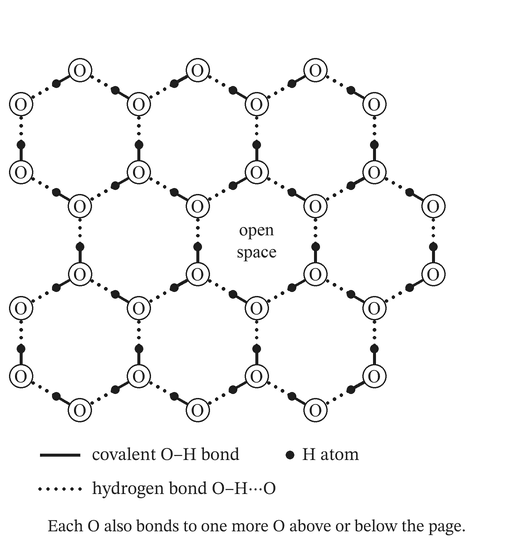
Step 2 — See what happens on melting. When ice melts, some hydrogen bonds break, the open cage partly collapses and the molecules move closer together. So water at 0 °C is denser than ice; water expands by about 9 % when it freezes.
Step 3 — Compare the densities. Ice has a density of about 0.917 g cm⁻³ and water at 0 °C about 1.000 g cm⁻³, so ice floats on water.
Why the other options are wrong:
Therefore, ice is lighter than water at its melting point because its crystals have an open (hollow) hexagonal arrangement of H₂O molecules.