
Opening your dashboard
Class 11 Biology Chapter 21: Seed Dormancy Solutions
43 textbook questions with step-by-step answers, free to read, for ISC 2026-27.
Get talked through Ch 21, not just shown the answer
Reading a finished solution is not the same as being able to do it. The AI tutor takes one question at a time and works it with you, in your own words, until you can.
- Ask it out loud, in your own words
- It gives you the next step, not the answer
- Stuck on part (ii)? Start there
43 questions with solutions
1–5 marks · Mixed difficulty
- 11 mark
Question 1
What is the term used for suspension of growth before germination, due to exogenous control?
Solve with AIWritten solution
Solution:
Concept: A seed may fail to grow either because the conditions outside it are unsuitable (exogenous control) or because something inside the seed holds it back (endogenous control).
Step 1 — The question asks for the outside-controlled state. We need the term for a seed that is not growing only because its surroundings are unsuitable.
Step 2 — The seed is ready, but its surroundings are not. Such a seed has a mature embryo and no block inside it; it lacks only enough water, oxygen or a suitable temperature. As soon as these are supplied, it germinates. This state of suspended growth is called quiescence.
Therefore, suspension of growth before germination due to exogenous control is called quiescence.
- 21 mark
Question 2
What is the term used for suspension of growth before germination, due to endogenous control?
Solve with AIWritten solution
Solution:
Concept: A seed may fail to grow either because the conditions outside it are unsuitable (exogenous control) or because something inside the seed holds it back (endogenous control).
Step 1 — The question asks for the inside-controlled state. We need the term for a seed that does not grow because of a block within the seed itself.
Step 2 — The seed stays inactive even in favourable conditions. The seed holds back its own growth, for example by a hard, impermeable seed coat, by growth inhibitors such as abscisic acid, or because its embryo is not yet mature. Even with enough water, oxygen and a suitable temperature, it does not germinate until this block is removed. This state is called dormancy.
Therefore, suspension of growth before germination due to endogenous control is called dormancy.
- 31 mark
Question 3
Which growth inhibitor is responsible for seed dormancy?
Solve with AIWritten solution
Solution:
Concept: Some seeds contain chemical growth inhibitors that stop the embryo from growing even when water, oxygen and a suitable temperature are available.
Step 1 — The question asks for the inhibitor behind seed dormancy. We need the chemical that keeps the embryo of a dormant seed from growing.
Step 2 — Abscisic acid holds the embryo back. Abscisic acid (ABA) builds up in the seed as it matures and blocks the growth of the embryo; it works against the gibberellins, which promote germination. Other inhibitors, such as coumarin, phenolic acids and short-chain fatty acids, occur in some seeds, but ABA is the main one.
Therefore, the growth inhibitor responsible for seed dormancy is abscisic acid (ABA).
- 41 mark
Question 4
What is scratching of seed coat to break seed dormancy called?
Solve with AIWritten solution
Solution:
Concept: A hard, impermeable seed coat keeps water and oxygen out of the seed, so the embryo cannot start growing.
Step 1 — The question asks for the name of the scratching treatment. We need the term for breaking dormancy by damaging the seed coat.
Step 2 — Scratching the coat lets water and oxygen in. Rubbing the seeds on sandpaper, nicking the coat with a knife or shaking the seeds with coarse sand weakens or breaks the coat. Water and oxygen can then enter, and the embryo starts to grow. Such treatment of the seed coat is called scarification; softening the coat with concentrated sulphuric acid has the same effect.
Therefore, scratching the seed coat to break seed dormancy is called scarification.
- 51 mark
Question 5
Which term is used for initial uptake of water by a dehydrated seed?
Solve with AIWritten solution
Solution:
Concept: A dry seed contains very little water, and its embryo cannot become active until the seed takes water in.
Step 1 — The question asks for the term for the first uptake of water. We need the name of the process by which a dry seed first absorbs water.
Step 2 — The dry seed's colloids soak up water. The hemicellulose and pectin of the cell walls and the stored proteins and starch of a dry seed are hydrophilic colloids. They take up water strongly, so the seed swells and its coat often splits. This first uptake of water by a dry seed is called imbibition.
Therefore, the initial uptake of water by a dehydrated seed is called imbibition.
- 61 mark
Question 6
Name the hormone that an active embryo secretes.
Solve with AIWritten solution
Solution:
Concept: In a germinating cereal grain, the embryo signals the tissue around the stored food to release that food for the growing seedling.
Step 1 — The question asks for the embryo's signal hormone. We need the hormone that the embryo releases once it becomes active.
Step 2 — The active embryo releases gibberellins. After imbibition the embryo becomes active and secretes gibberellins (such as gibberellic acid, GA). They diffuse to the aleurone layer, where they switch on the making of digestive enzymes that break down the food stored in the endosperm.
Therefore, the hormone that an active embryo secretes is gibberellin.
- 71 mark
Question 7
Which enzyme is synthesised in the aleurone layer of seed during activation?
Solve with AIWritten solution
Solution:
Concept: The aleurone layer is the protein-rich outer layer of the endosperm in a cereal grain; it responds to the gibberellins sent by the embryo.
Step 1 — The question asks for the enzyme the aleurone layer makes. We need the main enzyme produced there when the seed is activated.
Step 2 — Gibberellins switch on α-amylase. When gibberellins from the embryo reach the aleurone layer, its cells make α-amylase and release it into the endosperm. The α-amylase breaks the stored starch down into sugars, which the embryo absorbs and uses for growth. The aleurone layer also makes other hydrolysing enzymes, such as proteases, but α-amylase is the main one.
Therefore, the enzyme synthesised in the aleurone layer during activation is α-amylase.
- 81 mark
Question 8
Which hormone induces seed dormancy?
Solve with AIWritten solution
Solution:
Concept: Abscisic acid and gibberellins act against each other in seeds; the balance between them decides whether a seed stays dormant or germinates.
Step 1 — The question asks for the hormone that brings on dormancy. We need the hormone that makes a seed dormant.
Step 2 — Abscisic acid builds up as the seed matures. The level of abscisic acid (ABA) in the seed rises during seed development; it stops the embryo from germinating early on the parent plant and keeps the seed dormant. When dormancy is broken, for example by a cold treatment (stratification), the ABA level falls and the gibberellin level rises, so the seed can germinate.
Therefore, the hormone that induces seed dormancy is abscisic acid (ABA).
- 91 mark
Question 9
Cotyledons are pushed above the soil in which germination?
Solve with AIWritten solution
Solution:
Concept: Germination is named by where the cotyledons end up.
Step 1 — What is asked: We need the one term or fact the question asks for.
Step 2 — The fact: When the cotyledons are pushed above the soil, the germination is epigeal (epi = upon, ge = earth).
Therefore, it is epigeal germination.
- 101 mark
Question 10
Which part of the cotyledon grows rapidly in epigeal germination?
Solve with AIWritten solution
Solution:
Concept: The hypocotyl is the part of the embryo axis just below the cotyledons.
Step 1 — What is asked: We need the one term or fact the question asks for.
Step 2 — The fact: In epigeal germination the hypocotyl grows rapidly and lifts the cotyledons above the soil.
Note: The hypocotyl is not part of the cotyledon itself; it is the part of the embryo axis just below the point where the cotyledons are attached.
Therefore, the hypocotyl (the part just below the cotyledons) grows rapidly.
- 111 mark
Question 11
What is epicotyl?
Solve with AIWritten solution
Solution:
Concept: The embryo axis has a part above and a part below the point where the cotyledons are attached.
Step 1 — What is asked: We need the one term or fact the question asks for.
Step 2 — The fact: The epicotyl is the part of the embryo axis just above the cotyledons, between them and the plumule.
Therefore, the epicotyl is the region of the embryo axis just above the cotyledons.
- 121 mark
Question 12
Which part elongates in hypogeal germination?
Solve with AIWritten solution
Solution:
Concept: In hypogeal germination the cotyledons stay below the soil.
Step 1 — What is asked: We need the one term or fact the question asks for.
Step 2 — The fact: The cotyledons stay down because the part above them, the epicotyl, elongates and carries the plumule up.
Therefore, the epicotyl elongates.
- 131 mark
Question 13
Give two examples of epigeal germination.
Solve with AIWritten solution
Solution:
Concept: Epigeal germination is common in many dicot seeds.
Step 1 — What is asked: We need the one term or fact the question asks for.
Step 2 — The fact: Seeds of French bean and castor show epigeal germination; lima bean and sunflower are other examples.
Therefore, two examples are French bean and castor.
- 141 mark
Question 14
Give two examples of hypogeal germination.
Solve with AIWritten solution
Solution:
Concept: Hypogeal germination is seen in many cereals and in some dicots.
Step 1 — What is asked: We need the one term or fact the question asks for.
Step 2 — The fact: Seeds of maize and gram show hypogeal germination; pea, wheat and rice are other examples.
Therefore, two examples are maize and gram.
- 151 mark
Question 15
What type of germination does Rhizophora plant show?
Solve with AIWritten solution
Solution:
Concept: Rhizophora is a mangrove of salty, tidal marshes.
Step 1 — What is asked: We need the one term or fact the question asks for.
Step 2 — The fact: Its seed germinates inside the fruit while the fruit is still on the tree, which is vivipary.
Therefore, Rhizophora shows viviparous germination (vivipary).
- 161 mark
Question 16
If a seed germinates within a fruit, what is it called?
Solve with AIWritten solution
Solution:
Concept: Seeds normally germinate in the soil after they are shed.
Step 1 — What is asked: We need the one term or fact the question asks for.
Step 2 — The fact: Germination of a seed inside the fruit while still attached to the parent plant is vivipary.
Therefore, it is called vivipary.
- 171 mark
Question 17
Name a term used for gradual declining activity in a plant, leading to its death.
Solve with AIWritten solution
Solution:
Concept: All organs and organisms age after they mature.
Step 1 — What is asked: We need the one term or fact the question asks for.
Step 2 — The fact: The gradual decline in the functioning of an organ or organism, ending in death, is senescence.
Therefore, the term is senescence.
- 181 mark
Question 18
In a plant, if first the older leaves and then the branches and last of all main shoot tip dies off, what is it called?
Solve with AIWritten solution
Solution:
Concept: Senescence is named by which parts die and in what order.
Step 1 — What is asked: We need the name of the senescence in which parts die one after another, oldest first.
Step 2 — The fact: When parts die one after another in a fixed order, older leaves first and then lateral organs and branches, it is progressive or sequential senescence.
Note: In a living perennial the main shoot and the roots stay alive and keep forming new parts while the older leaves and branches senesce in turn; the main shoot tip dies only when the whole plant finally dies.
Therefore, it is progressive (sequential) senescence.
- 191 mark
Question 19
What kind of senescence does banana plant show?
Solve with AIWritten solution
Solution:
Concept: In some plants only the above-ground part dies.
Step 1 — What is asked: We need the one term or fact the question asks for.
Step 2 — The fact: In banana the aerial shoot dies after fruiting, while the underground stem survives and gives a new plant. This is shoot senescence.
Therefore, the banana plant shows shoot senescence.
- 201 mark
Question 20
Name of process by which leaves, flowers or fruits of a plant shed.
Solve with AIWritten solution
Solution:
Concept: Plants drop old leaves, flowers and fruits through a special layer at their base.
Step 1 — What is asked: We need the one term or fact the question asks for.
Step 2 — The fact: The shedding of leaves, flowers or fruits from a plant is called abscission.
Therefore, the process is abscission.
- 212 marks
Question 21
What is seed dormancy? How is seed dormancy different from seed quiescence?
Solve with AIWritten solution
Solution:
Concept: A seed may fail to germinate either because of its surroundings or because of the seed itself.
Step 1 — Define seed dormancy: Seed dormancy is a resting state of a living seed in which its metabolic activity is greatly reduced and it does not germinate even when water, oxygen and a suitable temperature are present. It is due to internal (endogenous) causes such as a hard seed coat, inhibitors like ABA or an immature embryo.
Step 2 — Give the difference: In quiescence the seed fails to germinate only because outside (exogenous) conditions are unfavourable, such as lack of water or extreme temperature. A quiescent seed germinates as soon as conditions become favourable, but a dormant seed does not.
Therefore, dormancy is internally controlled and persists in favourable conditions, while quiescence is externally controlled and ends when conditions become favourable.
- 222 marks
Question 22
List two causes of seed dormancy.
Solve with AIWritten solution
Solution:
Concept: Dormancy is under the seed's own (endogenous) control.
Step 1 — First cause: A hard, impermeable seed coat keeps water and oxygen out of the seed, so the embryo cannot become active.
Step 2 — Second cause: Chemical growth inhibitors such as abscisic acid (ABA), coumarin and phenolic acids in the embryo or seed stop the embryo from growing. (Other causes are an immature embryo and a need for light or low temperature.)
Therefore, two causes are a hard impermeable seed coat and growth inhibitors such as ABA.
- 232 marks
Question 23
Why does scarification help in breaking seed dormancy?
Solve with AIWritten solution
Solution:
Concept: In many seeds dormancy is caused by a hard, impermeable seed coat.
Step 1 — What scarification does: Scarification is scratching, abrading or pricking the seed coat. It makes small breaks in the hard coat, so the coat becomes permeable to water and oxygen.
Step 2 — Why dormancy ends: Water now enters, the seed imbibes and swells, metabolism restarts and the embryo becomes active. The weakened coat also no longer holds the swelling embryo back, so the radicle can break out.
Therefore, scarification breaks seed-coat dormancy by letting water and oxygen reach the embryo and by weakening the coat that holds it in.
- 242 marks
Question 24
Give two advantages of seed dormancy.
Solve with AIWritten solution
Solution:
Concept: Dormancy delays germination until a suitable time.
Step 1 — First advantage: Seeds germinate only in favourable conditions. For example, seeds shed in summer do not germinate at once, so the seedlings are not killed by the cold season that follows.
Step 2 — Second advantage: Dormant seeds can survive unfavourable periods and stay alive for a long time, so they are spread in time and space and can be stored, then germinated when dormancy is broken.
Therefore, dormancy makes germination happen only in the right season and lets seeds survive and be stored for a long time.
- 252 marks
Question 25
What is imbibition? What is its cause?
Solve with AIWritten solution
Solution:
Concept: Germination begins with the uptake of water by a dry seed.
Step 1 — Define imbibition: Imbibition is the initial uptake of water by a dry, dehydrated seed, which makes it swell.
Step 2 — Give its cause: It is caused by adsorption of water by hydrophilic molecules of the seed: structural molecules such as hemicellulose and pectin of the cell walls and storage molecules such as proteins and starch. The imbibitional force is so strong that it can rupture the seed coat.
Therefore, imbibition is the first uptake of water by a dry seed, caused by adsorption of water by its hydrophilic molecules.
- 262 marks
Question 26
Where is food stored in the seeds? Name the hydrolytic enzymes that break the food reserve in seeds.
Solve with AIWritten solution
Solution:
Concept: A seed stores insoluble food that must be digested into soluble substances before the embryo can use it.
Step 1 — Where food is stored: Food (carbohydrates, lipids and proteins) is stored in the endosperm in some seeds, such as cereal grains and castor, and in the cotyledons in others, such as bean, pea and gram.
Step 2 — Name the enzymes: The hydrolytic enzymes are amylases (such as α-amylase, starch to sugars), proteases (proteins to amino acids) and lipases (lipids to fatty acids and glycerol).
Therefore, food is stored in the endosperm or the cotyledons, and it is broken down by amylases, proteases and lipases.
- 272 marks
Question 27
What is the role of ABA and gibberellins in seed dormancy?
Solve with AIWritten solution
Solution:
Concept: Abscisic acid (ABA) and gibberellins act against each other (antagonistically) in seeds.
Step 1 — Role of ABA: ABA is a growth inhibitor that induces seed dormancy. Its level rises during seed development and brings about dormancy of the embryo.
Step 2 — Role of gibberellins: Gibberellins break dormancy and promote germination. The active embryo secretes them, and in cereal grains they cause the aleurone layer to make α-amylase and other enzymes that digest stored food.
Therefore, ABA induces seed dormancy and gibberellins break it.
- 283 marks
Question 28
What is epigeal germination? What happens to epicotyl in epigeal germination? Give two examples of seeds that show epigeal germination.
Solve with AIWritten solution
Solution:
Concept: In epigeal germination (epi = upon, ge = earth) the cotyledons come above the soil. The hypocotyl lies below the cotyledons and the epicotyl above them.
Step 1 — Define epigeal germination: It is the type of germination in which the cotyledons are pushed above the ground because the hypocotyl elongates rapidly. The hypocotyl first forms a loop, then straightens and pulls the cotyledons out of the soil.
Step 2 — State what happens to the epicotyl: The epicotyl does not grow at first. After the cotyledons are above the soil, the plumule comes out from between them and the epicotyl elongates, carrying the first leaves upwards, so it forms the part of the stem above the cotyledons.
Step 3 — Give examples: Seeds of French bean and castor show epigeal germination; lima bean and sunflower are other examples.
Therefore, in epigeal germination the hypocotyl lifts the cotyledons above the soil, the epicotyl later elongates above them to carry the leaves, and French bean and castor are examples.
- 293 marks
Question 29
What is hypogeal germination? What kind of germination is shown by
(i) maize
(ii) gram seed
(iii) lima bean.
Solve with AIWritten solution
Solution:
Concept: Germination is epigeal or hypogeal depending on whether the cotyledons come above the soil or stay below it.
Step 1 — Define hypogeal germination: It is the type of germination in which the cotyledons remain below the soil (or just at its surface) because the epicotyl elongates and carries the plumule up.
Step 2 — Part (i): In maize the grain with its cotyledon (scutellum) stays in the soil, so it shows hypogeal germination.
Step 3 — Part (ii): In gram the cotyledons stay inside the seed coat below the soil, so it shows hypogeal germination.
Step 4 — Part (iii): In lima bean the hypocotyl elongates and lifts the cotyledons above the soil, so it shows epigeal germination.
Therefore: (i) maize, hypogeal; (ii) gram, hypogeal; (iii) lima bean, epigeal.
- 303 marks
Question 30
What is viviparity? Give an example and explain.
Solve with AIWritten solution
Solution:
Concept: Vivipary (viviparity) is the germination of a seed while it is still inside the fruit and attached to the parent plant, which nourishes it.
Step 1 — Give an example: It is seen in mangroves that grow in salty, tidal marshes, such as Rhizophora.
Step 2 — Explain how it happens: In Rhizophora the seed does not rest. It germinates inside the fruit while the fruit hangs on the tree, and the seedling grows a long, heavy, spear-like axis (mainly the hypocotyl, with the radicle at its tip).
Step 3 — Explain why it helps: The seedling never has to germinate in the salty, airless mud. When it lodges in the soft mud it quickly gives out roots, while the plumule stays above the salt water. So it is less likely to be washed away by the tides than a small seed, and a new plant is formed in much less time.
Note: The long part of the Rhizophora seedling that hangs from the fruit is mainly the hypocotyl, not the radicle alone.
Note: Not every seedling plants itself where it falls. Many fall when the tide is in, float and are carried by the water, sometimes for weeks, and root only when they are stranded on mud. Because the seedling is already well grown, it roots soon after it settles, which is what helps it establish in tidal mud.
Therefore, viviparity is germination of a seed on the parent plant, as in the mangrove Rhizophora, which lets the grown seedling root quickly in tidal mud.
- 313 marks
Question 31
Give two features of senescence. Which plants show whole plant senescence?
Solve with AIWritten solution
Solution:
Concept: Senescence is the gradual decline in the functioning of an organ or organism that ends in its death.
Step 1 — First feature: There is a decrease in functional capacity: metabolism fails more and more, and dry weight decreases.
Step 2 — Second feature: Cell breakdown increases: more cells degenerate than are replaced, toxic and waste substances build up, and mistakes in protein synthesis increase.
Step 3 — Name the plants: Whole plant senescence is shown by plants that flower and fruit only once and then die (monocarpic plants): annuals such as wheat, rice, beans, soybean, gram and mustard, and some long-lived plants, such as many bamboos, that flower once after many years.
Therefore, senescence shows a fall in functional capacity and a rise in cell breakdown, and whole plant senescence occurs in monocarpic plants such as wheat, rice, mustard and many bamboos.
- 323 marks
Question 32
What happens in synchronous senescence? Give two advantages of senescence. Give two examples of shoot senescence.
Solve with AIWritten solution
Solution:
Concept: Senescence may affect the whole plant, only its shoot, or its leaves one after another or all together.
Step 1 — Explain synchronous senescence: In synchronous (simultaneous) senescence all the leaves of the plant age and are shed at the same time. Temperate deciduous trees such as elm and maple drop all their leaves in autumn and stand bare in winter.
Step 2 — Give two advantages: (a) Old, inefficient organs such as leaves and flowers are replaced by new, young ones. (b) Nutrients are withdrawn from the ageing parts and sent to the growing parts, so they are recycled; leaf fall before winter also cuts water loss and metabolic needs.
Step 3 — Give two examples of shoot senescence: Banana and Gladiolus show shoot senescence; the shoot dies each year but the underground stem survives.
Therefore, in synchronous senescence all leaves are shed together; senescence replaces old organs and recycles nutrients; banana and Gladiolus show shoot senescence.
- 332 marks
Question 33
Differentiate between Quiescence and Dormancy.
Solve with AIWritten solution
Solution:
Concept: Both are states of suspended growth in seeds; they differ in what controls them.
Step 1 — Compare them: The table compares the two states point by point.
Feature Quiescence Dormancy Control Exogenous (outside conditions) Endogenous (inside the seed) Favourable conditions Seed germinates as soon as they are present Seed does not germinate even when they are present Causes Lack of water, extreme temperature, unsuitable soil or light Hard seed coat, inhibitors like ABA, immature embryo Ending Ends when the surroundings become suitable Ends only after the cause is removed (scarification, chilling, leaching) Step 2 — State the key difference: The deciding test is what happens when water, oxygen and a suitable temperature are all supplied. A quiescent seed germinates at once, because nothing inside it was stopping growth; a dormant seed still does not germinate until its internal block is removed.
Therefore, quiescence is controlled from outside and ends in favourable conditions, while dormancy is controlled from inside and persists even in favourable conditions.
- 342 marks
Question 34
Differentiate between Epigeal and Hypogeal germination.
Solve with AIWritten solution
Solution:
Concept: The two kinds of germination are told apart by where the cotyledons end up and which part of the axis elongates.
Step 1 — Compare them: The table compares the two kinds point by point.
Feature Epigeal germination Hypogeal germination Cotyledons Pushed above the soil Remain below the soil Part that elongates rapidly Hypocotyl Epicotyl Cotyledons later Turn green, become leaf-like, then shrivel and fall Do not turn green; they dry up in the soil Examples French bean, castor, sunflower Pea, gram, maize Step 2 — Show the seedlings: The figure shows a seedling of each kind with the parts labelled.
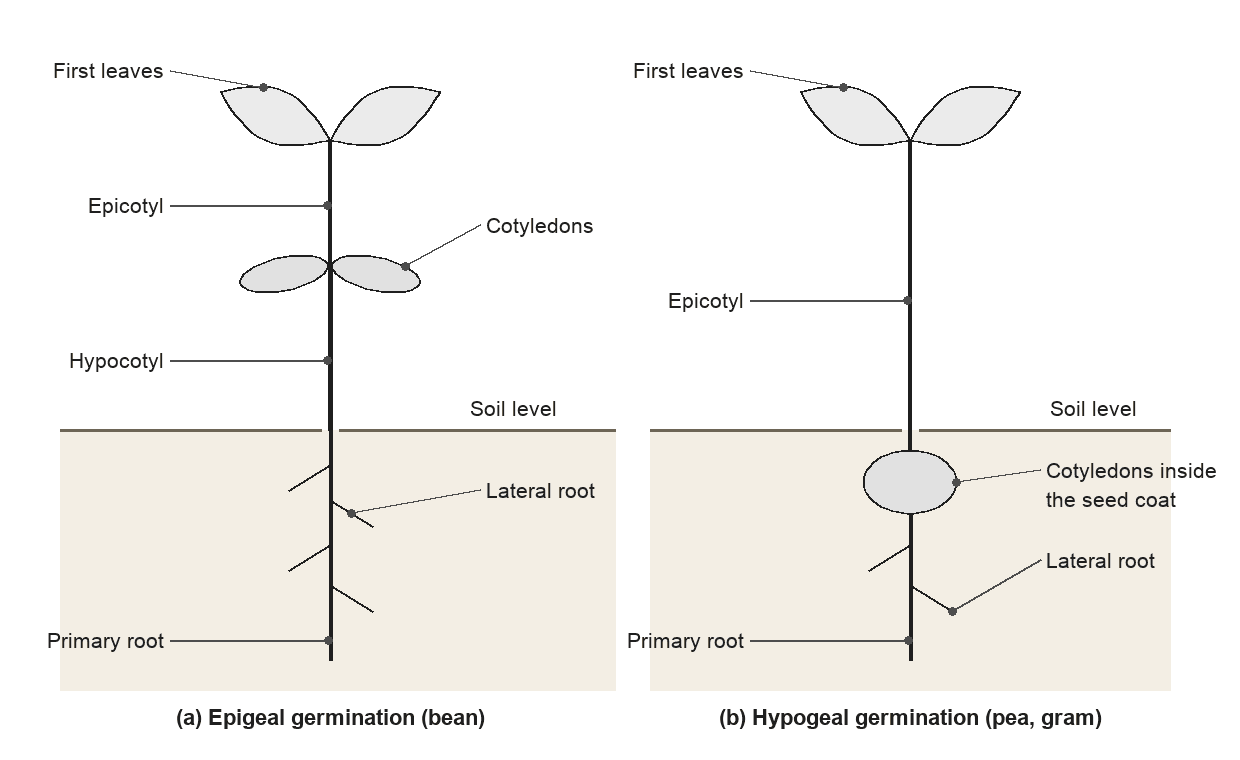
Therefore, in epigeal germination the hypocotyl elongates and lifts the cotyledons above the soil, while in hypogeal germination the epicotyl elongates and the cotyledons stay below.
- 352 marks
Question 35
Differentiate between Hypocotyl and Epicotyl.
Solve with AIWritten solution
Solution:
Concept: The embryo axis is divided by the point where the cotyledons are attached.
Step 1 — Compare them: The table compares the two parts point by point.
Feature Hypocotyl Epicotyl Position Part of the axis just below the cotyledons Part of the axis just above the cotyledons Lies between Cotyledons and radicle Cotyledons and plumule Rapid elongation causes Epigeal germination Hypogeal germination In the seedling Forms the stem between root and cotyledons Forms the stem that carries the first leaves Step 2 — State the key difference: The two parts are told apart only by their position on the axis relative to the point where the cotyledons are attached. Below that point is the hypocotyl, and above it is the epicotyl, so whichever of them elongates decides whether the cotyledons are lifted above the soil.
Therefore, the hypocotyl lies below the cotyledons and its elongation gives epigeal germination, while the epicotyl lies above them and its elongation gives hypogeal germination.
- 362 marks
Question 36
Differentiate between Whole plant and Shoot senescence.
Solve with AIWritten solution
Solution:
Concept: Senescence can involve the whole plant or only a part of it.
Step 1 — Compare them: The table compares the two types point by point.
Feature Whole plant senescence Shoot senescence Part that dies The whole plant: root, stem and leaves Only the shoot above the ground What survives Nothing but the seeds The underground stem and roots, which form a new plant When Once, after flowering and seed production Every year, at the end of the season Examples Wheat, rice, mustard, many bamboos Banana, Gladiolus, alfalfa Step 2 — State the key difference: The difference lies in whether any living part of the plant body is left. In whole plant senescence the plant flowers once and the entire body dies, so the species continues only through its seeds; in shoot senescence the underground perennating organ stays alive and sends up a new shoot in the next favourable season.
Therefore, in whole plant senescence the entire plant dies after seeding, while in shoot senescence only the aerial shoot dies and the underground part survives.
- 375 marks
Question 37
Explain various ways in which the seed dormancy can be broken.
Solve with AIWritten solution
Solution:
Concept: Dormancy has several causes, so the method used to break it depends on the cause: the seed coat, chemical inhibitors, an immature embryo or a need for light or cold.
Step 1 — Soften or break the seed coat: A hard seed coat can be softened by soaking in water, or by the enzymes in the digestive tract of birds and animals that eat the seeds. Soil microorganisms also break down some seed coats.
Step 2 — Scarify the seed coat: Scarification is scratching or abrading the seed coat, removing the testa or pricking it with a pin. A short dip in hot water or in strong sulphuric acid does the same for very hard coats. Water and oxygen can then enter and the embryo can grow.
Step 3 — Lower the inhibitors: Water-soluble inhibitors are washed out by keeping seeds in running water (leaching). Keeping moist seeds at a low temperature for some weeks (stratification or chilling) lowers their ABA and raises their gibberellin level. Alternating temperatures and chemicals such as potassium nitrate and thiourea also break dormancy in many seeds.
Step 4 — Use growth regulators: Treating seeds with gibberellins breaks dormancy in many seeds, because gibberellin works against ABA and starts germination. Cytokinins and ethylene break it in some seeds (ethylene, for example, in groundnut).
Step 5 — Give light: Seeds that need light, such as lettuce and tobacco, are exposed to light after soaking; red light is the effective part.
Step 6 — Allow after-ripening: Seeds whose embryo is immature, or which need further changes after shedding, are simply stored for some weeks or months (after-ripening). During this time the embryo completes its growth and the seed becomes able to germinate.
Therefore, seed dormancy is broken by softening or scarifying the seed coat, by leaching, chilling or chemicals, by growth regulators such as gibberellins, by giving light, and by after-ripening, as the cause of dormancy needs.
- 385 marks
Question 38
How do the seeds of plants growing in marshy land germinate?
Solve with AIWritten solution
Solution:
Concept: Plants of salty, tidal marshes (mangroves) face mud that is soft, waterlogged and salty, and tides that would carry away any seed that drops. Many of them show vivipary.
Step 1 — Name the kind of germination: Seeds of mangroves such as Rhizophora, Bruguiera and Ceriops show vivipary: they germinate while the fruit is still attached to the parent plant.
Step 2 — Describe germination on the tree: The seed does not rest after it forms. It germinates inside the fruit, nourished by the parent plant, and the radicle comes out of the fruit.
Step 3 — Describe seedling growth: The axis of the seedling grows into a long, heavy, spear-like structure hanging from the fruit; this part is mainly the hypocotyl, with the radicle at its lower tip.
Step 4 — Describe establishment: The seedling then falls. When it lodges in the mud, its radicle quickly gives out roots, while the plumule and the upper part stay above the salt water.
Step 5 — State the advantage: Because the seedling is already grown, it roots soon after it settles, so it is less likely to be drifted away by the tidal currents than a small seed, and a new plant forms in much less time.
Note: Sonneratia and Heritiera are mangroves too, but their seeds are shed before they germinate, so the clear examples of vivipary are Rhizophora, Bruguiera and Ceriops.
Note: Not every seedling plants itself where it falls. Many fall when the tide is in, float and are carried by the water, sometimes for weeks, and root only when they are stranded on mud. Because the seedling is already well grown, it roots soon after it settles, which is what helps it establish in tidal mud.
Therefore, seeds of marshland (mangrove) plants show vivipary: they germinate on the parent plant and the grown seedling drops, roots quickly once it lodges in mud and so is less likely to be washed away.
- 395 marks
Question 39
How is the stored food made available to the embryo in a seed?
Solve with AIWritten solution
Solution:
Concept: Food in a seed is stored as insoluble starch, proteins and lipids in the endosperm (as in barley) or in the cotyledons. It must be digested into soluble substances before it can reach the embryo. This is mobilisation of reserves.
Step 1 — Imbibition: The seed takes in water by imbibition, swells and restarts its metabolism.
Step 2 — Hormone signal: The embryo becomes active and secretes gibberellins, which diffuse to the aleurone layer (the outer layer of the endosperm in a cereal grain).
Step 3 — Enzyme synthesis: In the aleurone layer gibberellins cause the synthesis of α-amylase and other hydrolysing enzymes; respiratory enzymes already present are activated.
Step 4 — Digestion of food: The hydrolysing enzymes diffuse into the food store and break the food into water-soluble products: starch to sugars (amylases), proteins to amino acids (proteases), and lipids to fatty acids and glycerol (lipases).
Step 5 — Translocation and use: The soluble products are absorbed and moved to the embryo through the cotyledon (the scutellum in cereals). The embryo uses them for respiration and to build new cells, so it grows into a seedling.
Therefore, stored food reaches the embryo through imbibition, gibberellin secretion by the embryo, enzyme synthesis in the aleurone layer, hydrolysis of food into soluble products, and their translocation to the embryo.
- 405 marks
Question 40
What is senescence? How does it occur in various plants?
Solve with AIWritten solution
Solution:
Concept: Senescence is the gradual decline in the smooth functioning of an organ or organism, ending in its death. It is the period between full maturity and death, and it may affect the whole plant or only a part.
Step 1 — Describe the changes: During senescence functional capacity falls, cell breakdown and cell loss increase, toxic and waste materials build up, dry weight falls and mistakes in protein synthesis increase. It is controlled by hormones; for example, cytokinins delay the senescence of leaves.
Step 2 — Whole plant senescence: The whole plant (root, stem and leaves) ages together and dies after producing seeds, as in beans, soybean, wheat, rice, gram and mustard. Many bamboos and the true sago palm (Metroxylon) live for years, flower once and then die.
Step 3 — Progressive (sequential) senescence: Parts die in a fixed order: older leaves first, then lateral organs and branches, while the main shoot and the roots stay alive and keep forming new parts. This is seen in many perennial plants.
Step 4 — Shoot senescence: Only the above-ground shoot dies each year; the underground stem and roots survive and form a new plant in the favourable season, as in banana, Gladiolus and alfalfa.
Step 5 — Simultaneous (synchronous) senescence: All the leaves are shed at the same time, as in temperate deciduous trees such as elm and maple in autumn.
Therefore, senescence is the gradual decline that ends in death, and it occurs as whole plant, progressive, shoot or simultaneous senescence in different plants.
- 415 marks
Question 41
Explain various steps during epigeal germination in a lima bean seed.
Solve with AIWritten solution
Solution:
Concept: In epigeal germination the hypocotyl (the part just below the cotyledons) elongates rapidly and lifts the cotyledons above the soil.
Step 1 — Swelling and emergence of the radicle: The seed absorbs water and swells. The seed coat bursts and the radicle comes out.
Step 2 — Root growth: The radicle grows downwards into the soil and forms the primary root, from which lateral roots soon arise.
Step 3 — Hypocotyl loop: The hypocotyl elongates and forms a loop (hook) that pushes up through the soil, so the delicate plumule and cotyledons are pulled up behind it and are not damaged.
Step 4 — Cotyledons above the soil: The hypocotyl straightens and lifts the cotyledons above the ground. The seed coat drops off and the plumule comes out from between the cotyledons.
Step 5 — Leaves and fall of cotyledons: The epicotyl elongates and the first leaves unfold and start photosynthesis. The cotyledons turn green in the light, pass their food to the seedling, then shrivel and fall off.
Step 6 — Show the seedling: The labelled figure shows the seedling at the end of epigeal germination (panel a) beside a hypogeal seedling for comparison (panel b).
Therefore, in epigeal germination of lima bean the radicle emerges and forms roots, the hypocotyl loops and straightens to lift the cotyledons above the soil, and the plumule grows into the leafy shoot.
- 425 marks
Question 42
What kind of germination is shown by a maize seed? Explain.
Solve with AIWritten solution
Solution:
Concept: A maize grain is a one-seeded fruit; its food is stored in the endosperm, and its single cotyledon (scutellum) absorbs this food. The radicle is covered by a sheath (coleorhiza) and the plumule by a sheath (coleoptile).
Step 1 — Name the kind: A maize grain shows hypogeal germination: the grain with its cotyledon stays below the soil.
Step 2 — Swelling and radicle: The grain absorbs moisture and swells, the seed coat splits, and the radicle pierces the coleorhiza and comes out.
Step 3 — Roots: The radicle grows down and forms the primary root. Adventitious roots also arise from the base of the axis, and later many more appear, forming a fibrous root system.
Step 4 — Shoot: The coleoptile grows straight up through the soil, protecting the plumule. Above the soil the plumule grows out of the coleoptile, and the axis above the grain elongates, so the grain itself remains in the ground.
Step 5 — Leaves and food: The foliage leaves appear and start photosynthesis. Meanwhile the scutellum absorbs the food from the endosperm for the seedling until the food stored in the endosperm is used up.
Note: In grasses such as maize the part of the axis that elongates between the grain and the coleoptile is strictly called the mesocotyl; it plays the role of the epicotyl in hypogeal germination.
Therefore, maize shows hypogeal germination: the grain stays in the soil while the coleoptile and plumule grow up, and the radicle and adventitious roots grow down.
- 435 marks
Question 43
What is vivipary? Explain.
Solve with AIWritten solution
Solution:
Concept: Vivipary is a special kind of germination in which the seed germinates while it is still inside the fruit and attached to the parent plant, which nourishes it. It is an adaptation of mangroves of salty, tidal marshes.
Step 1 — Give the examples: Vivipary is seen in mangroves such as Rhizophora, Bruguiera and Ceriops, which grow on sea coasts and in marshy land.
Step 2 — Germination on the parent: The seed has no resting stage. It germinates inside the fruit while the fruit hangs on the tree, and the radicle comes out of the fruit.
Step 3 — Growth of the seedling: The seedling grows a long, heavy, spear-like axis (mainly the hypocotyl, with the radicle at its tip), still fed by the parent plant. The plant can be seen bearing fruits with seedlings hanging from them.
Step 4 — Fall and establishment: When it is ready, the seedling breaks away and drops into the marsh. In Rhizophora the cotyledons stay behind inside the fruit on the tree, so what falls is the hypocotyl with the plumule at its upper end. When it lodges in the mud, the radicle quickly gives out roots and fixes it, while the plumule stays above the salt water.
Step 5 — Advantages: The grown seedling roots soon after it settles, so it is less likely to be drifted away by the tides than a small seed; it avoids the problem of germinating in salty, airless mud; and a new plant is established in much less time.
Note: Sonneratia and Heritiera are mangroves too, but their seeds are shed before they germinate, so they are not examples of vivipary.
Note: Not every seedling plants itself where it falls. Many fall when the tide is in, float and are carried by the water, sometimes for weeks, and root only when they are stranded on mud. Because the seedling is already well grown, it roots soon after it settles, which is what helps it establish in tidal mud.
Therefore, vivipary is the germination of a seed on the parent plant, as in Rhizophora, which lets the grown seedling root quickly in tidal mud.
What Class 11 Biology Ch 21 covers
The sections of the chapter, in the order the book takes them. Every question above comes from one of these.
- 01Seed Dormancy
- 02Seed Germination
- 03Kinds of Germination
- 04Senescence
- 05Abscission
More ways to study this chapter
The same chapter asked three other ways. Practise it, revise it, and see what the board has set on Ch 21 before.
Class 11 Biology Ch 21 questions students ask
How many questions are there in Class 11 Biology Ch 21?
43 questions. Every one is solved step by step on this page.
Are these Class 11 Biology solutions free?
Yes. Every question and its full working is free to read, with no account needed.
Can I download the Class 11 Biology Ch 21 solutions as a PDF?
There is no PDF to download. Every solution is on this page instead, which means it is searchable, always the current syllabus, and readable on a phone. Use your browser's print option if you want it on paper.