
Opening your dashboard
Class 11 Biology Chapter 21 Seed Dormancy: Practice Questions
80 questions on Chapter 21, each worked through on its own page with the AI tutor. Class 11 Biology, ICSE 2026-27.
80 questions
1–5 marks · Mixed difficulty
- 11 mark
Question 1
(Hypothetical data.) Seeds of a cereal were kept dry in a sealed jar for a year and none of them germinated. When the same seeds were sown in moist soil at 27 °C, 94 out of 100 germinated within three days. Their failure to germinate in the jar is best described as
- 21 mark
Question 2
Freshly shed seeds of a plant have an embryo that is still structurally immature and unable to make enough gibberellin. Which treatment is most likely to make these seeds germinate soon after shedding?
- 33 marks
Question 3
(Hypothetical data.) A seed technologist tested a batch of hard seeds of a wild legume. For each treatment 50 seeds were used, and all were then kept on moist filter paper at 27 °C for 10 days. The results are given below.
Treatment Seeds germinated (out of 50) P: no treatment 3 Q: soaked in water at room temperature for 24 hours 5 R: seed coat nicked with a blade, embryo not harmed 46 S: seed coat rubbed with sandpaper 44 (a) Calculate the germination percentage for each treatment.
(b) Using the data, identify the most likely cause of dormancy in these seeds.
(c) Explain why treatments R and S were successful.
- 43 marks
Question 4
(Hypothetical data.) Seeds of a temperate tree were kept moist at 4 °C (moist chilling, also called stratification) for different numbers of days and were then moved to 25 °C. The graph shows the percentage that germinated in each batch of 100 seeds.

(a) What is the shortest chilling period tested that gave at least 80% germination?
(b) By how many percentage points did germination rise between 0 days and 60 days of chilling?
(c) Explain how chilling breaks the dormancy of these seeds, and why this response is useful to the tree in nature.
- 52 marks
Question 5
(Hypothetical data.) In a desert, the seeds of an annual herb do not germinate after a light shower of about 5 mm of rain, but germinate in large numbers after a heavy rain of about 30 mm. Their seed coats contain a water-soluble germination inhibitor.
(a) Explain why only the heavy rain makes the seeds germinate.
(b) How does this behaviour help the seedlings to survive?
- 61 mark
Question 6
(Hypothetical data.) Embryos were taken out of young, developing cotton seeds and grown on a nutrient medium without any added hormone. These embryos kept growing with no dormancy. Embryos on the same medium with abscisic acid (ABA) added stopped growing. What does this experiment show?
- 72 marks
Question 7
A national seed bank dries the seeds of crop varieties to a low moisture content and stores them in sealed packets at about −18 °C. Every few years a sample of each packet is tested for germination.
(a) Explain how drying and cold storage help the seeds stay alive for many years.
(b) Before the test, seeds of some species are first given a treatment such as chilling or scarification. Why is this necessary?
- 81 mark
Question 8
(Hypothetical data.) Soaked seeds of a weed germinated well on wet filter paper in light, but hardly at all in a dark cupboard at the same temperature. On a farm, the same seeds lay buried 10 cm deep for years without germinating, and germinated soon after ploughing brought them to the surface. The best explanation is that these seeds
- 93 marks
Question 9
(Hypothetical data.) Seeds of a wild fruit tree were collected from bird droppings and, separately, from ripe fruits still on the tree. Out of 100 seeds of each kind, 72 seeds from droppings and 9 seeds taken from fruits germinated within 15 days under the same conditions.
(a) How many times better was germination of the seeds from droppings? Suggest how passage through the bird's gut produced this difference.
(b) State two ways in which eating of its fruits by birds benefits the tree.
- 103 marks
Question 10
(Hypothetical data.) Two sets of 20 dry pea seeds, each of mass 10.0 g, were soaked in water. Set L was alive; set B had first been killed by heating the dry seeds in an oven and then cooled, so its seeds were dead. Both sets were weighed (after blotting) at intervals. Radicles appeared in set L at about 30 hours; no seed of set B germinated.

(a) From the graph, calculate the percentage increase in mass of each set at 24 hours.
(b) Explain why the dead seeds of set B also gained mass.
(c) Explain why only set L kept gaining mass after 24 hours.
- 111 mark
Question 11
Equal masses of dry seeds of a bean (rich in starch and protein) and of groundnut kernels (about half their mass is oil) were soaked in water for 12 hours. Which result is expected, and why?
- 123 marks
Question 12
(Hypothetical data.) Four sets of 25 gram seeds were set up and observed for 7 days.
Set Conditions Seeds germinated W dry cotton wool, room temperature (28 °C) 0 X moist cotton wool, room temperature (28 °C) 24 Y moist cotton wool in a refrigerator (4 °C) 1 Z covered by boiled and cooled water with a thin layer of oil on top, 28 °C 0 (a) Calculate the germination percentage of set X.
(b) Name the condition for germination that was missing in each of sets W, Y and Z, giving a reason in each case.
- 131 mark
Question 13
A farmer sows rice seeds and bean seeds in the same flooded nursery bed. The rice germinates under the water, but most of the bean seeds rot without germinating. The best explanation is that
- 144 marks
Question 14
(Hypothetical data.) Barley grains were cut in half and the halves were placed, cut face down, on starch agar for 2 days. The agar was then flooded with iodine solution. A clear zone (not blue-black) around a half-grain shows that the starch there has been digested.
Plate Placed on the agar Width of clear zone (mm) 1 half-grains with the embryo 12 2 half-grains without the embryo 0 3 half-grains without the embryo, on agar containing gibberellic acid 11 4 half-grains without the embryo and with the aleurone layer scraped off, on agar containing gibberellic acid 0 (a) What does a clear zone show about the half-grain?
(b) What do plates 1 and 2, taken together, show about the embryo?
(c) What do plates 2 and 3 show?
(d) What does plate 4 show?
- 151 mark
Question 15
(Hypothetical data.) Germination of 100 seeds of a crop was tested at six temperatures, all other conditions being the same.
Temperature (°C) 5 15 25 30 40 45 Germination (%) 6 48 88 93 31 0 Which conclusion is best supported by these data?
- 162 marks
Question 16
(Hypothetical data.) Two vacuum flasks were filled with soaked pea seeds. Flask A had living seeds; flask B had seeds that had been boiled and then rinsed in a mild antiseptic. After 48 hours the thermometer in flask A read 31 °C and that in flask B read 24 °C, the same as the room.
(a) Explain the rise in temperature in flask A.
(b) Why were the seeds in flask B rinsed in antiseptic?
- 173 marks
Question 17
(Hypothetical data.) In a developing pea seed, 70 g of every 100 g of fresh mass was water. In the mature seed at the time of shedding, only 12 g of every 100 g was water, and the seed coat had become hard.
(a) Explain how the loss of water helps the seed to survive until conditions are favourable.
(b) How does the hardening of the seed coat help?
(c) The embryo in such a seed is described as being in a state of suspended animation. What does this mean?
- 181 mark
Question 18
On a school garden visit, a student sees a seedling whose two thick, green, leaf-like cotyledons stand about 5 cm above the soil on a stalk, with its first true leaves just opening between them. Which statement correctly describes this seedling?
- 194 marks
Question 19
(Hypothetical data.) Two young seedlings, X and Y, growing in transparent jars of moist sawdust, were marked with waterproof ink at three points: the junction of root and stem, the node where the cotyledons are attached, and just below the first foliage leaves. The distances between marks were measured on day 1 and day 7.
Seedling Junction of root and stem → cotyledon node (mm), day 1 → day 7 Cotyledon node → first leaves (mm), day 1 → day 7 X 4 → 62 3 → 9 Y 3 → 4 5 → 70 (a) Calculate the increase in length of each region in X and in Y.
(b) Name the region of the axis measured in each column.
(c) State, with a reason, which seedling showed epigeal germination and which showed hypogeal germination, and where the cotyledons of each would be found if they were grown in soil.
- 201 mark
Question 20
In a maize seedling a few days old, the first structure to push up through the soil surface is a pointed, closed sheath that protects the young leaves inside it. This structure is the
- 212 marks
Question 21
When a French bean seedling emerges from the soil, its hypocotyl is first bent into a hook (loop), with the cotyledons trailing below the bend. Explain why this shape is useful, and state what happens to the hook once it reaches the light.
- 223 marks
Question 22
Mangrove restoration workers on a coastal mudflat collect the long, spear-like seedlings hanging from Rhizophora trees and push the pointed lower end of each into the soft mud.
(a) Which part of the seedling forms most of this long spear, and where did the seed germinate?
(b) Give two features of the mangrove habitat that make normal germination of seeds in the soil difficult.
(c) Explain how this type of germination helps the young plants overcome these problems.
- 231 mark
Question 23
A student studies four germinating plants. In which one does the young seedling, during its germination, keep drawing water and food from the parent plant instead of from the soil?
- 243 marks
Question 24
Farmers usually sow French bean seeds at a shallower depth than gram (chickpea) seeds. A hard crust on the soil surface after heavy rain also harms the emergence of French bean seedlings much more than that of gram seedlings. Explain both observations using the type of germination of each crop.
- 252 marks
Question 25
The cotyledons of a sunflower seedling turn green a day or two after they come above the soil, but those of a gram seedling never turn green. Explain this difference, and state what finally happens to the cotyledons of both seedlings.
- 261 mark
Question 26
(Hypothetical data.) In a forest plot, a bamboo clump grew for 40 years without flowering. In its 41st year every stem of the clump flowered and set seed, and then the entire clump, including its underground parts, died. This bamboo shows
- 274 marks
Question 27
During a year-long field study, a student wrote the following notes. Name the type of senescence shown in each, giving one reason.
(a) A mustard field: after the pods ripened, every plant, including its roots, stem and leaves, dried up and died together.
(b) A turmeric bed: each winter all the leafy shoots died back, but the underground rhizomes stayed alive and sprouted again after the rains.
(c) A maple tree in a hill garden: in autumn all its leaves changed colour and were shed within a few weeks, leaving the tree bare.
(d) A perennial shrub: the lowest, oldest leaves yellowed and dropped first, then some side branches died, while new leaves kept forming at the shoot tip.
- 283 marks
Question 28
(Hypothetical data.) Discs cut from mature green leaves were floated in two dishes kept in the dark: one on plain water and the other on a dilute solution of kinetin (a cytokinin). The graph shows the mean chlorophyll content per disc.
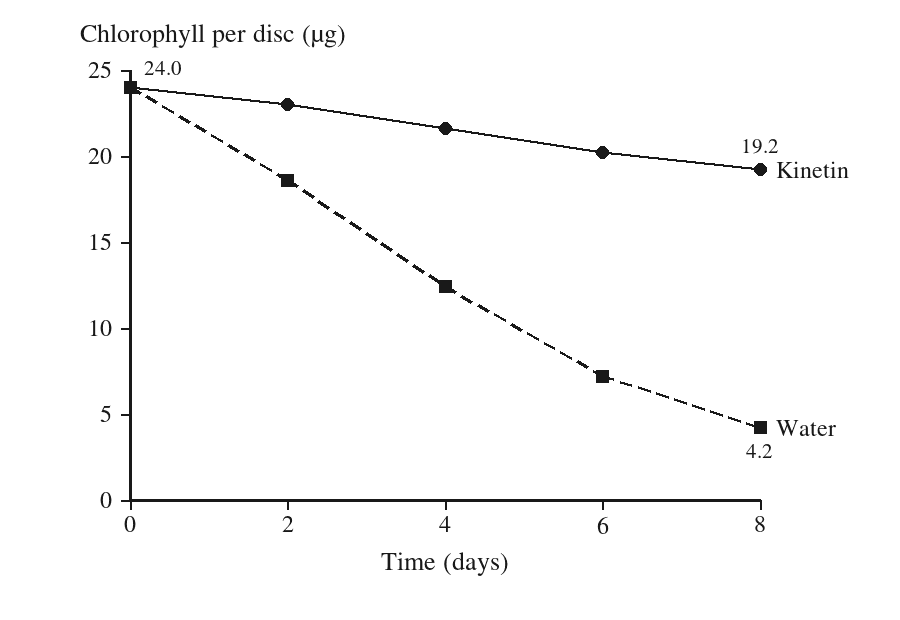
(a) Calculate the percentage of the day-0 chlorophyll left on day 8 in each dish.
(b) What does the change in the discs on water show?
(c) What do the results show about the role of cytokinins in leaves?
- 291 mark
Question 29
(Hypothetical data.) The rate of photosynthesis of one leaf of a tree was measured from the week it unfolded.
Week 1 3 5 7 9 11 13 15 Rate (arbitrary units) 4 11 18 20 20 15 8 2 During which period was the leaf senescent?
- 302 marks
Question 30
(Hypothetical data.) A fully green leaf of a deciduous tree contained 12.0 mg of nitrogen in summer. A leaf of the same size from the same tree, collected just as it fell in autumn, contained 4.8 mg of nitrogen.
(a) What percentage of the leaf's nitrogen was withdrawn before the leaf fell?
(b) Explain why this withdrawal is an advantage to the tree.
- 311 mark
Question 31
In temperate regions the soil water may stay frozen for weeks in winter. How does shedding all their leaves in autumn help deciduous trees survive such winters?
- 323 marks
Question 32
(Hypothetical data.) In a soybean field, plants left alone turned yellow and died about 30 days after their pods began to fill. On neighbouring plants every young pod was removed as soon as it formed, and these plants stayed green for about 60 days longer.
(a) Name the type of senescence shown by the plants left alone.
(b) Suggest why removing the pods delayed senescence.
(c) State one advantage of this type of senescence to the species.
- 331 mark
Question 33
Which of the following is an example of senescence rather than abscission?
- 341 mark
Question 34
A florist wants cut leafy branches to stay green for longer. Which treatment is most likely to delay the senescence of their leaves?
- 353 marks
Question 35
A 60-year-old mango tree loses old leaves and grows new ones every year, and it flowers and fruits again and again. A wheat plant, by contrast, dies a few weeks after its grain ripens.
(a) Name the type of senescence shown by each plant.
(b) For each plant, state where the useful substances from its senescing parts are sent.
- 362 marks
Question 36
For a leaf that is entering senescence, state whether each of the following increases or decreases, with a reason.
(a) Its functional capacity
(b) The breakdown of its cell contents
(c) Its dry weight
(d) The loss of its cells compared with their replacement
- 373 marks
Question 37
A student says that senescence is simply a plant "wearing out" by accident. Give three observations of plants that show that senescence is a controlled, regulated process.
- 382 marks
Question 38
In a tall perennial plant growing in a crowded bed, the lowest leaves, which are the oldest and the most shaded, turn yellow and fall first. Give two ways in which this pattern of senescence benefits the plant.
- 391 mark
Question 39
A gardener plucks a green leaf from a shrub and sees a ragged, moist wound on the stem. A leaf of the same shrub that falls naturally in autumn leaves a smooth, dry scar. What explains the difference?
- 404 marks
Question 40
The diagram shows the base of a leaf attached to a stem shortly before the leaf falls in autumn.
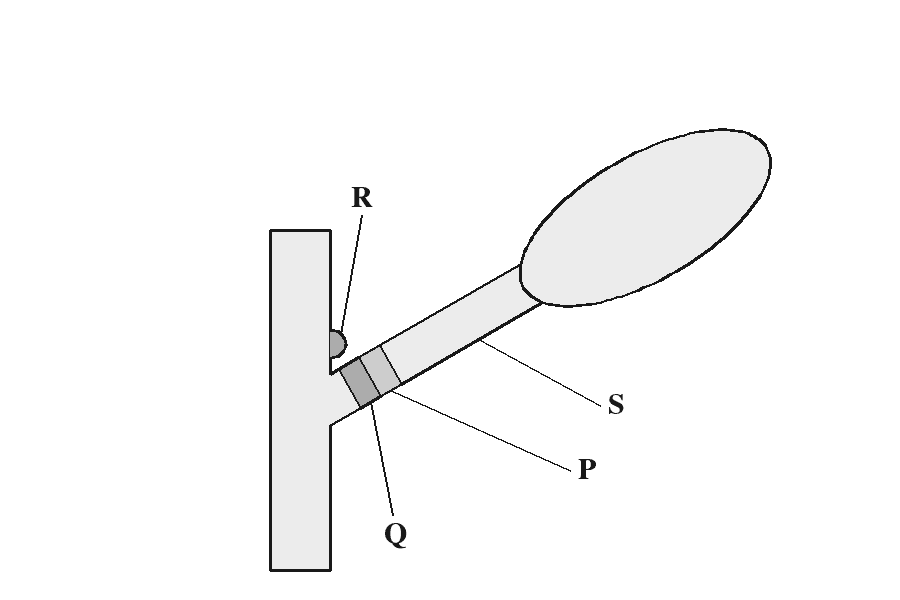
(a) Identify the parts labelled P, Q, R and S.
(b) Explain why it matters that layer Q lies on the stem side of the zone and layer P on the leaf side.
(c) What will happen to part R after the leaf has fallen?
- 414 marks
Question 41
(Hypothetical data.) Forty similar mature leaves on Coleus plants were divided into four groups of ten:
A — leaves left intact;
B — leaf blade cut off and the cut end of the petiole covered with plain lanolin paste;
C — leaf blade cut off and the cut end covered with lanolin paste containing auxin;
D — leaf blade cut off and the cut end covered with lanolin paste containing a chemical that releases ethylene.
The bar chart shows the mean number of days until the leaf (A) or the petiole (B, C, D) fell.

(a) How many days sooner did the petioles of group B fall than the leaves of group A?
(b) What does the comparison of A and B suggest about the leaf blade, and why was plain lanolin used in B?
(c) What do the results of C and D show about auxin and ethylene?
- 421 mark
Question 42
(Hypothetical data.) In a laboratory, the bases of petioles of bean leaves were treated with a chemical that blocks the activity of pectinase. What is the most likely result?
- 432 marks
Question 43
In autumn, a light breeze is enough to bring down the leaves of a deciduous tree, yet the same leaves stayed on through strong summer storms. Explain why.
- 441 mark
Question 44
(Hypothetical data.) In an apple orchard in Himachal Pradesh, many nearly ripe apples drop from the trees before they can be picked. Two weeks before harvest, a horticulturist sprays the trees with a dilute solution of a synthetic auxin (NAA). What effect is expected, and why?
- 453 marks
Question 45
(Hypothetical data.) The table shows the relative levels of auxin and abscisic acid (ABA) in the stalks of mango fruits as the fruits ripened, and the percentage of fruits that had dropped by each week.
Week 0 2 4 6 8 Auxin (relative units) 100 80 55 30 15 ABA (relative units) 10 20 45 70 90 Fruits dropped (%) 0 1 6 25 60 (a) Describe how the levels of the two hormones change during ripening.
(b) Calculate the ratio of auxin to ABA at week 0 and at week 8.
(c) Relate the change in the hormone balance to the dropping of fruits, and state one limit to what these data can prove.
- 461 mark
Question 46
Which of the following is NOT an example of abscission?
- 472 marks
Question 47
(Hypothetical data.) In a city park, a deciduous tree standing next to a bright street lamp kept the leaves on its lamp-facing branches for about three weeks longer in autumn than identical trees farther from the lamp. Shortening days and falling temperatures in autumn act as signals that start leaf senescence and abscission. Suggest an explanation for the observation.
- 483 marks
Question 48
The following events take place when a leaf is shed. They are given in a jumbled order.
P — The auxin coming from the ageing leaf blade decreases.
Q — Wind or the weight of the leaf breaks the weakened connection.
R — Pectinases digest the middle lamella of the separation cells, and cellulases soften their walls.
S — A separation layer and a protective layer of cells form at the base of the petiole.
T — The scar left on the stem is sealed.
(a) Arrange the events in the correct order.
(b) Explain why event R makes event Q possible.
(c) Why is event T important to the plant?
- 491 mark
Question 49
A student claims that leaf fall is purely mechanical: the wind simply tears old leaves off. Which observation best shows that this claim is wrong?
- 503 marks
Question 50
Abscission is not limited to leaves.
(a) The petals of many flowers fall soon after the flower has been pollinated. Suggest one advantage of this to the plant.
(b) Under severe drought, a cotton plant sheds many of its young flower buds and developing bolls (fruits). Suggest how this helps the plant.
(c) When fruits are ripe they fall from the plant. How does this help the plant species?
- 511 mark
Question 51
Which one is not a cause of seed dormancy?
- 521 mark
Question 52
Which one of the following helps in breaking seed dormancy?
- 531 mark
Question 53
The following is true of epigeal germination?
- 541 mark
Question 54
Viviparity refers to
- 551 mark
Question 55
Temperate deciduous trees show
- 561 mark
Question 56
Seeds of some plants are unable to germinate even when conditions are favourable. This is called
- 571 mark
Question 57
Which method out of the following makes the seed coat permeable to water so that embryo expansion is not physically retarded?
- 581 mark
Question 58
After imbibition of water, hormone released by the embryo to mobilize the stored food material is
- 591 mark
Question 59
Progressive or sequential senescence is shown by
- 601 mark
Question 60
________ refers to suspension of growth due to exogenous control.
- 611 mark
Question 61
Cotyledons remain below the soil and ________ elongates in ________ germination.
- 621 mark
Question 62
When embryo becomes active by imbibing water, it secretes ________ hormone.
- 631 mark
Question 63
In epigeal germination, there is rapid elongation of ________ .
- 641 mark
Question 64
________ is germination of a seed while it is still attached to the parent plant.
- 651 mark
Question 65
In a seed, the suspension of growth due to exogenous factors is called seed dormancy.
- 661 mark
Question 66
A chemical inhibitor such as ethylene, in the embryo is responsible for prevention of seed germination.
- 671 mark
Question 67
Seed coat dormancy can be overcome by scarification.
- 681 mark
Question 68
The concentration of ABA decreases during the seed development and it brings about embryo dormancy.
- 691 mark
Question 69
There is elongation of epicotyl in hypogeal germination.
- 705 marks
Question 70
Match the following:
Column A Column B 1. Quiescence (a) Elongation of epicotyl 2. Seed dormancy (b) Elongation of hypocotyl 3. Imbibition (c) Presence of immature embryo or germination inhibitors 4. Epigeal germination (d) Caused by adsorption of structural molecules 5. Hypogeal germination (e) Due to extreme climate conditions of water and temperature - 711 mark
Question 71
Seed germination in which cotyledons get pushed above the ground.
- 721 mark
Question 72
Scratching of seed coat to break the seed dormancy.
- 731 mark
Question 73
Type of seed germination when it is still inside the fruit and attached to the parent plant.
- 741 mark
Question 74
The changes in this zone at the base of the petiole bring about shedding of the leaves.
- 751 mark
Question 75
Type of senescence seen in banana and Gladioli plants.
- 761 mark
Question 76
Assertion (A): Seed dormancy is a resting state of a seed, in which the metabolic activity of the seed is greatly reduced.
Reason (R): Seed dormancy can be broken by scarification or by softening the seed coat.
- 771 mark
Question 77
Assertion (A): ABA induces seed dormancy while auxins break it.
Reason (R): ABA brings about hardening of the seed coat and it becomes impermeable to water.
- 781 mark
Question 78
Assertion (A): Imbibition of water in a barley seed brings activation of embryo.
Reason (R): Activation of embryo brings immediate secretion of proteases in the seeds.
- 791 mark
Question 79
Assertion (A): In the mangrove plants, the seeds germinate and give out radicle, when still attached to the parent plant.
Reason (R): As the seedlings fall into the marsh land, they quickly give out roots and do not get drifted away.
- 801 mark
Question 80
Assertion (A): Imbibition is initial uptake of water by dehydrated seeds.
Reason (R): Imbibition is caused by adsorption of water by structural molecules like hemicellulose and pectin.