
Opening your dashboard
Class 11 Biology Chapter 21 Seed Dormancy: Competency-Based Questions (CBQ)
40 questions on Chapter 21, each worked through on its own page with the AI tutor. Class 11 Biology, ICSE 2026-27.
40 questions
1–5 marks · Mixed difficulty
- 14 marks
Question 1
A forest-department nursery near Jodhpur raises seedlings of babul, a thorny tree legume whose seeds have a very hard seed coat. Batches of 200 seeds were given four treatments and then sown in moist nursery beds; the seedlings were counted after 21 days. The acid treatments were carried out by trained staff wearing gloves and goggles, and the seeds were washed thoroughly afterwards. (Hypothetical data.)
Treatment Seedlings after 21 days (out of 200) T1: no treatment 12 T2: boiling water poured over the seeds, which were left to soak in it overnight as it cooled 148 T3: soaked in concentrated sulphuric acid for 30 minutes 164 T4: soaked in concentrated sulphuric acid for 120 minutes; cut seeds showed blackened, dead embryos 38 (a) Calculate the germination percentage for each treatment. (1 mark)
(b) Explain why so few untreated seeds germinated although the beds were moist and warm, and how treatments T2 and T3 overcame this. (1 mark)
(c) Explain why T4 gave far fewer seedlings than T3. The nursery must raise 4,100 seedlings this season; how many seeds should it treat by the best method? (2 marks)
- 21 mark
Question 2
Assertion (A): Seeds of many alpine plants of the Himalaya are shed in late summer, yet they do not germinate until the following spring, even when the autumn is mild and moist.
Reason (R): Seedlings that came up in autumn would very likely be killed in the harsh winter, and dormancy delays germination until a season in which the seedlings can survive.
- 34 marks
Question 3
In a wheat-growing district of Punjab, a spell of rain fell on ripe crops just before harvest. A scientist compared two wheat varieties, R and W, grown side by side. (Hypothetical data.)
Measurement Variety R Variety W Grains that sprouted while still on the ears after 3 rainy days (%) 4 46 Abscisic acid (ABA) in the grains at harvest (relative units) 80 25 Germination of grains sown 4 months after harvest (%) 95 96 (a) What was unusual about the germination of the grains of variety W, and why did the rain set it off? (1 mark)
(b) Use the ABA data to explain why variety R sprouted far less on the ears. (1 mark)
(c) A breeder suggests a variety whose grains stay dormant for at least a year after harvest. Using the last row of the table, explain why some dormancy at harvest helps the farmer, but dormancy lasting a year would be a problem. (2 marks)
- 41 mark
Question 4
(Hypothetical data.) A botanist in Bhopal sowed 100 hard-coated seeds of a wild legume, 2 cm deep, in pots of moist garden soil, and another 100, also 2 cm deep, in pots of the same soil that had first been sterilised by heating to kill its microorganisms. All the pots stood side by side in one greenhouse and were watered equally. After four months, 47 seeds had germinated in the garden soil but only 5 in the sterilised soil. The most likely explanation is that
- 54 marks
Question 5
A farmer near Anand brought seed of a fodder grass, collected a month earlier from their own field, to a seed-testing laboratory. The analyst placed 100 seeds on moist paper at 25 °C for 14 days; 31 germinated. All the other 69 seeds had swollen with water. The analyst then cut these 69 seeds and soaked them in tetrazolium solution. This colourless chemical is turned red by the respiratory enzymes of living cells, while dead tissue stays unstained. The embryos of 61 seeds turned red; 8 stayed unstained. (Hypothetical data.)
(a) What percentage of the seeds germinated, and what percentage were alive? (1 mark)
(b) In what state were the 61 seeds with red-stained embryos? Explain why their failure to germinate was not quiescence, and why a hard seed coat was not the cause. (2 marks)
(c) Suggest one treatment likely to make these 61 seeds germinate, giving a reason. (1 mark)
- 64 marks
Question 6
At a malting plant in Jaipur, 100 kg of dry barley grains containing 12% water are steeped (soaked) in tanks for two days. Air is bubbled through the water, and the water is drained off for a few hours each day. At the end of steeping the grains contain 45% water. They are spread on a germination floor at 16 °C for five days, during which the starch-digesting enzymes in the grains rise to their highest level. Finally the grains are dried in a hot kiln, which stops germination; the dried product is called malt. (Hypothetical data.)
(a) Calculate the mass of water taken up by the 100 kg of grains during steeping, and name the process by which dry grains first take up water. (1 mark)
(b) Why is air bubbled through the steeping water, and the water drained off from time to time? (1 mark)
(c) Explain why the maltster stops germination by kilning after five days, instead of letting the seedlings grow on for three weeks. (2 marks)
- 71 mark
Question 7
A grocer in Kochi filled a metal tin to the brim with dry peas and pressed its lid on firmly. During a night of heavy rain, water leaked in through a small hole in the side of the tin. By morning the peas had swollen, none had sprouted, and the lid had been forced off. Which process produced the force that pushed the lid off?
- 84 marks
Question 8
Students at a college in Hyderabad sowed maize grains in moist sand and kept them in a dark room. Every two days they took 20 seedlings, separated each grain's endosperm from its seedling axis (roots and shoot), dried both parts and weighed them. The graph shows the mean dry mass per grain. (Hypothetical data.)
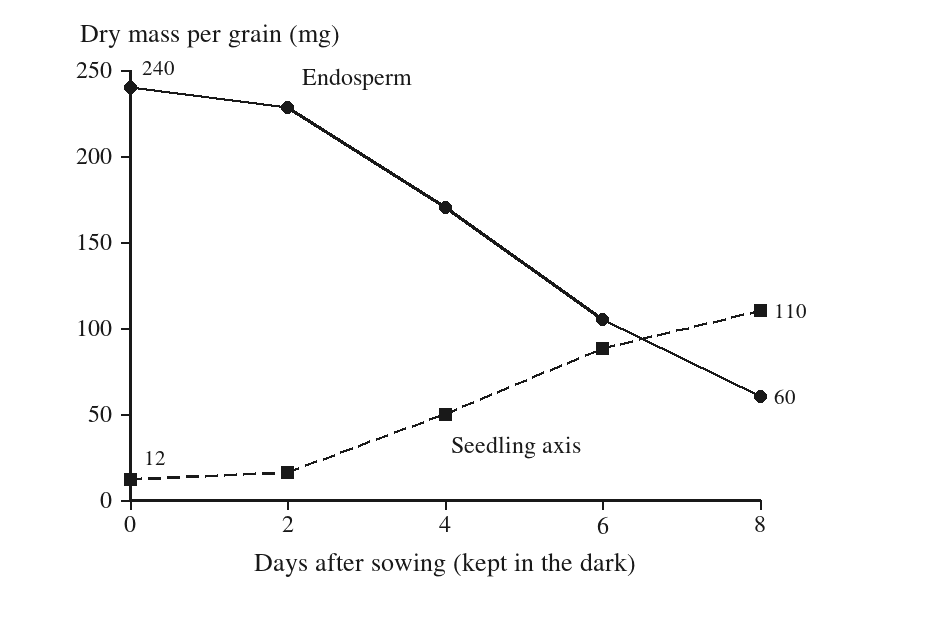
(a) From the graph, find the decrease in dry mass of the endosperm and the increase in dry mass of the seedling axis between day 0 and day 8. (1 mark)
(b) Explain why the seedling axis gained much less dry mass than the endosperm lost. (1 mark)
(c) Predict how each curve would have differed after day 4 if the seedlings had been moved into bright light on day 4 (assume the shoots emerge into the light by about day 5). Give a reason for each prediction. (2 marks)
- 91 mark
Question 9
(Hypothetical data.) A food-science laboratory in Indore let green gram (moong) seeds sprout for 48 hours. For every 100 g of dry seed, the stored protein fell from 24 g to 19 g, while the free amino acids rose from 1.0 g to 4.6 g. Which enzymes were mainly responsible for this change?
- 101 mark
Question 10
Assertion (A): In germinating mustard seeds, the activity of the enzyme lipase rises sharply during the first few days.
Reason (R): Lipases break down the starch stored in the seed into glucose, which is then carried to the growing embryo.
- 114 marks
Question 11
On a farm near Shillong, a hailstorm broke off ten-day-old seedlings of pea and of French bean exactly at soil level. In both plants a small bud lies in the axil of each cotyledon, where the cotyledon joins the seedling axis. The farmer counted how many broken seedlings sent up new shoots within two weeks. (Hypothetical data.)
Crop Seedlings broken at soil level Seedlings that sent up new shoots Pea 50 41 French bean 50 0 (a) Pea shows hypogeal germination and French bean shows epigeal germination. For each crop, state where the cotyledons were when the hail struck and which part of the axis had lengthened. (1 mark)
(b) Calculate the percentage of pea seedlings that sent up new shoots. (1 mark)
(c) Explain why many pea seedlings grew again but no French bean seedling did. (2 marks)
- 121 mark
Question 12
Assertion (A): When castor seeds germinate, their cotyledons are carried above the soil and become the first green, leaf-like organs of the seedling.
Reason (R): Castor seeds store their food mainly in their cotyledons, not in an endosperm.
- 131 mark
Question 13
On a field trip to the Sundarbans, students saw slender, green, pencil-like structures 15–25 cm long hanging downwards from the branches of a Ceriops tree growing in tidal mud. Each had a small fruit at its upper end. These structures are most likely
- 141 mark
Question 14
Assertion (A): When maize grains are sown, each grain stays below the soil surface while the young shoot grows up into the air.
Reason (R): Maize is a monocotyledonous plant.
- 151 mark
Question 15
In a seed-testing laboratory in New Delhi, analysts record a seed as having begun to germinate as soon as its radicle breaks through the seed coat. In most seeds the radicle comes out before the plumule. What is the main advantage of this order to a young seedling in the soil?
- 164 marks
Question 16
Students in Srinagar (about 1,600 m above sea level) measured the pigments in leaves of poplar trees, which are deciduous, from August to November. Chlorophyll is green; carotenoids are yellow-orange pigments present in green leaves all along. The graph shows their results. (Hypothetical data.)
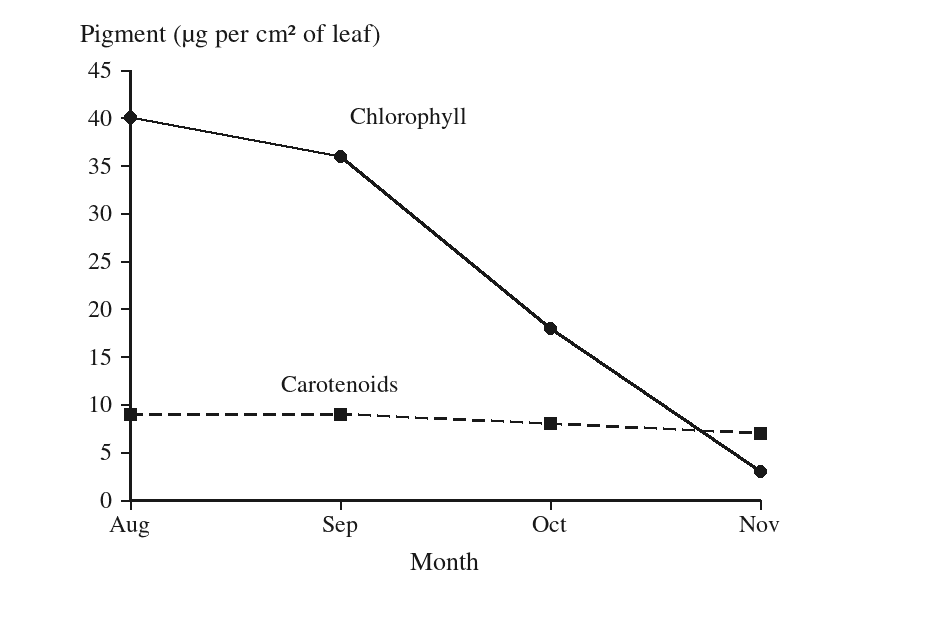
(a) Calculate the percentage of the August chlorophyll content that had been lost by November. (1 mark)
(b) The leaves looked green in August but golden yellow in November, although their carotenoid content had also fallen a little. Explain this, using the ratio of chlorophyll to carotenoids in each month. (1 mark)
(c) In the same year, poplars at Pahalgam (about 2,700 m, where autumn temperatures fall earlier) turned yellow about two weeks earlier. Suggest what this shows about the control of leaf senescence, and give one advantage to the trees of their leaves senescing in autumn. (2 marks)
- 171 mark
Question 17
Assertion (A): A detached leaf of French bean that forms roots at the base of its petiole stays green for weeks, whereas a detached leaf that forms no roots turns yellow within a few days.
Reason (R): Roots are a major site of cytokinin production, and cytokinins delay the senescence of leaves.
- 184 marks
Question 18
On a college campus in Shimla, students placed leaf-litter traps under a horse chestnut tree (a deciduous broad-leaved tree) and under a deodar (an evergreen conifer). Every month they dried and weighed the fallen leaves. (Hypothetical data.)
Months Horse chestnut (g of leaves per m²) Deodar (g of leaves per m²) January to August (total) 20 153 September 30 14 October 160 13 November 80 12 December 10 8 Whole year 300 200 (a) Calculate, for each tree, the percentage of its yearly leaf fall that came down in September to November. (1 mark)
(b) Name the kind of senescence shown by the leaves of each tree, using the data to support your answer. Explain why the deodar stays green all year although it sheds 200 g of leaves per m² a year. (2 marks)
(c) By the following June, the thick layer of fallen horse chestnut leaves had almost disappeared from the ground. Suggest what happened to it and how this benefits the tree. (1 mark)
- 191 mark
Question 19
Assertion (A): Because senescence ends in the death of an organ or of the whole plant, it brings no advantage to the plant.
Reason (R): During senescence, nutrients are withdrawn from the old, ageing parts and directed to the young, growing parts of the plant.
- 201 mark
Question 20
Assertion (A): A chickpea (gram) crop dies completely, roots, stems and leaves, within a few weeks after its pods have ripened.
Reason (R): Chickpea seeds show hypogeal germination.
- 214 marks
Question 21
A plant nursery near Pune kept potted hibiscus plants, in bud, for three days in three rooms before sending them to shops. Ripening bananas give off ethylene gas. Each room held 20 plants at the same temperature. (Hypothetical data.)
Room Conditions Flower buds and leaves shed per plant (mean) 1 closed, with crates of ripening bananas 26 2 closed, with no fruit 2 3 well ventilated, with crates of ripening bananas 5 (a) Which two rooms should be compared to show that the bananas caused the shedding? How many times as many organs were shed in the room with bananas? (1 mark)
(b) Suggest why Room 3 had much less shedding than Room 1, although both held ripening bananas. (1 mark)
(c) Describe the changes at the base of a bud stalk or leaf stalk that lead to its shedding, and say what happens to the scar left behind. (2 marks)
- 221 mark
Question 22
Before machine-picking, some cotton growers in Gujarat spray their crop with a chemical that releases ethylene inside the plant. Within about ten days most of the leaves fall, so the picked cotton is not mixed with leaves. Which statement best explains the leaf fall?
- 234 marks
Question 23
A polyhouse near Pune grows tomatoes. Tomato flowers usually pollinate themselves, but their pollen is released only when the flower is shaken, as by wind or bees; inside the closed polyhouse there is neither. The grower tagged two sets of 200 flowers at the same temperature: set P was left untouched, and in set Q every flower was gently vibrated each morning with a small electric vibrator to release its pollen. After ten days the grower counted the flowers that had dropped off. (Hypothetical data.)
Set Flowers tagged Flowers dropped P: untouched 200 150 Q: vibrated each morning 200 24 (a) Calculate the percentage of flowers dropped in each set. (1 mark)
(b) Developing seeds produce the hormone auxin. Use this fact to explain how pollination reduced flower drop in set Q. (2 marks)
(c) Suggest one advantage to a tomato plant of shedding the flowers that have not been pollinated. (1 mark)
- 241 mark
Question 24
A weeping fig (Ficus benjamina) that had stood for months on a bright verandah in Bengaluru was moved to a dim corner of an office kept at about 24 °C. Within ten days it shed many green leaves, which came off cleanly at the base of their stalks, while its stem, roots and remaining leaves stayed healthy. The best explanation is that
- 251 mark
Question 25
Assertion (A): A leaf separates from the stem because the cells of its protective layer break down and come apart.
Reason (R): In the separation layer, pectinases digest the pectin of the middle lamellae and cellulases soften the cell walls.
- 264 marks
Question 26
Read the sources given and answer any four from the questions given below.
A. Seeds from three plant species were collected from the wild and subjected to different dormancy-breaking treatments in the laboratory. Treatments included scarification (abrasion of seed coat), stratification (exposure to cold temperatures), and application of plant growth regulators. Germination rates were monitored over time to assess the effectiveness of each treatment.
The research findings revealed the following. Species A exhibited optimal germination at lower temperatures and with moderate moisture in soil. Species B showed a preference for continuous light exposure, moderate temperature and low moisture in soil. Species C displayed tolerance to drought conditions but required higher temperatures for germination.
(1) Which environmental factor had the most significant impact on the germination of Species A?
(a) Light exposure
(b) Low wind
(c) Temperature variation
(d) High moisture
(2) Which species exhibited a preference for continuous light exposure?
(a) Species A
(b) Species B
(c) Species C
(d) None of the species
(3) Which environmental factor was not investigated in the case study?
(a) Temperature variation
(b) Light exposure
(c) Wind intensity
(d) Water availability
(4) How did the germination responses of Species A differ from those of Species B?
(a) Species A needed higher temperature than Species B.
(b) Species A needed more water as compared to Species B.
(c) Species A and B showed similar germination responses at high temperature.
(d) Species B germinated in low moisture but not Species A and C.
- 271 mark
Question 27
A student in Nashik noticed that tomato seeds hardly ever sprout inside a ripe tomato, although they lie in moist jelly at a warm temperature. She set up four lots, each of 100 seeds in a covered dish on moist filter paper, all at 25 °C in the same light, and counted the seeds that had germinated after 7 days. (Hypothetical data.)
Lot Seeds and treatment Seeds germinated (out of 100) P Tomato seeds from ripe fruits, with their jelly left on 6 Q Tomato seeds from the same fruits, washed free of jelly in running water 89 R Mustard seeds, filter paper wetted with filtered tomato juice 11 S Mustard seeds, filter paper wetted with water 95 Which conclusion is best supported by these results?
- 281 mark
Question 28
Assertion (A): When testing freshly harvested seeds of some grasses, seed analysts often wet the germination paper with a dilute solution of potassium nitrate, and more of the dormant seeds then germinate.
Reason (R): Nitrate is a source of nitrogen that plants absorb and use to make amino acids and proteins.
- 291 mark
Question 29
Assertion (A): In a field in Haryana whose soil water has become very salty, wheat seeds take up water more slowly than in ordinary soil, and many of them fail to germinate.
Reason (R): A seed gains water only while its water potential is lower (more negative) than the water potential of the soil water around it.
- 301 mark
Question 30
A student writes in her notebook: "All monocot seeds show hypogeal germination, because the single cotyledon always stays inside the seed below the soil." Which one of the following observations, made in a school garden in Lucknow, shows that her claim is wrong?
- 311 mark
Question 31
In a banana plantation near Jalgaon, each banana plant bears one bunch of fruit. After the bunch is cut, the leafy aerial shoot (the pseudostem with its leaves) dries up and is cut down. The farmer does not replant: one sucker that grows from the underground stem of the same plant is allowed to grow on and gives the next crop. Cultivated bananas are seedless. Which statement correctly explains how the farmer gets a second crop?
- 321 mark
Question 32
In a laboratory in Bengaluru, short pieces of bean leaf stalk, each with its abscission zone and a little stem tissue, were kept in air containing ethylene. Every 12 hours some pieces were tested: the activity of the enzyme cellulase in the abscission zone was measured, and so was the break strength, the pull (in grams-weight) needed to break the piece at the zone. Pieces kept in air without ethylene still had a break strength of about 180 g after 48 hours. (Hypothetical data.)
Time in ethylene (hours) 0 12 24 36 48 Cellulase activity (relative units) 4 5 28 66 90 Break strength (g) 180 176 104 34 6 Which conclusion is best supported by these data?
- 332 marks
Question 33
Students at a college in Pune soaked pea seeds in water and measured, every 6 hours, the carbon dioxide given out and the oxygen taken up by the seeds. The radicles broke through the seed coats at about 30 hours. (Hypothetical data.)
Time after soaking (hours) 0 6 12 18 24 30 36 42 48 CO₂ given out (μL per seed per hour) 2 18 24 27 30 40 55 64 70 O₂ taken up (μL per seed per hour) 1 6 8 10 12 28 50 62 68 (a) Calculate the ratio of CO₂ given out to O₂ taken up at 12 hours and at 42 hours. (1 mark)
(b) Explain the change in this ratio between 12 hours and 42 hours. (1 mark)
- 342 marks
Question 34
A vegetable seller in Mumbai sells sprouted moong (green gram). In each sprout, a smooth white stalk about 4 cm long joins a short, thin root at its lower end to the two seed halves (the cotyledons), now mostly free of the green seed coat, at its upper end.
(a) Which part of the seedling forms most of the white stalk? Give a reason based on its position. (1 mark)
(b) If such a sprout were planted in moist soil in a pot and allowed to grow, where would its cotyledons be found, and what type of germination would this be? (1 mark)
- 352 marks
Question 35
A student from Srinagar says: "Trees shed their leaves only to survive cold winters." A classmate from Jabalpur (Madhya Pradesh) replies that in many teak (Tectona grandis) forests near her home the trees stand bare during the hot, dry months of March to May, and put out new leaves at about the start of the monsoon rains.
(a) Evaluate the student's claim, using the classmate's observation. (1 mark)
(b) Explain how shedding its leaves in the dry season helps a teak tree. (1 mark)
- 363 marks
Question 36
A farmer in Bihar found that his wheat field had about 10,000 live seeds per m² of the weed bathua (Chenopodium album) in its soil. From then on he pulled out every bathua seedling each year long before it could flower, so no new seeds were added to the soil. He counted the seedlings he removed. Assume that every seed that did not come up stayed alive in the soil. (Hypothetical data.)
Year 1 2 3 4 Bathua seedlings that came up (per m²) 2,000 1,600 1,280 1,024 (a) For each year, calculate the percentage of the seeds in the soil at the start of that year that came up. (1 mark)
(b) How many seeds per m² were still in the soil at the end of year 4? How many seedlings should the farmer expect in year 5? (1 mark)
(c) Explain how this pattern of germination helps the weed to survive, and what it means for the farmer. (1 mark)
- 373 marks
Question 37
Farmers in a dry district of Madhya Pradesh are advised to "prime" chickpea seed before sowing: soak the seed in water overnight (about 8 hours), let it dry on the surface in the shade for an hour so the seeds do not stick together, and sow it the same day. A trial on one farm gave these results. (Hypothetical data.)
Seed Days taken to reach half of the final emergence Final emergence (%) Not primed 7 70 Primed 5 85 (a) For every 1,000 seeds sown, how many more seedlings came up from the primed seed? (1 mark)
(b) Explain why the primed seed emerged about two days earlier. (1 mark)
(c) Farmers are told never to soak the seed until the radicle peeps out, and never to store primed seed for weeks before sowing. Give a reason for each instruction. (1 mark)
- 383 marks
Question 38
A seed company in Indore has developed a new pulse variety. Before selling it, the company must tell farmers two things: whether the variety shows epigeal or hypogeal germination, and whether its cotyledons supply stored food to the young seedling after germination. You are asked to plan simple tests using seeds of the variety, soil, transparent containers and a waterproof marker pen.
(a) Describe how you would find out the type of germination, and what you would look for. (1 mark)
(b) Describe a fair test to find out whether the cotyledons feed the young seedling. (1 mark)
(c) State the result that would show that the cotyledons do supply food, and why. (1 mark)
- 395 marks
Question 39
A forest nursery in Uttarakhand raises seedlings of a hill tree for planting on bare slopes. Its seeds have hard coats and are shed in autumn; in the wild they come up only in spring, after lying in cold, wet soil through the winter. To find a quick method, the nursery staff gave five batches of 200 seeds different treatments. They then kept every batch moist at 20 °C for 30 days and counted the seeds that germinated. (Hypothetical data.)
Batch Treatment before the test Seeds germinated (out of 200) T1 none 4 T2 seed coat nicked with a blade, embryo unharmed 22 T3 intact seeds kept in moist sand at 4 °C for 60 days 10 T4 seed coat nicked, then kept in moist sand at 4 °C for 60 days 158 T5 seed coat nicked, then soaked for 24 hours in a dilute gibberellic acid solution (no chilling) 140 (a) Calculate the germination percentage of each batch. (1 mark)
(b) Using batches T2, T3 and T4, show that these seeds have two separate causes of dormancy. Explain why moist chilling of intact seeds (T3) failed. (2 marks)
(c) Explain why T5 worked almost as well as T4. The nursery must have its seedlings ready within six weeks of receiving the seed; which method should it use, and why? (2 marks)
- 404 marks
Question 40
Rice breeders in Punjab are testing a "stay-green" variety S, whose leaves stay green for weeks after flowering, against a normal variety N, whose leaves turn yellow while the grain fills. Both were grown side by side with the same fertiliser and irrigation. At harvest, the scientists measured the nitrogen in the grain and in the straw (leaves and stems) of each variety, and the grain yield. (Hypothetical data.)
Measurement at harvest Variety N Variety S Nitrogen in the grain (kg per hectare) 80 62 Nitrogen left in the straw (kg per hectare) 30 55 Grain yield (tonnes per hectare) 6.0 6.1 (a) For each variety, calculate the percentage of the nitrogen in the whole crop (grain and straw) that ended up in the grain. (1 mark)
(b) Using what happens to leaves during senescence, explain why the grain of variety N holds more nitrogen. (1 mark)
(c) A farmer says: "Variety S is clearly better: its leaves stay green longer and it gives the same yield, so I will switch to it." Evaluate this claim, using the data. (2 marks)