
Question 415 marksMedium
Explain various steps during epigeal germination in a lima bean seed.
Confirming your payment
Sign up now and get 250 free tokens.
Seed Dormancy · Question 41 of 43
Explain various steps during epigeal germination in a lima bean seed.
Solution:
Concept: In epigeal germination the hypocotyl (the part just below the cotyledons) elongates rapidly and lifts the cotyledons above the soil.
Step 1 — Swelling and emergence of the radicle: The seed absorbs water and swells. The seed coat bursts and the radicle comes out.
Step 2 — Root growth: The radicle grows downwards into the soil and forms the primary root, from which lateral roots soon arise.
Step 3 — Hypocotyl loop: The hypocotyl elongates and forms a loop (hook) that pushes up through the soil, so the delicate plumule and cotyledons are pulled up behind it and are not damaged.
Step 4 — Cotyledons above the soil: The hypocotyl straightens and lifts the cotyledons above the ground. The seed coat drops off and the plumule comes out from between the cotyledons.
Step 5 — Leaves and fall of cotyledons: The epicotyl elongates and the first leaves unfold and start photosynthesis. The cotyledons turn green in the light, pass their food to the seedling, then shrivel and fall off.
Step 6 — Show the seedling: The labelled figure shows the seedling at the end of epigeal germination (panel a) beside a hypogeal seedling for comparison (panel b).
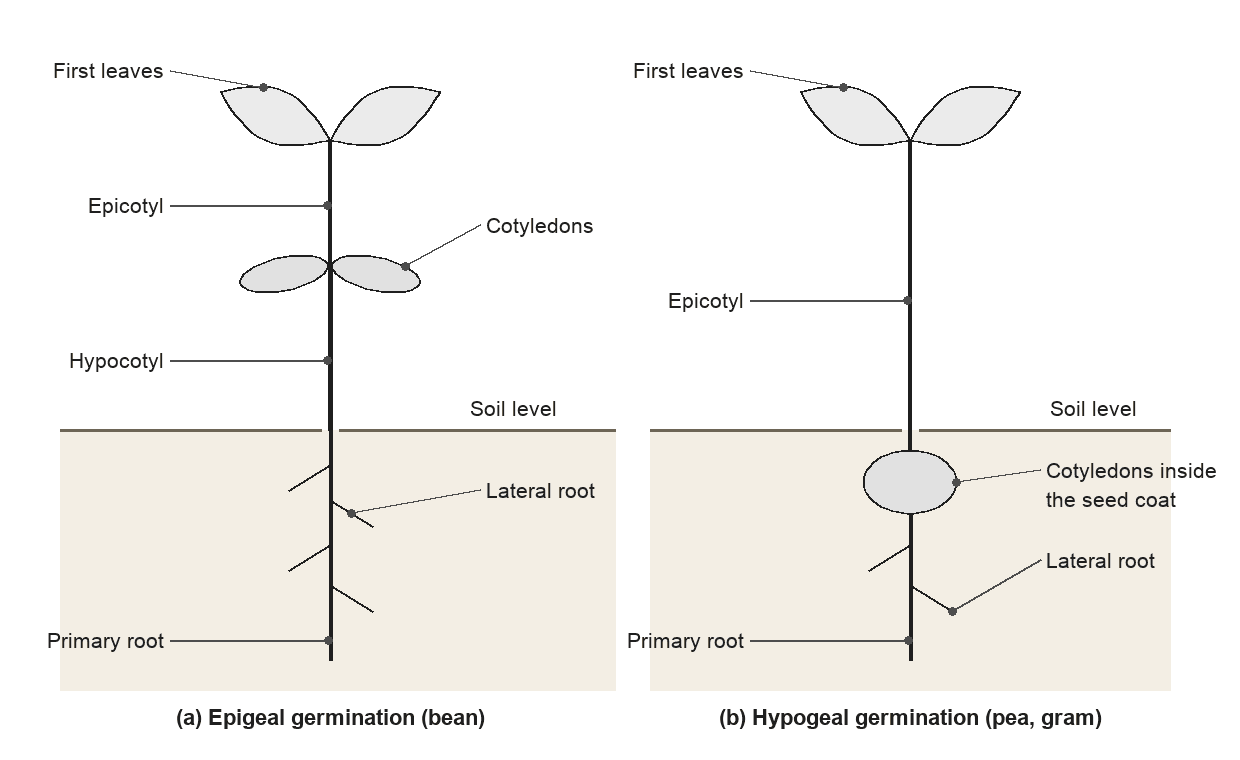
Therefore, in epigeal germination of lima bean the radicle emerges and forms roots, the hypocotyl loops and straightens to lift the cotyledons above the soil, and the plumule grows into the leafy shoot.