
Opening your dashboard
Class 11 Biology Chapter 17: Mineral Nutrition Solutions
40 textbook questions with step-by-step answers, free to read, for ISC 2026-27.
Get talked through Ch 17, not just shown the answer
Reading a finished solution is not the same as being able to do it. The AI tutor takes one question at a time and works it with you, in your own words, until you can.
- Ask it out loud, in your own words
- It gives you the next step, not the answer
- Stuck on part (ii)? Start there
40 questions with solutions
1–5 marks · Mixed difficulty
- 11 mark
Question 1
Name the element found in the chlorophyll molecule.
Solve with AIWritten solution
Solution:
Concept: Chlorophyll is a porphyrin ring with one metal atom held at its centre.
Step 1 — What is asked: We need the element that is a characteristic part of chlorophyll.
Step 2 — The fact: The chlorophyll molecule has a magnesium atom at the centre of its ring (the rest is carbon, hydrogen, oxygen and nitrogen). That is why magnesium deficiency causes chlorosis.
Therefore, the element is magnesium (Mg).
- 21 mark
Question 2
Which element is fixed by the leguminous plants?
Solve with AIWritten solution
Solution:
Concept: Leguminous plants carry nitrogen-fixing bacteria in their root nodules.
Step 1 — What is asked: We need the element fixed by leguminous plants.
Step 2 — The fact: Bacteria of the genus Rhizobium in the root nodules of legumes convert atmospheric nitrogen (N₂) into ammonia, which the plant uses.
Therefore, leguminous plants (through Rhizobium) fix nitrogen.
- 31 mark
Question 3
What is another name given to water culture experiments?
Solve with AIWritten solution
Solution:
Concept: Plants can be grown with their roots in a solution of mineral salts instead of soil.
Step 1 — What is asked: We need the other name of water culture experiments.
Step 2 — The fact: Growing plants in a nutrient solution without soil is called hydroponics (soil-less culture).
Therefore, water culture experiments are also called hydroponics.
- 41 mark
Question 4
Which elements are called micronutrients? Name any four.
Solve with AIWritten solution
Solution:
Concept: Essential elements are grouped by the amount the plant needs.
Step 1 — What is asked: We need the meaning of micronutrients and four examples.
Step 2 — The definition: Micronutrients (trace elements) are essential elements needed in very small amounts, less than 10 mmol per kg of dry matter.
Step 3 — Examples: The micronutrients are iron, manganese, copper, zinc, boron, molybdenum, chlorine and nickel.
Therefore, essential elements needed only in traces are micronutrients, for example iron, manganese, copper and zinc.
- 51 mark
Question 5
Which element is required in the meristematic tissues like buds, leaves and root tips?
Solve with AIWritten solution
Solution:
Concept: Each nutrient is most abundant where its job is done.
Step 1 — What is asked: We need the element needed especially in buds, young leaves and root tips.
Step 2 — The fact: Potassium (K⁺) is more abundant in, and required most by, meristematic tissues, buds, leaves and root tips, where it keeps cells turgid and activates many enzymes.
Therefore, the element is potassium (K⁺).
- 61 mark
Question 6
Which element is present in the middle lamellae of cell wall?
Solve with AIWritten solution
Solution:
Concept: The middle lamella cements neighbouring plant cells together.
Step 1 — What is asked: We need the element in the middle lamella.
Step 2 — The fact: The middle lamella is made mainly of calcium pectate, so it contains calcium.
Therefore, the element is calcium (Ca²⁺).
- 71 mark
Question 7
What are deficiency symptoms of molybdenum in lemon leaf?
Solve with AIWritten solution
Solution:
Concept: A deficiency symptom is a visible change in the plant when an essential element is short.
Step 1 — What is asked: We need to find how a lemon leaf looks when molybdenum is deficient.
Step 2 — The symptoms: Citrus leaves short of molybdenum develop yellow spot: large yellow patches appear between the veins (interveinal chlorosis), often with brown gum on the lower surface, first on the older leaves. The patches later die, and the leaf shows marginal necrosis (death of tissue along the edges) with curled margins; badly affected leaves fall early.
Therefore, molybdenum deficiency in a lemon leaf gives yellow spot (large interveinal yellow patches that later die), with marginal necrosis and curled margins.
- 81 mark
Question 8
What is necrosis?
Solve with AIWritten solution
Solution:
Concept: Deficiency symptoms have names that describe what happens to the plant.
Step 1 — What is asked: We need the meaning of necrosis.
Step 2 — The definition: Necrosis is the localised death of tissues, such as buds, leaf tips, leaf margins or scattered spots on leaves. It is caused by deficiency of Ca, Mg, Cu or K.
Therefore, necrosis is the localised death of plant tissue.
- 91 mark
Question 9
If a plant shows delayed flowering, what is it due to?
Solve with AIWritten solution
Solution:
Concept: Some deficiencies affect when a plant flowers.
Step 1 — What is asked: We need the cause of delayed flowering.
Step 2 — The fact: Delayed flowering is caused by a low concentration of nitrogen, sulphur and molybdenum, elements needed to make proteins and to use nitrogen.
Therefore, delayed flowering is due to deficiency of nitrogen, sulphur and molybdenum.
- 101 mark
Question 10
From where is element hydrogen obtained by the plants?
Solve with AIWritten solution
Solution:
Concept: Carbon, hydrogen and oxygen are non-mineral elements; they come from air and water, not from rock.
Step 1 — What is asked: We need the source of hydrogen for plants.
Step 2 — The fact: Plants get hydrogen from water, which they absorb through the roots. During photosynthesis water is split, and its hydrogen is used to reduce CO₂ to sugar.
Therefore, plants obtain hydrogen from water, released when water is split during photosynthesis.
- 111 mark
Question 11
What is NPK fertiliser?
Solve with AIWritten solution
Solution:
Concept: Fertilisers replace the nutrients that crops remove from the soil.
Step 1 — What is asked: We need the meaning of NPK fertiliser.
Step 2 — The fact: NPK fertiliser is a compound fertiliser that supplies nitrogen (N), phosphorus (P) and potassium (K). The three numbers on the bag, such as 15-15-15 or 10-26-26, give the percentage by mass of nitrogen (as N), phosphate (as P₂O₅) and potash (as K₂O).
Therefore, NPK fertiliser is a compound fertiliser that supplies nitrogen, phosphorus and potassium.
- 121 mark
Question 12
Why is magnesium essential for plants?
Solve with AIWritten solution
Solution:
Concept: An essential element has a specific job that no other element can do.
Step 1 — What is asked: We need the reason magnesium is essential.
Step 2 — The fact: Magnesium is a part of the chlorophyll molecule, which is needed for photosynthesis. It also activates enzymes of photosynthesis and respiration and holds ribosome subunits together.
Therefore, magnesium is essential because it is a part of chlorophyll (and activates many enzymes).
- 131 mark
Question 13
In deficiency of nitrogen, which leaves show chlorosis first?
Solve with AIWritten solution
Solution:
Concept: A mobile element is moved out of old leaves into young ones when it is short.
Step 1 — What is asked: We need to find where chlorosis appears first when nitrogen is deficient.
Step 2 — The fact: Nitrogen is highly mobile. When it is short, the plant breaks down proteins in the older leaves and sends the nitrogen to the growing parts, so the older leaves turn yellow first.
Therefore, in nitrogen deficiency chlorosis appears first in the older leaves.
- 141 mark
Question 14
If there are purple or red spots on leaves and leaves and flower buds fall prematurely, which deficiency may be there in a plant?
Solve with AIWritten solution
Solution:
Concept: Each deficiency has its own set of symptoms; a set of symptoms is matched as a whole.
Step 1 — What is asked: We need the deficiency that gives purple or red spots plus early fall of leaves and flower buds.
Step 2 — Match the symptoms: Phosphorus deficiency gives purple or red spots on leaves, dull green leaves, delayed seed germination and premature fall of leaves and flower buds. All the symptoms in the question fit it.
Step 3 — Check the close case: Magnesium deficiency can also give purple spots and early leaf fall on older leaves, but the fall of flower buds points to phosphorus.
Therefore, the plant is most likely deficient in phosphorus (magnesium deficiency gives some similar signs).
- 151 mark
Question 15
Why is purification of water and nutrient salts so important in studies involving mineral nutrition using hydroponics?
Solve with AIWritten solution
Solution:
Concept: Hydroponics finds out whether an element is essential by leaving it out of the solution.
Step 1 — What is asked: We need to find why pure water and pure salts are needed.
Step 2 — The reason: Micronutrients are needed in tiny amounts (less than 10 mmol per kg of dry matter). Even traces of them as impurities in tap water or in impure salts would supply the plant's whole need, so the element being tested would not really be absent and the experiment would give a false result.
Therefore, pure water and salts are used so that no element reaches the plant as an impurity.
- 162 marks
Question 16
What is the criteria of essentiality of elements?
Solve with AIWritten solution
Solution:
Concept: Out of about 60 elements found in plants, only some are essential; Arnon and Stout (1939) gave three tests.
Step 1 — What is asked: We need the criteria that decide whether an element is essential.
Step 2 — Criterion 1: The element must be absolutely necessary for normal growth and reproduction: without it the plant cannot complete its life cycle or set seed.
Step 3 — Criterion 2: The requirement must be specific: no other element can replace it.
Step 4 — Criterion 3: The element must be directly involved in the plant's metabolism, for example as part of a molecule or as an enzyme activator. Magnesium meets all three, being part of chlorophyll.
Therefore, an element is essential when it is necessary for normal growth and reproduction, cannot be replaced by another element and is directly involved in metabolism.
- 172 marks
Question 17
What are macro and micronutrients?
Solve with AIWritten solution
Solution:
Concept: Essential elements are divided into two groups by the amount the plant needs.
Step 1 — What is asked: We need the meaning of macronutrients and micronutrients.
Step 2 — Macronutrients: Macronutrients are essential elements present in plant tissues in large amounts, more than 10 mmol per kg of dry matter: carbon, hydrogen, oxygen, nitrogen, phosphorus, potassium, calcium, magnesium and sulphur.
Step 3 — Micronutrients: Micronutrients (trace elements) are essential elements needed in very small amounts, less than 10 mmol per kg of dry matter: iron, manganese, copper, zinc, boron, molybdenum, chlorine and nickel.
Step 4 — Common point: Both groups are equally essential; they differ only in the amount needed.
Therefore, macronutrients are essential elements needed in large amounts (such as N, P, K) and micronutrients are essential elements needed in traces (such as Fe, Zn, Cu).
- 182 marks
Question 18
What is nitrification?
Solve with AIWritten solution
Solution:
Concept: Plants absorb nitrogen mainly as nitrate, and soil bacteria oxidise the ammonia released from dead matter into nitrate.
Step 1 — What is asked: We need the meaning of nitrification and how it happens.
Step 2 — Definition: Nitrification is the conversion of ammonia, first into nitrite and then into nitrate, by nitrifying bacteria in the soil.
Step 3 — First step: Nitrosomonas oxidises ammonia to nitrite:
Step 4 — Second step: Nitrobacter oxidises nitrite to nitrate:
These bacteria are chemoautotrophs: they use the energy of these oxidations to make food.
Therefore, nitrification is the oxidation of ammonia to nitrite (by Nitrosomonas) and then to nitrate (by Nitrobacter).
- 192 marks
Question 19
What is hydroponics?
Solve with AIWritten solution
Solution:
Concept: To study which minerals a plant needs, the soil (whose contents are unknown) must be removed.
Step 1 — What is asked: We need the meaning of hydroponics.
Step 2 — Definition: Hydroponics is growing plants with their roots in a nutrient solution of known composition, without soil. It was first done by Julius von Sachs in 1860.
Step 3 — How it is done: The solution is aerated, and its concentration and pH are kept steady. In experiments on mineral needs, pure salts and distilled water are used, and leaving out one element shows whether it is essential.
Therefore, hydroponics is the technique of growing plants in a nutrient solution without soil.
- 202 marks
Question 20
Name the mineral element required by plants in the greatest amount.
Solve with AIWritten solution
Solution:
Concept: Among the elements that plants take from the soil, one is needed far more than the others.
Step 1 — What is asked: We need the mineral element needed in the largest amount.
Step 2 — The fact: Nitrogen is needed by all parts of the plant, especially meristems and active cells, because it is part of proteins, nucleic acids, chlorophyll, hormones, vitamins, coenzymes and ATP.
Step 3 — Why not C, H or O: Carbon, hydrogen and oxygen are needed in still larger amounts, but they come from air and water and are non-mineral elements.
Therefore, nitrogen is the mineral element required in the greatest amount.
- 212 marks
Question 21
What is the significance of phosphorus in a plant?
Solve with AIWritten solution
Solution:
Concept: Phosphorus is absorbed as phosphate ions (H₂PO₄⁻ or HPO₄²⁻) and is needed most by young tissues.
Step 1 — What is asked: We need the roles of phosphorus.
Step 2 — Structural role: Phosphorus is a part of cell membranes (phospholipids), some proteins, all nucleic acids (DNA and RNA) and nucleotides.
Step 3 — Energy role: It is part of ATP and NADP and is needed for all phosphorylation reactions, so energy transfer in the cell depends on it.
Therefore, phosphorus is needed for membranes, nucleic acids, ATP and NADP, and for all phosphorylation reactions.
- 222 marks
Question 22
What does the deficiency of potassium lead to in plants?
Solve with AIWritten solution
Solution:
Concept: Potassium is mobile, so its deficiency shows first in older leaves.
Step 1 — What is asked: We need the effects of potassium deficiency.
Step 2 — Leaf symptoms: The leaves show scorched tips, yellow and shrivelled margins and chlorosis between the veins, with plastid breakdown.
Step 3 — Growth symptoms: Internodes become short, shoots die back, apical dominance is lost so the plant looks bushy, and cambial activity falls, so growth is stunted.
Therefore, potassium deficiency leads to scorched, yellow leaf margins, short internodes, dieback, a bushy habit and stunted growth.
- 232 marks
Question 23
Name the enzymes in which molybdenum forms an important component.
Solve with AIWritten solution
Solution:
Concept: Molybdenum is absorbed as molybdate ions and works in nitrogen metabolism.
Step 1 — What is asked: We need the enzymes that contain molybdenum.
Step 2 — First enzyme: Nitrogenase, the molybdenum-iron protein that reduces N₂ to ammonia in nitrogen fixation.
Step 3 — Second enzyme: Nitrate reductase, the flavoprotein that reduces nitrate to nitrite in nitrate assimilation.
Therefore, molybdenum is a component of nitrogenase and nitrate reductase.
- 242 marks
Question 24
How do plants get nitrogen?
Solve with AIWritten solution
Solution:
Concept: Plants cannot use N₂ gas (78 % of air) directly; they need fixed nitrogen.
Step 1 — What is asked: We need the ways in which plants obtain nitrogen.
Step 2 — From the soil: Most plants absorb nitrogen from the soil through their roots, mainly as nitrate (NO₃⁻) and also as ammonium (NH₄⁺) ions. These come from nitrogen fixed by microbes, lightning and fertilisers, and from ammonification and nitrification of dead matter.
Step 3 — From symbiotic bacteria: Leguminous plants also get ammonia directly from Rhizobium living in their root nodules, which fix atmospheric nitrogen. Inside the plant, nitrate is reduced to ammonia, which forms amino acids.
Therefore, plants get nitrogen as nitrate and ammonium ions from the soil and, in legumes, also from nitrogen-fixing bacteria in root nodules.
- 252 marks
Question 25
Define the terms: nitrification and denitrification.
Solve with AIWritten solution
Solution:
Concept: Nitrification and denitrification are two steps of the nitrogen cycle that work in opposite directions.
Step 1 — What is asked: We need definitions of the two terms.
Step 2 — Nitrification: Nitrification is the oxidation of ammonia to nitrite by Nitrosomonas and then of nitrite to nitrate by Nitrobacter, in the soil.
Step 3 — Denitrification: Denitrification is the reduction of soil nitrate to free nitrogen gas (N₂) by bacteria such as Pseudomonas and Thiobacillus; it returns nitrogen to the atmosphere.
Therefore, nitrification converts ammonia to nitrate, while denitrification converts nitrate back to nitrogen gas.
- 263 marks
Question 26
What do you understand by water culture technique? Explain its significance.
Solve with AIWritten solution
Solution:
Concept: The soil contains an unknown mixture of minerals, so the mineral needs of a plant can be studied only in a solution of known composition.
Step 1 — What is asked: We need the meaning of the water culture technique and why it is useful.
Step 2 — The technique: In water culture (hydroponics) a plant is grown with its roots in a solution of mineral salts in water, without soil; for experiments on mineral needs the salts are pure and the water distilled. The plant is held by a cotton plug, air is bubbled through the solution to give the roots oxygen, and the solution is topped up and its pH checked. The set-up is shown below.
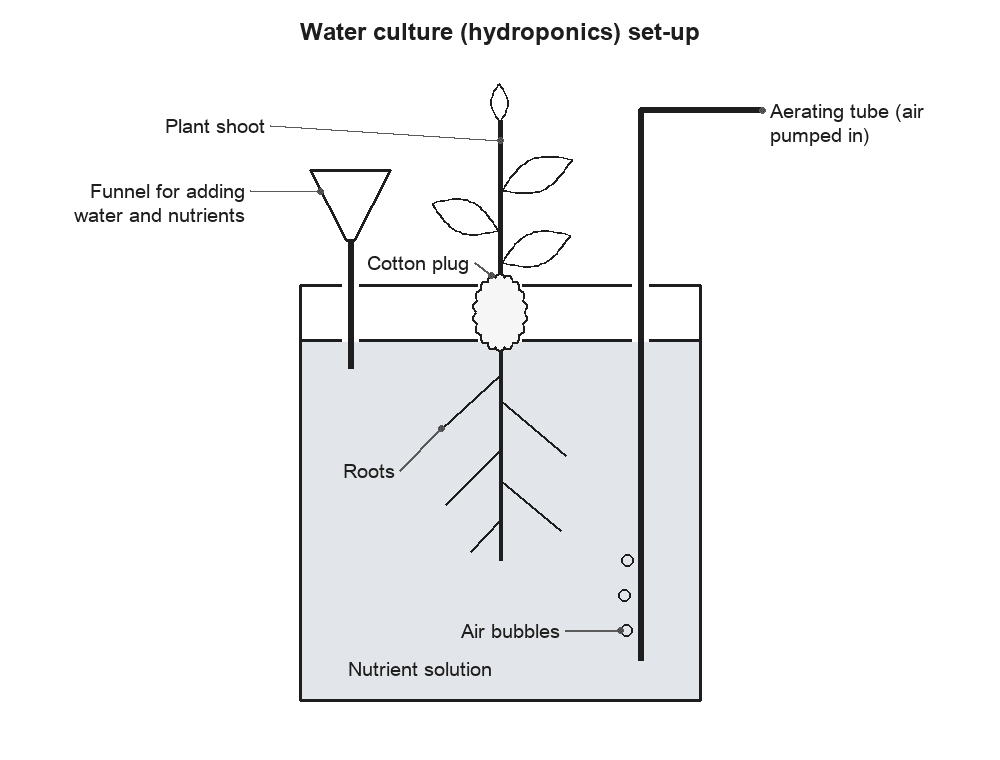
Step 3 — Use in finding essential elements: One set of plants gets all the nutrients; in another set one element is left out. If the plants lacking it fail to grow or reproduce normally, the element is essential.
Step 4 — Other uses: The technique shows how much of each element is needed and what its deficiency symptoms look like. It is also used commercially to grow vegetables such as tomato, seedless cucumber and lettuce, using less space and water.
Therefore, water culture is growing plants in a known nutrient solution without soil; it identifies essential elements, their amounts and deficiency symptoms, and is used for commercial crops.
- 273 marks
Question 27
Give deficiency symptoms of (i) calcium in sugar beet plant, (ii) potassium in tomato and (iii) molybdenum in lemon leaf.
Solve with AIWritten solution
Solution:
Concept: A deficiency symptom is a visible change when an essential element is short; where it appears depends on how mobile the element is.
Step 1 — Part (i), calcium in sugar beet: Calcium is immobile, so the young leaves and meristems suffer: the young leaf tips become hooked, and the growing regions show necrosis and chlorosis.
Step 2 — Part (ii), potassium in tomato: Potassium is mobile, so the older leaves show it first: the leaf margins become yellow, scorched and shrivelled.
Step 3 — Part (iii), molybdenum in lemon: The lemon leaf develops yellow spot: large yellow patches between the veins, often with brown gum on the lower surface, which later die. The leaf also shows marginal necrosis with curled margins.
Therefore: (i) hooked leaf tips in sugar beet, (ii) shrivelled, scorched margins in tomato leaves, (iii) yellow spot (interveinal yellow patches that later die) with marginal necrosis and curled margins in lemon leaves.
- 283 marks
Question 28
What is the reason for toxicity of nutrients? Give one example.
Solve with AIWritten solution
Solution:
Concept: Micronutrients are needed in tiny amounts within a narrow range: a moderate decrease causes deficiency and a moderate increase causes toxicity.
Step 1 — What is asked: We need to find why too much of a nutrient harms the plant, with an example.
Step 2 — Definition of toxicity: Any mineral ion concentration in the tissues that reduces the dry weight of the tissues by about 10 % is considered toxic. The toxic level differs from one element and one plant to another.
Step 3 — Reason: An excess of one element can block the uptake or the use of another element, so the plant shows the deficiency symptoms of that other element.
Step 4 — Example: manganese: Excess manganese competes with iron and magnesium for uptake and with magnesium for binding to enzymes, and it slows the movement of calcium to the shoot apex. The plant shows brown spots surrounded by chlorotic veins: these are really the deficiency symptoms of iron, magnesium and calcium.
Therefore, nutrients become toxic when excess of one element upsets the uptake or use of others; for example, excess manganese induces deficiency of iron, magnesium and calcium.
- 293 marks
Question 29
What are the sources for these elements: Carbon, Nitrogen and Oxygen?
Solve with AIWritten solution
Solution:
Concept: Elements obtained from air and water are non-mineral elements; nitrogen comes from the air but is taken up through the soil.
Step 1 — Carbon: Plants take carbon as carbon dioxide from the air, through the stomata, and fix it in photosynthesis.
Step 2 — Nitrogen: Plants absorb nitrogen from the soil as nitrate (NO₃⁻) or ammonium (NH₄⁺) ions. This nitrogen came from the atmosphere through fixation by bacteria and cyanobacteria (legumes get it directly from Rhizobium), lightning and fertilisers.
Step 3 — Oxygen: Plants take oxygen as O₂ and CO₂ from the air and from water; oxygen is also produced inside the plant during photosynthesis.
Therefore: carbon comes from CO₂ of the air, nitrogen from nitrate and ammonium ions of the soil (ultimately fixed from the air), and oxygen from air and water.
- 303 marks
Question 30
What is the role of (i) leghaemoglobin and (ii) nitrogenase in plants?
Solve with AIWritten solution
Solution:
Concept: Nitrogen fixation in legume nodules needs an enzyme that splits N₂ and a way to keep oxygen away from it.
Step 1 — Part (i), leghaemoglobin: Leghaemoglobin is a pink, haemoglobin-like pigment of legume root nodules. It binds oxygen and keeps the free oxygen inside the nodule very low, because nitrogenase is destroyed by oxygen. At the same time it delivers enough oxygen to the bacteroids for the respiration that supplies ATP.
Step 2 — Part (ii), nitrogenase: Nitrogenase is a molybdenum-iron protein found in nitrogen-fixing prokaryotes. It is the only enzyme that can break the N≡N triple bond; it reduces N₂ to ammonia, using electrons and ATP:
Step 3 — How they work together: Leghaemoglobin creates the low-oxygen conditions in which nitrogenase can work.
Therefore: (i) leghaemoglobin protects nitrogenase from oxygen; (ii) nitrogenase reduces atmospheric N₂ to ammonia.
- 313 marks
Question 31
Explain the major process by which amino acids are synthesised in the plants.
Solve with AIWritten solution
Solution:
Concept: Every amino acid has an amino group (–NH₂) and a carboxyl group (–COOH); plants add nitrogen from ammonia to keto acids.
Step 1 — What is asked: We need to find how plants make amino acids.
Step 2 — Reductive amination: Ammonia (as NH₄⁺) reacts with α-ketoglutaric acid to form glutamic acid. The enzyme is glutamate dehydrogenase, and NADPH supplies the reducing power:
Step 3 — Transamination: The amino group of glutamic acid is then passed to the keto group of other keto acids by transaminase enzymes. Each keto acid becomes a new amino acid; about 17 other amino acids are made this way.
Step 4 — Amides: Glutamic acid and aspartic acid can take up one more NH₂ group to form the amides glutamine and asparagine, which carry nitrogen around the plant.
Step 5 — The main route in real plants: Studies since the 1970s show that most ammonia actually enters plant amino acids through the GS–GOGAT cycle, while glutamate dehydrogenase (reductive amination) plays only a small part. Glutamine synthetase first adds NH₄⁺ to glutamic acid, using ATP, to form glutamine. Glutamate synthase (GOGAT) then moves this amide group to α-ketoglutaric acid, giving two molecules of glutamic acid. Either way, glutamic acid is the amino-group donor for transamination.
Therefore, plants make amino acids by first building ammonia into glutamic acid (reductive amination in the textbook scheme, mainly the GS–GOGAT cycle in real plants) and then passing its amino group to keto acids by transamination.
- 322 marks
Question 32
Differentiate between: Micronutrients and Macronutrients
Solve with AIWritten solution
Solution:
Concept: Essential elements are grouped by the amount the plant needs; both groups are equally essential.
Step 1 — What is asked: We need the differences between micronutrients and macronutrients.
Step 2 — Compare them: The table compares the two point by point.
Feature Micronutrients Macronutrients Amount in dry matter Less than 10 mmol per kg More than 10 mmol per kg Other name Trace elements (microelements) Major elements (macroelements) Examples Fe, Mn, Cu, Zn, B, Mo, Cl, Ni C, H, O, N, P, K, Ca, Mg, S Main roles Mostly enzyme activators and parts of enzymes Mostly building blocks of biomolecules and energy compounds Step 3 — Key difference: The difference is only in the amount needed: a lack of either kind is equally harmful.
Therefore, micronutrients are needed in traces and macronutrients in large amounts.
- 332 marks
Question 33
Differentiate between: Chlorosis and Necrosis
Solve with AIWritten solution
Solution:
Concept: Chlorosis and necrosis are two common deficiency symptoms (hunger signs).
Step 1 — What is asked: We need the differences between chlorosis and necrosis.
Step 2 — Compare them: The table compares the two point by point.
Feature Chlorosis Necrosis Meaning Yellowing of leaves due to loss of chlorophyll Localised death of tissues Tissue Remains alive, only pale Dies and turns brown Parts affected Leaves, often in patterns (between veins) Buds, leaf tips, margins or spots on leaves Caused by lack of N, K, Mg, S, Fe, Mn, Zn, Mo Ca, Mg, Cu, K Step 3 — Key difference: Chlorosis is loss of green colour in living tissue, while necrosis is death of the tissue.
Therefore, chlorosis is yellowing due to loss of chlorophyll and necrosis is localised death of tissue.
- 342 marks
Question 34
Differentiate between: Nitrification and Ammonification
Solve with AIWritten solution
Solution:
Concept: Both are steps of the nitrogen cycle carried out by soil microbes.
Step 1 — What is asked: We need the differences between nitrification and ammonification.
Step 2 — Compare them: The table compares the two point by point.
Feature Nitrification Ammonification Change Ammonia → nitrite → nitrate Organic nitrogen (proteins, urea) → ammonia Organisms Nitrosomonas, Nitrobacter (chemoautotrophs) Many decomposer bacteria and fungi Type of reaction Oxidation Breakdown (decomposition) of organic matter Order in the cycle Follows ammonification Comes first, after death and decay Step 3 — Key difference: Ammonification releases ammonia from dead organic matter, and nitrification then oxidises that ammonia to nitrate.
Therefore, ammonification forms ammonia from dead organic matter, while nitrification oxidises ammonia to nitrate.
- 355 marks
Question 35
How is atmospheric nitrogen fixed by the bacteria?
Solve with AIWritten solution
Solution:
Concept: N₂ (78 % of air) has a very strong triple bond; only some prokaryotes, using the enzyme nitrogenase, can reduce it to ammonia. This is biological nitrogen fixation.
Step 1 — What is asked: We need the bacteria that fix nitrogen and how they do it.
Step 2 — Free-living bacteria: Some bacteria fix nitrogen while living freely in the soil: aerobic Azotobacter and Beijerinckia, and anaerobic Clostridium and Rhodospirillum. Free-living cyanobacteria such as Nostoc and Aulosira also fix nitrogen, mainly in water and wet soils such as rice fields.
Step 3 — Symbiotic bacteria: Rhizobium lives in the root nodules of legumes (pea, bean, gram, groundnut); Frankia forms nodules on non-legumes such as Alnus and Casuarina; the cyanobacterium Anabaena lives with the water fern Azolla. Azospirillum lives loosely on the roots of grasses, rice and maize.
Step 4 — The reaction: In all of them the enzyme nitrogenase (a molybdenum-iron protein) reduces N₂ to ammonia. It needs a strong reducing agent, ATP and the enzyme:
Step 5 — Protection from oxygen: Nitrogenase is destroyed by oxygen. In legume nodules the pink pigment leghaemoglobin binds oxygen and keeps the free oxygen low; cyanobacteria fix nitrogen in thick-walled heterocysts.
Step 6 — Use of the ammonia: The ammonia is quickly built into glutamine and glutamic acid, and other amino acids are then made from them by transamination. The host legume receives this fixed nitrogen and in return supplies the bacteroids with organic acids (mainly malate, made from its sugars) as fuel for respiration.
Therefore, atmospheric nitrogen is fixed by free-living and symbiotic bacteria (and cyanobacteria), whose nitrogenase reduces N₂ to ammonia using electrons and ATP under low-oxygen conditions.
- 365 marks
Question 36
What is the meaning of deficiency symptoms? Give the functions and deficiency symptoms of nitrogen, phosphorus and potassium.
Solve with AIWritten solution
Solution:
Concept: Each essential element has a specific job, so its shortage produces its own visible changes; where they appear first depends on whether the element is mobile.
Step 1 — Meaning of deficiency symptoms: When an essential element is below its critical concentration, the plant shows changes in form and colour called deficiency symptoms (hunger signs), such as chlorosis, necrosis and stunted growth. They disappear when the element is supplied.
Step 2 — Nitrogen: functions: Nitrogen, absorbed mainly as NO₃⁻ (also NH₄⁺), is part of proteins, nucleic acids, vitamins, hormones, coenzymes, ATP and chlorophyll. It is needed in the greatest amount, especially by meristems.
Step 3 — Nitrogen: deficiency: Chlorosis first in the older leaves (nitrogen is mobile), stunted growth, dormant lateral buds, late flowering and purple colour in the stem.
Step 4 — Phosphorus: functions: Phosphorus, absorbed as H₂PO₄⁻ or HPO₄²⁻, is part of membranes, nucleic acids, nucleotides, ATP and NADP and is needed for all phosphorylation reactions.
Step 5 — Phosphorus: deficiency: Delayed seed germination, purple or red spots on leaves, dull green leaves and premature fall of leaves and flower buds.
Step 6 — Potassium: functions: Potassium, absorbed as K⁺, keeps the anion–cation balance, controls the opening and closing of stomata, keeps cells turgid and activates many enzymes; it is plentiful in meristems, buds and root tips.
Step 7 — Potassium: deficiency: Scorched leaf tips, yellow and shrivelled margins, interveinal chlorosis, short internodes, dieback of shoots, loss of apical dominance (bushy plant) and loss of cambial activity.
Therefore, deficiency symptoms are the visible signs of a shortage of an essential element; nitrogen, phosphorus and potassium each have the functions and symptoms given above.
- 375 marks
Question 37
Explain various steps in the nitrogen fixation by bacteria.
Solve with AIWritten solution
Solution:
Concept: Biological nitrogen fixation is the reduction of N₂ to ammonia by the enzyme nitrogenase of prokaryotes; it needs (i) a strong reducing agent, (ii) energy from ATP and (iii) the enzyme nitrogenase.
Step 1 — Supply of the requirements: The bacterium supplies electrons from a strong reducing agent (reduced ferredoxin or flavodoxin) and ATP from respiration. In root nodules both come from the bacteroids' respiration of organic acids (mainly malate) that the host makes from the sugars it sends to the nodule.
Step 2 — Binding of N₂: A molecule of N₂ binds to the MoFe protein of nitrogenase. The Fe protein, using 2 ATP for each electron, passes electrons to it.
Step 3 — Stepwise reduction: The bound N₂ is reduced in three steps of 2 electrons + 2 H⁺ each: N≡N to the diimide level (HN=NH), then to the hydrazine level (H₂N–NH₂), and finally to two molecules of ammonia, which are released.
Step 4 — Overall reaction: Two more electrons are released as H₂, so the whole reaction uses 8 electrons and 16 ATP:
This is 8 ATP for each NH₃ formed, a very high energy cost.
Step 5 — Protection from oxygen: Nitrogenase is inactivated by oxygen, so it works only in low-oxygen conditions; in legume nodules leghaemoglobin binds oxygen and protects it.
Step 6 — Assimilation of ammonia: At the pH of the cell, ammonia exists as NH₄⁺; It is toxic in excess, so it is quickly built into glutamine and glutamic acid and then into other amino acids and amides.
Note: The reducing agent in nitrogen-fixing cells is reduced ferredoxin (or flavodoxin); in root nodules it comes from respiration of organic acids supplied by the host, not from photosynthesis inside the nodule.
Therefore, in nitrogen fixation nitrogenase binds N₂ and reduces it step by step (2e⁻ + 2H⁺ at a time) to two NH₃, using a reducing agent and 16 ATP, under low-oxygen conditions.
- 385 marks
Question 38
Give a schematic diagram showing reduction of a molecule of nitrogen and formation of ammonia.
Solve with AIWritten solution
Solution:
Concept: Nitrogenase holds one N₂ molecule and adds hydrogen to it step by step until two ammonia molecules are formed.
Step 1 — What is asked: We need a diagram of the stepwise reduction of N₂ to NH₃ by nitrogenase.
Step 2 — The diagram: The schematic diagram is shown below.
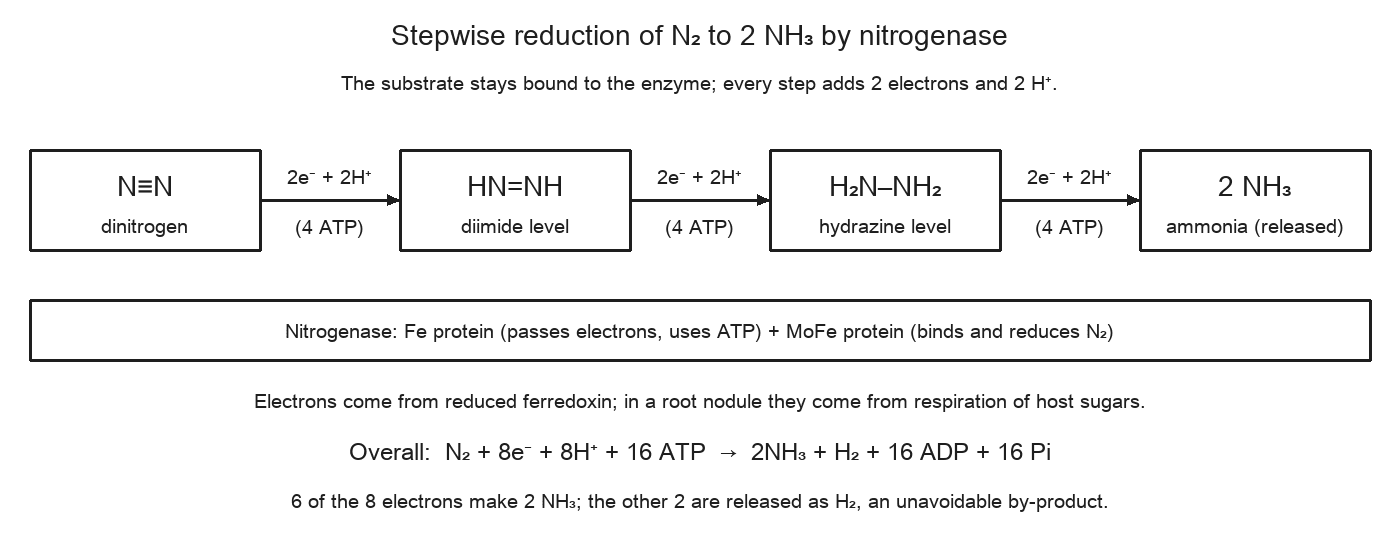
Step 3 — Binding: The enzyme nitrogenase binds a molecule of dinitrogen (N≡N) at its MoFe protein.
Step 4 — Reduction steps: Each step adds 2 electrons and 2 H⁺ (2 H): N≡N becomes HN=NH, then H₂N–NH₂, and then the N–N bond breaks to give 2 NH₃. The intermediates stay bound to the enzyme.
Step 5 — Energy and electrons: Electrons come from reduced ferredoxin, and each electron costs 2 ATP. Two extra electrons form H₂, so overall:
Step 6 — Release: The two ammonia molecules leave the enzyme, which is then free to bind another N₂.
Therefore, nitrogenase reduces one N₂ in steps of 2e⁻ + 2H⁺ (N≡N to HN=NH to H₂N–NH₂ to 2NH₃), using 16 ATP and releasing one H₂.
- 395 marks
Question 39
Explain the terms (i) reductive amination, (ii) transamination, (iii) denitrification, (iv) biological fixation and (v) bacteroids.
Solve with AIWritten solution
Solution:
Concept: All five terms belong to the nitrogen metabolism of plants and soil microbes.
Step 1 — Part (i), reductive amination: Ammonia (NH₄⁺) combines with α-ketoglutaric acid, with NADPH as the reducing agent, to form glutamic acid; the enzyme is glutamate dehydrogenase:
Step 2 — Part (ii), transamination: The amino group of one amino acid (mainly glutamic acid) is transferred to the keto group of a keto acid by a transaminase. The keto acid becomes a new amino acid and the donor becomes a keto acid.
Step 3 — Part (iii), denitrification: Soil nitrate is reduced to free nitrogen gas by bacteria such as Pseudomonas and Thiobacillus, mainly in waterlogged, poorly aerated soil; it returns nitrogen to the air.
Step 4 — Part (iv), biological fixation: Living prokaryotes (free-living bacteria such as Azotobacter, symbiotic Rhizobium and Frankia, and cyanobacteria such as Nostoc and Anabaena) reduce atmospheric N₂ to ammonia with the enzyme nitrogenase.
Step 5 — Part (v), bacteroids: Inside the cells of a root nodule, Rhizobium cells released from the infection thread change into bacteroids, each group enclosed in a membrane. They enlarge (in legumes such as pea and clover they become swollen, Y-shaped or branched), stop dividing and fix nitrogen, protected by leghaemoglobin.
Therefore: (i) reductive amination forms glutamic acid from ammonia, (ii) transamination moves amino groups to keto acids, (iii) denitrification returns nitrate to N₂, (iv) biological fixation is N₂ reduction by living prokaryotes, (v) bacteroids are the nitrogen-fixing forms of Rhizobium in nodules.
- 405 marks
Question 40
Explain the development of root nodules in soya bean plant.
Solve with AIWritten solution
Solution:
Concept: A root nodule is a swelling on a legume root, formed by the plant in response to rhizobia (the Rhizobium group of bacteria), inside which the bacteria fix nitrogen. In soya bean the partner is mainly Bradyrhizobium japonicum, earlier called Rhizobium japonicum.
Step 1 — What is asked: We need the stages in which a root nodule forms, shown in the figure below.
Step 2 — The stages in a figure: The four main stages are drawn below.
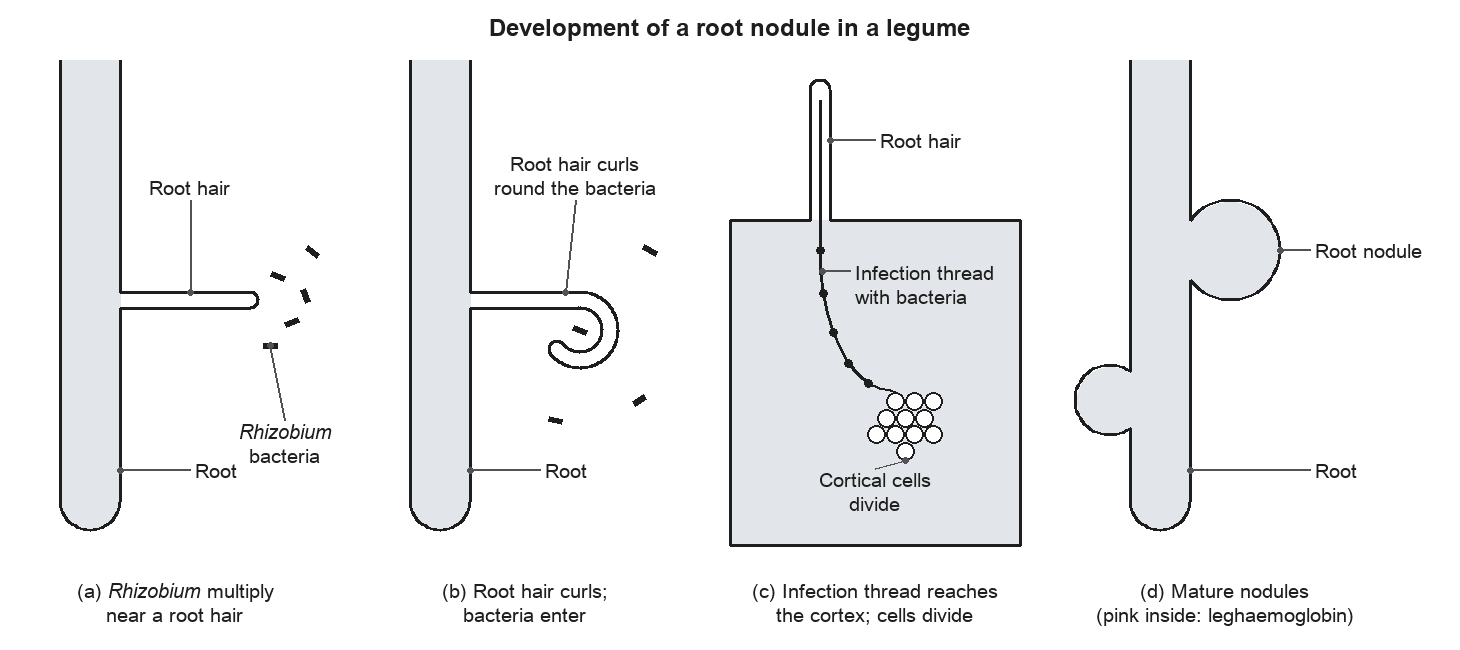
Step 3 — Contact and multiplication: The soya bean root releases chemicals (flavonoids) that attract the rhizobia and switch on their nodulation genes. The bacteria multiply near the root hairs and stick to them.
Step 4 — Curling of the root hair: Chemical signals from the bacteria (Nod factors) make the root hair curl round them, trapping the bacteria in the curl.
Step 5 — Infection thread: At the curl the wall of the root hair is broken down and the plasma membrane grows inwards as an infection thread, which carries the dividing bacteria through the root hair into the cortex.
Step 6 — Cell division: Cells of the root cortex start dividing (a changed balance of the plant hormones cytokinin and auxin promotes this), forming a mass of new cells, the nodule primordium. Soya bean forms rounded (determinate) nodules, whose first divisions are in the outer cortex. The general textbook account names the inner cortex and pericycle, which is where the elongated nodules of pea and clover begin.
Step 7 — Bacteroids: The infection thread grows into the dividing cells, and the bacteria are released from it into these cells, each group enclosed in a membrane. They enlarge into bacteroids, which fix nitrogen.
Step 8 — Mature nodule: The cells grow into a mature nodule with its own vascular connection to the root, for exchange of sugars and fixed nitrogen. It contains nitrogenase and the pink pigment leghaemoglobin. Both plant genes and bacterial genes (nod, nif and fix) control the process.
Note: Bacteroids form only after the bacteria are released from the infection thread into the dividing cortical cells, not while they are still in the root hair.
Therefore, a soya bean nodule develops by attraction of rhizobia (Bradyrhizobium), curling of the root hair, growth of an infection thread into the cortex, division of cortical cells, and formation of bacteroids inside a mature, pink nodule.
What Class 11 Biology Ch 17 covers
The sections of the chapter, in the order the book takes them. Every question above comes from one of these.
- 01Essential Mineral Elements
- 02Hydroponics
- 03Role of Macro and Micronutrients
- 04Deficiency Symptoms and Toxicity
- 05Metabolism of Nitrogen
More ways to study this chapter
The same chapter asked three other ways. Practise it, revise it, and see what the board has set on Ch 17 before.
Class 11 Biology Ch 17 questions students ask
How many questions are there in Class 11 Biology Ch 17?
40 questions. Every one is solved step by step on this page.
Are these Class 11 Biology solutions free?
Yes. Every question and its full working is free to read, with no account needed.
Can I download the Class 11 Biology Ch 17 solutions as a PDF?
There is no PDF to download. Every solution is on this page instead, which means it is searchable, always the current syllabus, and readable on a phone. Use your browser's print option if you want it on paper.