
Opening your dashboard
Class 11 Biology Chapter 17 Mineral Nutrition: Practice Questions
111 questions on Chapter 17, each worked through on its own page with the AI tutor. Class 11 Biology, ICSE 2026-27.
111 questions
1–4 marks · Mixed difficulty
- 11 mark
Question 1
In a water-culture study (Hypothetical data.), bean plants grew poorly when element W was left out of the solution, because iron then settled out as an insoluble salt. When W was left out but iron was supplied in a form that stays dissolved, the plants grew normally and set seed. No compound or enzyme in the plants was found to contain or need W. What is the correct conclusion about W?
- 23 marks
Question 2
Analysis of oven-dried leaves of a crop (Hypothetical data.) gave 2.4 g of magnesium and 0.11 g of manganese per kg of dry matter. Take the atomic masses Mg = 24 and Mn = 55, and use the rule that an element present at more than 10 mmol per kg of dry matter is a macronutrient.
(a) Convert each value to mmol per kg of dry matter and classify each element.
(b) Why are such limits stated per kg of dry matter rather than per kg of fresh leaves?
- 31 mark
Question 3
When guard cells take in potassium ions (K⁺), water enters them and the stoma opens. Under which functional category of essential elements does this role of potassium fall?
- 43 marks
Question 4
Three elements were tested in water culture (Hypothetical data.).
X: Plants grown without X completed their life cycle normally.
Y: Plants grown without Y showed deficiency symptoms, but the symptoms disappeared when another element, Z, was added in place of Y.
V: Plants grown without V never formed seeds, no other element could make up for V, and V was found to be part of an enzyme.
Decide whether each element is essential, naming the criterion of essentiality that decides it.
- 53 marks
Question 5
Dry-weight analysis of a maize plant gave these percentages for its three most abundant elements (Hypothetical data.).
Element Percentage of dry weight Oxygen 45.4 Carbon 43.6 Hydrogen 6.15 (a) What percentage of the dry weight do these three elements make up together?
(b) What percentage is left for all the other elements?
(c) Mineral elements form only this small remaining part. Why, then, does a maize crop fail when even one of them is missing?
- 64 marks
Question 6
Soil does much more for roots than supply mineral ions. Name four other services that soil gives to a plant, and state how a water-culture (hydroponic) set-up replaces or makes each one unnecessary.
- 71 mark
Question 7
Use the list of 17 essential elements in which nickel is counted as a micronutrient. How many of the following elements are micronutrients?
Iron, calcium, boron, magnesium, chlorine, sulphur, nickel, potassium
- 81 mark
Question 8
In a water-culture experiment with tomato seedlings (Hypothetical data.), one jar was set up exactly like the others except that no air was bubbled through it. After ten days its plants had absorbed far less nitrate and potassium than the others. What is the best explanation?
- 93 marks
Question 9
The bar chart shows the mean dry mass of maize plants after six weeks in five water-culture jars (Hypothetical data.). Four jars received a complete nutrient solution or one with a single nutrient left out (–N, –Fe, –Ca); the fifth received distilled water only.
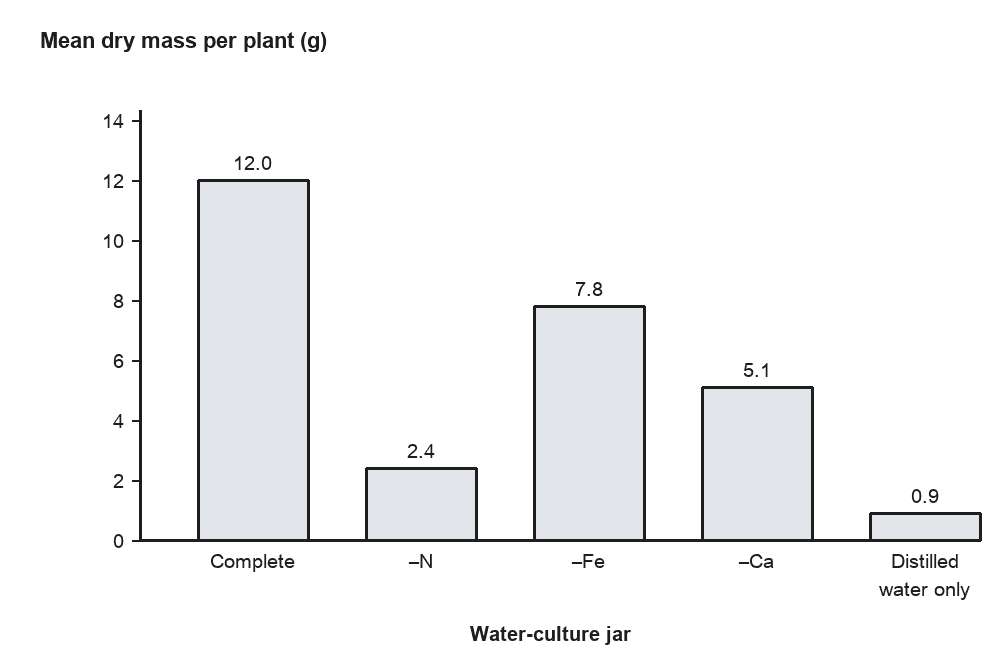
(a) Which jar is the control, and why is it needed?
(b) Calculate the percentage fall in dry mass of the –N plants compared with the control.
(c) Leaving out iron lowered the dry mass the least. Does this show that iron is less essential than nitrogen? Explain.
- 103 marks
Question 10
A student set up a water-culture experiment to show that zinc is essential. To the student's surprise, plants in the zinc-free jar grew just as well as those in the complete solution (Hypothetical data.). Suggest three faults in the set-up that could explain this result.
- 111 mark
Question 11
In a commercial hydroponic unit, plants sit in a long trough set on a slight slope, and a pump lifts nutrient solution from a reservoir to the higher end of the trough. Why is the trough given a slight slope?
- 122 marks
Question 12
In hydroponics, the concentration and pH of the nutrient solution must be checked and adjusted frequently. Explain why the solution does not stay the same on its own.
- 131 mark
Question 13
Knop's nutrient solution (1865) was made with only these five salts:
, , , and .
Which essential element is not supplied by any of these salts?
- 142 marks
Question 14
A rooftop farm in a city grows lettuce and tomatoes by hydroponics instead of in soil. Give two advantages of growing these crops in this way.
- 151 mark
Question 15
Much of the iron and copper in a leaf cell is not free in the cell sap as ions, as potassium is, but is bound in proteins of the membranes of mitochondria and chloroplasts. Which property makes both of them useful at these membranes?
- 162 marks
Question 16
A grower makes a nutrient solution with potassium nitrate, magnesium sulphate and sodium molybdate . Write the ion in which a plant takes up nitrogen, sulphur, molybdenum and potassium from this solution, and state whether each ion is a cation or an anion.
- 171 mark
Question 17
Chloroplasts isolated from manganese-deficient spinach leaves (Hypothetical data.) released much less oxygen in light than chloroplasts from healthy leaves, although both had about the same chlorophyll content. Which role of manganese explains this?
- 183 marks
Question 18
Root tips of pea seedlings grown in a calcium-free culture solution (Hypothetical data.) stopped lengthening, their root hairs failed to grow, and the tips finally turned brown and died. Explain three roles of calcium that account for these observations.
- 191 mark
Question 19
Young leaves of a rose plant turn pale yellow, first between the veins and later in the veins too. A soil test shows enough magnesium but too little iron (Hypothetical data.). Iron is not an atom of the chlorophyll molecule. Why does a lack of iron still cause yellowing?
- 201 mark
Question 20
A sunflower crop on a boron-poor soil (Hypothetical data.) flowered normally, but many florets failed to form seeds after pollination. Which role of boron is most directly linked to this result?
- 214 marks
Question 21
Maize was grown in two plots on a molybdenum-deficient soil (Hypothetical data.). Plot 1 received a nitrate fertiliser only; Plot 2 received an ammonium fertiliser supplying the same mass of nitrogen. Plants in Plot 1 turned yellow and stunted, like nitrogen-deficient plants, while plants in Plot 2 stayed green.
(a) Name the molybdenum-containing enzyme that the Plot 1 plants depend on, and the reaction it catalyses.
(b) Explain why the Plot 1 plants look nitrogen-deficient although plenty of nitrogen was supplied.
(c) Explain why the Plot 2 plants are much less affected.
(d) A soybean crop on the same soil, relying on its root nodules for nitrogen, also showed nitrogen deficiency. Name the second molybdenum-containing enzyme involved.
- 223 marks
Question 22
A seedling was given phosphate containing radioactive phosphorus (³²P). After a few days the label was found spread through many kinds of molecules. Name three kinds of molecules in which the label would appear, and give the role of each in the plant.
- 231 mark
Question 23
A mustard crop on sulphur-poor soil showed lower amounts of several molecules than a healthy crop. Which one of the following molecules does not contain sulphur?
- 242 marks
Question 24
Zinc-deficient plants show small, malformed leaves ('little leaf') and stunted growth. A student says this proves that zinc is an atom of the plant hormone auxin. Correct the student and explain how zinc is linked to these symptoms.
- 253 marks
Question 25
Identify each essential element from the clues given, and give a reason for each choice.
(a) It is absorbed as an anion; together with Na⁺ and K⁺ it keeps the anion–cation balance of cells, and it is needed for the water-splitting reaction that releases oxygen.
(b) It is absorbed as a monovalent cation; it activates more than 40 enzymes, is common in the cell sap of vacuoles where it keeps cells turgid, and is abundant in buds and root tips.
(c) It is absorbed as a divalent cation; it activates RuBisCO and PEP carboxylase and is essential for binding the components of ribosomes.
- 261 mark
Question 26
In a maize field, the older leaves show yellowing between the veins and purple, dying spots, while the young leaves are healthy and green. A deficiency of which element best fits these symptoms?
- 273 marks
Question 27
Two tomato plants were examined (Hypothetical data.). Plant A has pale yellow older leaves while its young leaves are green. Plant B has pale yellow young leaves while its older leaves are green. Soil tests show that one plant lacks nitrogen and the other lacks sulphur.
(a) Which plant lacks nitrogen and which lacks sulphur?
(b) Explain your answer using the mobility of the two elements.
(c) Why do both deficiencies cause yellowing in the first place?
- 283 marks
Question 28
The graph shows how the growth of a crop depends on the concentration of a micronutrient E in its leaf tissue (Hypothetical data.). Take the critical concentration to be the concentration at which growth first reaches 90 per cent of the maximum as the concentration rises.
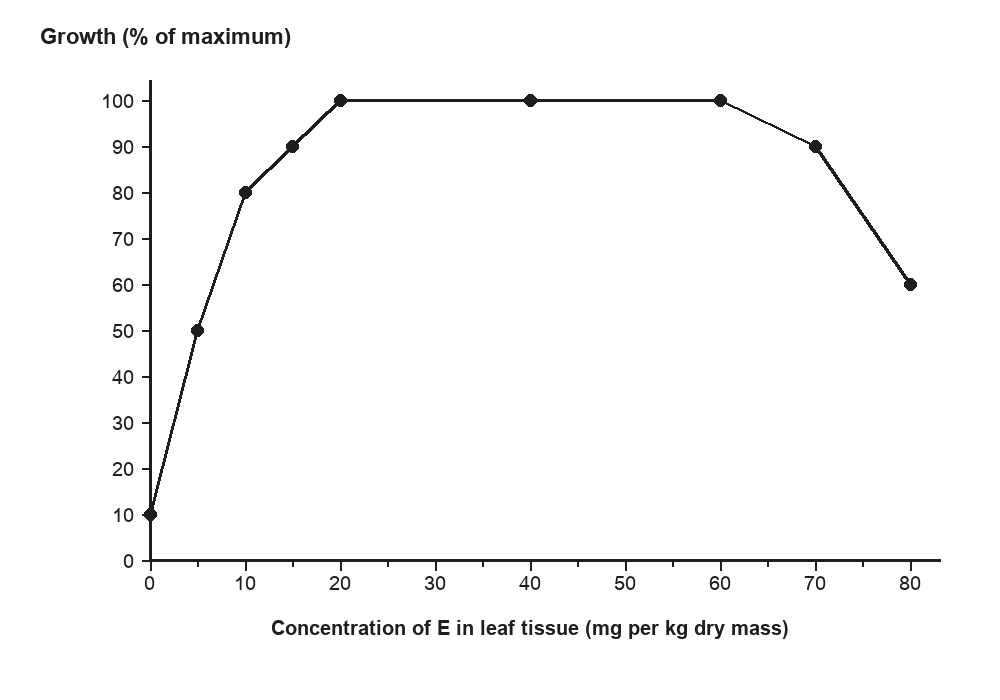
(a) Read the critical concentration of E from the graph.
(b) What is the growth at 10 mg per kg, and what is the state of a plant whose tissue has this concentration?
(c) Between 20 and 60 mg per kg the growth stays at 100 per cent. Explain this part of the graph.
- 291 mark
Question 29
Leaves of a crop growing where manganese is far too plentiful show brown spots surrounded by yellow (chlorotic) veins. Leaf tests show the plants are short of three other elements, although the soil contains plenty of them. Which three elements are these most likely to be?
- 303 marks
Question 30
Barley seedlings were grown in solutions with increasing copper, and the copper content of the shoots and their dry mass were measured (Hypothetical data.).
Copper in shoot (mg per kg dry mass) 10 20 30 40 Shoot dry mass (g) 50.0 50.0 46.5 43.0 Take a tissue concentration as toxic if it reduces dry mass by 10 per cent or more compared with the best growth.
(a) Calculate the percentage reduction in dry mass at 30 and at 40 mg per kg.
(b) Which of these concentrations is toxic?
(c) Why is it hard to give one toxic level that holds for every micronutrient and every crop?
- 311 mark
Question 31
In a mango orchard, shoots die back from the tip, the leaves wither and fall, and the bark becomes rough and splits, oozing a gummy substance. A deficiency of which element is the most likely cause?
- 323 marks
Question 32
Identify the element whose deficiency is most likely in each case.
(a) Interveinal chlorosis with grey spots on the leaves.
(b) Small, malformed leaves showing the 'little leaf' and 'mottle leaf' condition, with stunted growth.
(c) Wilted leaves, stunted root growth and reduced fruiting.
- 332 marks
Question 33
A farmer wants to give 60 kg of nitrogen to a field. The farmer buys NPK fertiliser labelled 15-15-15 in 50 kg bags; the first number on the label is the percentage of nitrogen by mass. How many bags are needed? Why do fields under repeated cultivation need such fertilisers?
- 341 mark
Question 34
Leaf analysis of a wheat crop (Hypothetical data.) shows 12 mg of zinc per kg of dry matter. For this crop the critical concentration of zinc is 20 mg per kg. The leaves still look normal. What is the best conclusion?
- 352 marks
Question 35
A gardener's plant produced pale, abnormal young leaves. After the gardener watered it with a dilute solution containing a missing mineral element, the new leaves grew normally.
(a) What does this recovery show about the cause of the abnormal leaves?
(b) What would have happened if the element had never been supplied?
- 364 marks
Question 36
The diagram shows the nitrogen cycle in a field. Five processes are marked by the letters P, Q, R, S and T.
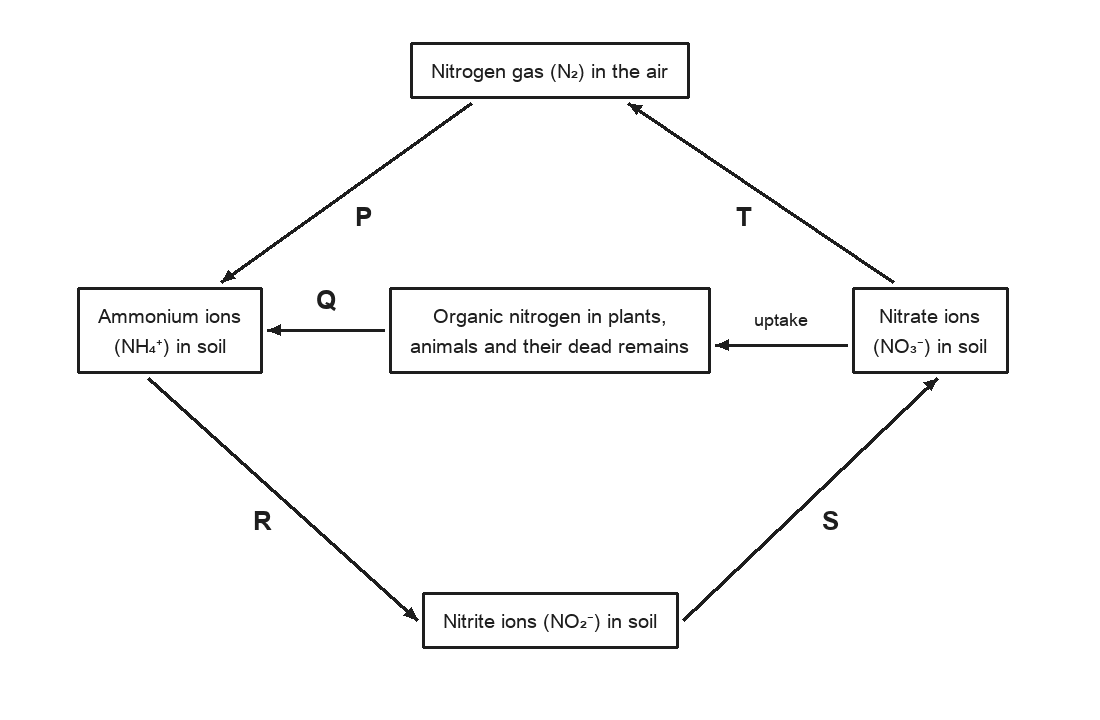
Name the process shown by each letter, and name one organism that carries out each of R, S and T.
- 371 mark
Question 37
Biological nitrogen fixation can be summed up by this equation.
How many ATP molecules are used to make 10 molecules of ammonia in this way?
- 383 marks
Question 38
Biological nitrogen fixation can be summed up by this equation.
(a) The 8 electrons and 8 H⁺ together supply 8 hydrogen atoms. How many of these end up in the two ammonia molecules, and how many in the hydrogen gas?
(b) What percentage of the electrons is used to make hydrogen gas rather than ammonia?
(c) Name the carrier that supplies electrons to nitrogenase and the process that supplies its ATP.
- 391 mark
Question 39
A mutant pea plant forms root nodules containing Rhizobium, but the nodules are white instead of pink because the plant cannot make leghaemoglobin. These nodules fix almost no nitrogen. What is the best explanation?
- 403 marks
Question 40
A farmer grows gram (a legume) and wheat in turn on the same field. After a gram crop, wheat gives a good yield with less urea than when wheat follows wheat (Hypothetical data.).
(a) How does the gram crop add nitrogen to the field?
(b) How does this nitrogen become available to the next wheat crop?
(c) Why can wheat not add nitrogen in the same way?
- 411 mark
Question 41
A soil sample rich in ammonium ions was treated with a chemical that kills Nitrobacter but not Nitrosomonas (Hypothetical data.). Which ion would build up in this soil?
- 422 marks
Question 42
The nitrifying bacteria Nitrosomonas and Nitrobacter are described as chemoautotrophs. Explain what this term means for these two bacteria, naming the reaction that supplies each of them with energy.
- 431 mark
Question 43
Some glutamic acid in a plant is converted into glutamine by the enzyme glutamine synthetase. Which change takes place in this reaction?
- 443 marks
Question 44
Classify each of these nitrogen-fixing organisms as free-living or symbiotic, and for the free-living ones say whether each is an aerobic bacterium, an anaerobic bacterium or a cyanobacterium:
Azotobacter, Beijerinckia, Clostridium, Nostoc, Rhizobium, Frankia
- 451 mark
Question 45
Certain bacteria live on the root surface of rice and maize and fix nitrogen there, without forming nodules and without entering deep into the root tissue. Which organism and kind of association fit this description?
- 461 mark
Question 46
Four events in the formation of a root nodule in a legume are listed below in a jumbled order.
P: The root hair curls around the attached bacteria.
Q: Bacteria released into inner root cells become bacteroids.
R: An infection thread grows inward from the root hair to the cortex.
T: A mature nodule forms a vascular connection with the root.
Which option gives the correct sequence of these events?
- 474 marks
Question 47
Pea plants were grown in four pots of sterilised sand, watered with a nutrient solution containing no nitrogen except where stated (Hypothetical data.).
Pot Treatment Nodules per plant Shoot nitrogen (mg per plant) 1 Nothing added 0 12 2 Rhizobium added 25 60 3 Nitrate added, no Rhizobium 0 58 4 Rhizobium added, solution lacking molybdenum 22 15 (a) How many times as much nitrogen did the Pot 2 plants contain as the Pot 1 plants, and what does this show?
(b) How did the Pot 3 plants get their nitrogen without nodules?
(c) Why did the Pot 4 plants form nodules but gain little nitrogen?
(d) Why was sterilised sand used instead of garden soil?
- 481 mark
Question 48
During a thunderstorm, some atmospheric nitrogen is fixed and reaches the soil with the rain. Which statement about this process is correct?
- 493 marks
Question 49
Absorbed nitrate is reduced to ammonium in two steps.
Step catalysed by nitrate reductase:
Step catalysed by nitrite reductase:
(a) How many electrons are needed to reduce one nitrate ion to one ammonium ion?
(b) How many electrons are needed to make 5 ammonium ions from nitrate?
(c) In nitrogen fixation, 8 electrons are used for every 2 molecules of ammonia formed. Which route uses more electrons per ammonia molecule?
- 502 marks
Question 50
Air is about 78 per cent nitrogen, yet nitrogen is often the element that limits the growth of crops. Explain this.
- 511 mark
Question 51
Magnesium is an essential nutrient because it is
- 521 mark
Question 52
Microelements are those nutrients which
- 531 mark
Question 53
Which of the following element is a micronutrient?
- 541 mark
Question 54
Which macroelement is required in the middle lamellae of the cell wall?
- 551 mark
Question 55
Which element activates the enzyme nitrate reductase during the nitrogen fixation?
- 561 mark
Question 56
Which of the following is a component of indole acetic acid (IAA)?
- 571 mark
Question 57
The condition stem crack of celery is due to deficiency of
- 581 mark
Question 58
The element that is not very mobile and remains fixed to mitochondria and chloroplasts is
- 591 mark
Question 59
The most abundant element present in the plants is
- 601 mark
Question 60
Middle lamella mainly contains
- 611 mark
Question 61
The appearance of yellow edges to leaves is due to deficiency of this mineral element
- 621 mark
Question 62
The macronutrients which are an essential component of all organic compounds, yet not obtained by plants from soil is
- 631 mark
Question 63
Which is essential for root hair growth?
- 641 mark
Question 64
Nitrification is the process of conversion of
- 651 mark
Question 65
The nitrifying bacteria Nitrosomonas is a
- 661 mark
Question 66
The enzyme that can split a nitrogen molecule during nitrogen fixation is
- 671 mark
Question 67
Which of the following is involved in the symbiotic nitrogen fixation?
- 681 mark
Question 68
The number of essential elements required for normal growth of plants is
(i) 10
(ii) 16
(iii) 20
(iv) 25
- 691 mark
Question 69
Name the element that plays an important role in biological nitrogen fixation
- 701 mark
Question 70
Which of the following is a macronutrient?
- 711 mark
Question 71
Zn, Mo, Fe, Cu are
- 721 mark
Question 72
_______ element can be obtained from both mineral and non-mineral sources.
- 731 mark
Question 73
_______ is essential for binding the components of ribosomes.
- 741 mark
Question 74
____, ____ and ____ are the three main elements usually supplied as chemical fertilisers.
- 751 mark
Question 75
Yellowing of leaves due to low content of chlorophyll is called _______.
- 761 mark
Question 76
The root nodules contain a pigment called _______.
- 771 mark
Question 77
_______ bacteria converts nitrite ions to nitrate ions.
- 781 mark
Question 78
The conversion of ammonia to nitrates is called _______.
- 791 mark
Question 79
The deficiency of sulphur causes chlorosis first in _______.
- 801 mark
Question 80
_______ enzyme is a flavoprotein and contains molybdenum.
- 811 mark
Question 81
Nitrogen is absorbed as _______ and _______ ions from the _______.
- 821 mark
Question 82
Oxygen and hydrogen are called macronutrients as they can be easily obtained from water which is found in plenty.
- 831 mark
Question 83
Potassium is found in abundance in meristematic tissues, buds and root tip.
- 841 mark
Question 84
Copper is an essential part of chlorophyll molecule.
- 851 mark
Question 85
For actively mobilised elements, the deficiency symptoms first appear in young leaves.
- 861 mark
Question 86
Most common fertiliser NPK has essential nutrients: nitrogen, potassium and phosphorus.
- 871 mark
Question 87
Bacteria Nitrobacter converts nitrates to nitrites.
- 881 mark
Question 88
Nitrogenase is the only enzyme that can split nitrogen molecule for nitrogen fixation.
- 891 mark
Question 89
Bacteroids stimulate cell division in the infected root cortex cells.
- 901 mark
Question 90
Cyanobacteria Nostoc has symbiotic relationship with leguminous plants.
- 911 mark
Question 91
Elements like carbon, oxygen and hydrogen which are obtained from the atmosphere are called non-mineral elements.
- 921 mark
Question 92
A technique of growing plants directly in normal culture solutions without soil.
- 931 mark
Question 93
Elements that are necessary for normal growth of plant and cannot be replaced by any other element.
- 941 mark
Question 94
Elements needed by the plant in minute quantity or traces but absolutely essential.
- 951 mark
Question 95
An essential element that is an activator for enzymes necessary for photosynthesis.
- 961 mark
Question 96
Name of the symptom that leads to yellowing of leaves due to loss of chlorophyll.
- 971 mark
Question 97
Deficiency symptom which refers to localised death of the tissues such as buds, leaf tips or margins.
- 981 mark
Question 98
Nitrogen fixation by free-living or symbiotic bacteria.
- 991 mark
Question 99
Process of conversion of nitrates present in soil back to nitrogen gas by bacteria Pseudomonas.
- 1001 mark
Question 100
A pink colour pigment present in root nodules of leguminous plants that plays an important part in nitrogen fixation.
- 1011 mark
Question 101
An enzyme essential for nitrogen fixation to take place, it reduces nitrogen molecule to ammonia.
- 1021 mark
Question 102
In the question given below, there are two statements marked as Assertion (A) and Reason (R). Read the statements and choose the correct option.
Assertion (A): Hydroponics is a way of growing plants directly in culture solution containing nutrients without soil.
Reason (R): Purified water and mineral salts are always not essential for the growth of plants in hydroponics.
- 1031 mark
Question 103
In the question given below, there are two statements marked as Assertion (A) and Reason (R). Read the statements and choose the correct option.
Assertion (A): Zinc activates enzymes like carboxylases and dehydrogenases.
Reason (R): Absence of zinc can cause little leaf and mottled leaf condition in plants.
- 1041 mark
Question 104
In the question given below, there are two statements marked as Assertion (A) and Reason (R). Read the statements and choose the correct option.
Assertion (A): Excess of manganese (Mn) induces deficiency symptoms of iron (Fe) and magnesium (Mg).
Reason (R): Manganese (Mn) competes with iron (Fe) for uptake and with magnesium (Mg) for binding with enzymes.
- 1051 mark
Question 105
In the question given below, there are two statements marked as Assertion (A) and Reason (R). Read the statements and choose the correct option.
Assertion (A): Magnesium (Mg²⁺) is important to activate enzymes in photosynthesis and carbohydrate metabolism.
Reason (R): Mg²⁺ is involved in the synthesis of nucleic acids (DNA and RNA).
- 1061 mark
Question 106
In the question given below, there are two statements marked as Assertion (A) and Reason (R). Read the statements and choose the correct option.
Assertion (A): Root nodules of leguminous plants contain nitrogen-fixing bacteria Rhizobium and a pigment called leghaemoglobin.
Reason (R): Leghaemoglobin combines with oxygen and protects the enzyme nitrogenase which functions only under anaerobic conditions.
- 1071 mark
Question 107
In the question given below, there are two statements marked as Assertion (A) and Reason (R). Read the statements and choose the correct option.
Assertion (A): Reductive amination involves the transfer of amino group from one amino acid to the keto group of a keto acid.
Reason (R): In transamination reaction, ammonia reacts with α-ketoglutaric acid and forms glutamic acid.
- 1081 mark
Question 108
In the question given below, there are two statements marked as Assertion (A) and Reason (R). Read the statements and choose the correct option.
Assertion (A): Nitrates present in the soil are reduced to nitrogen by the process of denitrification.
Reason (R): Denitrification is carried by bacteria Pseudomonas and Azotobacter.
- 1093 marks
Question 109
'All elements that are present in a plant need not be essential to its survival'. Comment.
- 1102 marks
Question 110
Why is purification of water and nutrient salts so important in studies involving mineral nutrition using hydroponics?
- 1114 marks
Question 111
Which of the following statements are true? If false, correct them:
(i) Boron deficiency leads to stout axis.
(ii) Every mineral element that is present in a cell is needed by the cell.
(iii) Nitrogen as a nutrient element, is highly immobile in the plants.
(iv) It is very easy to establish the essentiality of micronutrients because they are required only in trace quantities.