
Opening your dashboard
Class 11 Biology Chapter 17 Mineral Nutrition: Competency-Based Questions (CBQ)
40 questions on Chapter 17, each worked through on its own page with the AI tutor. Class 11 Biology, ICSE 2026-27.
40 questions
1–5 marks · Mixed difficulty
- 14 marks
Question 1
At an agricultural research station in Haryana, barley was grown in water culture for three generations. Grain harvested from each generation was used to raise the next. One line was always given a complete nutrient solution; the other line was given the same solution with nickel left out, using specially purified salts and water. The germination of the grain harvested from each generation was tested. (Hypothetical data.)
Generation Germination of grain, complete solution Germination of grain, nickel left out 1 96 % 93 % 2 95 % 52 % 3 96 % 8 % The nickel-free plants of generation 3 also showed dead (necrotic) leaf tips in which urea had built up. Nickel is a part of the enzyme urease, which breaks urea down into ammonia and carbon dioxide.
(a) By what percentage was the germination of generation-3 grain lower in the nickel-free line than in the complete-solution line? (1 mark)
(b) Which criterion of essentiality do the germination results satisfy? Explain. (1 mark)
(c) Explain why the effect of leaving out nickel was small in generation 1 and became severe only in later generations, and why urea built up in the leaf tips. (2 marks)
- 24 marks
Question 2
In a school laboratory in Kolkata, students collected 500 g of fresh leaves from a guava tree. They dried the leaves in an oven until the mass stopped changing; the dry mass was 75 g. They then burnt the dry leaves completely in a crucible; the ash left behind weighed 5.25 g. (Hypothetical data.)
(a) What percentage of the fresh leaves was water? (1 mark)
(b) What percentage of the dry mass was left as ash? (1 mark)
(c) The ash contains almost no carbon, hydrogen, oxygen or nitrogen, yet these four elements make up most of the dry mass of a plant. Explain where they went on burning, and state where a plant obtains its carbon, hydrogen and oxygen. (2 marks)
- 31 mark
Question 3
Assertion (A): Nitrogen is often grouped with the mineral elements, although the nitrogen in a plant comes originally from the air.
Reason (R): Nitrogen is a constituent of proteins, nucleic acids and chlorophyll.
- 41 mark
Question 4
Oven-dried leaves of maize plants grown on an acid soil were analysed in a laboratory. They contained 220 mg of aluminium and 110 mg of iron per kg of dry matter. (Hypothetical data.) Which conclusion follows correctly?
- 54 marks
Question 5
A Class 11 project group in Bengaluru wants to test whether chlorine is essential for tomato plants, using water culture. Their complete nutrient solution is made from these salts:
, , , , , , , , , , and an iron chelate (sodium iron EDTA).
(a) Which two salts in the list supply chloride ions? (1 mark)
(b) Suggest a replacement for each of these two salts so that the chlorine-free solution still supplies every other element. (1 mark)
(c) Describe the results that would show that chlorine is an essential element, and state one precaution needed because chlorine is required only in traces. (2 marks)
- 61 mark
Question 6
Assertion (A): To test whether boron is essential, the culture vessels should be made of polythene rather than of ordinary borosilicate laboratory glass.
Reason (R): Boron is a macronutrient, so plants need a large and steady supply of it.
- 71 mark
Question 7
Assertion (A): Vegetables such as tomato, seedless cucumber and lettuce are produced commercially by hydroponics.
Reason (R): The technique of growing plants in a nutrient solution was introduced by Julius von Sachs in 1860.
- 81 mark
Question 8
A student plans a water-culture project with mustard seedlings. Which one of the following questions can the experiment not answer?
- 94 marks
Question 9
A plant physiology laboratory in Ludhiana analysed healthy wheat leaves. Each gram of dry leaf contained 9.0 mg of chlorophyll and 2.7 mg of magnesium in all. (Hypothetical data.) Take all the chlorophyll as chlorophyll a, , with a molar mass of 893.5 g per mol; the atomic mass of magnesium is 24.3.
(a) Calculate the mass of magnesium held in the chlorophyll of 1 g of dry leaf. (1 mark)
(b) What percentage of the leaf's magnesium is held in chlorophyll? (1 mark)
(c) Using two other roles of magnesium, explain why a leaf needs far more magnesium than its chlorophyll holds. (2 marks)
- 104 marks
Question 10
In a tomato polyhouse near Nashik, many fruits developed a dark, sunken patch at the blossom end (the end away from the stalk). This disorder, called blossom-end rot, is linked to a shortage of calcium in the fruit tissue. Calcium was measured in different parts of the plants, and a trial was run in which the young fruits were sprayed weekly with a dilute calcium chloride solution. (Hypothetical data.)
Part analysed Calcium (mg per g dry mass) Older leaves 32 Blossom end of healthy fruits 1.6 Blossom end of affected fruits 0.7 Fruits affected: 24 % before the trial; 6 % in the sprayed rows.
(a) By what percentage did the calcium spray reduce the proportion of affected fruits? (1 mark)
(b) The older leaves are rich in calcium, yet the fruit end is short of it. Explain this using the mobility of calcium. (1 mark)
(c) Explain how a shortage of calcium can lead to the death of the young cells at the blossom end. (2 marks)
- 111 mark
Question 11
Assertion (A): Iron and copper can act as carriers of electrons in photosynthesis and respiration.
Reason (R): Iron can change between the Fe²⁺ and Fe³⁺ forms, and copper between the Cu⁺ and Cu²⁺ forms, by gaining or losing an electron.
- 121 mark
Question 12
Soil tests on a soybean field in Madhya Pradesh show that the soil is low in sulphur. The farmer also wants to give the crop a little nitrogen at sowing. Which one fertiliser supplies both elements?
- 131 mark
Question 13
In a school activity, discs cut from the pale young leaves of a crop and from healthy leaves were dropped into hydrogen peroxide solution. Discs from the pale leaves gave far fewer bubbles of oxygen. (Hypothetical data.) A shortage of which element best explains both the pale young leaves and the weaker breakdown of hydrogen peroxide?
- 144 marks
Question 14
In a tea garden in Assam, the leaves of bushes in two sections, P and Q, were turning evenly pale yellow and growth was slow. Soil tests suggested a shortage of either nitrogen or sulphur in each section. An agronomist counted the percentage of leaves showing chlorosis at each leaf position along the shoots. (Hypothetical data.)
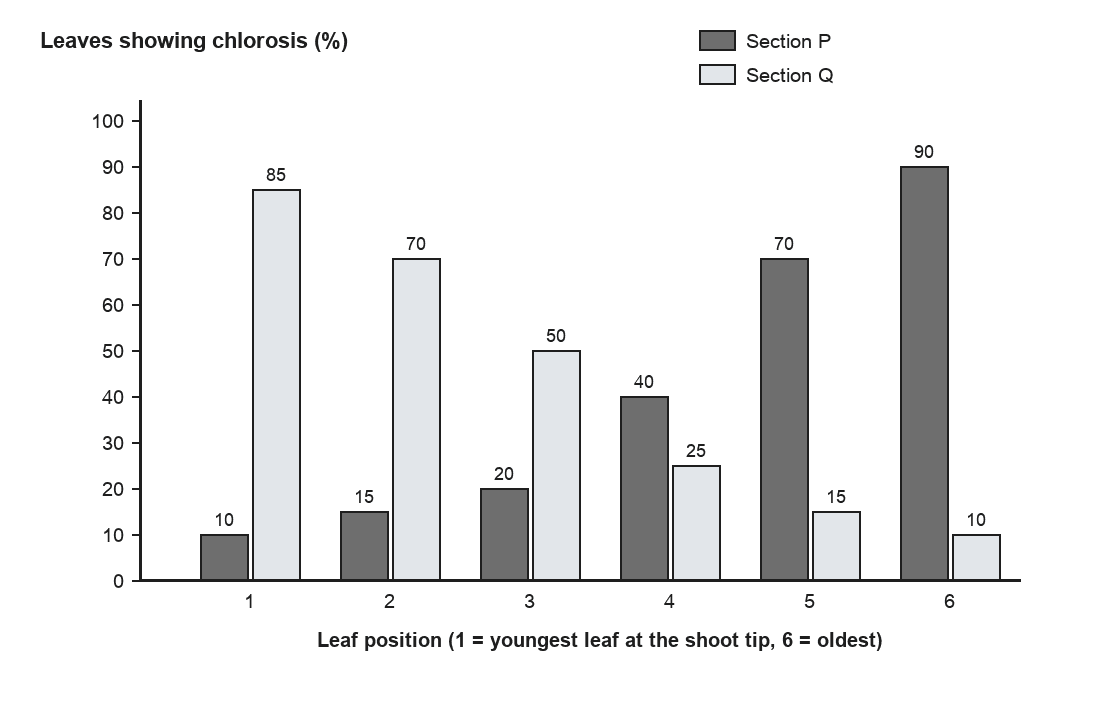
(a) In which section does the chlorosis start in the youngest leaves? (1 mark)
(b) Identify the element most likely to be deficient in each section. Give a reason based on how the element moves in the plant. (2 marks)
(c) Suggest a simple field trial with two fertilisers that would confirm the diagnosis for Section Q. (1 mark)
- 154 marks
Question 15
Soybean on a strongly acid soil in Meghalaya grew poorly, and its young leaves showed yellowing between the veins, like iron deficiency, although the soil contained plenty of iron. In acid soils more manganese dissolves in the soil water; adding lime raises the pH of the soil. A field trial tested four doses of lime. (Hypothetical data.)
Lime (t per ha) Soil pH Leaf manganese (mg per kg dry mass) Leaf iron (mg per kg dry mass) Grain yield (t per ha) 0 4.6 840 55 1.5 2 5.2 460 80 2.3 4 5.8 220 105 2.9 6 6.3 120 110 3.0 (a) Calculate the percentage increase in grain yield when 4 t per ha of lime was applied, compared with no lime. (1 mark)
(b) Use the leaf data to explain why the unlimed plants showed symptoms of iron deficiency, although the soil had enough iron. (2 marks)
(c) The farmer asks whether to apply 6 t per ha instead of 4 t per ha. Give your advice, using the data. (1 mark)
- 161 mark
Question 16
Assertion (A): A crop whose leaves hold a nutrient just below its critical concentration may grow less well even before any visible deficiency symptom appears.
Reason (R): The critical concentration of a nutrient is the concentration at which it becomes toxic to the plant.
- 171 mark
Question 17
Assertion (A): Yellowing (chlorosis) of a crop's leaves is, on its own, enough to identify which element is deficient.
Reason (R): Deficiency of any one of several elements, such as nitrogen, potassium, magnesium, sulphur, iron, manganese, zinc and molybdenum, can cause chlorosis.
- 181 mark
Question 18
In a potato field in Uttar Pradesh, the lower, older leaves have scorched tips and yellow, shrivelled margins, and the stems have short internodes. The youngest leaves still look normal. A deficiency of which element is most likely?
- 194 marks
Question 19
At a research farm in Odisha, two plots were set up in concrete tanks lined so that no water could drain out. Both received the same amount of potassium nitrate fertiliser in which the nitrogen was labelled with the heavy isotope ¹⁵N. The soil of Plot D was kept moist but well aerated; Plot F was kept flooded throughout. At harvest, the ¹⁵N found in the crop and in the soil was measured. (Hypothetical data.)
Plot ¹⁵N in crop (% of applied) ¹⁵N in soil (% of applied) D (aerated) 54 28 F (flooded) 30 22 Since no water drained out, any ¹⁵N not found in the crop or the soil escaped from the field as gas.
(a) Calculate the percentage of the applied ¹⁵N lost as gas from each plot. (1 mark)
(b) Name the process that most likely caused the larger loss from Plot F, name two bacteria that carry it out, and explain why flooding favours it. (2 marks)
(c) Why did the scientists label the fertiliser with ¹⁵N instead of simply measuring the total nitrogen in the crop? (1 mark)
- 204 marks
Question 20
Rice farmers near Thanjavur grow the small floating fern Azolla on the water of their paddy fields. Cavities in the leaves of Azolla contain the cyanobacterium Anabaena. After a few weeks the fern is mixed into the mud. A trial compared grain yields. (Hypothetical data.)
Treatment Grain yield (t per ha) No nitrogen added 3.0 Azolla grown and mixed into the mud (no urea) 3.9 Urea giving 60 kg nitrogen per ha 4.2 The Azolla mixed into each hectare had a fresh mass of 10 t, of which 0.25 % was nitrogen.
(a) Calculate the mass of nitrogen added to each hectare by the Azolla. (1 mark)
(b) Which partner of the Azolla association fixes atmospheric nitrogen, and where in the association is it fixed? (1 mark)
(c) The nitrogen fixed in Azolla reaches the rice only after the fern is mixed into the mud. Explain how this nitrogen becomes available to the rice roots. (2 marks)
- 214 marks
Question 21
At a dryland farm in Karnataka, maize and cowpea were grown together in alternate rows. To find how much of its nitrogen the cowpea fixed from the air, scientists spread a small amount of fertiliser labelled with ¹⁵N evenly over the plot. Maize, which cannot fix nitrogen, was used as the reference plant. At flowering they measured the ¹⁵N enrichment (atom % ¹⁵N excess) of the shoots. (Hypothetical data.)
Crop Atom % ¹⁵N excess Total nitrogen in shoots (kg per ha) Maize (reference) 0.80 95 Cowpea 0.20 80 The scientists used this relation:
(a) Calculate the percentage of the cowpea's nitrogen that came from the air. (1 mark)
(b) Calculate the mass of nitrogen per hectare that the cowpea fixed from the air. (1 mark)
(c) Explain why the cowpea shoots were less enriched with ¹⁵N than the maize shoots, and why maize is a suitable reference plant. (2 marks)
- 221 mark
Question 22
Assertion (A): Nitrogen fixation in the root nodules of a groundnut crop falls when the crop is heavily shaded for several days.
Reason (R): Nitrogenase needs a large supply of ATP, which the nodules make by respiration fuelled by sugars sent down from the leaves.
- 231 mark
Question 23
Assertion (A): A well-nodulated pea crop usually needs more nitrogen fertiliser than a cereal crop does to give a good yield.
Reason (R): Rhizobium living in the root nodules of pea fixes atmospheric nitrogen and passes the ammonia to the host plant.
- 241 mark
Question 24
In a laboratory, an extract of pea leaves was given glutamic acid and pyruvic acid (a keto acid). After an hour, the amino acid alanine and α-ketoglutaric acid were found in the mixture. Which process took place, and which enzyme catalysed it?
- 251 mark
Question 25
Casuarina trees planted on nitrogen-poor coastal sand in Tamil Nadu grow well without nitrogen fertiliser. Their roots bear nodules, although Casuarina is not a legume. The nitrogen-fixing organism in these nodules is most likely
- 265 marks
Question 26
Match the following:
Column A Column B 1. Major constituent of proteins and nucleic acids (a) Manganese 2. Forms an important part of chlorophyll molecule (b) Nitrogen 3. Component of many enzymes like nitrogenase (c) Calcium 4. Important for splitting of water during photosynthesis (d) Magnesium 5. Needed for development of normal cell wall (e) Molybdenum - 275 marks
Question 27
Read the sources given and answer any four from the questions given below.
Hydroponics is an art of growing plants without soil. A hydroponic system includes a water solution containing all necessary nutrients. Nutrient water is in contact with roots and it keeps the plant fed and hydrated. A hydroponic system can grow plants and vegetables faster than growing outdoors in soil. Plants often yield more, require less space and use less water than with conventional gardening. Many types of plants grow well hydroponically. Some of the best plants to grow are herbs, lettuce and greens, tomatoes, peppers and strawberries. Root vegetables like potato and tall plants and vines do not grow well by hydroponics. Hydroponics require a higher level of monitoring and micro-managing than growing plants traditionally. The nutrient solution needs to be flushed and replaced regularly. The water-borne diseases are considerably higher in hydroponic plants as the same water is circulated again and again.
(1) As compared to conventional gardening, the hydroponic plants need
(a) more water
(b) less water
(c) same amount of water
(d) less nutrients
(2) Where is the nutrient solution added in hydroponics?
(a) soil
(b) plant
(c) roots directly
(d) water
(3) The following plants grow well by hydroponics
(a) herbs and lettuce
(b) potato
(c) vine crops
(d) pineplant
(4) Which diseases are considerably higher in hydroponic plants?
(a) soil bacterial disease
(b) air-borne fungus
(c) water-borne diseases
(d) soil fungal disease
(5) Which of the following statements is true for hydroponic plants?
(a) yield less
(b) need more space
(c) nutrients are added regularly
(d) use more water
- 285 marks
Question 28
Read the sources given and answer any four from the questions given below.
The micronutrients are as essential for plant metabolism and growth as macronutrients although they are required in very low concentrations. Boron (B) and molybdenum (Mo) are essential micronutrients. The main functions of B include seed production, root elongation and sugar metabolism. When managing the quantities of boron, it is important to keep in mind that boron should be applied before the flowering crop stage. Application of boron during later stages is useless. The chief biochemical functions of Mo include its role in nitrogen fixation in legumes and regulation of nitrate reduction and protein content. Plants can have very high levels of Mo before its toxicity symptoms appear. It is well-known that feeding crops, high in Mo, by the cattle, results in Mo toxicity, often referred to as molybdenosis.
(1) Which of the following statements is not true of micronutrients?
(a) required in trace amounts
(b) essential for plant growth
(c) not as essential as macronutrients
(d) show deficiency symptoms
(2) For good yield, boron should be applied to the plant
(a) before flowering stage
(b) after flowering stage
(c) after fertilisation in plants
(d) after fruits are formed
(3) Main function of boron is
(a) abscission of flowers
(b) small size of fruits
(c) root elongation
(d) fat metabolism
(4) An important function of molybdenum is
(a) nitrogen fixation
(b) sugar metabolism
(c) chlorophyll production
(d) root elongation
(5) Molybdenosis is associated with
(a) deficiency of molybdenum in plants
(b) molybdenum toxicity in cattle
(c) deficiency of molybdenum in cattle
(d) low nitrogen fixation
- 295 marks
Question 29
Explain the following with examples: (i) macronutrients (ii) micronutrients (iii) beneficial nutrients (iv) toxic elements and (v) essential elements.
- 303 marks
Question 30
If a plant shows a symptom which could develop due to deficiency of more than one nutrient, how would you find out experimentally, the real deficient mineral element?
- 313 marks
Question 31
Why is that in certain plants deficiency symptoms appear first in younger parts of the plant while in others they do so in mature organs?
- 321 mark
Question 32
At a rice research institute in Cuttack, rice plants were raised in water culture in two sets. Set 1 received a complete nutrient solution containing all the essential elements. Set 2 received the same solution with silicon added as silicic acid. The plants of both sets grew, flowered and produced viable grain. (Hypothetical data.)
Observation at harvest Set 1 (no silicon) Set 2 (silicon added) Plants that fell over (lodged), % 40 8 Leaves with blast-disease spots, % 35 10 Grain per plant, g 18 24 On the basis of these results, how should silicon be classified for rice?
- 331 mark
Question 33
A farm near Pune grew the same lettuce variety in two ways for one crop: in soil beds watered through channels, and in a closed hydroponic unit in which the nutrient solution flows back to its reservoir and is used again. For each square metre, the water supplied and the lettuce harvested were measured, and the water lost by transpiration from the plants was estimated. (Hypothetical data.)
Per square metre, one crop Soil beds Closed hydroponic unit Water supplied (L) 300 60 Lettuce harvested (kg) 1.5 3.0 Water transpired by the plants (L) 45 50 Which statement correctly compares the two systems and explains the difference?
- 341 mark
Question 34
Assertion (A): On a hot afternoon, a potassium-deficient crop wilts sooner than a well-fed crop of the same kind.
Reason (R): Potassium ions help to keep cells turgid and are needed for the opening and closing of stomata.
- 351 mark
Question 35
Assertion (A): Using ammonium fertilisers on a well-aerated field year after year tends to make the soil more acidic.
Reason (R): When Nitrobacter oxidises nitrite ions to nitrate ions, hydrogen ions are released.
- 362 marks
Question 36
A hydroponic grower in Hyderabad is filling a 250 L tank with nutrient solution. The recipe needs potassium nitrate, , at a concentration of 5 mmol per litre. The grower keeps a stock solution of potassium nitrate containing 1 mol per litre. Take the atomic masses N = 14 and K = 39. (Hypothetical data.)
(a) What volume of the stock solution must be put into the tank before it is made up to 250 L with water? (1 mark)
(b) How many milligrams of nitrogen and of potassium does each litre of the final solution receive from this salt? (1 mark)
- 372 marks
Question 37
A farmer in Punjab has grown rice and wheat in turn on one field for 12 years, adding only NPK fertiliser every season. Over this time the wheat yield has fallen from 5.0 to 4.2 t per ha. A soil test now gives these results; a value below the critical level means that the nutrient is likely to be deficient for the crop. (Hypothetical data.)
Nutrient in the soil Soil test result Nitrogen, phosphorus and potassium Above their critical levels Zinc 0.4 mg per kg (critical level 0.6 mg per kg) Sulphur 7 mg per kg (critical level 10 mg per kg) The farmer says: "Since I add NPK every season, my soil cannot be short of any nutrient." Evaluate this claim using the data, and suggest how the farmer should correct the problem.
- 383 marks
Question 38
In many plants, a good part of the nitrogen absorbed by the roots is first built into organic compounds in the root and then carried up to the shoot in the xylem. The table gives the formulae of two amino acids and of the two amides made from them. Take the atomic masses H = 1, C = 12, N = 14 and O = 16.
Compound Formula Glutamic acid (amino acid) Glutamine (amide) Aspartic acid (amino acid) Asparagine (amide) (a) Calculate the percentage of nitrogen by mass in glutamic acid and in glutamine. (1 mark)
(b) Work out the number of nitrogen atoms per carbon atom in each of the four compounds, and name the compound that carries the most nitrogen per carbon atom. (1 mark)
(c) The carbon skeletons of these compounds are made from sugars produced in photosynthesis. Explain why carrying nitrogen as amides rather than as amino acids is economical for the plant. (1 mark)
- 393 marks
Question 39
An agricultural extension officer in Bihar wants farmers to be able to tell six common deficiencies apart in the field. These are the officer's notes, in no particular order:
Deficient element Main symptoms Sulphur Young leaves turn evenly pale yellow; older leaves stay green Potassium Older leaves show scorched tips and yellow, shrivelled margins Iron Young leaves turn yellow between the veins, while the veins stay green at first Nitrogen Older leaves turn evenly yellow; young leaves stay green Calcium Growing tips of shoots and roots die; the tips of young leaves become hooked Magnesium Older leaves turn yellow between the veins, often with purple or dead spots Using these notes, construct a dichotomous key with five numbered pairs of contrasting statements (couplets) that leads to each of the six elements. Begin with the feature that best divides the six into two groups, and explain why that feature works well as the first step.
- 405 marks
Question 40
Neem-coated urea is the common form of urea fertiliser sold in India. At a farm in Uttar Pradesh, two plots of well-drained loam under irrigated wheat each received urea supplying 120 kg of nitrogen per ha: Plot U got ordinary urea and Plot N got neem-coated urea. In the soil, urea is first broken down to ammonium ions (). Soil particles carry negative charges, so they hold positive ions such as but not negative ions such as nitrate (), which rain or irrigation water can wash down below the roots. (Hypothetical data.)
Soil nitrogen (mg of nitrogen per kg of soil):
Days after applying urea Plot U: NH₄⁺-N Plot U: NO₃⁻-N Plot N: NH₄⁺-N Plot N: NO₃⁻-N 7 40 14 48 6 14 18 34 36 16 28 4 22 14 22 Season totals Plot U Plot N Nitrate-nitrogen washed below the root zone (kg per ha) 28 16 Grain yield (t per ha) 4.6 4.9 (a) Calculate the percentage reduction in nitrate-nitrogen washed below the root zone in Plot N compared with Plot U. (1 mark)
(b) Using the soil data for days 7 and 14, identify the step of the nitrogen cycle that the neem coating slows down, and name the bacterium that carries out this step. Explain why slowing this step reduces the loss of nitrogen by washing. (2 marks)
(c) A fertiliser dealer claims: "Neem-coated urea gives the crop more nitrogen than ordinary urea." Evaluate this claim using the data. (2 marks)