
Question 405 marksMedium
Explain the development of root nodules in soya bean plant.
Confirming your payment
Sign up now and get 250 free tokens.
Mineral Nutrition · Question 40 of 40
Explain the development of root nodules in soya bean plant.
Solution:
Concept: A root nodule is a swelling on a legume root, formed by the plant in response to rhizobia (the Rhizobium group of bacteria), inside which the bacteria fix nitrogen. In soya bean the partner is mainly Bradyrhizobium japonicum, earlier called Rhizobium japonicum.
Step 1 — What is asked: We need the stages in which a root nodule forms, shown in the figure below.
Step 2 — The stages in a figure: The four main stages are drawn below.
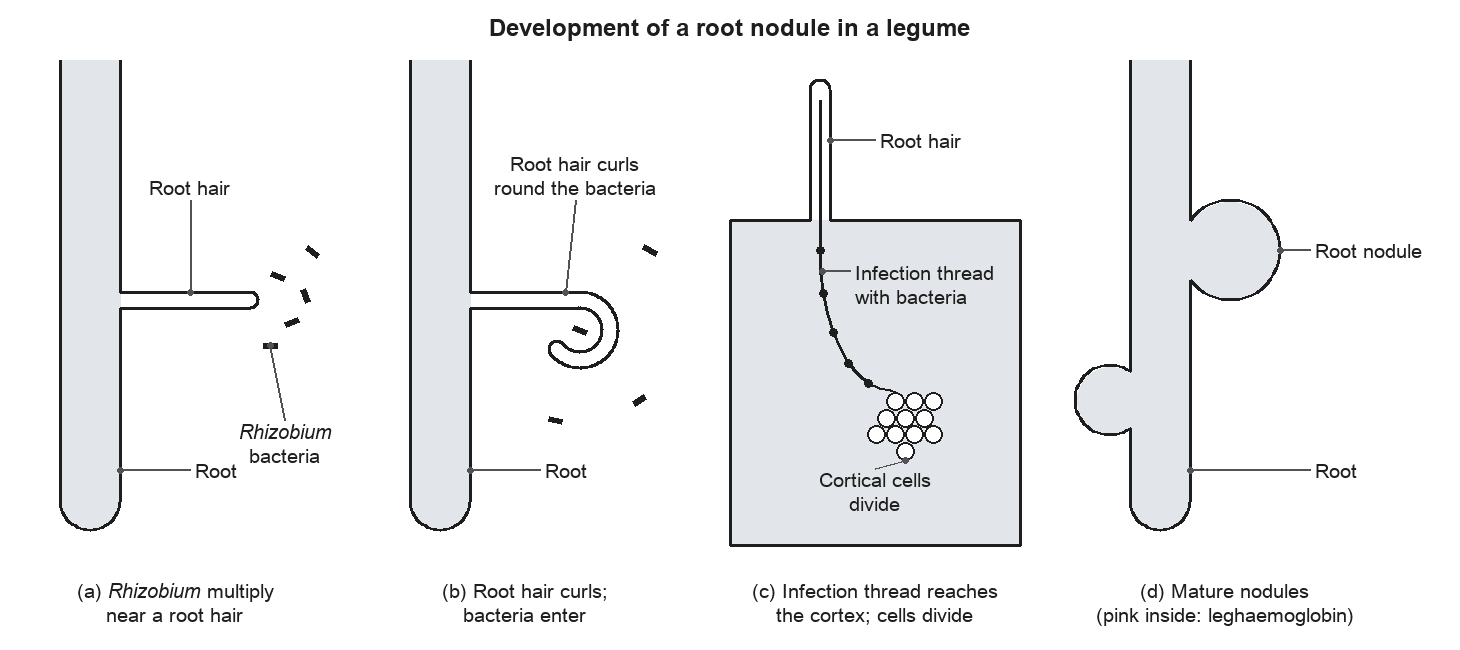
Step 3 — Contact and multiplication: The soya bean root releases chemicals (flavonoids) that attract the rhizobia and switch on their nodulation genes. The bacteria multiply near the root hairs and stick to them.
Step 4 — Curling of the root hair: Chemical signals from the bacteria (Nod factors) make the root hair curl round them, trapping the bacteria in the curl.
Step 5 — Infection thread: At the curl the wall of the root hair is broken down and the plasma membrane grows inwards as an infection thread, which carries the dividing bacteria through the root hair into the cortex.
Step 6 — Cell division: Cells of the root cortex start dividing (a changed balance of the plant hormones cytokinin and auxin promotes this), forming a mass of new cells, the nodule primordium. Soya bean forms rounded (determinate) nodules, whose first divisions are in the outer cortex. The general textbook account names the inner cortex and pericycle, which is where the elongated nodules of pea and clover begin.
Step 7 — Bacteroids: The infection thread grows into the dividing cells, and the bacteria are released from it into these cells, each group enclosed in a membrane. They enlarge into bacteroids, which fix nitrogen.
Step 8 — Mature nodule: The cells grow into a mature nodule with its own vascular connection to the root, for exchange of sugars and fixed nitrogen. It contains nitrogenase and the pink pigment leghaemoglobin. Both plant genes and bacterial genes (nod, nif and fix) control the process.
Note: Bacteroids form only after the bacteria are released from the infection thread into the dividing cortical cells, not while they are still in the root hair.
Therefore, a soya bean nodule develops by attraction of rhizobia (Bradyrhizobium), curling of the root hair, growth of an infection thread into the cortex, division of cortical cells, and formation of bacteroids inside a mature, pink nodule.