
Opening your dashboard
Class 11 Biology Chapter 16: Transport in Plants Solutions
82 textbook questions with step-by-step answers, free to read, for ISC 2026-27.
Get talked through Ch 16, not just shown the answer
Reading a finished solution is not the same as being able to do it. The AI tutor takes one question at a time and works it with you, in your own words, until you can.
- Ask it out loud, in your own words
- It gives you the next step, not the answer
- Stuck on part (ii)? Start there
82 questions with solutions
1–5 marks · Mixed difficulty
- 11 mark
Question 1
If a crystal of sugar is put in a glass of water, name the process by which it gets mixed in water?
Solve with AIWritten solution
Solution:
Concept: Particles of a substance spread on their own from where they are more concentrated to where they are less concentrated.
Step 1 — What is asked: We need the process that spreads sugar evenly through the water.
Step 2 — The fact: The sugar dissolves, and its molecules move at random from the region of high concentration around the crystal to the rest of the water, until they are evenly spread. This net movement of particles down their concentration gradient, by their own random motion and with no energy supplied from outside, is diffusion.
Therefore, the sugar gets mixed in water by diffusion.
- 21 mark
Question 2
Name the factors that affect the diffusion rate.
Solve with AIWritten solution
Solution:
Concept: Diffusion is the passive movement of molecules down their concentration gradient.
Step 1 — What is asked: We need the conditions that make diffusion faster or slower.
Step 2 — The factors: The rate depends on the concentration gradient (steeper gradient, faster diffusion), the permeability of the membrane separating the two regions, the temperature (warmer, faster) and the pressure.
Therefore, diffusion rate is affected by the concentration gradient, membrane permeability, temperature and pressure.
- 31 mark
Question 3
Give the symbol and the measurement unit of water potential.
Solve with AIWritten solution
Solution:
Concept: Water potential measures the free energy of water, that is, its tendency to move.
Step 1 — What is asked: We need the symbol and the unit of water potential.
Step 2 — The fact: Water potential is written with the Greek letter ψ (psi), often as . It is a pressure, so it is measured in pascals (Pa), usually megapascals (MPa); older books use bars (1 MPa = 10 bars).
Therefore, the symbol is ψ (psi) and the unit is the pascal (usually MPa).
- 41 mark
Question 4
What is the movement of water with respect to water potential?
Solve with AIWritten solution
Solution:
Concept: Water potential is the tendency of water to leave a system.
Step 1 — What is asked: We need the direction in which water moves.
Step 2 — The rule: Water always moves from a region of higher water potential (less negative) to a region of lower water potential (more negative), for example from soil to root hair, and from cell to cell.
Therefore, water moves from higher water potential to lower water potential.
- 51 mark
Question 5
What will be the water potential of a solution having solutes with respect to pure water?
Solve with AIWritten solution
Solution:
Concept: Pure water at atmospheric pressure has a water potential of zero.
Step 1 — What is asked: We need to find how ψ of a solution compares with that of pure water.
Step 2 — The reason: Dissolved solute particles dilute the water, so a given volume holds fewer free water molecules and the free energy of the water falls. The fall depends on the number of dissolved particles, not on their kind, so the water potential of the solution drops below zero.
Therefore, a solution has a lower (negative) water potential than pure water.
- 61 mark
Question 6
If the cell wall, cell membrane and tonoplast are there in a cell, which membranes are semipermeable?
Solve with AIWritten solution
Solution:
Concept: A semi-permeable (selectively permeable) membrane lets water pass but holds back many solutes.
Step 1 — What is asked: We need to find which of the three layers are selectively permeable.
Step 2 — The fact: The cell membrane (plasma membrane) and the tonoplast (membrane round the vacuole) are selectively permeable. The cell wall is freely permeable, so it is not a semi-permeable membrane.
Therefore, the cell membrane and the tonoplast are the semi-permeable membranes.
- 71 mark
Question 7
What is another term used for water potential earlier?
Solve with AIWritten solution
Solution:
Concept: Before the term water potential was adopted, the water status of a cell was described by a quantity that is never negative.
Step 1 — What is asked: We need the older term for water potential.
Step 2 — The fact: The older term is diffusion pressure deficit (DPD), coined by Meyer. DPD is zero for pure water and positive for a solution, so the two are related by .
Therefore, water potential was earlier called diffusion pressure deficit (DPD).
- 81 mark
Question 8
What is the term used for diffusion of water molecules across a semipermeable membrane?
Solve with AIWritten solution
Solution:
Concept: Water moves through a semi-permeable membrane from higher to lower water potential.
Step 1 — What is asked: We need the name of this special kind of diffusion.
Step 2 — The fact: The movement of water (the solvent) from a dilute solution to a concentrated one through a semi-permeable membrane is called osmosis.
Therefore, it is called osmosis.
- 91 mark
Question 9
What is the osmotic potential of pure water?
Solve with AIWritten solution
Solution:
Concept: Osmotic (solute) potential, , is the part of water potential due to dissolved solutes.
Step 1 — What is asked: We need the osmotic potential of pure water.
Step 2 — The reason: Pure water has no solutes, so nothing lowers its free energy; by convention its osmotic potential is zero. Every solution has a negative osmotic potential.
Therefore, the osmotic potential of pure water is zero.
- 101 mark
Question 10
Which process or movement of water leads to turgidity of plant cells?
Solve with AIWritten solution
Solution:
Concept: A plant cell becomes turgid when water fills its vacuole and presses the protoplast against the wall.
Step 1 — What is asked: We need the movement of water that makes a cell turgid.
Step 2 — The fact: When a cell is in a hypotonic solution or pure water, water enters it by endosmosis; the vacuole swells and the cell becomes turgid.
Therefore, endosmosis leads to turgidity of plant cells.
- 111 mark
Question 11
Which pressure is equal and opposite to turgor pressure?
Solve with AIWritten solution
Solution:
Concept: Turgor pressure is the pressure of the protoplast on the cell wall.
Step 1 — What is asked: We need the back-pressure that balances turgor pressure.
Step 2 — The fact: The rigid cell wall presses back on the protoplast with an equal and opposite force, called wall pressure.
Therefore, wall pressure is equal and opposite to turgor pressure.
- 121 mark
Question 12
What is the term used for uptake of water by the hemicellulose and pectin molecules of seed wall?
Solve with AIWritten solution
Solution:
Concept: Dry plant materials contain hydrophilic colloids such as cellulose, hemicellulose, pectin and proteins.
Step 1 — What is asked: We need the name of water uptake by these colloids.
Step 2 — The fact: These molecules attract water to their surfaces and swell, without forming a solution. This is imbibition, the first step in seed germination.
Therefore, it is called imbibition.
- 131 mark
Question 13
Name the forms of water in which it exists in the soil.
Solve with AIWritten solution
Solution:
Concept: Rain water that enters the soil is held in different ways by the soil particles.
Step 1 — What is asked: We need the forms of soil water.
Step 2 — The forms: Soil water occurs as gravitational water (drains down to the water table), capillary water (held in the fine pores between particles) and hygroscopic water (a thin film held tightly round each particle).
Therefore, soil water exists as gravitational, capillary and hygroscopic water.
- 141 mark
Question 14
Which soil water form is readily available to the plant roots?
Solve with AIWritten solution
Solution:
Concept: Roots can take up only the water that is not held too tightly and does not drain away.
Step 1 — What is asked: We need the form of soil water that roots use easily.
Step 2 — The fact: Capillary water, held in the fine pores between soil particles by surface tension, stays within reach of the root hairs and is easily absorbed.
Therefore, capillary water is readily available to plant roots.
- 151 mark
Question 15
Which form of soil water is least available to the plants and why?
Solve with AIWritten solution
Solution:
Concept: The more tightly water is held by soil particles, the harder it is for roots to absorb.
Step 1 — What is asked: We need the least available form and the reason.
Step 2 — The fact: Hygroscopic water forms a very thin film round each soil particle and is held by strong attractive forces, so root hairs cannot pull it away.
Therefore, hygroscopic water is least available because it is held very tightly as a thin film round soil particles.
- 161 mark
Question 16
Name the pathway in which water flows along and between the cell walls of adjacent cells and through the intercellular spaces.
Solve with AIWritten solution
Solution:
Concept: Water crosses the root cortex either through the non-living walls and spaces or through living cytoplasm.
Step 1 — What is asked: We need the name of the wall-and-space route.
Step 2 — The fact: The continuous system of cell walls and intercellular spaces is the apoplast, and water moving through it, without crossing any membrane, follows the apoplast pathway.
Therefore, it is the apoplast pathway.
- 171 mark
Question 17
What is symplast pathway?
Solve with AIWritten solution
Solution:
Concept: The cytoplasm of neighbouring plant cells is joined by plasmodesmata.
Step 1 — What is asked: We need the meaning of the symplast pathway.
Step 2 — The definition: In the symplast pathway water enters the cytoplasm of a cell (crossing its plasma membrane once) and then moves from cell to cell through the cytoplasmic strands of the plasmodesmata.
Therefore, the symplast pathway is the movement of water from cell to cell through the cytoplasm connected by plasmodesmata.
- 181 mark
Question 18
Of the various pathways, which one is considered the most important as it seems to offer least resistance?
Solve with AIWritten solution
Solution:
Concept: Water can cross the root cortex by the apoplast, symplast or vacuolar (transmembrane) route.
Step 1 — What is asked: We need the main, least-resistance route.
Step 2 — The fact: In the apoplast pathway water flows through walls and spaces without crossing membranes, so it meets the least resistance and carries most of the water by mass flow.
Therefore, the apoplast pathway is the most important one.
- 191 mark
Question 19
Where are Casparian strips in a root? Which chemical do they contain?
Solve with AIWritten solution
Solution:
Concept: The endodermis is the innermost layer of the root cortex.
Step 1 — Where: Casparian strips are bands on the radial and transverse (side) walls of the endodermis cells.
Step 2 — Chemical: They contain suberin, a waxy, waterproof substance, which makes the strip impermeable to water.
Note: The textbook answer is suberin. Studies since 2012 show that the Casparian strip itself is built mainly of lignin; suberin is laid down later as lamellae over the endodermal cell walls.
Therefore, Casparian strips lie in the walls of root endodermis cells and contain suberin.
- 201 mark
Question 20
If the stem of a herbaceous plant is cut the sap exudes from that part. What is it due to?
Solve with AIWritten solution
Solution:
Concept: Living root cells can push water up the xylem with a positive pressure.
Step 1 — What is asked: We need the cause of sap oozing from a cut stem.
Step 2 — The fact: Root cells actively pump mineral ions into the xylem; water follows by osmosis and builds a positive pressure, the root pressure, which pushes sap out of the cut end.
Therefore, the exudation is due to root pressure.
- 211 mark
Question 21
The droplets are seen at the end of veins on the grass blades in early morning hours. What is it called?
Solve with AIWritten solution
Solution:
Concept: At night transpiration is low, while root pressure keeps pushing water up.
Step 1 — What is asked: We need the name of loss of water as drops at vein endings.
Step 2 — The fact: The extra water is forced out as liquid drops through hydathodes at the vein endings. This is guttation.
Therefore, it is called guttation.
- 221 mark
Question 22
In the capillary theory, what are the cohesive and adhesive forces?
Solve with AIWritten solution
Solution:
Concept: Water molecules are polar, so they attract each other and attract polar surfaces.
Step 1 — Cohesive force: It is the attraction between water molecules themselves (through hydrogen bonds), which holds the water column together.
Step 2 — Adhesive force: It is the attraction between water molecules and the walls of the xylem vessels, which helps water cling to and creep up the walls.
Therefore, cohesion is attraction among water molecules, and adhesion is attraction between water and the xylem walls.
- 231 mark
Question 23
In the transpiration pull theory, what causes the tension that leads to lifting of the water column?
Solve with AIWritten solution
Solution:
Concept: The water column in the xylem is continuous from the leaf to the root.
Step 1 — What is asked: We need the origin of tension in the xylem.
Step 2 — The cause: Water evaporates (transpires) from the walls of leaf mesophyll cells into the air spaces and out through stomata. The mesophyll cells then draw water from the leaf xylem, and this loss of water from the xylem creates a negative pressure, the tension, which pulls the whole column up.
Therefore, the tension is caused by loss of water by transpiration, which draws water out of the leaf xylem.
- 241 mark
Question 24
Name the important sites of transpiration in plants.
Solve with AIWritten solution
Solution:
Concept: Transpiration is the loss of water as vapour from the aerial parts of a plant.
Step 1 — What is asked: We need the places from which water vapour is lost.
Step 2 — The sites: Water is lost through stomata (about 90%), through the cuticle of leaves and young stems (about 5–10%), and through lenticels in the bark (a very small share).
Therefore, the sites of transpiration are stomata, cuticle and lenticels.
- 251 mark
Question 25
Which site accounts for about 90% of transpiration in plants?
Solve with AIWritten solution
Solution:
Concept: Most leaf water vapour escapes through tiny pores in the epidermis.
Step 1 — What is asked: We need the main site of transpiration.
Step 2 — The fact: Stomatal transpiration (through stomata) accounts for about 90% of the water lost; the cuticle (about 5–10%) and lenticels (a very small share) account for the rest.
Therefore, stomata account for about 90% of transpiration.
- 261 mark
Question 26
Name one anti-transpirant.
Solve with AIWritten solution
Solution:
Concept: An anti-transpirant is a substance applied to plants to reduce the loss of water by transpiration.
Step 1 — What is asked: We need one such substance.
Step 2 — The example: Abscisic acid (ABA) is a plant hormone that makes stomata close, so less water vapour escapes (it also cuts CO₂ uptake while the stomata are shut). Film-forming silicone or wax emulsions, which coat the leaf, are others.
Note: Phenyl mercuric acetate (PMA), named in older books, is a toxic mercury compound and is no longer used.
Therefore, abscisic acid (ABA) is an anti-transpirant.
- 271 mark
Question 27
What is the shape of guard cells in dicot plants?
Solve with AIWritten solution
Solution:
Concept: Each stoma is bordered by two guard cells whose shape differs in dicots and grasses.
Step 1 — What is asked: We need the shape in dicots.
Step 2 — The fact: In dicot leaves the guard cells are kidney-shaped (bean-shaped), with their thick inner walls facing the pore.
Therefore, dicot guard cells are kidney-shaped (bean-shaped).
- 281 mark
Question 28
What leads to opening of stomata with reference to guard cells and why?
Solve with AIWritten solution
Solution:
Concept: A stoma is a turgor-operated valve: its guard cells open it when turgid and close it when flaccid.
Step 1 — What leads to opening: The stoma opens when its guard cells become turgid by taking in water.
Step 2 — Why: The guard cell wall is uneven: the inner wall (facing the pore) is thick, the outer wall is thin, and cellulose microfibrils run radially round the cell. As turgor rises, the thin outer walls stretch outwards, and the radial microfibrils stop the cells getting fatter, so they lengthen and bow apart. This pulls the thick inner walls away from each other, and the pore opens.
Note: The printed reason, that the tough inner walls themselves become convex, is not accurate; the thin outer walls stretch and the bowing cells pull the inner walls apart.
Therefore, stomata open because the guard cells become turgid and, due to their uneven walls and radial microfibrils, bow apart.
- 291 mark
Question 29
What is the effect of accumulation of K⁺ ions in guard cells and opening of stomata?
Solve with AIWritten solution
Solution:
Concept: The turgor of guard cells is controlled by the movement of ions into and out of them.
Step 1 — Effect on the guard cells: Accumulation of K⁺ (balanced by Cl⁻ and malate) raises the solute concentration, so the water potential of the guard cells falls.
Step 2 — Effect on the stoma: Water enters from nearby cells by endosmosis; the guard cells become turgid and the stoma opens.
Therefore, K⁺ accumulation lowers the guard cells' water potential, they become turgid, and the stoma opens.
- 301 mark
Question 30
Which type of plants show guard cells that are dumb-bell shaped?
Solve with AIWritten solution
Solution:
Concept: Guard cells are kidney-shaped in most plants but dumb-bell-shaped in grasses and sedges.
Step 1 — What is asked: We need the plants with dumb-bell-shaped guard cells.
Step 2 — The fact: Dumb-bell-shaped guard cells are found in grasses (family Poaceae, e.g. wheat, maize) and sedges, which are monocots.
Note: The printed answer says monocot plants in general; most other monocots (e.g. lilies) have kidney-shaped guard cells.
Therefore, grasses (such as wheat and maize) and sedges, which are monocots, have dumb-bell-shaped guard cells.
- 312 marks
Question 31
What is osmosis? Name various factors that affect osmosis in a plant.
Solve with AIWritten solution
Solution:
Concept: Osmosis is a special kind of diffusion — of water — through a selectively permeable membrane.
Step 1 — Definition: Osmosis is the movement of water from a region of its higher water potential (a dilute solution) to a region of lower water potential (a concentrated solution) through a semi-permeable membrane.
Step 2 — Factors: It is affected by the concentration (water potential) gradient across the membrane, the pressure on either side (pressure raises water potential and can stop osmosis), the temperature (warmer, faster) and the permeability of the membrane to water.
Therefore, osmosis is water movement through a semi-permeable membrane down its water-potential gradient, affected by concentration, pressure, temperature and membrane permeability.
- 322 marks
Question 32
Define the term water potential. How do solute particles affect the water potential?
Solve with AIWritten solution
Solution:
Concept: Water potential is the chemical potential (free energy) of water compared with pure water.
Step 1 — Definition: Water potential (ψ) is the free energy of water in a system compared with that of pure water at atmospheric pressure, which is taken as zero; it measures the tendency of water to move out.
Step 2 — Effect of solutes: Solute particles dilute the water, so there are fewer free water molecules and their free energy falls; adding solutes therefore lowers the water potential (makes it more negative). The fall depends on the number of dissolved particles, so more solute means a lower ψ.
Therefore, water potential is the free energy of water relative to pure water, and solutes lower it.
- 332 marks
Question 33
Explain two important pathways by which water moves in the root cortex.
Solve with AIWritten solution
Solution:
Concept: After entering the root hair, water crosses the cortex to reach the endodermis.
Step 1 — Apoplast pathway: Water moves through the cell walls and intercellular spaces, without crossing any membrane. It meets little resistance and moves by mass flow, so most water goes this way.
Step 2 — Symplast pathway: Water enters the cytoplasm and moves from cell to cell through the plasmodesmata. It must cross a plasma membrane once, so it is slower.
Therefore, water crosses the cortex by the apoplast (walls and spaces) and the symplast (cytoplasm and plasmodesmata) pathways.
- 342 marks
Question 34
What are casparian strips? How they influence movement of water?
Solve with AIWritten solution
Solution:
Concept: The endodermis is the innermost layer of the cortex, around the vascular cylinder.
Step 1 — What they are: Casparian strips are waterproof bands of suberin (the textbook answer) in the radial and transverse walls of the endodermis cells.
Step 2 — Their effect: They block the apoplast pathway at the endodermis. Water and dissolved minerals are forced to cross the plasma membrane into the cytoplasm (symplast), so the living cells control what enters the xylem.
Note: The textbook answer is suberin. Studies since 2012 show that the Casparian strip itself is built mainly of lignin; suberin is laid down later as lamellae over the endodermal cell walls.
Therefore, Casparian strips are waterproof (suberin) bands in endodermal walls that stop apoplastic flow and force water through the cells.
- 352 marks
Question 35
What is osmotic pressure? Name the process used for removing salts from saline water.
Solve with AIWritten solution
Solution:
Concept: A solution separated from pure water by a semi-permeable membrane draws water in by osmosis.
Step 1 — Osmotic pressure: It is the pressure that must be applied to a solution to just stop the osmotic entry of pure water into it across a semi-permeable membrane. It is positive and is numerically equal to the osmotic potential, which has a negative sign.
Step 2 — Removing salts: If a pressure greater than the osmotic pressure is applied to saline water, water is forced out through the membrane, leaving the salts behind. This is reverse osmosis (RO), used in water purifiers.
Therefore, osmotic pressure is the pressure that stops osmotic entry of water, and salts are removed by reverse osmosis.
- 362 marks
Question 36
What is imbibition? List two conditions necessary for the imbibition to take place.
Solve with AIWritten solution
Solution:
Concept: Imbibition is a special type of diffusion in which water is adsorbed by solid colloids.
Step 1 — Definition: Imbibition is the uptake of water by hydrophilic colloids such as cellulose, hemicellulose, pectin, starch and proteins in dry seeds or wood, which then swell.
Step 2 — Two conditions: There must be a water-potential gradient between the imbibant (very negative ψ) and the liquid, and there must be an affinity between the imbibant and the liquid (for example, dry seeds imbibe water but not kerosene).
Therefore, imbibition is water uptake by colloids, needing a water-potential gradient and affinity between the imbibant and the liquid.
- 372 marks
Question 37
If a plant is transversely cut above the soil surface, a sap exudes out from the cut surface, what is it called and what is it due to?
Solve with AIWritten solution
Solution:
Concept: Sap can be pushed up from the roots even without transpiration.
Step 1 — What it is called: The oozing of sap from the cut stump is called exudation (also called bleeding).
Step 2 — Cause: It is due to root pressure: root cells actively load mineral ions into the xylem, water follows by osmosis, and a positive pressure develops that pushes the sap up and out.
Therefore, it is exudation (bleeding), caused by root pressure.
- 382 marks
Question 38
Define the terms: adhesion and cohesion.
Solve with AIWritten solution
Solution:
Concept: Water molecules are polar and form hydrogen bonds.
Step 1 — Adhesion: It is the attraction between water molecules and other polar surfaces, such as the walls of xylem vessels and tracheids.
Step 2 — Cohesion: It is the mutual attraction between water molecules themselves, which gives water high tensile strength so a thin column does not normally break.
Therefore, adhesion is attraction of water to other surfaces, and cohesion is attraction between water molecules.
- 392 marks
Question 39
Give two important points highlighting significance of transpiration.
Solve with AIWritten solution
Solution:
Concept: Transpiration loses most of the absorbed water, but it is also useful to the plant.
Step 1 — Ascent of sap and minerals: Transpiration creates the pull that lifts water from the roots and carries the dissolved minerals to all parts of the plant.
Step 2 — Cooling: Evaporation of water from the leaf surface cools the leaf and protects it from heat injury.
Therefore, transpiration helps in the upward movement of water and minerals, and cools the leaves.
- 402 marks
Question 40
What is the importance of semi-permeable membrane in osmosis?
Solve with AIWritten solution
Solution:
Concept: Osmosis needs a barrier that lets water through but not the solute.
Step 1 — Role: The semi-permeable membrane allows water (solvent) molecules to pass but holds back solute molecules.
Step 2 — Why it matters: Because solutes cannot cross, a difference in water potential is kept across the membrane, and water moves alone from the dilute side to the concentrated side. Without the membrane, solute and water would simply diffuse and mix.
Therefore, the semi-permeable membrane lets only water pass, keeping the gradient that drives osmosis.
- 412 marks
Question 41
What happens during plasmolysis and turgidity?
Solve with AIWritten solution
Solution:
Concept: A plant cell gains or loses water by osmosis depending on the outside solution.
Step 1 — Plasmolysis: In a hypertonic solution, water leaves the cell by exosmosis; the vacuole and protoplast shrink and the cell membrane pulls away from the cell wall.
Step 2 — Turgidity: In a hypotonic solution or pure water, water enters by endosmosis; the vacuole swells and the protoplast presses against the wall (turgor pressure), making the cell firm (turgid).
Therefore, in plasmolysis the protoplast shrinks away from the wall, and in turgidity it swells and presses against the wall.
- 422 marks
Question 42
What happens during exosmosis? Why does a plant wilt?
Solve with AIWritten solution
Solution:
Concept: Exosmosis is outward osmosis.
Step 1 — Exosmosis: When a cell is in a hypertonic solution, water moves out of the cell by osmosis; the cell loses turgor and may become plasmolysed.
Step 2 — Wilting: A plant wilts when it loses more water by transpiration than its roots can absorb. Its cells lose turgor, become flaccid, and the leaves and young stems droop.
Therefore, in exosmosis water leaves the cell, and a plant wilts when water loss exceeds water uptake.
- 432 marks
Question 43
What is passive and active absorption of water and minerals?
Solve with AIWritten solution
Solution:
Concept: Absorption is passive when the plant spends no metabolic energy on it, and active when it uses ATP.
Step 1 — Water: In passive absorption of water, the pull of transpiration draws water in through the root (most water enters this way); in active absorption, the root cells' own osmotic activity (active loading of ions) draws water in and produces root pressure.
Step 2 — Minerals: In passive absorption, ions move down their concentration (electrochemical) gradient by diffusion, ion exchange or mass flow, without energy; in active absorption, carrier proteins use ATP from respiration to take in ions against their gradient, selectively.
Therefore, passive absorption uses no metabolic energy (transpiration pull, diffusion), while active absorption uses energy from respiration.
- 442 marks
Question 44
Name the important sites of transpiration in plants.
Solve with AIWritten solution
Solution:
Concept: Water vapour leaves a plant only where its surface is open or thin.
Step 1 — Stomatal and cuticular: Stomata in leaves and young stems account for about 90% of transpiration; a smaller share, usually about 5–10%, evaporates through the cuticle (more where the cuticle is thin, less where it is thick).
Step 2 — Lenticular: Lenticels, small pores of loosely packed cells in the bark of woody stems, also lose a very small share of the water.
Therefore, the sites of transpiration are stomata, cuticle and lenticels.
- 452 marks
Question 45
In the capillary theory, what are the cohesive and adhesive forces?
Solve with AIWritten solution
Solution:
Concept: Capillarity is the rise of water in narrow tubes because of these two forces.
Step 1 — Cohesive force: It is the attraction between water molecules, due to hydrogen bonding; it keeps the water column continuous.
Step 2 — Adhesive force: It is the attraction between water molecules and the walls of the xylem (or a glass capillary); it lets water cling to and climb the walls.
Therefore, cohesion is water–water attraction and adhesion is water–wall attraction.
- 463 marks
Question 46
What is facilitated diffusion? How is it different from simple diffusion and osmosis?
Solve with AIWritten solution
Solution:
Concept: Substances that cannot pass easily through the lipid bilayer (ions, sugars, water in bulk) need protein doorways in the membrane.
Step 1 — Facilitated diffusion: It is the passive movement of a substance down its concentration gradient through specific membrane proteins — channels (e.g. porins, aquaporins for water) or carrier proteins (uniporters). It uses no ATP, and its rate levels off once all the carriers are busy (saturation).
Step 2 — Difference from simple diffusion: Simple diffusion needs no protein: small non-polar molecules (O₂, CO₂) pass straight through the lipid bilayer; it is not selective and does not saturate.
Step 3 — Difference from osmosis: Osmosis is the movement of water only through a semi-permeable membrane, from higher to lower water potential; facilitated diffusion moves solutes (and water through aquaporins) through specific proteins.
Note: Facilitated diffusion uses no ATP and never moves a substance uphill; only active transport does both.
Therefore, facilitated diffusion is passive, protein-aided transport down a gradient; it differs from simple diffusion in needing selective proteins and from osmosis in moving solutes rather than only water.
- 473 marks
Question 47
What is the water potential of pure water? How is it affected by (i) solute concentration and (ii) pressure? Give the symbol to represent it.
Solve with AIWritten solution
Solution:
Concept: Water potential has two parts: , the solute potential and the pressure potential.
Step 1 — Pure water: The water potential of pure water at atmospheric pressure is zero by convention.
Step 2 — (i) Solute concentration: Solutes lower the free energy of water, so is always negative; the higher the solute concentration, the lower (more negative) the water potential.
Step 3 — (ii) Pressure: A pressure greater than atmospheric (such as turgor pressure in a cell) makes positive and raises the water potential; a tension (as in the xylem) makes it negative.
Step 4 — An example: For a cell with MPa and MPa, we add the two parts.
Step 5 — Symbol: Water potential is shown by the Greek letter ψ (psi), written .
Therefore, ψ of pure water is zero; solutes lower it, pressure raises it, and it is written ψ (psi).
- 483 marks
Question 48
What is turgor pressure? Name the pressure equal and opposite to it. Define plasmolysis.
Solve with AIWritten solution
Solution:
Concept: A plant cell has a rigid wall round its protoplast.
Step 1 — Turgor pressure: It is the pressure exerted by the protoplast (cell contents) against the cell wall when water enters the cell by osmosis; it is the pressure potential of the cell.
Step 2 — The opposite pressure: The cell wall pushes back with an equal and opposite wall pressure, so the cell does not burst.
Step 3 — Plasmolysis: It is the shrinkage of the protoplast away from the cell wall when a cell loses water by exosmosis in a hypertonic solution.
Therefore, turgor pressure is the push of the protoplast on the wall, wall pressure balances it, and plasmolysis is the shrinking of the protoplast from the wall.
- 493 marks
Question 49
What is osmosis? How do temperature and pressure affect it?
Solve with AIWritten solution
Solution:
Concept: Osmosis depends on the difference in water potential across a semi-permeable membrane.
Step 1 — Osmosis: It is the diffusion of water through a semi-permeable membrane from a region of higher water potential (dilute solution) to one of lower water potential (concentrated solution).
Step 2 — Temperature: A rise in temperature makes water molecules move faster, so osmosis speeds up.
Step 3 — Pressure: Pressure raises water potential. Pressure applied on the solution side slows osmosis, a pressure equal to the osmotic pressure stops it, and a greater pressure reverses it (reverse osmosis); water moves from the high-pressure side to the low-pressure side.
Therefore, osmosis is water movement down its water-potential gradient through a semi-permeable membrane; warming speeds it, and pressure on the solution slows, stops or reverses it.
- 503 marks
Question 50
Define the terms hypotonic and hypertonic solutions. What happens when a plant cell is placed in these solutions?
Solve with AIWritten solution
Solution:
Concept: Tonicity compares the solute concentration outside a cell with that of its cell sap.
Step 1 — Hypotonic: A hypotonic solution has a lower solute concentration (higher water potential) than the cell sap. Water enters the cell by endosmosis; the cell becomes turgid, but the wall stops it from bursting.
Step 2 — Hypertonic: A hypertonic solution has a higher solute concentration (lower water potential) than the cell sap. Water leaves by exosmosis; the protoplast shrinks away from the wall and the cell is plasmolysed.
Step 3 — In both cases: Water moves only until the water potentials inside and outside become equal.
Therefore, a plant cell becomes turgid in a hypotonic solution and plasmolysed in a hypertonic one.
- 513 marks
Question 51
Explain different ways the plants absorb water and transport it to root cortex.
Solve with AIWritten solution
Solution:
Concept: Root hairs give a huge, cuticle-free surface for absorbing capillary water from the soil.
Step 1 — Entry into the root hair: The cell sap of a root hair has a lower water potential than the soil water, so water enters by osmosis; the wall also takes up water by imbibition.
Step 2 — Apoplast pathway: Most water moves on through the cell walls and intercellular spaces of the cortex, without crossing membranes, by mass flow.
Step 3 — Symplast and vacuolar pathways: Some water moves through the cytoplasm from cell to cell through plasmodesmata (symplast), and a little passes through the vacuoles and membranes of each cell (vacuolar or transmembrane route) by osmosis.
Therefore, water enters root hairs by osmosis and crosses the cortex mainly by the apoplast, with some by the symplast and vacuolar routes.
- 523 marks
Question 52
Explain the (i) root pressure theory and (ii) capillarity theory.
Solve with AIWritten solution
Solution:
Concept: These are two older explanations of how water rises in the xylem; neither can lift water to the top of tall trees.
Step 1 — (i) Root pressure theory: Root cells actively pump mineral ions into the xylem, lowering its water potential; water follows by osmosis and a positive pressure (root pressure) pushes sap up. It is seen as exudation from cut stems and as guttation.
Step 2 — Limits of root pressure: The pressure is small and gives only a modest push; it is absent or very weak in most conifers and is low when transpiration is high, so it is only a minor help.
Step 3 — (ii) Capillarity theory: Water rises in narrow tubes because of adhesion to the walls and cohesion between water molecules. In xylem vessels (about 20–500 μm wide) it rises only from a few centimetres to about 1.5 metres, so capillarity alone cannot explain the ascent of sap in tall trees.
Therefore, root pressure pushes sap up by active ion loading and osmosis, and capillarity lifts it by adhesion and cohesion, but both explain only small rises.
- 533 marks
Question 53
Explain the cohesion-tension or transpiration pull theory.
Solve with AIWritten solution
Solution:
Concept: This theory, given by Dixon and Joly (1894), is the most widely accepted explanation of the ascent of sap.
Step 1 — Pull from the leaves: Water evaporates from the mesophyll cell walls into the leaf air spaces and leaves through stomata (transpiration). The mesophyll cells draw water from the leaf xylem, creating a tension (negative pressure) in it.
Step 2 — Unbroken column: Cohesion between water molecules and adhesion to the lignified xylem walls keep a thin, continuous water column from leaf to root, which has high tensile strength and does not normally break.
Step 3 — Water lifted: The tension is passed down the column to the roots, so the whole column is pulled up, and water enters the root from the soil along a falling water-potential gradient (soil to root to leaf to air).
Therefore, transpiration creates tension in the xylem, and cohesion and adhesion keep the column continuous, so water is pulled up from roots to leaves.
- 543 marks
Question 54
What are stomata? List the factors that affect opening and closing of stomata.
Solve with AIWritten solution
Solution:
Concept: Stomata control both gas exchange and water loss of the leaf.
Step 1 — Stomata: Stomata are tiny pores in the epidermis of leaves and young stems, each surrounded by two guard cells whose turgor opens or closes the pore.
Step 2 — External factors: Light (stomata usually open in light, close in dark; CAM plants do the reverse), water supply (water stress closes them), CO₂ concentration inside the leaf (high CO₂ closes, low CO₂ opens) and temperature (very high temperature can close them).
Step 3 — Internal factors: The movement of K⁺ (with Cl⁻ and malate) into or out of guard cells and the hormone abscisic acid (ABA), which closes stomata during water stress.
Therefore, stomata are guard-cell-bordered pores, and their opening depends on light, water, CO₂, temperature, K⁺ movement and ABA.
- 553 marks
Question 55
Explain the mass flow hypothesis of transport of substances.
Solve with AIWritten solution
Solution:
Concept: The mass flow (pressure flow) hypothesis, proposed by Münch, explains how sugar moves in the phloem from a source to a sink.
Step 1 — Loading at the source: Sugar made in the leaf (source) is converted to sucrose and actively loaded (using ATP) through companion cells into the sieve tubes. This lowers the water potential of the sieve tubes.
Step 2 — Pressure builds up: Water enters the sieve tubes from the nearby xylem by osmosis, creating a high turgor (hydrostatic) pressure at the source end.
Step 3 — Flow and unloading: The sap moves in bulk along the sieve tubes, through the sieve plates, towards the sink (roots, fruits, growing tips), where sucrose is unloaded (often actively) and used or stored. Water then leaves by osmosis and returns in the xylem, so pressure stays low at the sink end.

Therefore, in mass flow, active loading of sucrose at the source and unloading at the sink set up a pressure gradient that drives sap through the sieve tubes from source to sink.
- 562 marks
Question 56
Osmotic pressure and Osmotic potential
Solve with AIWritten solution
Solution:
Concept: Osmotic pressure and osmotic potential describe the same effect of solutes, seen from two sides.
Step 1 — What is compared: We compare Osmotic pressure (OP) and Osmotic potential (ψs), feature by feature.
Step 2 — The differences: The main points of difference are given below.
Feature Osmotic pressure (OP) Osmotic potential (ψs) Meaning Pressure needed to stop osmotic entry of pure water into a solution Lowering of water potential caused by dissolved solutes Sign Positive Negative (equal in size to OP) Symbol π (pi) Pure water Zero Zero Therefore, osmotic pressure is a positive pressure that stops osmosis, while osmotic potential is the equal, negative effect of solutes on water potential.
- 572 marks
Question 57
Osmotic potential and Matric potential
Solve with AIWritten solution
Solution:
Concept: Both lower the water potential, but for different reasons.
Step 1 — What is compared: We compare Osmotic potential (ψs) and Matric potential (ψm), feature by feature.
Step 2 — The differences: The main points of difference are given below.
Feature Osmotic potential (ψs) Matric potential (ψm) Cause Dissolved solute particles Adsorption of water on surfaces (walls, colloids) Where important Cell sap and solutions Dry seeds, cell walls, soil Also called Solute potential Imbibition potential Sign Negative Negative (very low in dry seeds) Therefore, osmotic potential is due to solutes, while matric potential is due to binding of water to surfaces such as walls and colloids.
- 582 marks
Question 58
Diffusion and Osmosis
Solve with AIWritten solution
Solution:
Concept: Both are passive movements down a gradient, but osmosis is a special case.
Step 1 — What is compared: We compare Diffusion and Osmosis, feature by feature.
Step 2 — The differences: The main points of difference are given below.
Feature Diffusion Osmosis What moves Solute, gas or liquid molecules Water (solvent) only Membrane Not needed (or freely permeable) Semi-permeable membrane needed Direction Higher to lower concentration of that substance Higher to lower water potential Energy No metabolic energy No metabolic energy (passive) Therefore, diffusion is free movement of any molecules down their gradient, while osmosis is movement of water through a semi-permeable membrane.
- 592 marks
Question 59
Osmosis and Imbibition
Solve with AIWritten solution
Solution:
Concept: Both move water from higher to lower water potential.
Step 1 — What is compared: We compare Osmosis and Imbibition, feature by feature.
Step 2 — The differences: The main points of difference are given below.
Feature Osmosis Imbibition Membrane Semi-permeable membrane needed No membrane needed Absorbing material A solution (cell sap) Hydrophilic colloids (cellulose, pectin, proteins) Result Water enters a solution Solid swells; no solution forms; heat is released Example Water entering root hairs Swelling of dry seeds Therefore, osmosis moves water into a solution across a membrane, while imbibition is uptake of water by colloids without a membrane.
- 602 marks
Question 60
Apoplast and Symplast pathway
Solve with AIWritten solution
Solution:
Concept: Water crosses the root cortex by two main routes.
Step 1 — What is compared: We compare Apoplast pathway and Symplast pathway, feature by feature.
Step 2 — The differences: The main points of difference are given below.
Feature Apoplast pathway Symplast pathway Route Cell walls and intercellular spaces (non-living) Cytoplasm joined by plasmodesmata (living) Membranes crossed None Plasma membrane crossed on entry Speed / resistance Fast, little resistance (mass flow) Slower, more resistance At the endodermis Blocked by the Casparian strip Continues into the stele Therefore, the apoplast is the non-living wall route and the symplast is the living cytoplasmic route.
- 612 marks
Question 61
Diffusion and Osmosis
Solve with AIWritten solution
Solution:
Concept: Diffusion is the general process, and osmosis is diffusion of water through a semi-permeable membrane.
Step 1 — What is compared: We compare Diffusion and Osmosis, feature by feature.
Step 2 — The differences: The main points of difference are given below.
Feature Diffusion Osmosis Examples Spread of sugar or ink in water; CO₂ entering a leaf Water entering a root hair; potato osmometer Depends on Concentration gradient of the diffusing substance Water-potential gradient across a membrane Occurs in Gases, liquids and solutions Liquids (solutions) only Pressure produced No pressure builds up Can build up osmotic / turgor pressure Therefore, diffusion is the net movement of a substance down its concentration gradient and can occur in any medium, with or without a membrane, while osmosis needs a semi-permeable membrane and can build up turgor pressure.
- 622 marks
Question 62
Active transport and Diffusion
Solve with AIWritten solution
Solution:
Concept: Substances cross membranes either passively or by spending energy.
Step 1 — What is compared: We compare Active transport and Diffusion, feature by feature.
Step 2 — The differences: The main points of difference are given below.
Feature Active transport Diffusion Gradient Against the concentration gradient (uphill) Down the concentration gradient Energy Uses ATP No metabolic energy Proteins Needs specific carrier proteins (pumps) No protein needed (simple diffusion) Selectivity / saturation Highly selective; saturates Not selective; does not saturate Therefore, active transport uses ATP and carriers to move substances uphill, while diffusion is passive movement downhill.
- 632 marks
Question 63
Endosmosis and Exosmosis
Solve with AIWritten solution
Solution:
Concept: Both are osmosis; they differ only in direction.
Step 1 — What is compared: We compare Endosmosis and Exosmosis, feature by feature.
Step 2 — The differences: The main points of difference are given below.
Feature Endosmosis Exosmosis Direction of water Into the cell Out of the cell Outside solution Hypotonic (or pure water) Hypertonic Effect on cell Cell swells, becomes turgid Cell shrinks; may plasmolyse Example Raisins swelling in water Grapes shrinking in strong sugar syrup Therefore, in endosmosis water enters the cell from a hypotonic solution, and in exosmosis water leaves it into a hypertonic solution.
- 642 marks
Question 64
Osmotic pressure and Turgor pressure
Solve with AIWritten solution
Solution:
Concept: Both are pressures linked with osmosis.
Step 1 — What is compared: We compare Osmotic pressure and Turgor pressure, feature by feature.
Step 2 — The differences: The main points of difference are given below.
Feature Osmotic pressure Turgor pressure Nature A potential pressure of a solution An actual pressure inside a cell Exerted by / on Shown only when the solution is in an osmometer Protoplast on the cell wall Depends on Solute concentration Amount of water that has entered the cell Role Drives water uptake Keeps cells firm and stomata open Therefore, osmotic pressure is the potential pressure of a solution, while turgor pressure is the real push of the protoplast on the wall.
- 652 marks
Question 65
Turgor pressure and Wall pressure
Solve with AIWritten solution
Solution:
Concept: In a turgid cell two equal and opposite pressures act at the wall.
Step 1 — What is compared: We compare Turgor pressure and Wall pressure, feature by feature.
Step 2 — The differences: The main points of difference are given below.
Feature Turgor pressure Wall pressure Exerted by Protoplast (cell contents) Cell wall Direction Outwards, on the cell wall Inwards, on the protoplast Role Keeps the cell firm Stops the cell from bursting Relation Equal and opposite to wall pressure Equal and opposite to turgor pressure Therefore, turgor pressure is the outward push of the protoplast and wall pressure is the equal inward push of the wall.
- 662 marks
Question 66
Turgidity and Flaccidity
Solve with AIWritten solution
Solution:
Concept: A cell is turgid when full of water and flaccid when it has lost water.
Step 1 — What is compared: We compare Turgidity and Flaccidity, feature by feature.
Step 2 — The differences: The main points of difference are given below.
Feature Turgidity Flaccidity Cause Entry of water (cell in hypotonic solution) Loss of water (cell in hypertonic solution, or water lost by transpiration faster than it is absorbed) Turgor pressure High; protoplast presses on the wall Low or nil Effect on plant Stems upright, leaves spread, stomata open Stems and leaves droop (wilting) Therefore, turgidity is the firm, water-filled state and flaccidity is the soft state after water loss.
- 672 marks
Question 67
Hypotonic and Hypertonic solution
Solve with AIWritten solution
Solution:
Concept: Tonicity is judged by comparing the outside solution with the cell sap.
Step 1 — What is compared: We compare Hypotonic solution and Hypertonic solution, feature by feature.
Step 2 — The differences: The main points of difference are given below.
Feature Hypotonic solution Hypertonic solution Solute concentration Lower than the cell sap Higher than the cell sap Water potential Higher than the cell's Lower than the cell's Water movement Into the cell (endosmosis) Out of the cell (exosmosis) Effect on plant cell Cell becomes turgid Cell becomes plasmolysed Therefore, a hypotonic solution makes a plant cell turgid, while a hypertonic solution plasmolyses it.
- 685 marks
Question 68
What is the role of osmosis in plants? What is diffusion and active transport? Name the factors that affect osmosis. What is water potential?
Solve with AIWritten solution
Solution:
Concept: Water and solutes move in plants passively (diffusion, osmosis) or by spending energy (active transport).
Step 1 — Role of osmosis: Osmosis brings water into root hairs and moves it from cell to cell; it keeps cells turgid, which supports soft stems and leaves, opens stomata and helps cell enlargement; it drives water into sieve tubes in phloem transport.
Step 2 — Diffusion: It is the passive movement of molecules from a region of their higher concentration to one of lower concentration, with no energy spent, e.g. CO₂ entering and water vapour leaving the leaf.
Step 3 — Active transport: It is the movement of a substance against its concentration gradient by carrier proteins that change shape using energy from ATP, e.g. uptake of mineral ions by root cells, driven by the H⁺-ATPase (proton pump) of plant cell membranes, and the Na⁺–K⁺ pump of animal cells.
Step 4 — Factors affecting osmosis: The concentration (water-potential) gradient, pressure (which raises water potential), temperature, and the permeability of the membrane.
Step 5 — Water potential: It is the free energy of water compared with pure water (taken as zero), written ψ and measured in MPa; water moves from higher to lower ψ. It has two parts.
Here is the (negative) solute potential and the pressure potential.
Note: Carrier proteins do not rotate within the membrane, as older diagrams show; they change shape to move the ion across.
Therefore, osmosis supplies and distributes water and keeps cells turgid; diffusion is passive and active transport uses ATP; osmosis depends on gradient, pressure, temperature and permeability; and water potential is the free energy of water, ψw = ψs + ψp.
- 695 marks
Question 69
Discuss the cohesion-tension-transpiration pull theory for uptake of water in plants.
Solve with AIWritten solution
Solution:
Concept: The cohesion-tension theory of Dixon and Joly (1894) explains how water rises even in the tallest trees, with no pump.
Step 1 — Transpiration creates a pull: Water evaporates from the walls of mesophyll cells into the leaf air spaces and diffuses out through the stomata. The mesophyll cells, now with a lower water potential, draw water from neighbouring cells and finally from the leaf xylem.
Step 2 — Tension in the xylem: Removing water from the top of the xylem puts the water column under tension (negative pressure), like sucking water up a straw.
Step 3 — Cohesion and adhesion: Cohesion (hydrogen bonds between water molecules) gives the column high tensile strength, and adhesion to the lignified walls of the narrow vessels and tracheids keeps it attached, so a thin unbroken column runs from the leaves to the roots.
Step 4 — The column is lifted: The tension is transmitted down the continuous column to the roots, so the whole column moves up; forces of this kind can lift water more than 100 m.
Step 5 — Water enters the root: The falling water potential from soil to root to stem to leaf to air keeps water flowing in from the soil. Because the force comes from transpiration, this is called transpiration pull.
Therefore, transpiration pulls water out of the leaf xylem, cohesion and adhesion keep the column unbroken, and the whole column is drawn up from the roots.
- 705 marks
Question 70
How do potassium ions help in opening and closing of stomata? Explain any four factors that affect transpiration.
Solve with AIWritten solution
Solution:
Concept: Stomata open when guard cells are turgid and close when they are flaccid; ion movement controls this turgor.
Step 1 — Opening by K⁺: In light, a proton pump (using ATP) sends H⁺ out of the guard cells, and K⁺ flows in, balanced by Cl⁻ and malate (made from starch). The solute concentration rises, water potential falls, water enters by endosmosis, the guard cells become turgid and the stoma opens.
Step 2 — Closing by K⁺ loss: In the dark or under water stress (when ABA builds up), K⁺ and anions leave the guard cells; their water potential rises, water leaves by exosmosis, they become flaccid and the stoma closes.
Step 3 — Temperature and light: A higher temperature increases evaporation, so transpiration rises; light opens stomata, so transpiration is higher by day than at night.
Step 4 — Humidity: High humidity (moist air) reduces the gradient of water vapour between leaf and air, so transpiration falls; dry air increases it.
Step 5 — Wind: Moderate wind removes the moist air near the stomata and increases transpiration; very strong wind may close the stomata and lower it. (Soil water is another factor: dry soil reduces it.)
Therefore, K⁺ entry makes guard cells turgid and opens stomata, K⁺ loss closes them, and transpiration is affected by temperature, light, humidity and wind (and soil water).
- 715 marks
Question 71
Give an experiment to demonstrate root pressure in a plant. Define the terms active and passive absorption.
Solve with AIWritten solution
Solution:
Concept: Root pressure is the positive pressure that develops in the xylem of roots when root cells load ions actively and water follows by osmosis.
Step 1 — Set-up: Take a well-watered potted herbaceous plant (e.g. tomato). Cut the stem a few centimetres above the soil, and fix a glass tube to the stump with rubber tubing. Pour a little water into the tube and mark its level.

Step 2 — Observation: After some time the water level in the tube rises above the first mark. A mercury manometer attached in the same way shows a positive pressure.
Step 3 — Inference: The plant has no leaves left, so there is no transpiration; the sap is pushed up from the roots by root pressure. Killing the roots with a metabolic poison stops it, so it depends on living, respiring cells.
Step 4 — Active absorption: It is absorption of water caused by the activity of root cells themselves: they spend energy loading ions into the xylem, water follows by osmosis, and root pressure develops. Only a small share of water enters this way.
Step 5 — Passive absorption: It is absorption of water caused by the transpiration pull from the leaves; the root acts only as a passive surface, and no metabolic energy of the root is used. Most water is absorbed this way.
Therefore, the rise of water in a tube fixed to a cut stem shows root pressure; active absorption uses the root's own energy, and passive absorption is driven by transpiration pull.
- 725 marks
Question 72
What is plasmolysis? What is the importance of turgidity in plants? What is endosmosis and exosmosis?
Solve with AIWritten solution
Solution:
Concept: Plant cells gain or lose water by osmosis, and their state of turgor matters for the whole plant.
Step 1 — Plasmolysis: When a cell is placed in a hypertonic solution, water leaves it by exosmosis; the protoplast shrinks and the cell membrane pulls away from the cell wall. This is plasmolysis; it is usually reversible (deplasmolysis) if the cell is put back in water soon.
Step 2 — Importance of turgidity (1): Turgor keeps soft stems upright and leaves spread flat to catch light, giving shape and support to herbaceous plants.
Step 3 — Importance of turgidity (2): Turgor helps cell enlargement during growth, controls the opening of stomata through the guard cells, and causes movements such as the drooping of Mimosa leaves.
Step 4 — Endosmosis: It is the entry of water into a cell by osmosis when the cell is in a hypotonic solution or pure water; the cell swells and becomes turgid.
Step 5 — Exosmosis: It is the exit of water from a cell by osmosis when the cell is in a hypertonic solution; the cell shrinks and may be plasmolysed.
Therefore, plasmolysis is shrinkage of the protoplast from the wall, turgidity gives support, growth and stomatal opening, and endosmosis and exosmosis are the entry and exit of water by osmosis.
- 735 marks
Question 73
Explain the terms (i) Plasmolysis (ii) Imbibition (iii) Osmosis (iv) Diffusion (v) Osmotic potential
Solve with AIWritten solution
Solution:
Concept: These five terms describe how water and solutes move in plants.
Step 1 — (i) Plasmolysis: It is the shrinkage of the protoplast away from the cell wall when a cell loses water by exosmosis in a hypertonic solution.
Step 2 — (ii) Imbibition: It is the uptake of water by hydrophilic colloids (cellulose, pectin, proteins) of dry seeds and wood, which swell without forming a solution, e.g. swelling of soaked seeds.
Step 3 — (iii) Osmosis: It is the movement of water through a semi-permeable membrane from higher to lower water potential (dilute to concentrated solution).
Step 4 — (iv) Diffusion: It is the passive, random movement of molecules from a region of their higher concentration to lower concentration until evenly spread, e.g. CO₂ entering a leaf.
Step 5 — (v) Osmotic potential: It is the lowering of water potential caused by dissolved solutes; it is written , is zero for pure water and negative for every solution, and is equal in size to the osmotic pressure.
Therefore, plasmolysis, imbibition, osmosis and diffusion are ways in which water and solutes move or cells respond, and osmotic potential is the negative effect of solutes on water potential.
- 745 marks
Question 74
Give schematic arrow diagram showing parts of plant showing movement of water from soil till xylem of the plant root cortex, root hair, soil, xylem, endodermis.
Solve with AIWritten solution
Solution:
Concept: Water moves from soil to root xylem along a falling water-potential gradient.
Step 1 — The diagram: The schematic arrow diagram arranges the parts in the order water passes through them.
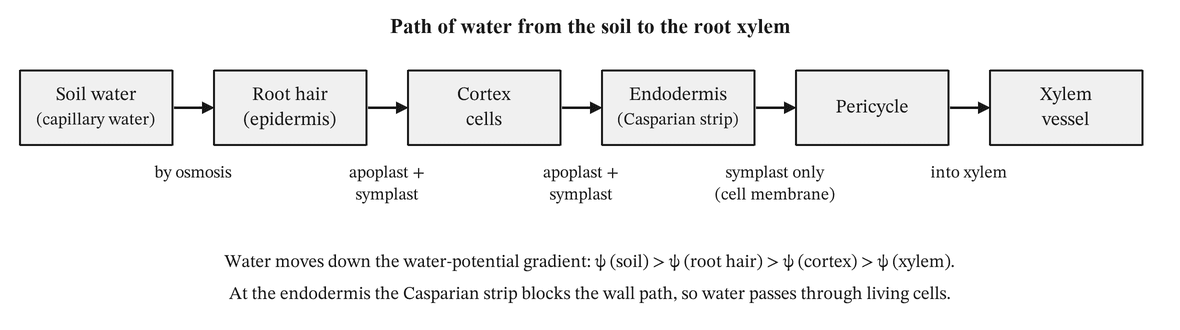
Step 2 — Soil to root hair: Capillary soil water has a higher water potential than the cell sap of the root hair, so water enters by osmosis.
Step 3 — Across the cortex: Water crosses the cortex by the apoplast (walls and spaces) and symplast (cytoplasm and plasmodesmata) pathways.
Step 4 — Endodermis: At the endodermis the suberin Casparian strip blocks the wall route, so water must cross the plasma membrane and pass through the living cells.
Step 5 — Into the xylem: Water then passes through the pericycle into the xylem vessels and rises to the stem and leaves.
Note: The textbook answer is suberin. Studies since 2012 show that the Casparian strip itself is built mainly of lignin; suberin is laid down later as lamellae over the endodermal cell walls.
Therefore, water moves: soil, root hair, cortex, endodermis, pericycle, xylem.
- 755 marks
Question 75
Compare the plant cells kept in isotonic, hypotonic and hypertonic solutions.
Solve with AIWritten solution
Solution:
Concept: The behaviour of a plant cell depends on the water potential of the outside solution compared with its cell sap.
Step 1 — Isotonic solution: Its solute concentration (and water potential) equals that of the cell sap; water enters and leaves equally, so there is no net movement and the cell keeps its shape.
Step 2 — Hypotonic solution: It is more dilute than the cell sap (higher water potential); water enters by endosmosis, the vacuole swells, turgor pressure rises and the cell becomes turgid (the wall stops it bursting).
Step 3 — Hypertonic solution: It is more concentrated than the cell sap (lower water potential); water leaves by exosmosis, the protoplast shrinks away from the wall and the cell is plasmolysed.
Step 4 — Comparison: The three cases are compared below.
Feature Isotonic Hypotonic Hypertonic Solution vs cell sap Same concentration Less concentrated More concentrated Net water movement None Into the cell Out of the cell Process Equilibrium Endosmosis Exosmosis Result Shape unchanged Turgid cell Plasmolysed cell Therefore, a plant cell is unchanged in an isotonic solution, turgid in a hypotonic solution and plasmolysed in a hypertonic solution.
- 765 marks
Question 76
Explain the mechanism of stomatal action in dicot plants and monocot plants. What is sugar–starch hypothesis? List a few factors that affect stomatal movement.
Solve with AIWritten solution
Solution:
Concept: A stoma opens when its guard cells become turgid and closes when they lose turgor; the shape of the guard cells decides how turgor moves the walls.
Step 1 — Dicot stomata: Dicots have kidney-shaped guard cells with thick inner walls and thin outer walls, and radial cellulose microfibrils. When turgid, the thin outer walls stretch outwards and the cells bow apart, pulling the inner walls away and opening the pore; when flaccid they straighten and the pore closes.
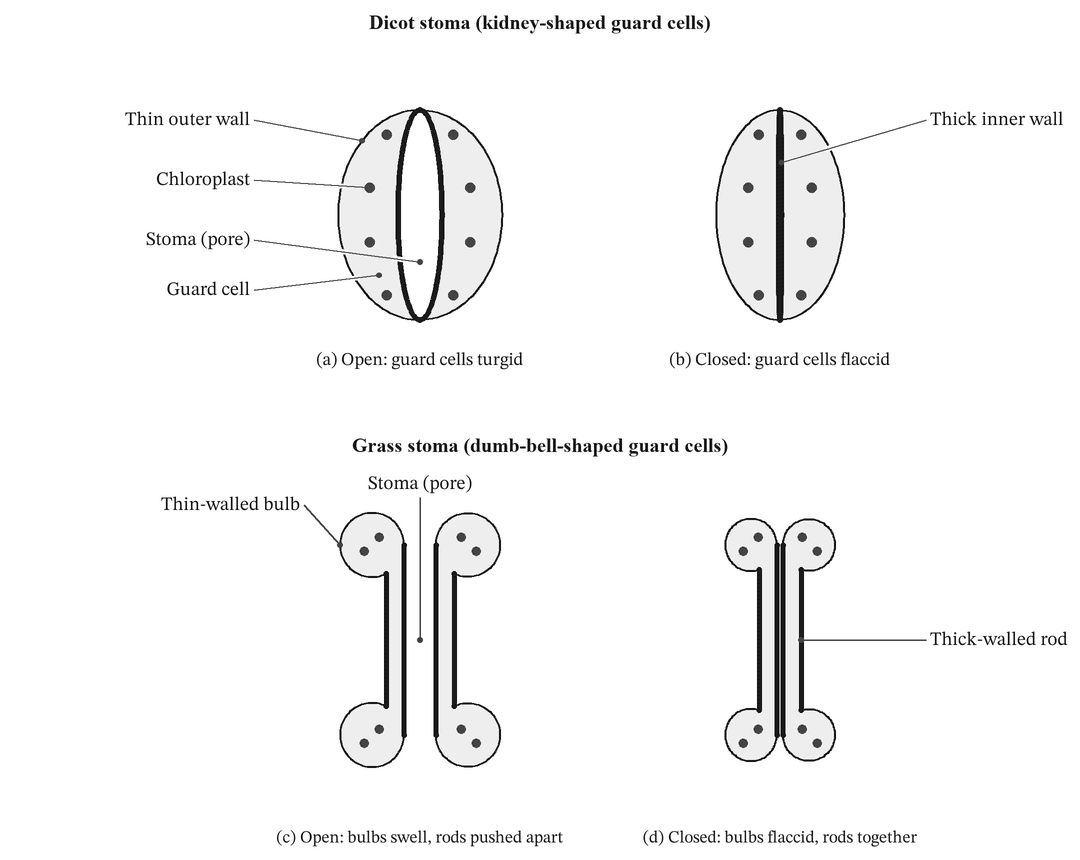
Step 2 — Grass (monocot) stomata: Grasses have dumb-bell-shaped guard cells with thin-walled bulbous ends and a thick-walled narrow middle. When turgid, the bulbs swell and push the thick middle parts apart, opening the pore; when they lose water the bulbs shrink and the pore closes.
Step 3 — What changes the turgor: The accepted mechanism is the K⁺ ion mechanism: in light, H⁺ is pumped out and K⁺ enters the guard cells (with Cl⁻ and malate), lowering their water potential, so water enters and they open; loss of K⁺ in the dark or under ABA closes them.
Step 4 — Sugar–starch hypothesis: This older idea said that in light, photosynthesis uses up CO₂, the pH of guard cells rises and enzymes convert starch to sugar, so water enters and the stoma opens; in the dark, CO₂ builds up, pH falls, sugar turns back to starch and the stoma closes. It cannot explain stomata of guard cells without starch or of CAM plants (open at night), so it has been replaced by the K⁺ mechanism.
Step 5 — Factors: Light, CO₂ concentration inside the leaf, water supply (water stress closes them), temperature, K⁺ (and Cl⁻, H⁺) ions and the hormone abscisic acid.
Note: The starch–sugar hypothesis is now of historical interest; K⁺ movement is the accepted mechanism.
Therefore, stomata open when guard cells become turgid by K⁺ uptake (kidney-shaped cells bow apart, dumb-bell cells push their rods apart); the sugar–starch hypothesis is an older explanation; and light, CO₂, water, temperature, ions and ABA affect stomatal movement.
- 775 marks
Question 77
Name the pathways of mineral transport in plants. Explain the movement of substances from.
Solve with AIWritten solution
Solution:
Concept: Mineral ions are absorbed by roots (mostly actively) and carried, with water, to the regions that need them.
Step 1 — Pathways in the root: Ions move across the root by the apoplast pathway (with water through cell walls and spaces) and the symplast pathway (through cytoplasm and plasmodesmata).
Step 2 — At the endodermis: The Casparian strip blocks the apoplast, so ions must enter the endodermal cells through their membranes, mostly by active transport; the endodermis thus controls which ions, and how much, reach the xylem.
Step 3 — Upward movement in xylem: The ions are loaded into the xylem and carried up with the transpiration stream; Stout and Hoagland (1939) showed with radioactive tracers that minerals move up in the xylem.
Step 4 — Unloading at the sinks: The chief sinks are growing regions — apical and lateral meristems, young leaves, developing flowers, fruits and seeds, and storage organs; ions are unloaded at fine vein endings by diffusion and active uptake.
Step 5 — Remobilisation: Mobile elements (nitrogen, phosphorus, sulphur, potassium) are moved from older, senescing leaves to younger parts through the phloem; elements built into structures, such as calcium, are not remobilised.
Note: The printed question stops after 'from'; the answer explains movement from the soil and roots to the sinks of the plant.
Therefore, minerals cross the root by the apoplast and symplast pathways, enter the xylem through the endodermis, rise in the transpiration stream to the sinks, and mobile ones are remobilised through the phloem.
- 782 marks
Question 78
Why is it better to transplant a seedling in the evening and not in the morning?
Solve with AIWritten solution
Solution:
Concept: A seedling loses many root hairs when it is uprooted, so for some time it absorbs water poorly.
Step 1 — In the evening: Transplanted in the evening, the seedling faces the night, when stomata are closed, the air is cool and transpiration is very low. It loses little water while new root hairs form and the roots settle in the soil.
Step 2 — In the morning: Transplanted in the morning, it faces the heat and light of the day, with high transpiration that the damaged roots cannot make up, so it wilts and may die.
Therefore, evening transplanting lets the seedling recover overnight when water loss by transpiration is lowest.
- 792 marks
Question 79
Weeds can be killed by sprinkling salt on the soil they grow.
Solve with AIWritten solution
Solution:
Concept: Water moves from higher to lower water potential.
Step 1 — Effect on the soil: Salt makes the soil solution hypertonic, with a lower water potential than the cell sap of the weed's roots.
Step 2 — Effect on the weed: The roots cannot absorb water; instead water leaves the root cells by exosmosis, the cells are plasmolysed, and the weed wilts and dies.
Therefore, salt kills weeds by making the soil hypertonic, so their cells lose water and are plasmolysed.
- 802 marks
Question 80
The raisins swell when kept in water.
Solve with AIWritten solution
Solution:
Concept: A dry raisin contains a concentrated sugar solution inside its cells.
Step 1 — Water potential: Water has a higher water potential than the concentrated cell sap of the raisin.
Step 2 — Result: Water enters the raisin by endosmosis, its skin acting as a semi-permeable membrane; the raisin fills with water and swells.
Therefore, raisins swell in water because water enters them by endosmosis.
- 812 marks
Question 81
Pickles do not get spoiled if they contain large amount of salt.
Solve with AIWritten solution
Solution:
Concept: Food spoils when bacteria and fungi grow in it.
Step 1 — Hypertonic medium: A large amount of salt makes the pickle a strongly hypertonic medium.
Step 2 — Effect on microbes: Bacteria and fungi that get into it lose water by exosmosis and are plasmolysed, and fungal spores cannot take up the water they need to germinate, so microbes cannot grow and the pickle does not spoil.
Therefore, salt preserves pickles by plasmolysing the microbes that would spoil them.
- 822 marks
Question 82
Why do the leaves of a plant wilt when taken out of the soil?
Solve with AIWritten solution
Solution:
Concept: A plant stays turgid only while it absorbs as much water as it loses.
Step 1 — No absorption: Out of the soil, the roots can no longer absorb water.
Step 2 — Loss continues: Transpiration from the leaves goes on, so the cells lose water, become flaccid, and the leaves droop (wilt).
Therefore, the leaves wilt because water loss by transpiration continues while no water is absorbed.
What Class 11 Biology Ch 16 covers
The sections of the chapter, in the order the book takes them. Every question above comes from one of these.
- 01Means of Transport
- 02Plant-Water Relations
- 03Absorption and Transport of Water
- 04Water Movement up a Plant
- 05Transpiration and Stomata
- 06Absorption and Translocation of Minerals
More ways to study this chapter
The same chapter asked three other ways. Practise it, revise it, and see what the board has set on Ch 16 before.
Class 11 Biology Ch 16 questions students ask
How many questions are there in Class 11 Biology Ch 16?
82 questions. Every one is solved step by step on this page.
Are these Class 11 Biology solutions free?
Yes. Every question and its full working is free to read, with no account needed.
Can I download the Class 11 Biology Ch 16 solutions as a PDF?
There is no PDF to download. Every solution is on this page instead, which means it is searchable, always the current syllabus, and readable on a phone. Use your browser's print option if you want it on paper.