
Opening your dashboard
Class 11 Biology Chapter 16 Transport in Plants: Practice Questions
122 questions on Chapter 16, each worked through on its own page with the AI tutor. Class 11 Biology, ICSE 2026-27.
122 questions
1–4 marks · Mixed difficulty
- 11 mark
Question 1
(Hypothetical data.) Root cells were placed in solutions of a polar sugar Z, and the rate at which they took up Z was measured. The concentration of Z inside the cells always stayed lower than outside.
Outside concentration of Z (mM) 1 2 4 8 16 Rate of uptake of Z (units) 12 18 24 29 32 A respiratory poison that stops the making of ATP did not change these rates. By which process do the cells take up Z?
- 22 marks
Question 2
On a bright morning, the partial pressure of carbon dioxide in the air spaces inside a leaf is lower than in the air outside the leaf.
(a) In which direction does carbon dioxide diffuse through the open stomata? Give a reason.
(b) At night photosynthesis stops, but respiration goes on in the leaf cells. How does the direction of carbon dioxide diffusion change, and why?
- 31 mark
Question 3
Which feature is shared by facilitated diffusion and active transport, but not by simple diffusion?
- 43 marks
Question 4
(Hypothetical data.) A carrier protein in the plasma membrane of a plant cell moves the amino acid glycine into the cell. Explain each of these observations.
(a) The same carrier does not move sucrose into the cell.
(b) Raising the outside concentration of glycine from 1 mM to 10 mM speeds up its uptake, but raising it further, to 20 mM, gives no further increase.
(c) A chemical that reacts with the side chains of the carrier protein stops glycine uptake, although plenty of glycine is still present outside.
- 51 mark
Question 5
In active transport, a carrier protein moves an ion across the plasma membrane against its concentration gradient. How does the carrier do this?
- 61 mark
Question 6
(Hypothetical data.) A leaf mesophyll cell has a solute potential of −0.9 MPa and a pressure potential of +0.3 MPa. What is its water potential?
- 73 marks
Question 7
(Hypothetical data.) Two neighbouring cells, P and Q, in the cortex of a root have the values given below.
Cell Solute potential (MPa) Pressure potential (MPa) P −1.2 +0.5 Q −0.9 +0.4 (a) Calculate the water potential of each cell.
(b) In which direction will water move between the two cells? Give a reason.
(c) Which cell has the higher concentration of solutes in its sap? How do you know?
- 83 marks
Question 8
(Hypothetical data.) Three identical plant cells each have a solute potential of −0.8 MPa and a pressure potential of +0.2 MPa. One cell is placed in each of these liquids:
(a) pure water;
(b) a sucrose solution of water potential −0.6 MPa;
(c) a sucrose solution of water potential −1.0 MPa.
For each liquid, state whether the cell gains water, loses water or shows no net change, and explain why.
- 91 mark
Question 9
(Hypothetical data.) A plant cell whose sap has a solute potential of −0.7 MPa is left in pure water until it is fully turgid and there is no more net movement of water. Taking the solute potential as unchanged, what is its pressure potential now?
- 101 mark
Question 10
(Hypothetical data.) Strips of onion epidermis were placed in sucrose solutions of different water potentials. In the solution of water potential −0.75 MPa, about half of the cells had just begun to show plasmolysis: their protoplasts were starting to pull away from the walls. What is the best estimate of the solute potential of these cells?
- 114 marks
Question 11
(Hypothetical data.) Cylinders cut from a radish root were weighed, placed in sucrose solutions of different water potentials for two hours, and weighed again. The table gives the percentage change in mass.
Water potential of solution (MPa) 0 −0.2 −0.4 −0.6 −0.8 −1.0 Change in mass (%) +12 +7 +3 −1 −5 −8 (a) Why did the cylinders gain mass in pure water (0 MPa)?
(b) Assuming the change in mass is linear between −0.4 MPa and −0.6 MPa, estimate the water potential of the radish tissue.
(c) Why did the cylinders lose mass in the −1.0 MPa solution?
(d) Why is the change recorded as a percentage of the starting mass rather than in grams?
- 123 marks
Question 12
(Hypothetical data.) Two 50 g samples of dry pea seeds were soaked for 12 hours at the same temperature, one in water and one in a concentrated salt solution. At the end, the seeds in water weighed 95 g and the water around them had become slightly warmer; the seeds in the salt solution weighed only 58 g.
(a) Name the process by which the dry seeds first take up water, and say what in the seeds takes up the water.
(b) Why did the water around the seeds become warmer?
(c) Why did the seeds in the salt solution gain much less mass?
- 133 marks
Question 13
(Hypothetical data.) A sucrose solution has an osmotic pressure of 0.9 MPa. It is placed in an osmometer and separated from pure water by a semi-permeable membrane.
(a) What is the solute (osmotic) potential of this solution?
(b) What pressure must be applied to the solution to just stop pure water entering it?
(c) What is the water potential of the solution while this pressure is applied, and why does net movement of water then stop?
- 142 marks
Question 14
(Hypothetical data.) The water potential of a root-hair cell is reported as −6 bars, and that of the cortical cell next to it as −0.75 MPa.
(a) Express the water potential of the root-hair cell in MPa, given that 1 MPa = 10 bars.
(b) Will water move from the root-hair cell into the cortical cell? Explain.
- 151 mark
Question 15
A dye that can move through cell walls but cannot cross cell membranes is added to the water around a young root. After some time, a transverse section of the root is examined. Up to which point would the dye be found?
- 163 marks
Question 16
(Hypothetical data.) A 10 mm length of a young root is 0.5 mm in diameter. It carries 2000 root hairs, each 1 mm long and 0.01 mm in diameter. Treat the root and each hair as a cylinder whose side surface area is (diameter × length); ignore the ends and the small area covered by the hair bases. Leave your answers in terms of , then give them in mm² using .
(a) Calculate the surface area of this length of root without its hairs.
(b) Calculate the total surface area of the root hairs.
(c) By how many times do the root hairs increase the absorbing surface? Why does this matter for the uptake of water?
- 171 mark
Question 17
Which of the following is not a feature that helps a root hair absorb water from the soil?
- 183 marks
Question 18
(Hypothetical data.) Samples of a clay soil and a sandy soil were soaked with water and allowed to drain for two days. Then a plant was grown in each soil, without watering, until it wilted permanently.
Soil Water held after draining (mL per 100 g soil) Water left when the plant wilted (mL per 100 g soil) Clay 40 25 Sandy 10 3 (a) Which form of soil water drained away during the two days?
(b) Why does the clay soil hold more water after draining?
(c) Calculate the water each plant could use from 100 g of its soil, and explain why the plant in clay soil wilted although its soil still held 25 mL of water.
- 193 marks
Question 19
(Hypothetical data.) The rates of water absorption by the roots and of transpiration by the leaves of a sunflower plant were measured on a sunny day.
Time 6 am 9 am 12 noon 3 pm 6 pm 9 pm Transpiration (g per hour) 5 30 60 45 15 4 Absorption (g per hour) 8 20 45 55 25 10 (a) At which time is the excess of transpiration over absorption greatest? What happens to the water content of the plant at that time?
(b) Why does the rise in absorption lag behind the rise in transpiration?
(c) Why is absorption greater than transpiration in the evening and at night?
- 203 marks
Question 20
(Hypothetical data.) Tomato plants were cut off just above the soil, and the sap that came out of each cut stump was collected for 2 hours. The roots were kept under different conditions.
Condition of the roots Sap exuded (mL in 2 h) Aerated water, 25 °C 4.0 Water bubbled with nitrogen gas (no oxygen), 25 °C 0.3 Aerated water with a respiratory poison, 25 °C 0.2 Aerated water, 5 °C 0.8 (a) What pushes the sap out of the cut stump?
(b) Use the data to show that this push depends on respiration in the roots.
(c) Explain how respiration in the root cells leads to water entering the xylem.
- 211 mark
Question 21
On a humid morning after a warm night, drops of liquid hang at the tips of the leaves of young wheat seedlings growing in moist soil. When one such drop dries on a clean glass slide, it leaves a faint white residue. Which explanation fits these observations?
- 223 marks
Question 22
(Hypothetical data.) In a narrow tube with walls that water wets fully, water rises by capillarity to a height given approximately by
where is the height and is the radius of the tube, both in centimetres.
(a) A xylem vessel has a radius of 0.0025 cm (25 µm). How high could capillarity alone raise water in it?
(b) What percentage of the height of a 24 m tall tree is this?
(c) What, according to the most widely accepted theory, actually raises water to the top of such a tree?
- 231 mark
Question 23
Sensitive instruments fixed around a tree trunk show that the trunk becomes very slightly thinner around midday than it is at dawn, and that it shrinks most on hot, dry days. Which explanation agrees with the cohesion–tension theory?
- 244 marks
Question 24
(Hypothetical data.) A leafy shoot of balsam was cut under water and stood in a dilute red dye for 30 minutes in a bright, airy room. A thin transverse section of the stem, cut 5 cm above the dye, is shown below. The dark patches were stained red by the dye; the light patches and the rest of the section were not stained.

(a) Name the tissues marked P and Q.
(b) What does this result show about the path by which water moves up the stem?
(c) Why are the stained patches arranged in a ring?
(d) Draw a labelled diagram of one vascular bundle as it appears in this section, showing which part is stained.
- 251 mark
Question 25
(Hypothetical data.) Each option lists water potentials in this order: soil water → root xylem → leaf cells → outside air. Which set would allow a continuous flow of water from the soil, through a plant, into the air?
- 264 marks
Question 26
(Hypothetical data.) The set-up shown below was used to measure the rate of water uptake by a leafy shoot. The capillary tube has an internal radius of 0.5 mm. In 12 minutes, the air bubble moved 36 mm along the scale.
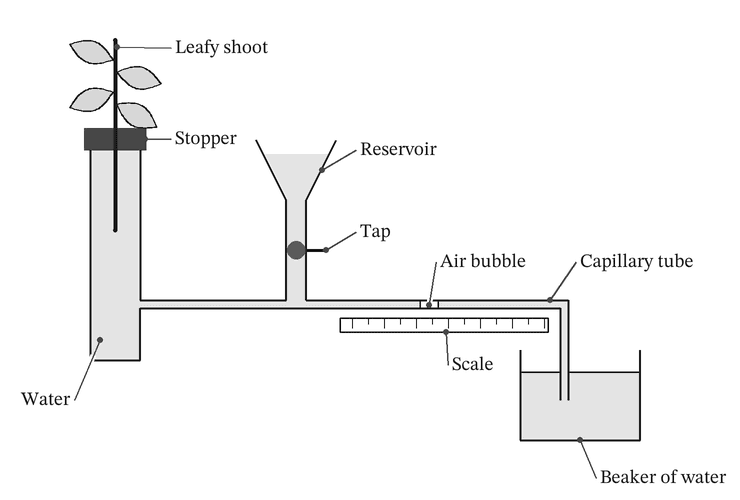
(a) In which direction does the air bubble move, and why?
(b) Calculate the volume of water taken up by the shoot per minute (volume of a cylinder = ; take ).
(c) Why is this rate of uptake not exactly equal to the rate of transpiration?
(d) Why must the shoot be cut under water and all the joints be airtight?
- 274 marks
Question 27
(Hypothetical data.) Four similar potted plants, with their pots and soil sealed in plastic bags, were kept at 25 °C under different conditions and weighed every hour.
Plant Conditions Mass lost (g per hour) A Bright light, still air, 50% humidity 2.4 B Bright light, gentle breeze from a fan, 50% humidity 3.6 C Bright light, still air, 90% humidity 0.9 D Darkness, still air, 50% humidity 0.4 (a) Why were the pots and soil sealed in plastic bags?
(b) Compare plants A and B, and explain the difference.
(c) Compare plants A and C, and explain the difference.
(d) Compare plants A and D, and explain why plant D still loses some water.
- 281 mark
Question 28
(Hypothetical data.) Dry blue cobalt chloride paper turns pink as it absorbs water. Pieces of this paper were clipped to the upper and lower surfaces of a leaf of each of two plants, and the time taken for each piece to turn pink was noted.
Leaf Upper surface Lower surface Plant X 28 min 5 min Plant Y 10 min 9 min Which conclusion is best supported by these results?
- 291 mark
Question 29
During a long dry spell, the stomata of a wheat crop stay closed for most of the day, even in bright light. Which change in the guard cells best explains this?
- 303 marks
Question 30
The statements P to T describe events in the guard cells of a dicot leaf when its stoma opens in the morning. They are not in the correct order.
P: Water enters the guard cells from the neighbouring cells by osmosis.
Q: K⁺ ions are taken up actively into the guard cells, balanced by Cl⁻ and malate ions.
R: The thin outer walls stretch outwards, and the radial cellulose microfibrils pull the thick inner walls apart.
S: The solute concentration of the guard cells rises, so their water potential falls.
T: The guard cells become turgid and swell.
(a) Arrange the statements in the correct order.
(b) Explain why the stoma opens, instead of the guard cells simply swelling evenly.
- 312 marks
Question 31
Under a microscope, the stomata on a maize leaf are seen to have dumb-bell-shaped guard cells, with thick walls in their narrow middle part and thin walls at their bulb-like ends. Explain how a rise in the turgor of these guard cells opens the stoma.
- 323 marks
Question 32
(Hypothetical data.) Plant X opens its stomata at night and keeps them closed for most of the day; plant Y opens its stomata during the day. Grown under the same hot, dry conditions, plant X used 80 g of water and plant Y used 500 g of water for each gram of dry matter they made.
(a) How many times more water did plant Y use than plant X for the same dry matter?
(b) Why does opening the stomata at night save water?
(c) Name the group of plants to which X belongs, give one example, and explain why the starch–sugar hypothesis cannot account for its stomatal behaviour.
- 331 mark
Question 33
(Hypothetical data.) All the stomata on both surfaces of two detached leaves were sealed with petroleum jelly. Leaf L has a thin cuticle and leaf M a thick, waxy cuticle. Over 6 hours, L lost 0.30 g of water and M lost 0.05 g. By which route did the leaves lose this water?
- 343 marks
Question 34
A farmer in a dry district sprays one field with a chemical that partly closes the stomata, and another field with a silicone emulsion that forms a thin film over the leaves.
(a) How does each spray reduce the loss of water from the crop?
(b) Why might the crop in both fields grow more slowly after spraying, even though it loses less water?
- 353 marks
Question 35
(Hypothetical data.) Two similar leaves on the same plant were kept in strong sunlight at an air temperature of 32 °C. The stomata of leaf E were left open, while those of leaf F were sealed with petroleum jelly. After 30 minutes, leaf E was at 31 °C and leaf F at 35 °C.
(a) Explain why leaf E stayed cooler.
(b) Give one other benefit of transpiration to the plant.
(c) Why is transpiration also described as a 'necessary evil'?
- 364 marks
Question 36
(Hypothetical data.) Excised barley roots were placed in a solution containing 0.5 mM K⁺. After some hours, the K⁺ concentration inside the root cells was 80 mM. The rate of K⁺ uptake was measured under different conditions.
Condition K⁺ uptake (µmol per g root per hour) Aerated solution, 25 °C 8.0 Solution bubbled with nitrogen (no oxygen), 25 °C 0.9 Aerated solution with a respiratory poison, 25 °C 0.7 Aerated solution, 2 °C 1.2 (a) How many times more concentrated is K⁺ inside the root cells than in the solution?
(b) Is the uptake of K⁺ mainly active or passive? Give two pieces of evidence from the data.
(c) Why does a little uptake continue even when there is no oxygen?
- 371 mark
Question 37
(Hypothetical data.) In a young willow stem, the bark (containing the phloem) was carefully separated from the wood (xylem) along a 20 cm length, and a strip of waxed paper was slipped between them. Radioactive potassium was then supplied to the roots. Five hours later, radioactivity was measured in the bark and wood of the separated region. Which result would show that mineral ions travel upwards mainly in the xylem?
- 381 mark
Question 38
Clay particles in soil hold K⁺ and Ca²⁺ ions loosely on their surfaces. How can a root hair obtain these held cations when few of them are free in the soil solution?
- 393 marks
Question 39
In a pot trial, plants grown without enough nitrogen showed yellowing first in their older, lower leaves. Plants grown without enough calcium showed damage first at their shoot tips and in their youngest leaves.
(a) Explain why the nitrogen-deficient plants showed symptoms in the old leaves first.
(b) Explain why the calcium-deficient plants showed symptoms in the young leaves first.
(c) Name three chief sinks to which mineral ions are carried in a growing plant.
- 401 mark
Question 40
(Hypothetical data.) Radioactive phosphate was supplied to the roots of a pea plant that was flowering and forming pods. Two days later, in which parts would the highest radioactivity per gram most likely be found?
- 413 marks
Question 41
(Hypothetical data.) The concentrations of two ions were measured in the soil solution around a root and in the sap of its xylem.
Ion Soil solution (mM) Root xylem sap (mM) K⁺ 1 12 Na⁺ 20 2 (a) Calculate the ratio of the concentration in the xylem sap to that in the soil solution for each ion.
(b) Explain how the structure of the endodermis lets the root control which ions reach the xylem.
(c) Which of the two ions must the root move against its concentration gradient, and what does this need?
- 421 mark
Question 42
(Hypothetical data.) Plants of the same kind were grown in the same nutrient solution in two rooms. In room 1 (warm, dry, windy air) they took up 30% more calcium per day than in room 2 (cool, humid, still air), although their roots respired at the same rate in both rooms. Which explanation fits best?
- 434 marks
Question 43
A complete ring of bark, 2 cm wide, was removed from the main stem of a young mango tree, leaving the wood (xylem) undamaged. The leaves above the ring stayed fresh for many weeks, but after some time the bark just above the ring became swollen.
(a) Which tissue was removed along with the bark, and what does it normally carry?
(b) Why did the bark just above the ring swell?
(c) Why did the leaves not wilt at first, and why does such a tree usually die in the end?
(d) Draw a labelled diagram of the ringed stem showing these effects.
- 441 mark
Question 44
In early spring, before its new leaves have opened, sugar moves upwards in the phloem of a deciduous tree, from food stored in its roots to its swelling buds. In this movement, which part is the source and which is the sink?
- 453 marks
Question 45
(Hypothetical data.) One mature leaf in the middle of a bean plant was given carbon dioxide containing radioactive carbon () for 30 minutes in light. After 4 hours, radioactivity was found in the shoot tip above this leaf and in the roots below it, but hardly any was found in the other mature leaves.
(a) In what main form was the radioactive carbon carried, and in which tissue?
(b) What does this result show about the direction of transport in this tissue?
(c) Why did the other mature leaves receive hardly any radioactivity?
- 461 mark
Question 46
According to the pressure flow (mass flow) hypothesis, sucrose is actively loaded into the sieve tubes of a leaf. What happens next in these sieve tubes at the source?
- 474 marks
Question 47
(Hypothetical data.) The table gives values for the sap in a sieve tube at a source (a leaf) and at a sink (a root), and the water potential of the xylem next to each.
Place of sieve-tube sap (MPa) of sieve-tube sap (MPa) of nearby xylem (MPa) Source (leaf) −1.6 +1.0 −0.4 Sink (root) −0.6 +0.3 −0.4 (a) Calculate the water potential of the sieve-tube sap at the source and at the sink.
(b) At each end, does water move into or out of the sieve tube from the nearby xylem? Explain.
(c) Explain what makes the sap flow along the sieve tube from the source to the sink.
- 481 mark
Question 48
Which of the following is not normally carried in solution in the phloem sap?
- 493 marks
Question 49
(Hypothetical data.) The rate at which sugar from the leaves reached the roots of a plant was measured in two experiments.
Experiment 1: A respiratory poison was applied to the source leaf; the transport of sugar almost stopped.
Experiment 2: A short length in the middle of the stem was cooled to 2 °C; transport slowed for a few minutes and then returned almost to normal.
(a) Explain why poisoning the source leaf stopped transport.
(b) What does Experiment 2 suggest about the movement of sap along the middle of the sieve tubes?
(c) At which other place in the pathway is energy needed, and why?
- 501 mark
Question 50
In a growing potato tuber, sucrose arriving in the phloem is unloaded into storage cells and turned into starch. How does this conversion help the flow of sap towards the tuber to continue?
- 511 mark
Question 51
The movement of water molecules from a region of high concentration to a region of low concentration through a semi-permeable membrane is due to
- 521 mark
Question 52
Pure water has been given an osmotic potential of
- 531 mark
Question 53
What increases the water potential of a solution?
- 541 mark
Question 54
Turgor pressure is always equal and opposite to the
- 551 mark
Question 55
The water lost during transpiration
- 561 mark
Question 56
Apoplast movement of water occurs through
- 571 mark
Question 57
The most readily available water for the plant is
- 581 mark
Question 58
The water left in the dry soils is generally the
- 591 mark
Question 59
Root pressure is due to
- 601 mark
Question 60
Accumulation of K ions leads to
- 611 mark
Question 61
The opening of stomata is controlled by the
- 621 mark
Question 62
Guttation is due to
- 631 mark
Question 63
The water is transported up to the leaves through
- 641 mark
Question 64
Transpiration means
- 651 mark
Question 65
In monocot plants, the guard cells are
- 661 mark
Question 66
A plant cell attains turgidity due to
- 671 mark
Question 67
Plasmolysis will occur when the cell is placed in _______ solution
- 681 mark
Question 68
Stomata can also open at night in the following plants
- 691 mark
Question 69
Loss of liquid water by guttation occurs through
- 701 mark
Question 70
The pathway of the movement of water through cell wall only is called
- 711 mark
Question 71
Gases diffuse from the area of _________ pressure to an area of _________ pressure.
- 721 mark
Question 72
Higher the concentration of a solution, _________ is its osmotic potential.
- 731 mark
Question 73
Solute particles _________ the kinetic energy of the solvent.
- 741 mark
Question 74
Water molecules move from a region of _________ water potential to a region of _________ water potential.
- 751 mark
Question 75
The turgor pressure of a plasmolysed cell is equal to _________.
- 761 mark
Question 76
When the guard cells are turgid, the stomata _________.
- 771 mark
Question 77
The plant hormone _________ leads to closing of stomata.
- 781 mark
Question 78
Lower the atmospheric pressure, _________ is the rate of transpiration.
- 791 mark
Question 79
When plant absorbs water from the soil, the water potential of the root cell is _________ than the soil.
- 801 mark
Question 80
Plants lose water by the process of _________ and _________.
- 811 mark
Question 81
Symport refers to the movement of molecules crossing the membrane in opposite direction.
- 821 mark
Question 82
Facilitated diffusion in a cell occurs by the expenditure of energy.
- 831 mark
Question 83
Movement of water in the cells is always from the higher water potential to lower water potential.
- 841 mark
Question 84
A plant cell becomes turgid when placed in a hypertonic solution.
- 851 mark
Question 85
Turgor pressure by the cytoplasm in a cell is always equal to the wall pressure of the cell wall.
- 861 mark
Question 86
The flow of water through interconnected plasmodesmata is called apoplast pathway.
- 871 mark
Question 87
Root pressure is the main force responsible for ascent of sap in tall plants.
- 881 mark
Question 88
Hydathodes are the pores through which excess water is released at the vein endings of leaves in herbaceous plants.
- 891 mark
Question 89
Dicot plants have kidney-shaped guard cells with inner thick walls.
- 901 mark
Question 90
Accumulation of potassium ions by the guard cells leads to increased turgidity and thus opening of stomata.
- 911 mark
Question 91
Initial uptake of water by the hydrophilic molecules of cell wall.
- 921 mark
Question 92
Movement of water out of the cell.
- 931 mark
Question 93
A solution containing lesser concentration than inside a cell.
- 941 mark
Question 94
The pressure responsible for keeping the stem upright.
- 951 mark
Question 95
Movement of molecules through a semi-permeable membrane.
- 961 mark
Question 96
Pressure that is equal and opposite to turgor pressure.
- 971 mark
Question 97
Shrinking of plant cell due to exosmosis.
- 981 mark
Question 98
The part of plant through which water reaches up to the leaves.
- 991 mark
Question 99
The term given to the phenomenon of exuding of drops at the margins of herbaceous plants due to root pressure.
- 1001 mark
Question 100
The strong force of attraction between the water molecules.
- 1011 mark
Question 101
The most widely accepted theory of ascent of sap.
- 1021 mark
Question 102
The pressure that leads to pushing up of xylem sap.
- 1031 mark
Question 103
Assertion (A): Osmosis is a special kind of diffusion of water molecules through a semi-permeable membrane.
Reason (R): The net direction and rate of osmosis depends on the pressure gradient.
- 1041 mark
Question 104
Assertion (A): In symport transport, both molecules cross the membrane at the same time in the same direction.
Reason (R): In antiport transport, both molecules move in opposite direction.
- 1051 mark
Question 105
Assertion (A): Turgor pressure is the positive hydrostatic pressure that develops in the plant cell due to entry of water.
Reason (R): During growth of cells, the turgor pressure is responsible for enlargement and extension.
- 1061 mark
Question 106
Assertion (A): The more number of solute molecules, lower (more negative) is the water potential.
Reason (R): The free energy of water is reduced by the presence of solute particles. This decreases the water potential.
- 1071 mark
Question 107
Assertion (A): Light is a very important factor in transpiration.
Reason (R): Light induces stomatal opening and therefore, transpiration increases in light and decreases in dark.
- 1081 mark
Question 108
Assertion (A): When humidity is high and soil has excess of water, plants tend to lose water in the form of droplets from lenticels.
Reason (R): Root pressure regulates the loss of water from lenticels.
- 1091 mark
Question 109
Assertion (A): Stomata are usually open during the day time and closed during the night.
Reason (R): Change in the turgidity of guard cells causes the opening or closing of stomata.
- 1101 mark
Question 110
Assertion (A): The capillary water is not readily available to the plants as it lies below the level of roots.
Reason (R): The only water available to the plants is the gravitational water.
- 1111 mark
Question 111
Assertion (A): In the root cortex movement of water from root hair to cortex occurs through apoplast pathway until it reaches the endodermis.
Reason (R): Casparian strips in endodermis are suberised.
- 1121 mark
Question 112
Assertion (A): During apoplast movement, water travels through the cells and their cytoplasm.
Reason (R): The symplast movement of water takes place exclusively through the intercellular spaces and the walls of the cells.
- 1133 marks
Question 113
The following paragraph is related to absorption of water from the soil. Copy and complete the following paragraph by selecting the correct word from those given in the box. You may use the term only once.
Exosmosis, Hypertonic, Osmosis, Isotonic, Hypotonic, Cortical, Endosmosis
Water enters the root hair from the soil by the process of ______. This is because the solution in the soil is ______ whereas the cell sap in the root hair cell is ______. The water then passes through the ______ cells by cell to cell ______ and reaches the xylem of the root.
- 1142 marks
Question 114
Account for the following briefly:
Herbaceous plants growing in well watered soils are found to wilt on a hot day.
- 1152 marks
Question 115
Give reason for the following:
Plants begin to die when excess of soluble fertilisers are added to the soil.
- 1162 marks
Question 116
Why do the wilted lettuce leaves if kept in cold water become crisp.
- 1172 marks
Question 117
Answer the following briefly:
Plants growing in fertilised soil are often found to wilt if the soil is not adequately watered, why?
- 1182 marks
Question 118
(i) Name the following:
The pressure exerted by cell contents on plant cell wall.
(ii) Select the correct answer out of the four available choices given under question:
The space between the cell wall and plasma membrane in plasmolysed cell is filled with:
(a) isotonic solution
(b) hypotonic solution
(c) hypertonic solution
(d) water
- 1192 marks
Question 119
Give suitable explanation for the following:
Grapes shrink when immersed in a very strong sugar solution.
- 1202 marks
Question 120
What happens when a pressure greater than the atmospheric pressure is applied to pure water or a solution?
- 1212 marks
Question 121
Explain what will happen to a plant cell if it is kept in a solution having higher water potential.
- 1223 marks
Question 122
How is the mycorrhizal association helpful in absorption of water and minerals in plants?