
Question 765 marksMedium
Explain the mechanism of stomatal action in dicot plants and monocot plants. What is sugar–starch hypothesis? List a few factors that affect stomatal movement.
Confirming your payment
Sign up now and get 250 free tokens.
Transport in Plants · Question 76 of 82
Explain the mechanism of stomatal action in dicot plants and monocot plants. What is sugar–starch hypothesis? List a few factors that affect stomatal movement.
Solution:
Concept: A stoma opens when its guard cells become turgid and closes when they lose turgor; the shape of the guard cells decides how turgor moves the walls.
Step 1 — Dicot stomata: Dicots have kidney-shaped guard cells with thick inner walls and thin outer walls, and radial cellulose microfibrils. When turgid, the thin outer walls stretch outwards and the cells bow apart, pulling the inner walls away and opening the pore; when flaccid they straighten and the pore closes.
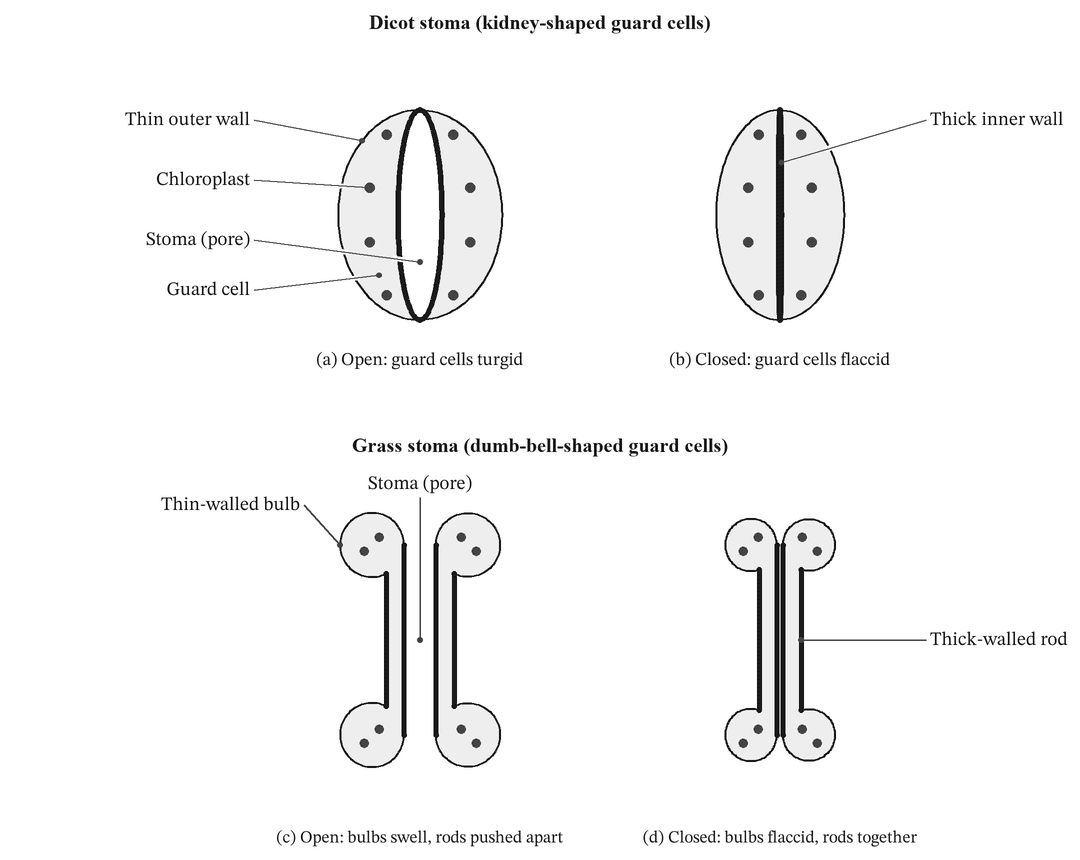
Step 2 — Grass (monocot) stomata: Grasses have dumb-bell-shaped guard cells with thin-walled bulbous ends and a thick-walled narrow middle. When turgid, the bulbs swell and push the thick middle parts apart, opening the pore; when they lose water the bulbs shrink and the pore closes.
Step 3 — What changes the turgor: The accepted mechanism is the K⁺ ion mechanism: in light, H⁺ is pumped out and K⁺ enters the guard cells (with Cl⁻ and malate), lowering their water potential, so water enters and they open; loss of K⁺ in the dark or under ABA closes them.
Step 4 — Sugar–starch hypothesis: This older idea said that in light, photosynthesis uses up CO₂, the pH of guard cells rises and enzymes convert starch to sugar, so water enters and the stoma opens; in the dark, CO₂ builds up, pH falls, sugar turns back to starch and the stoma closes. It cannot explain stomata of guard cells without starch or of CAM plants (open at night), so it has been replaced by the K⁺ mechanism.
Step 5 — Factors: Light, CO₂ concentration inside the leaf, water supply (water stress closes them), temperature, K⁺ (and Cl⁻, H⁺) ions and the hormone abscisic acid.
Note: The starch–sugar hypothesis is now of historical interest; K⁺ movement is the accepted mechanism.
Therefore, stomata open when guard cells become turgid by K⁺ uptake (kidney-shaped cells bow apart, dumb-bell cells push their rods apart); the sugar–starch hypothesis is an older explanation; and light, CO₂, water, temperature, ions and ABA affect stomatal movement.