
Opening your dashboard
Class 11 Biology Chapter 16 Transport in Plants: Competency-Based Questions (CBQ)
40 questions on Chapter 16, each worked through on its own page with the AI tutor. Class 11 Biology, ICSE 2026-27.
40 questions
1–6 marks · Mixed difficulty
- 14 marks
Question 1
A Class 11 student at a school in Chennai reads that a dissolved molecule spreads by diffusion in a time that grows with the square of the distance. For sucrose in water, the time is given approximately by
where is the distance in metres and . The student's table is given below. (Hypothetical data.)
Distance Approximate diffusion time 1 µm (across a small cell) 0.001 s 1 mm (across a few cells) 1,000 s (about 17 minutes) 1 m (from a leaf to the roots of a shrub) 1,000,000,000 s (about 32 years) (a) Use the formula to calculate the time sucrose would take to diffuse 10 cm, and give it in days. (1 mark)
(b) Sap in the sieve tubes of the shrub moves by mass flow at about 1 m per hour. How many minutes does mass flow take to carry sucrose 10 cm, and roughly how many times faster is this than diffusion over the same distance? (1 mark)
(c) Using the table, explain why diffusion is enough for movement inside a cell and between neighbouring cells, but plants need bulk flow (mass flow) in the xylem and phloem. (2 marks)
- 21 mark
Question 2
Assertion (A): Oxygen from the soil air can enter the root-hair cells of a mustard seedling only through carrier proteins that use energy from ATP.
Reason (R): Small non-polar molecules such as oxygen can diffuse directly through the lipid bilayer of the plasma membrane.
- 31 mark
Question 3
Root cells of a wheat seedling take up nitrate ions from the soil solution. A student claims that nitrate enters only by facilitated diffusion. Which observation would show that the student is wrong and that nitrate is taken up by active transport?
- 44 marks
Question 4
After sea water seeped into the groundwater near the coast of Gujarat, the soil solution of a farm became salty. An agricultural scientist measured the water potential () of the soil solution and of the root cells of two crops grown there. (Hypothetical data.)
Measurement Water potential (MPa) Soil solution of a normal field −0.15 Soil solution of the salty field −0.9 Root cells of rice in the salty field −0.7 Root cells of a salt-tolerant barley in the salty field −1.3 (a) In the salty field, in which direction will water move between the soil solution and the rice root cells? Give the reason. (1 mark)
(b) The rice plants in the salty field wilt even though the soil is wet. Explain why. (1 mark)
(c) Calculate the water potential difference that draws water into the barley roots, and suggest how the barley root cells have made their water potential so low. (2 marks)
- 51 mark
Question 5
Assertion (A): The water potential of a turgid cell in a crisp cucumber is less negative than the solute potential of its cell sap.
Reason (R): The cellulose cell wall of a cucumber cell is freely permeable to water and to the sugars dissolved in it.
- 61 mark
Question 6
Fresh strawberries are firm. When strawberries are frozen in a home freezer and then thawed, they become soft and limp, and juice leaks out of them. Which is the best explanation?
- 74 marks
Question 7
On a grape farm near Nashik, an agronomist decides when to irrigate by measuring water potentials. Readings were taken on days after a full irrigation (day 0). "Predawn" readings were taken just before sunrise; "midday" readings at about 1 p.m. (Hypothetical data.)
Day after irrigation Soil (MPa) Predawn leaf (MPa) Midday leaf (MPa) 0 −0.01 −0.05 −0.80 3 −0.03 −0.07 −0.90 6 −0.08 −0.12 −1.10 9 −0.20 −0.25 −1.40 12 −0.45 −0.50 −1.70 The farm's rule is to irrigate as soon as the predawn leaf water potential falls below −0.20 MPa.
(a) Explain why the predawn leaf water potential is always very close to the soil water potential. (1 mark)
(b) On which of the reading days should the vines first have been irrigated? Calculate the difference in water potential between the soil and the leaves at midday on that day. (1 mark)
(c) Explain why the midday leaf water potential is much lower than the predawn value on every day, and why the farm uses the predawn reading rather than the midday reading to decide when to irrigate. (2 marks)
- 84 marks
Question 8
After a flood in Bihar, part of a maize field stayed waterlogged for three days, while a nearby raised part drained quickly. A scientist compared plants from the two parts at noon on the third day. (Hypothetical data.)
Measurement Drained part Waterlogged part Oxygen dissolved in the soil water (mg per litre) 7.5 0.5 Water taken up by the roots (mL per plant per hour) 24 9 Appearance of the leaves at noon Turgid Wilted (a) Calculate the percentage fall in water uptake by the roots in the waterlogged part. (1 mark)
(b) The waterlogged plants are standing in water, yet they wilt. Explain how the shortage of oxygen around the roots reduces the uptake of water. (2 marks)
(c) Suggest one practical step a farmer can take to protect a maize crop from this problem in the rainy season. (1 mark)
- 91 mark
Question 9
Two batches of brinjal seedlings are moved from a nursery to a field on the same morning. Batch 1 is lifted with a ball of soil around its roots; batch 2 is pulled out bare-rooted, tearing off its fine roots. Both batches are watered well, but only batch 2 wilts for several days. Which is the best explanation?
- 104 marks
Question 10
A florist in Bengaluru tests three ways of handling cut roses. All stems are the same length and all vases hold clean water. (Hypothetical data.)
Treatment Water taken up on day 1 (mL per stem) Vase life (days before the flower droops) T1: stem cut in air and left in air for 1 minute, then put in water 6 4 T2: stem cut under water and moved to the vase without exposure to air 14 8 T3: treated as T1, then 3 cm cut off the base under water before going into the vase 13 7 (a) Calculate the percentage by which water uptake on day 1 was lower in T1 than in T2. (1 mark)
(b) Using the cohesion–tension theory, explain why cutting the stem in air reduced water uptake. (2 marks)
(c) Explain why recutting the base under water (T3) almost restored the uptake. (1 mark)
- 114 marks
Question 11
A forest researcher in a tall mountain ash (Eucalyptus regnans) forest measured the water potential of the topmost leaves of three trees of this species at midday. The soil water potential at the roots of all three was −0.1 MPa. Holding a column of water up against gravity needs about 0.01 MPa for every metre of height. (Hypothetical data.)
Tree height (m) Midday water potential of the topmost leaves (MPa) 20 −1.2 45 −1.6 70 −2.0 (a) Calculate the part of the water potential difference needed only to hold up the water column against gravity in the 20 m tree and in the 70 m tree. (1 mark)
(b) For the 70 m tree, calculate the total water potential difference between the soil and the topmost leaves, and the part of it that is left over after gravity is allowed for. What is this left-over part used for? (1 mark)
(c) The topmost leaves of very tall trees are often small. Using the data, suggest why there must be an upper limit to the height of trees, and give one property of water in the xylem that allows columns as tall as 70 m to be pulled up at all. (2 marks)
- 121 mark
Question 12
Assertion (A): Root pressure alone cannot raise water to the crown of a 60 m tall eucalyptus tree on a sunny afternoon.
Reason (R): Root pressure is usually only a fraction of a megapascal and is lowest when transpiration is fast, while holding a 60 m water column needs about 0.6 MPa against gravity alone.
- 131 mark
Question 13
At noon, a plant physiologist puts a drop of dye on the stem of a fast-transpiring sunflower plant and pricks through the drop into a xylem vessel with a fine needle. The dye is drawn quickly into the stem instead of sap leaking out. What does this show?
- 144 marks
Question 14
Students on a field trip near Shimla made peels of the upper and lower epidermis of two leaves: leaf P from a dicot shrub and leaf Q from maize. They counted the stomata in the circular field of view of a microscope, of diameter 0.40 mm. The figure shows one field of the lower epidermis of leaf P; the table gives the mean counts for the other peels. Take . (Hypothetical data.)
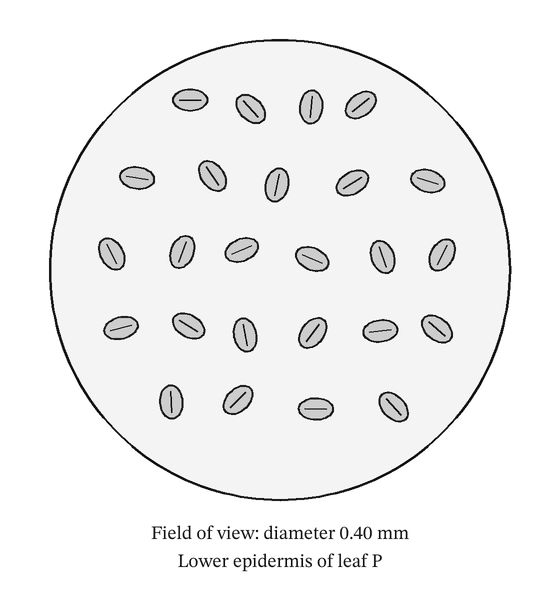
Peel Mean number of stomata per field Leaf P, upper epidermis 2 Leaf Q (maize), upper epidermis 8 Leaf Q (maize), lower epidermis 10 (a) Count the stomata in the figure, and calculate the number of stomata per mm² on the lower epidermis of leaf P. (1 mark)
(b) Calculate the ratio of lower to upper stomata for each leaf, and say which pattern is typical of a dicot leaf and which of a monocot leaf. (2 marks)
(c) On the floating leaf of a water lily in a pond, on which surface would you expect to find the stomata? Give a reason. (1 mark)
- 151 mark
Question 15
Assertion (A): On a cotton farm, the stomata of the crop begin to open at dawn, while the light is still too dim for much photosynthesis.
Reason (R): Stomata need only a very low intensity of light to open, compared with the intensity needed for photosynthesis.
- 161 mark
Question 16
On sunny days, a grower near Shimla raises the carbon dioxide concentration of the air inside a polyhouse to about 2.5 times that of the outside air, to increase the growth of a tomato crop. What change in the stomata and the water use of the crop is most likely?
- 174 marks
Question 17
On a school field trip to the Sundarbans, students learn that mangrove trees take up water from sea water but keep most of the salt out. A guide gives them these values. (Hypothetical data.)
Measurement Rhizophora Avicennia Sodium ions in the sea water around the roots (mM) 480 480 Sodium ions in the xylem sap (mM) 9.6 48 Salt crystals seen on the leaf surface None Many The water potential of the sea water is −2.4 MPa, and the midday water potential of the leaves of both trees is −3.2 MPa.
(a) Calculate the percentage of the sodium ions in sea water that each tree keeps out of its xylem sap. (1 mark)
(b) Explain how the leaves can still draw water from the sea water into the roots and up to the crown. (2 marks)
(c) Suggest why salt crystals appear on the leaves of Avicennia but not on those of Rhizophora. (1 mark)
- 181 mark
Question 18
Assertion (A): A tomato plant kept in a very humid greenhouse, where it transpires very little, cannot take up any mineral ions from its nutrient solution.
Reason (R): Root cells take up many mineral ions by active transport, using energy (ATP) from respiration.
- 191 mark
Question 19
Assertion (A): Before a teak tree sheds its leaves in the dry season, much of the nitrogen and phosphorus in those leaves is moved into the stem and other living parts.
Reason (R): Mineral ions absorbed by the roots are carried up to the leaves in the xylem along with the transpiration stream.
- 201 mark
Question 20
Excised maize roots were kept for 30 minutes in a solution of radioactive K⁺, then moved into a solution of non-radioactive K⁺. Within 10 minutes about 20% of the radioactive K⁺ came out of the roots; the other 80% stayed in the roots for hours. From where did the quickly released 20% most likely come? (Hypothetical data.)
- 214 marks
Question 21
In a plant physiology laboratory in Lucknow, an aphid was allowed to feed on the stem of a castor plant. Its mouthpart (stylet) had entered a single sieve tube. The aphid's body was then cut away with a laser, leaving the stylet in place. Sap went on oozing out of the cut end of the stylet at a steady rate for 4 hours. (Hypothetical data.)
Measurement Value Rate at which sap oozed out 0.5 µL per hour Sucrose concentration of the sap 0.5 mol per litre Relative molecular mass of sucrose 342 (a) The sap kept flowing out of the stylet although the aphid was no longer sucking. What does this show about the sap in the sieve tube? (1 mark)
(b) Calculate the mass of sucrose, in milligrams, collected from the stylet in 4 hours. (1 mark)
(c) A student suggests collecting sieve-tube sap simply by cutting the stem and collecting what flows out. Give two reasons why the stylet method gives a better sample. (2 marks)
- 224 marks
Question 22
In a polyhouse near Pune, a farmer removed some leaves from tomato plants so that each fruit was left with 1, 2 or 4 leaves to supply it. When the fruits were ripe, they were weighed and their sugar content was measured. (Hypothetical data.)
Leaves per fruit Mean mass of one fruit (g) Sugar content (% of fresh mass) 1 60 2.5 2 85 3.2 4 100 3.6 (a) In this experiment, which part of the plant is the source and which is the sink for sugars? (1 mark)
(b) Calculate the mass of sugar in one fruit for each treatment, and explain the trend. (2 marks)
(c) On a different plant carrying far too many fruits, the farmer removes about half of the young fruits. Predict the effect on the remaining fruits and give the reason. (1 mark)
- 231 mark
Question 23
Assertion (A): When phloem sap is collected from the leaves of sugarcane, most of the sugar in it is sucrose rather than glucose.
Reason (R): Sucrose is a monosaccharide, so it is the smallest sugar that a plant can make.
- 241 mark
Question 24
Assertion (A): Mass flow in the phloem uses energy at the source and usually at the sink, although the flow of sap along the sieve tube itself is passive.
Reason (R): Mature sieve tube elements have a large nucleus and many ribosomes, which supply the ATP needed for loading sucrose.
- 251 mark
Question 25
A farmer wants to kill a perennial weed that spreads by underground tubers. The farmer sprays a weedkiller that is absorbed by the leaves and moves inside the plant. It works best when sprayed on mature leaves at the stage when the plant is storing food in its tubers. Why?
- 266 marks
Question 26
Match the following:
Column I Column II 1. Guttation (a) Matric potential 2. Water potential (b) Semipermeable membrane 3. Imbibition (c) Hydathode 4. Osmosis (d) Psi (ψ) 5. Apoplast (e) Potassium ions 6. Guard cells (f) Cell wall - 275 marks
Question 27
Match the following:
Column I Column II 1. Initial intake of water by a dehydrated seed (a) Apoplast pathway 2. Movement of water between cell walls of adjacent cells and through intercellular spaces (b) Guttation 3. Placing a plant cell in a hypertonic solution (c) Imbibition 4. Exudation of moisture from the tip of leaves through hydathodes in herbaceous plants (d) Water potential 5. Capacity of a solution to give out water, represented by letter Ψ (psi) (e) Exosmosis - 285 marks
Question 28
Read the sources given and answer any four from the questions given below.
There are three main ways that molecules can pass through a phospholipid membrane. The first way requires no energy input by the cell and is called passive transport. The second way requires that the cell uses energy to pull in or pump out certain molecules and ions and this is called active transport. The third way is through transport proteins present within the membrane, which move the molecules across the membrane in bubble-like sacs. This is called facilitated transport. Even though facilitated diffusion involves transport proteins, it is still passive transport because the molecules move down the concentration gradient. In contrast to facilitated diffusion, which does not require energy and carries molecules or ions down a concentration gradient, active transport pumps molecules and ions against a concentration gradient.
(1) The transport proteins are involved in
(a) passive transport
(b) active transport
(c) facilitated diffusion
(d) diffusion
(2) Which of the following statement is true of active transport?
(a) no energy is involved
(b) energy is needed
(c) energy is released
(d) none of these
(3) In passive diffusion, the molecules move
(a) down the concentration gradient
(b) outside the membrane
(c) against the concentration gradient
(d) inside the membrane
(4) The transport proteins are present
(a) outside the membrane
(b) inner side of membrane
(c) within the membrane
(d) inside cytoplasm
(5) The facilitated diffusion involves movement of molecules by
(a) passive diffusion
(b) active diffusion
(c) using energy
(d) against concentration gradient
- 295 marks
Question 29
Read the sources given and answer any four from the questions given below.
Translocation is the movement of dissolved substances, such as sucrose and amino acids, from parts of the plant where the substances are made to other parts of the plant where they are needed. Translocation takes place in the phloem—the transport tissue which has two important tissues—sieve tube elements and companion cells. Parts of the plant that make these substances are referred to as sources, e.g., the leaves and the parts of the plant which store or use the substances are called sinks, e.g., bulbs and roots. When sucrose reaches a sink, it is converted into starch for carbohydrate storage. This maintains a concentration gradient between the source and the sink, so that more sucrose moves into the source. Translocation is an active process and so if respiration is reduced or inhibited, translocation gets reduced too.
(1) Translocation occurs through the following tissues
(a) leaves
(b) roots
(c) sieve tube elements
(d) flowers
(2) Which of the following part is referred as the source in the plants?
(a) stem
(b) bulbs
(c) roots
(d) leaves
(3) The movement of substances during translocation is from
(a) source to sink
(b) sink to source
(c) stem to leaves
(d) leaves to petiole
(4) _______ is the main form of food that is carried during translocation.
(a) lactose
(b) sucrose
(c) starch
(d) galactose
(5) If the respiration in plant gets reduced, the process of translocation
(a) increases
(b) decreases
(c) remains unaffected
(d) increases water uptake
- 305 marks
Question 30
Study the set-up given below and answer the questions given below:
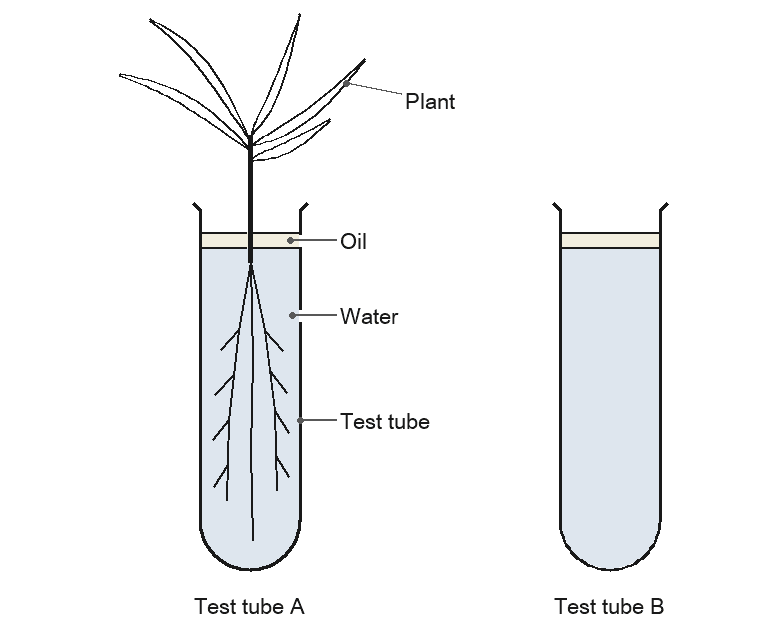
(i) Which physiological process does this setup of experiment show?
(ii) What will happen to the level of water in test tubes A & B?
(iii) Give one suitable reason for your answer in (ii).
(iv) Why is the surface of water covered with oil?
(v) What is the purpose of the setting up test tube B?
- 315 marks
Question 31
Study the diagram given below showing a plant cell kept in a strong sugar solution.
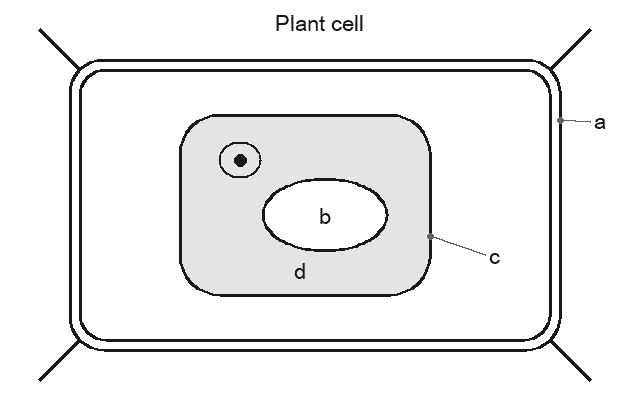
(i) Name the parts a, b, c and d.
(ii) Which part of the cell acts as a semi-permeable membrane?
(iii) Name the process the cell has undergone.
(iv) What is the reason of the process named in (iii) above?
(v) What will happen to this cell if it is kept in water?
- 324 marks
Question 32
Study the set-up given in the diagram and answer the following questions:
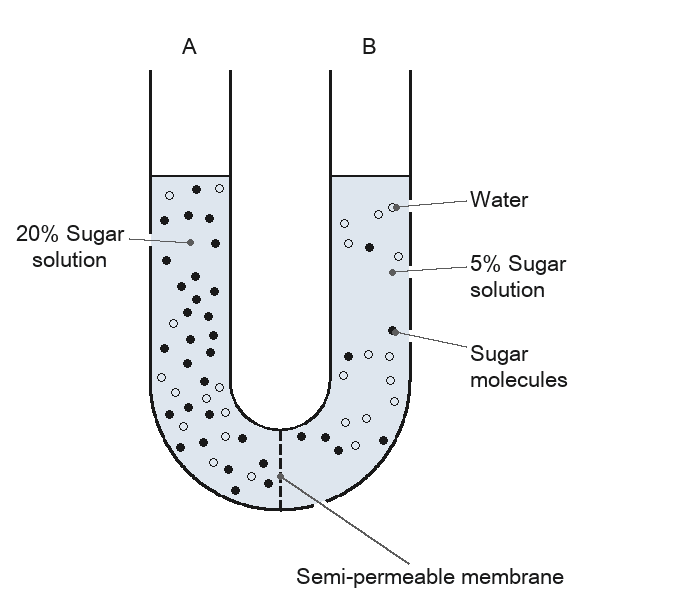
(i) Which limb of the set-up contains more concentrated solution?
(ii) What will be the level in tube A and tube B after 1 hour of set-up?
(iii) What is this process known as?
(iv) Why is the membrane called semi-permeable membrane?
- 333 marks
Question 33
Study the set-up shown in the diagram and answer the following:
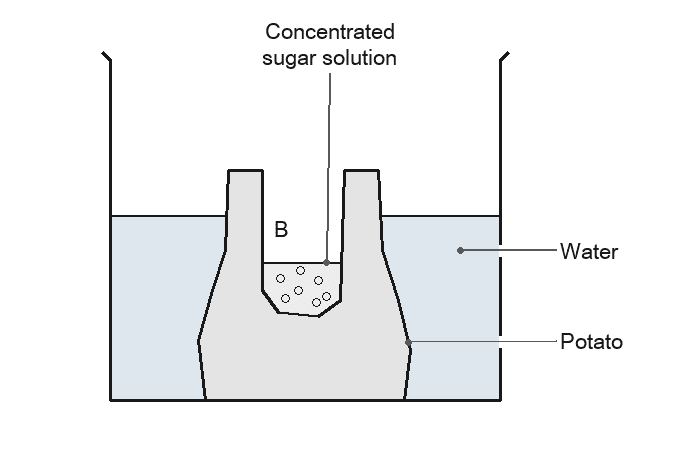
(i) What change will you observe in part 'B' of the setup after one hour? Give reason for this change.
(ii) What is the technical term for this process?
(iii) What will happen if a boiled potato is taken?
- 344 marks
Question 34
The figure given is a cross section of the root along with a root hair. Study it and answer the questions given below:
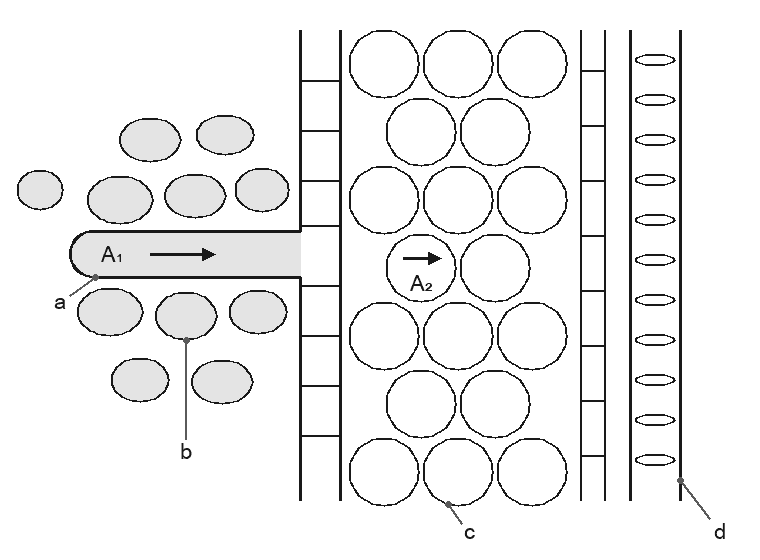
(i) Name the parts a, b, c and d.
(ii) Name the process involved in flow of water from A to A.
(iii) Mention two important features of part (a) that help it to absorb water.
(iv) What is the function of part 'd' in a plant?
- 355 marks
Question 35
Study this structure of a root hair and answer the following:
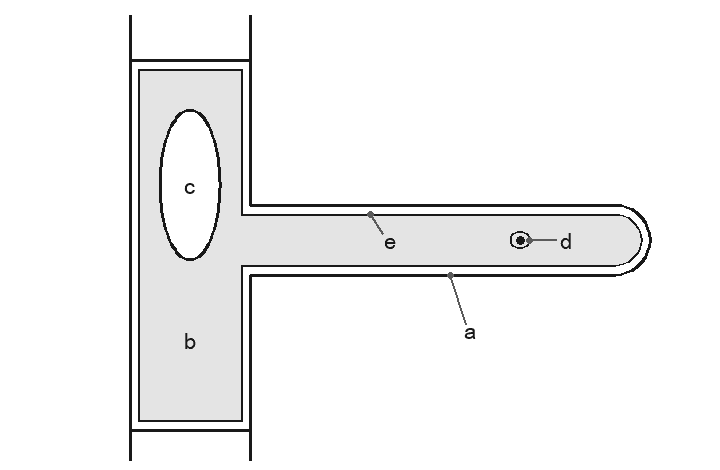
(i) Label parts a, b, c, d and e.
(ii) What is the function of root hair?
(iii) Give two important features of part 'a' that help in the function of root hair.
(iv) Give one important property of part 'e'.
(v) How many cells is a root hair made up of?
- 364 marks
Question 36
Observe the cell drawn and answer the following questions:
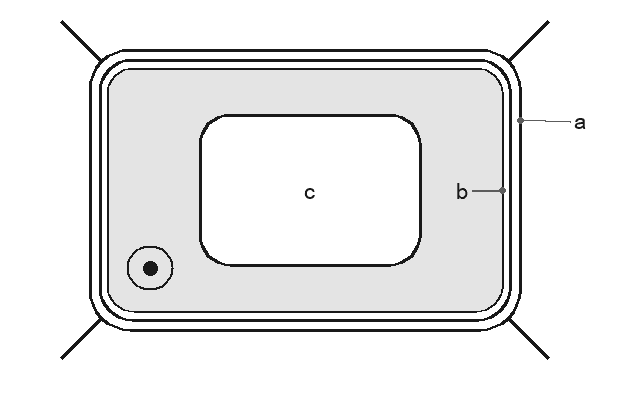
(i) Label parts a, b, and c. If this cell is kept in a concentrated sugar solution, what will happen, to parts 'b' and 'c'?
(ii) Give technical term for the condition of that cell in concentrated sugar solution.
(iii) Define the process involved for that.
(iv) How can the cell be brought back to the condition of cell shown in the diagram?
- 373 marks
Question 37
The figure given below is a diagrammatic representation of a part of the cross section of the root in the root hair zone. Study the same and then answer the questions that follow:

(i) Name the parts indicated 1–5.
(ii) Name the process responsible for the entry of water molecules from the soil into A₁ and A₂.
(iii) What pressure is responsible for the movement of water in the direction indicated by arrows?
(iv) How is this pressure set up?
- 383 marks
Question 38
Explain why xylem transport is unidirectional and phloem transport bidirectional.
- 391 mark
Question 39
In a school laboratory in Jodhpur, a student set up two leafy shoots with the same total leaf area. Each shoot was cut under water and stood in a sealed tube of water, and both were kept side by side in the same bright light at . Shoot P is from an oleander (Nerium) bush: in its thick leaves the stomata lie at the bottom of small pits on the lower surface, and the pits are lined with hairs. Shoot Q is from a garden balsam plant: its stomata lie level with the leaf surface, and its leaves have hardly any hairs. The water lost by each shoot was found by weighing, first in still air and then in a gentle breeze from a table fan. (Hypothetical data.)
Shoot Water lost in still air (mg per cm² of leaf per hour) Water lost in a gentle breeze (mg per cm² of leaf per hour) P (oleander) 1.5 1.8 Q (balsam) 6.0 10.5 Which explanation best fits both sets of results?
- 403 marks
Question 40
A potato grower near Agra digs up one plant to study how fast food reaches a growing tuber. In 60 days, the tuber gained g of dry mass. Take all of this dry mass as having arrived as solutes in the phloem sap, through the stolon (the thin underground stem that joins the tuber to the plant), and ignore the small amount used in the tuber's own respiration. (Hypothetical data.)
Measurement in the stolon Value Area of phloem in a cross-section of the stolon cm² Share of this phloem area made up of sieve tubes one-quarter Dissolved dry matter (mostly sucrose) in the sieve-tube sap g per cm³ of sap The speed of the sap in the sieve tubes can be found from: speed = (mass of dry matter delivered per hour) ÷ (concentration of dry matter in the sap × total cross-sectional area of the sieve tubes).
(a) Calculate the mass of dry matter delivered to the tuber per hour.
(b) Calculate the speed of the sap in the sieve tubes, in cm per hour and in metres per hour.
(c) During a cloudy week, the leaves make less sugar, and the sap loaded into the sieve tubes holds only g of dry matter per cm³. A student says: "The sap will simply flow twice as fast, so the tuber will keep gaining dry mass at the same rate." Using the mass flow (pressure flow) hypothesis, evaluate this claim.