
Opening your dashboard
Class 10 Maths Chapter 2: Banking Solutions
32 textbook questions with step-by-step answers, free to read, for ICSE 2026-27.
Get talked through Ch 2, not just shown the answer
Reading a finished solution is not the same as being able to do it. The AI tutor takes one question at a time and works it with you, in your own words, until you can.
- Ask it out loud, in your own words
- It gives you the next step, not the answer
- Stuck on part (ii)? Start there
32 questions with solutions
1–3 marks · Mixed difficulty
The first 29 solutions are on this page. This chapter is a long one, so the rest open on their own page to keep this one quick to load.
- 11 mark
Question 1
₹ 900 is deposited every month in a recurring deposit account at 10% rate of interest, the interest earned in 8 months is:
Solve with AIAnswer
- Correct
(A) ₹ 270
(B) ₹ 2,700
(C) ₹ 27
(D) ₹ 210
Answer: (A) ₹ 270
Concept: In a recurring deposit (R.D.) account the same sum is paid in every month. The first instalment earns interest for n months, the next for one month less, and so on down to 1 month for the last. So the interest is simple interest on one instalment for n(n + 1)/2 months in all, divided by 12 because the rate is per annum.
Step 1 — Write down the formula.
Let ₹ be the monthly instalment, the number of months and the rate of interest per annum. The interest on the whole deposit is given by this formula:
Step 2 — Put in the values.
Here P = 900, n = 8 and r = 10. We substitute them and simplify one step at a time.
So the interest earned in 8 months is ₹ 270.
Step 3 — See why the formula works.
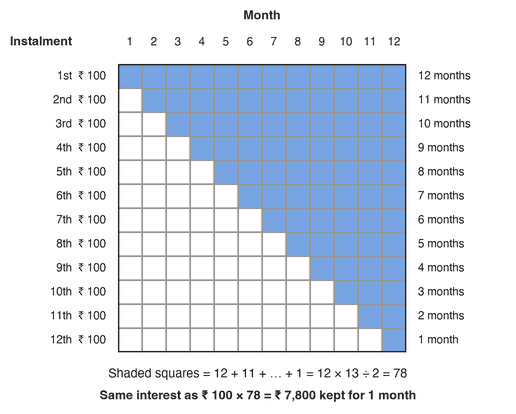
The figure shows each instalment and the months it stays in the bank: the 1st stays 8 months, the 2nd 7 months, and so on down to the 8th, which stays only 1 month. Adding these gives the total number of instalment-months.
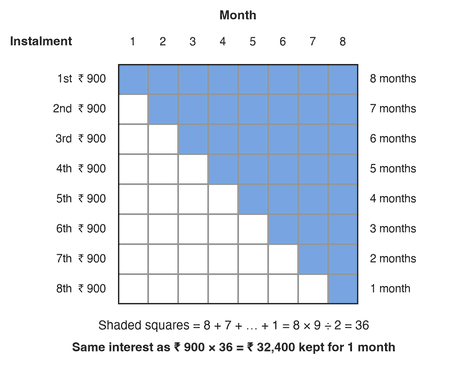
So the interest is the same as the interest on ₹ 900 × 36 kept in the bank for just 1 month, that is for 1/12 of a year.
This agrees with Step 2.
Watch out: Use , not , and keep the 2 in 2 × 12. Either slip gives a wrong interest.
Why the other options are wrong:
- (B) ₹ 2,700: this is 900 × 3, the value before multiplying by the rate 10/100.
- (C) ₹ 27: this takes the rate as 1% instead of 10%: 900 × 3 × 1/100 is 27.
- (D) ₹ 210: this multiplies 8 × 7 in place of 8 × 9 (it uses n − 1 where the formula has n + 1), and the interest then comes to ₹ 210 instead of ₹ 270.
Therefore, the interest earned in 8 months is ₹ 270, option (A).
- 21 mark
Question 2
A man gets ₹ 1,404 as interest at the end of one year. If the rate of interest is 12% per annum in R.D. account, the monthly instalment is :
Solve with AIAnswer
(A) ₹ 1,200
- Correct
(B) ₹ 1,800
(C) ₹ 2,400
(D) ₹ 3,600
Answer: (B) ₹ 1,800
Concept: In a recurring deposit (R.D.) account the same sum is paid in every month. The first instalment earns interest for n months, the next for one month less, and so on down to 1 month for the last. So the interest is simple interest on one instalment for n(n + 1)/2 months in all, divided by 12 because the rate is per annum. Here the interest is known, so the formula becomes an equation for the monthly instalment.
Step 1 — Write down the formula.
Let ₹ be the monthly instalment, the number of months and the rate of interest per annum. The interest on the whole deposit is given by this formula:
Step 2 — Change the time into months.
The account runs for 1 year, and each year has 12 instalments.
Step 3 — Write the interest in terms of P.
We put n = 12 and r = 12 in the formula and leave P as the unknown.
So every ₹ 1 of monthly instalment earns ₹ 0.78 of interest in the year.
Step 4 — Solve for P.
The interest is given as ₹ 1,404, so 0.78 P must equal 1,404. We divide both sides by 0.78.
So the monthly instalment is ₹ 1,800.
Check: With P = 1,800 the interest is 0.78 × 1,800, which is the given ₹ 1,404.
Watch out: is the number of months, not years. Change the time into months before using the formula. Here n = 12, not 1.
Why the other options are wrong:
- (A) ₹ 1,200: ₹ 1,200 a month would earn only 0.78 × 1,200, which is ₹ 936.
- (C) ₹ 2,400: ₹ 2,400 a month would earn 0.78 × 2,400, which is ₹ 1,872, more than ₹ 1,404.
- (D) ₹ 3,600: ₹ 3,600 a month would earn 0.78 × 3,600, which is ₹ 2,808, double the given interest.
Therefore, the monthly instalment is ₹ 1,800, option (B).
- 31 mark
Question 3
Manish opened an R.D. account in a bank and deposited ₹ 1,000 per month at the interest of 10% per annum and for 2 years. The total money deposited by him is :
Solve with AIAnswer
(A) ₹ 12,000
- Correct
(B) ₹ 24,000
(C) ₹ 2,400
(D) ₹ 4,000
Answer: (B) ₹ 24,000
Concept: The total money deposited is only the money the depositor pays in himself: the monthly instalment × the number of instalments. Interest is not part of it, so the rate of interest is not needed for this question.
Step 1 — Count the instalments.
One instalment is paid every month for 2 years.
So Manish pays 24 instalments.
Step 2 — Find the total money deposited.
Each of the 24 instalments is ₹ 1,000, so we multiply.
So Manish deposits ₹ 24,000 in all.
Watch out: Do not add any interest. The question asks for the money deposited, not the maturity value.
Why the other options are wrong:
- (A) ₹ 12,000: this counts only one year of instalments: 1,000 × 12 is 12,000.
- (C) ₹ 2,400: this is 10% of ₹ 24,000. It brings in the rate, which has nothing to do with the money deposited.
- (D) ₹ 4,000: this is only 4 instalments of ₹ 1,000; 24 instalments are paid in 2 years.
Therefore, the total money deposited by Manish is ₹ 24,000, option (B).
- 41 mark
Question 4
₹ 800 per month is deposited in an R.D. account for one and half years. If the depositor gets ₹ 2,280 as interest at the time of maturity, the rate of interest is :
Solve with AIAnswer
- Correct
(A) 20%
(B) 15%
(C) 10%
(D) 12%
Answer: (A) 20%
Concept: In a recurring deposit (R.D.) account the same sum is paid in every month. The first instalment earns interest for n months, the next for one month less, and so on down to 1 month for the last. So the interest is simple interest on one instalment for n(n + 1)/2 months in all, divided by 12 because the rate is per annum. Here the interest is known, so the formula becomes an equation for the rate.
Step 1 — Write down the formula.
Let ₹ be the monthly instalment, the number of months and the rate of interest per annum. The interest on the whole deposit is given by this formula:
Step 2 — Change the time into months.
One and a half years of monthly instalments is 1.5 × 12 instalments.
Step 3 — Write the interest in terms of r.
We put P = 800 and n = 18 in the formula and leave r as the unknown.
Step 4 — Solve for r.
The interest is given as ₹ 2,280, so 114 r must equal 2,280. We divide both sides by 114.
So the rate of interest is 20% per annum.
Check: At 20% the interest is 114 × 20, which is the given ₹ 2,280.
Watch out: The denominator is 2 × 12 = 24. Writing only 12 (forgetting the 2) doubles the interest.
Why the other options are wrong:
- (B) 15%: at 15% the interest would be 114 × 15, which is ₹ 1,710, less than ₹ 2,280.
- (C) 10%: this comes from writing 12 in place of 2 × 12: the equation becomes 228 r = 2,280, which gives r = 10.
- (D) 12%: at 12% the interest would be 114 × 12, which is ₹ 1,368, less than ₹ 2,280.
Therefore, the rate of interest is 20% per annum, option (A).
- 53 marks
Question 5
Each of A and B opened a recurring deposit account in a bank. If A deposited ₹ 1,200 per month for 3 years and B deposited ₹ 1,500 per month for years; find, on maturity, who will get more amount and by how much ? The rate of interest paid by the bank is 10% per annum.
Solve with AIWritten solution
Solution:
Concept: In a recurring deposit (R.D.) account the same sum is paid in every month. The first instalment earns interest for n months, the next for one month less, and so on down to 1 month for the last. So the interest is simple interest on one instalment for n(n + 1)/2 months in all, divided by 12 because the rate is per annum. The maturity value is the total money deposited plus this interest. We find the maturity value of each account separately and then compare them.
Given: A deposits ₹ 1,200 per month for 3 years; B deposits ₹ 1,500 per month for 2½ years; rate of interest = 10% per annum for both.
Step 1 — Write down the formula.
Let ₹ be the monthly instalment, the number of months and the rate of interest per annum. The interest on the whole deposit is given by this formula:
The maturity value (the money received at the end) is the total money deposited plus the interest:
Step 2 — Change both times into months.
A pays for 3 years and B for 2½ years, with 12 instalments in each year.
Step 3 — Find the interest for A.
We put P = 1,200, n = 36 and r = 10 in the formula.
So A earns ₹ 6,660 as interest.
Step 4 — Find the maturity value for A.
First we find the money A deposits, then we add the interest.
So A receives ₹ 49,860 on maturity.
Step 5 — Find the interest for B.
We put P = 1,500, n = 30 and r = 10 in the formula.
So B earns ₹ 5,812.50 as interest.
Step 6 — Find the maturity value for B.
Again we find the money deposited and add the interest.
So B receives ₹ 50,812.50 on maturity.
Step 7 — Compare the two amounts.
B's maturity value is the larger, so we subtract A's from it.
The figure shows the two maturity values side by side.
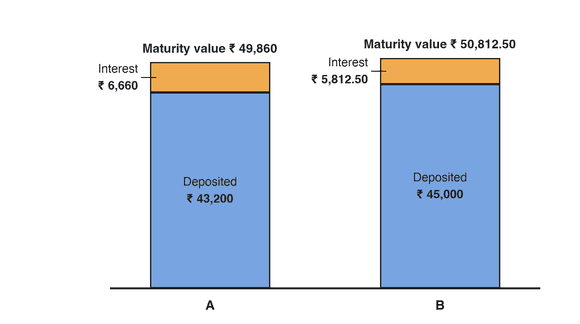
Check: B deposits ₹ 1,800 more than A but earns ₹ 847.50 less interest, because his money stays in the bank for a shorter time. The net difference is the same.
Watch out: Compare the maturity values, not just the interests. A earns more interest, but B gets more money back.
Therefore, B will get more on maturity, by ₹ 952.50.
- 63 marks
Question 6
Ashish deposits a certain sum of money every month in a Recurring Deposit Account for a period of 12 months. If the bank pays interest at the rate of 11% p.a. and Ashish gets ₹ 12,715 as the maturity value of this account, what sum of money did he pay every month ?
Solve with AIWritten solution
Solution:
Concept: In a recurring deposit (R.D.) account the same sum is paid in every month. The first instalment earns interest for n months, the next for one month less, and so on down to 1 month for the last. So the interest is simple interest on one instalment for n(n + 1)/2 months in all, divided by 12 because the rate is per annum. The maturity value is the total money deposited plus this interest. Here the maturity value is known and the instalment is not, so we let the instalment be ₹ P and form a simple equation.
Given: Time n = 12 months; rate of interest r = 11% per annum; maturity value = ₹ 12,715.
Step 1 — Write down the formula.
Let ₹ be the monthly instalment, the number of months and the rate of interest per annum. The interest on the whole deposit is given by this formula:
The maturity value (the money received at the end) is the total money deposited plus the interest:
Step 2 — Write the interest in terms of P.
We put n = 12 and r = 11 in the formula and leave P as the unknown.
Step 3 — Write the maturity value in terms of P.
In 12 months Ashish deposits 12 P, and we add the interest 0.715 P.
Step 4 — Form the equation and solve it.
The maturity value is given as ₹ 12,715, so 12.715 P must equal 12,715. We divide both sides by 12.715.
So Ashish pays ₹ 1,000 every month.
Check: With P = 1,000 he deposits ₹ 12,000 and earns ₹ 715 interest, which together make the given maturity value.
Watch out: The ₹ 12,715 is the maturity value (deposits + interest), not the interest. Do not put it equal to the interest alone.
Therefore, Ashish paid ₹ 1,000 every month.
- 73 marks
Question 7
A man has a Recurring Deposit Account in a bank for years. If the rate of interest is 12% per annum and the man gets ₹ 10,206 on maturity, find the value of monthly instalments.
Solve with AIWritten solution
Solution:
Concept: In a recurring deposit (R.D.) account the same sum is paid in every month. The first instalment earns interest for n months, the next for one month less, and so on down to 1 month for the last. So the interest is simple interest on one instalment for n(n + 1)/2 months in all, divided by 12 because the rate is per annum. The maturity value is the total money deposited plus this interest. Here the maturity value is known and the instalment is not, so we let the instalment be ₹ P and form a simple equation.
Given: Time = 3½ years; rate of interest r = 12% per annum; maturity value = ₹ 10,206.
Step 1 — Write down the formula.
Let ₹ be the monthly instalment, the number of months and the rate of interest per annum. The interest on the whole deposit is given by this formula:
The maturity value (the money received at the end) is the total money deposited plus the interest:
Step 2 — Change the time into months.
There are 12 instalments in each year.
Step 3 — Write the interest in terms of P.
We put n = 42 and r = 12 in the formula and leave P as the unknown.
Step 4 — Write the maturity value in terms of P.
In 42 months the man deposits 42 P, and we add the interest 9.03 P.
Step 5 — Form the equation and solve it.
The maturity value is given as ₹ 10,206, so 51.03 P must equal 10,206. We divide both sides by 51.03.
So the monthly instalment is ₹ 200.
Check: With P = 200 the man deposits ₹ 8,400 and earns ₹ 1,806 interest, which together make the given maturity value.
Watch out: is the number of months, not years. Change the time into months before using the formula. Here n = 42.
Therefore, the value of each monthly instalment is ₹ 200.
- 83 marks
Question 8
Puneet has a Recurring Deposit Account in the Bank of Baroda and deposits ₹ 140 per month for 4 years. If he gets ₹ 8,092 on maturity, find the rate of interest given by the bank.
Solve with AIWritten solution
Solution:
Concept: In a recurring deposit (R.D.) account the same sum is paid in every month. The first instalment earns interest for n months, the next for one month less, and so on down to 1 month for the last. So the interest is simple interest on one instalment for n(n + 1)/2 months in all, divided by 12 because the rate is per annum. The maturity value is the total money deposited plus this interest. So the interest is the maturity value minus the money deposited, and the formula then gives an equation for the rate.
Given: Monthly instalment P = ₹ 140; time = 4 years; maturity value = ₹ 8,092.
Step 1 — Write down the formula.
Let ₹ be the monthly instalment, the number of months and the rate of interest per annum. The interest on the whole deposit is given by this formula:
The maturity value (the money received at the end) is the total money deposited plus the interest:
Step 2 — Change the time into months.
There are 12 instalments in each year.
Step 3 — Find the interest.
First we find the money Puneet deposits.
The interest is the part of the maturity value above the money deposited.
So the interest is ₹ 1,372.
Step 4 — Write the interest in terms of r.
We put P = 140 and n = 48 in the formula and leave r as the unknown.
Step 5 — Solve for r.
The interest is ₹ 1,372, so 137.2 r must equal 1,372. We divide both sides by 137.2.
So the bank pays 10% per annum.
Check: At 10% the interest is 137.2 × 10, which is ₹ 1,372, and ₹ 6,720 + ₹ 1,372 is the given ₹ 8,092.
Watch out: Do not put the maturity value ₹ 8,092 in place of I. Subtract the deposits first to get the interest.
Therefore, the rate of interest given by the bank is 10% per annum.
- 93 marks
Question 9
David opened a Recurring Deposit Account in a bank and deposited ₹ 300 per month for two years. If he received ₹ 7,725 at the time of maturity, find the rate of interest per year.
Solve with AIWritten solution
Solution:
Concept: In a recurring deposit (R.D.) account the same sum is paid in every month. The first instalment earns interest for n months, the next for one month less, and so on down to 1 month for the last. So the interest is simple interest on one instalment for n(n + 1)/2 months in all, divided by 12 because the rate is per annum. The maturity value is the total money deposited plus this interest. So the interest is the maturity value minus the money deposited, and the formula then gives an equation for the rate.
Given: Monthly instalment P = ₹ 300; time = 2 years; maturity value = ₹ 7,725.
Step 1 — Write down the formula.
Let ₹ be the monthly instalment, the number of months and the rate of interest per annum. The interest on the whole deposit is given by this formula:
The maturity value (the money received at the end) is the total money deposited plus the interest:
Step 2 — Change the time into months.
There are 12 instalments in each year.
Step 3 — Find the interest.
First we find the money David deposits.
The interest is the part of the maturity value above the money deposited.
So the interest is ₹ 525.
Step 4 — Write the interest in terms of r.
We put P = 300 and n = 24 in the formula and leave r as the unknown.
Step 5 — Solve for r.
The interest is ₹ 525, so 75 r must equal 525. We divide both sides by 75.
So the rate of interest is 7% per year.
Check: At 7% the interest is 75 × 7, which is ₹ 525, and ₹ 7,200 + ₹ 525 is the given ₹ 7,725.
Watch out: Do not put the maturity value ₹ 7,725 in place of I. Subtract the deposits first to get the interest.
Therefore, the rate of interest is 7% per year.
- 103 marks
Question 10
Amit deposited ₹ 150 per month in a bank for 8 months under the Recurring Deposit Scheme. What will be the maturity value of his deposits, if the rate of interest is 8% per annum and interest is calculated at the end of every month?
Solve with AIWritten solution
Solution:
Concept: In a recurring deposit (R.D.) account the same sum is paid in every month. The first instalment earns interest for n months, the next for one month less, and so on down to 1 month for the last. So the interest is simple interest on one instalment for n(n + 1)/2 months in all, divided by 12 because the rate is per annum. The maturity value is the total money deposited plus this interest.
Given: Monthly instalment P = ₹ 150; time n = 8 months; rate of interest r = 8% per annum.
Step 1 — Write down the formula.
Let ₹ be the monthly instalment, the number of months and the rate of interest per annum. The interest on the whole deposit is given by this formula:
The maturity value (the money received at the end) is the total money deposited plus the interest:
Step 2 — Find the interest.
We put P = 150, n = 8 and r = 8 in the formula.
So the interest is ₹ 36.
Step 3 — Find the money deposited.
Amit pays ₹ 150 in each of the 8 months.
So he deposits ₹ 1,200.
Step 4 — Find the maturity value.
The maturity value is the money deposited plus the interest.
So the maturity value is ₹ 1,236.
Check: On average an instalment stays in the bank for (8 + 1) ÷ 2 = 4.5 months, so the interest is simple interest on ₹ 1,200 for 4.5 months.
Watch out: The maturity value includes the money deposited. The interest ₹ 36 alone is not the answer.
Therefore, the maturity value of Amit's deposits is ₹ 1,236.
- 113 marks
Question 11
A recurring deposit account of ₹ 1,200 per month has a maturity value of ₹ 12,440. If the rate of interest is 8% and the interest is calculated at the end of every month; find the time (in months) of this Recurring Deposit Account.
Solve with AIWritten solution
Solution:
Concept: In a recurring deposit (R.D.) account the same sum is paid in every month. The first instalment earns interest for n months, the next for one month less, and so on down to 1 month for the last. So the interest is simple interest on one instalment for n(n + 1)/2 months in all, divided by 12 because the rate is per annum. The maturity value is the total money deposited plus this interest. Here the time is unknown, so we let it be n months. Because the formula contains n(n + 1), this gives a quadratic equation in n.
Given: Monthly instalment P = ₹ 1,200; rate of interest r = 8% per annum; maturity value = ₹ 12,440.
Step 1 — Write down the formula.
Let ₹ be the monthly instalment, the number of months and the rate of interest per annum. The interest on the whole deposit is given by this formula:
The maturity value (the money received at the end) is the total money deposited plus the interest:
Step 2 — Write the interest in terms of n.
We put P = 1,200 and r = 8 in the formula and leave n as the unknown.
Step 3 — Form the equation.
Money deposited (1,200 n) plus the interest must equal the maturity value.
Every term is divisible by 4, so we divide by 4 to make the numbers smaller.
Step 4 — Solve by factorisation.
We need two numbers whose product is 3,110 and whose difference is 301. They are 311 and 10, so we split 301n as 311n − 10n.
Setting each bracket equal to zero gives two values.
A number of months cannot be negative, so we reject the negative value −311. That leaves n = 10.
Check: For 10 months the money deposited is ₹ 12,000 and the interest is 4 × 10 × 11, which is ₹ 440. Together they make the given ₹ 12,440.
Watch out: The money deposited is 1,200 n, which also depends on n. Do not forget this term when forming the equation.
Therefore, the time of this Recurring Deposit Account is 10 months.
- 123 marks
Question 12
Mr. Gulati has a Recurring Deposit Account of ₹ 300 per month. If the rate of interest is 12% and the maturity value of this account is ₹ 8,100; find the time (in years) of this Recurring Deposit Account.
Solve with AIWritten solution
Solution:
Concept: In a recurring deposit (R.D.) account the same sum is paid in every month. The first instalment earns interest for n months, the next for one month less, and so on down to 1 month for the last. So the interest is simple interest on one instalment for n(n + 1)/2 months in all, divided by 12 because the rate is per annum. The maturity value is the total money deposited plus this interest. Here the time is unknown, so we let it be n months. Because the formula contains n(n + 1), this gives a quadratic equation in n.
Given: Monthly instalment P = ₹ 300; rate of interest r = 12% per annum; maturity value = ₹ 8,100.
Step 1 — Write down the formula.
Let ₹ be the monthly instalment, the number of months and the rate of interest per annum. The interest on the whole deposit is given by this formula:
The maturity value (the money received at the end) is the total money deposited plus the interest:
Step 2 — Write the interest in terms of n.
We put P = 300 and r = 12 in the formula and leave n as the unknown.
Step 3 — Form the equation.
Money deposited (300 n) plus the interest must equal the maturity value.
We multiply every term by 2 to clear the fraction, then open the bracket and bring every term to the left side.
Every term is divisible by 3, so we divide by 3.
Step 4 — Solve by factorisation.
We need two numbers whose product is 5,400 and whose difference is 201. They are 225 and 24, so we split 201n as 225n − 24n.
Setting each bracket equal to zero gives two values.
A number of months cannot be negative, so we reject the negative value −225. That leaves n = 24.
Step 5 — Change the months into years.
The question asks for the time in years, and 12 months make 1 year.
Check: For 24 months the money deposited is ₹ 7,200 and the interest is 1.5 × 24 × 25, which is ₹ 900. Together they make the given ₹ 8,100.
Watch out: The answer is wanted in years. Solving gives months, so divide by 12 at the end.
Therefore, the time of this Recurring Deposit Account is 24 months, that is 2 years.
- 133 marks
Question 13
Mr. Gupta opened a recurring deposit account in a bank. He deposited ₹ 2,500 per month for two years. At the time of maturity he got ₹ 67,500. Find :
(i) the total interest earned by Mr. Gupta
(ii) the rate of interest per annum.
Solve with AIWritten solution
Solution:
Concept: In a recurring deposit (R.D.) account the same sum is paid in every month. The first instalment earns interest for n months, the next for one month less, and so on down to 1 month for the last. So the interest is simple interest on one instalment for n(n + 1)/2 months in all, divided by 12 because the rate is per annum. The maturity value is the total money deposited plus this interest. So the interest is the maturity value minus the money deposited, and the formula then gives an equation for the rate.
Given: Monthly instalment P = ₹ 2,500; time = 2 years; maturity value = ₹ 67,500.
Step 1 — Write down the formula.
Let ₹ be the monthly instalment, the number of months and the rate of interest per annum. The interest on the whole deposit is given by this formula:
The maturity value (the money received at the end) is the total money deposited plus the interest:
Step 2 — Change the time into months.
There are 12 instalments in each year.
Step 3 — Part (i): find the total interest.
First we find the money Mr. Gupta deposits.
The interest is the part of the maturity value above the money deposited.
So the total interest earned is ₹ 7,500. The figure shows the maturity value split into the deposits and the interest.
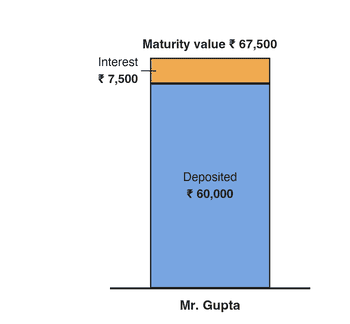
Step 4 — Write the interest in terms of r.
We put P = 2,500 and n = 24 in the formula and leave r as the unknown.
Step 5 — Part (ii): solve for r.
The interest is ₹ 7,500, so 625 r must equal 7,500. We divide both sides by 625.
So the rate of interest is 12% per annum.
Check: At 12% the interest is 625 × 12, which is the ₹ 7,500 found in part (i).
Watch out: In part (ii) use the interest ₹ 7,500 as I, not the maturity value ₹ 67,500.
Therefore, (i) the total interest earned is ₹ 7,500; (ii) the rate of interest is 12% per annum.
- 143 marks
Question 14
Mohan has a recurring deposit account in a bank for 2 years at 6% p.a. simple interest. If he gets ₹ 1,200 as interest at the time of maturity, find :
(i) the monthly instalment
(ii) the amount of maturity.
Solve with AIWritten solution
Solution:
Concept: In a recurring deposit (R.D.) account the same sum is paid in every month. The first instalment earns interest for n months, the next for one month less, and so on down to 1 month for the last. So the interest is simple interest on one instalment for n(n + 1)/2 months in all, divided by 12 because the rate is per annum. The maturity value is the total money deposited plus this interest. Here the interest is known, so the formula gives an equation for the monthly instalment.
Given: Time = 2 years; rate of interest r = 6% per annum; interest on maturity = ₹ 1,200.
Step 1 — Write down the formula.
Let ₹ be the monthly instalment, the number of months and the rate of interest per annum. The interest on the whole deposit is given by this formula:
The maturity value (the money received at the end) is the total money deposited plus the interest:
Step 2 — Change the time into months.
There are 12 instalments in each year.
Step 3 — Write the interest in terms of P.
We put n = 24 and r = 6 in the formula and leave P as the unknown.
Step 4 — Part (i): solve for P.
The interest is ₹ 1,200, so 1.5 P must equal 1,200. We divide both sides by 1.5.
So the monthly instalment is ₹ 800.
Step 5 — Part (ii): find the amount of maturity.
First we find the money Mohan deposits in 24 months.
Then we add the interest of ₹ 1,200.
So the amount of maturity is ₹ 20,400.
Check: With P = 800 the interest is 1.5 × 800, which is the given ₹ 1,200.
Watch out: The ₹ 1,200 is the interest only. The amount of maturity also includes the ₹ 19,200 deposited.
Therefore, (i) the monthly instalment is ₹ 800; (ii) the amount of maturity is ₹ 20,400.
- 151 mark
Question 15
In a recurring deposit account, John deposits ₹ 500 per month for 24 months. If the interest he earns is one-tenth of his total deposit, the rate of interest is :
Solve with AIAnswer
(A) 4·8%
- Correct
(B) 9·6%
(C) 7·2%
(D) 3·2%
Answer: (B) 9·6%
Concept: In a recurring deposit (R.D.) account the same sum is paid in every month. The first instalment earns interest for n months, the next for one month less, and so on down to 1 month for the last. So the interest is simple interest on one instalment for n(n + 1)/2 months in all, divided by 12 because the rate is per annum. Here the interest is known (as a fraction of the deposit), so the formula gives an equation for the rate.
Step 1 — Write down the formula.
Let ₹ be the monthly instalment, the number of months and the rate of interest per annum. The interest on the whole deposit is given by this formula:
Step 2 — Find the total deposit.
John pays ₹ 500 in each of the 24 months.
So his total deposit is ₹ 12,000.
Step 3 — Find the interest.
The interest is one-tenth of the total deposit.
So the interest is ₹ 1,200.
Step 4 — Write the interest in terms of r.
We put P = 500 and n = 24 in the formula and leave r as the unknown.
Step 5 — Solve for r.
The interest is ₹ 1,200, so 125 r must equal 1,200. We divide both sides by 125.
So the rate of interest is 9.6% per annum, which the book prints as 9·6%.
Check: At 9.6% the interest is 125 × 9.6, which is ₹ 1,200, one-tenth of ₹ 12,000.
Watch out: The denominator is 2 × 12 = 24. Writing only 12 (forgetting the 2) doubles the interest.
Why the other options are wrong:
- (A) 4·8%: this comes from writing 12 in place of 2 × 12: the equation becomes 250 r = 1,200, which gives r = 4.8.
- (C) 7·2%: at 7.2% the interest would be 125 × 7.2, which is ₹ 900, not ₹ 1,200.
- (D) 3·2%: at 3.2% the interest would be 125 × 3.2, which is ₹ 400, not ₹ 1,200.
Therefore, the rate of interest is 9·6% per annum, option (B).
- 161 mark
Question 16
₹ 50 per month is deposited for 20 months in a recurring deposit account. If the rate of interest is 10%; the maturity value is :
Solve with AIAnswer
(A) ₹ 187·50
(B) ₹ 87·50
(C) ₹ 2,175
- Correct
(D) ₹ 1,087·50
Answer: (D) ₹ 1,087·50
Concept: In a recurring deposit (R.D.) account the same sum is paid in every month. The first instalment earns interest for n months, the next for one month less, and so on down to 1 month for the last. So the interest is simple interest on one instalment for n(n + 1)/2 months in all, divided by 12 because the rate is per annum. The maturity value is the total money deposited plus this interest.
Step 1 — Write down the formula.
Let ₹ be the monthly instalment, the number of months and the rate of interest per annum. The interest on the whole deposit is given by this formula:
The maturity value (the money received at the end) is the total money deposited plus the interest:
Step 2 — Find the interest.
We put P = 50, n = 20 and r = 10 in the formula.
So the interest is ₹ 87.50.
Step 3 — Find the money deposited.
₹ 50 is paid in each of the 20 months.
So the money deposited is ₹ 1,000.
Step 4 — Find the maturity value.
The maturity value is the money deposited plus the interest.
So the maturity value is ₹ 1,087.50, which the book prints as ₹ 1,087·50.
Watch out: The maturity value includes the ₹ 1,000 deposited; the ₹ 87.50 is only the interest.
Why the other options are wrong:
- (A) ₹ 187·50: this is less than the ₹ 1,000 deposited, but a maturity value is always more than the money deposited.
- (B) ₹ 87·50: this is only the interest. The money deposited, ₹ 1,000, has to be added to it.
- (C) ₹ 2,175: this is exactly double the correct value, 2 × 1,087.50, so it cannot be the maturity value.
Therefore, the maturity value is ₹ 1,087·50, option (D).
- 171 mark
Question 17
A certain money is deposited every month for 8 months in a recurring deposit account at 12% p.a. simple interest. If the interest at the time of maturity is ₹ 36, the monthly instalment is :
Solve with AIAnswer
(A) ₹ 200
(B) ₹ 1,000
- Correct
(C) ₹ 100
(D) ₹ 500
Answer: (C) ₹ 100
Concept: In a recurring deposit (R.D.) account the same sum is paid in every month. The first instalment earns interest for n months, the next for one month less, and so on down to 1 month for the last. So the interest is simple interest on one instalment for n(n + 1)/2 months in all, divided by 12 because the rate is per annum. Here the interest is known, so the formula gives an equation for the monthly instalment.
Step 1 — Write down the formula.
Let ₹ be the monthly instalment, the number of months and the rate of interest per annum. The interest on the whole deposit is given by this formula:
Step 2 — Write the interest in terms of P.
We put n = 8 and r = 12 in the formula and leave P as the unknown.
So every ₹ 1 of monthly instalment earns ₹ 0.36 of interest.
Step 3 — Solve for P.
The interest is given as ₹ 36, so 0.36 P must equal 36. We divide both sides by 0.36.
So the monthly instalment is ₹ 100.
Check: With P = 100 the interest is 0.36 × 100, which is the given ₹ 36.
Why the other options are wrong:
- (A) ₹ 200: ₹ 200 a month would earn 0.36 × 200, which is ₹ 72, double the given interest.
- (B) ₹ 1,000: ₹ 1,000 a month would earn 0.36 × 1,000, which is ₹ 360, ten times the given interest.
- (D) ₹ 500: ₹ 500 a month would earn 0.36 × 500, which is ₹ 180, five times the given interest.
Therefore, the monthly instalment is ₹ 100, option (C).
- 181 mark
Question 18
In a recurring deposit account, Mohit deposited ₹ 5,000 per month for one year and at maturity gets ₹ 67,500; the total interest earned is :
Solve with AIAnswer
(A) ₹ 60,000
(B) ₹ 67,500
(C) ₹ 52,500
- Correct
(D) ₹ 7,500
Answer: (D) ₹ 7,500
Concept: The maturity value of a recurring deposit is the money deposited plus the interest. So the interest is the maturity value minus the money deposited; no formula and no rate are needed.
Step 1 — Find the money deposited.
Mohit pays ₹ 5,000 in each of the 12 months of one year.
So he deposits ₹ 60,000.
Step 2 — Find the interest.
The interest is the part of the maturity value above the money deposited.
So the total interest earned is ₹ 7,500.
Watch out: Do not give the maturity value ₹ 67,500 as the interest; it also contains the ₹ 60,000 deposited.
Why the other options are wrong:
- (A) ₹ 60,000: this is the money deposited (5,000 × 12), not the interest.
- (B) ₹ 67,500: this is the maturity value itself; the interest is only the part of it above the deposits.
- (C) ₹ 52,500: this is the money deposited minus the interest (60,000 − 7,500); it is not an amount the question asks for.
Therefore, the total interest earned is ₹ 7,500, option (D).
- 191 mark
Question 19
A certain money is deposited in a recurring deposit account for 15 months. If the interest earned for this deposit is one-fifth of the monthly instalment; the rate of interest is :
Solve with AIAnswer
(A) 6%
- Correct
(B) 2%
(C) 10%
(D) 4%
Answer: (B) 2%
Concept: In a recurring deposit (R.D.) account the same sum is paid in every month. The first instalment earns interest for n months, the next for one month less, and so on down to 1 month for the last. So the interest is simple interest on one instalment for n(n + 1)/2 months in all, divided by 12 because the rate is per annum. Here the interest is given as a fraction of the instalment, so P cancels and we can find the rate without knowing P.
Step 1 — Write down the formula.
Let ₹ be the monthly instalment, the number of months and the rate of interest per annum. The interest on the whole deposit is given by this formula:
Step 2 — Write the interest in terms of P and r.
Let the monthly instalment be ₹ P. We put n = 15 in the formula and leave P and r as letters.
Step 3 — Form the equation and solve it.
The interest is one-fifth of the monthly instalment, so we put it equal to P/5. Since P is not zero, we can divide both sides by P and then multiply both sides by 10.
So the rate of interest is 2% per annum.
Check: At 2% the interest is P × 10 × 2/100, which is P/5, one-fifth of the instalment.
Watch out: The instalment P is not given and is not needed. It cancels from both sides of the equation.
Why the other options are wrong:
- (A) 6%: at 6% the interest would be P × 10 × 6/100, which is 3P/5, three-fifths of the instalment.
- (C) 10%: at 10% the interest would be P × 10 × 10/100, which is P, the whole instalment.
- (D) 4%: at 4% the interest would be P × 10 × 4/100, which is 2P/5, two-fifths of the instalment.
Therefore, the rate of interest is 2% per annum, option (B).
- 201 mark
Question 20
In a cumulative deposit account, a man deposited ₹ 5,000 per month for 6 months and received ₹ 33,000 on maturity.
Assertion (A) : The interest received by him is ₹ 3,000.
Reason (R) : Interest received in a cumulative deposit account = Maturity value − Total sum deposited.
Solve with AIAnswer
(A) A is true, R is false.
(B) A is false, R is true.
- Correct
(C) Both A and R are true and R is the correct reason for A.
(D) Both A and R are true and R is the incorrect reason for A.
Answer: (C) Both A and R are true and R is the correct reason for A.
Concept: A cumulative deposit account is another name for a recurring deposit account. Its maturity value is the total sum deposited plus the interest, so the interest is the maturity value minus the total sum deposited.
Step 1 — Judge the Reason.
The Reason states exactly this rule: interest = maturity value − total sum deposited. So the Reason is true.
Step 2 — Judge the Assertion.
We first find the total sum deposited: ₹ 5,000 in each of the 6 months.
Then we use the rule in the Reason with the maturity value of ₹ 33,000.
So the interest is ₹ 3,000, and the Assertion is true. The figure shows the maturity value split into the deposits and the interest.
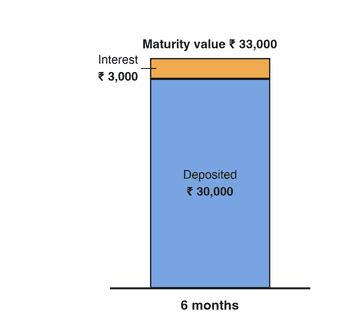
Step 3 — Decide whether the Reason explains the Assertion.
The ₹ 3,000 in the Assertion is found directly by using the rule in the Reason, so the Reason is the correct reason for the Assertion.
Why the other options are wrong:
- (A) A is true, R is false: the Reason is the basic rule for the interest of a recurring (cumulative) deposit, so it is not false.
- (B) A is false, R is true: the Assertion is not false: ₹ 33,000 − ₹ 30,000 is ₹ 3,000.
- (D) Both A and R are true and R is the incorrect reason for A: the Reason is not an incorrect reason; the Assertion is worked out directly from it.
Therefore, both the Assertion and the Reason are true and the Reason is the correct reason for the Assertion, option (C).
- 211 mark
Question 21
Mohit deposited ₹ 2,000 per month in a recurring deposit account on which the bank pays an interest of 10% per month.
Assertion (A) : The total sum deposited in years = ₹ 36,000
Reason (R) : Maturity value of this account = ₹ 36,000 + Interest on it
Solve with AIAnswer
(A) A is true, R is false.
(B) A is false, R is true.
(C) Both A and R are true and R is the correct reason for A.
- Correct
(D) Both A and R are true and R is the incorrect reason for A.
Answer: (D) Both A and R are true and R is the incorrect reason for A.
Concept: The total sum deposited in a recurring deposit account is only the monthly instalment × the number of instalments; no interest is involved. The maturity value is that sum plus the interest on it.
Step 1 — Judge the Assertion.
We first change 1½ years into months, because one instalment is paid every month.
Then we multiply the instalment by the number of instalments.
So the total sum deposited is ₹ 36,000, and the Assertion is true.
Step 2 — Judge the Reason.
For any recurring deposit, maturity value = total sum deposited + interest. Here the total sum deposited is ₹ 36,000, so the maturity value is ₹ 36,000 + the interest on it. So the Reason is true.
Step 3 — Decide whether the Reason explains the Assertion.
The Assertion is found by multiplying ₹ 2,000 by 18 only; it needs neither the maturity value nor the interest, so the rate given in the question is not used at all. The Reason is a true statement about a different quantity, so it is not the reason for the Assertion.
Note: The question prints the rate as “10% per month”. Recurring deposit rates are always quoted per annum, so this is very likely a misprint for 10% per annum. The rate is not used in either statement, so the answer is the same either way.
Watch out: The total sum deposited never includes interest; only the maturity value does.
Why the other options are wrong:
- (A) A is true, R is false: the Reason is not false: a maturity value is always the sum deposited plus its interest.
- (B) A is false, R is true: the Assertion is not false: 2,000 × 18 is 36,000.
- (C) Both A and R are true and R is the correct reason for A: both are true, but the Assertion does not follow from the Reason; it needs only the instalment and the number of months.
Therefore, both the Assertion and the Reason are true, but the Reason is not the correct reason for the Assertion, option (D).
- 221 mark
Question 22
Mr Sharma deposited ₹ 100 per month in a cumulative deposit account for 1 year at the rate of 6% p.a.
Statement (1) : Qualifying sum of his whole deposit = ₹ 7,800.
Statement (2) : Let a sum of ₹ P be deposited every month in a bank for months. If the rate of interest be p.a., then interest on the whole deposit (I) .
Solve with AIAnswer
(A) Both the statements are true.
(B) Both the statements are false.
- Correct
(C) Statement 1 is true, and statement 2 is false.
(D) Statement 1 is false, and statement 2 is true.
Answer: (C) Statement 1 is true, and statement 2 is false.
Concept: In a recurring deposit (R.D.) account the same sum is paid in every month. The first instalment earns interest for n months, the next for one month less, and so on down to 1 month for the last. So the interest is simple interest on one instalment for n(n + 1)/2 months in all, divided by 12 because the rate is per annum. The qualifying sum is the single sum that, kept for 1 month, earns the same interest as all the instalments together: qualifying sum = P × n(n + 1)/2.
Step 1 — Judge statement 1.
Mr Sharma deposits ₹ 100 a month for 1 year, so P = 100 and n = 12. We put these values in the qualifying sum.
The figure shows the 78 instalment-months: the 1st instalment stays 12 months, the 2nd 11 months, and so on down to 1 month. So the qualifying sum is ₹ 7,800, and statement 1 is true.
Step 2 — Judge statement 2.
The correct interest is simple interest on the qualifying sum for 1 month, that is for 1/12 of a year:
Statement 2 has only 12 in the denominator instead of 2 × 12, so it gives double the true interest. With Mr Sharma's numbers the true interest works out as below.
Statement 2's formula, with only 12 in the denominator, gives twice as much.
₹ 78 is double the true ₹ 39, so statement 2 is false.
Watch out: The denominator is 2 × 12 = 24. Writing only 12 (forgetting the 2) doubles the interest.
Why the other options are wrong:
- (A) Both the statements are true: statement 2 is not true; it leaves out the 2 in 2 × 12.
- (B) Both the statements are false: statement 1 is not false; the qualifying sum does work out to ₹ 7,800.
- (D) Statement 1 is false, and statement 2 is true: this is the wrong way round: statement 1 is the true one and statement 2 the false one.
Therefore, statement 1 is true and statement 2 is false, option (C).
- 231 mark
Question 23
For a recurring deposit account in a bank, the deposit is ₹ 1,000 per month for 2 years at 10% p.a. rate of interest.
Statement (1) : The interest earned is 10% of ₹ (24 × 1,000).
Statement (2) : For monthly instalment = ₹ P, number of instalment = and rate of interest p.a.; the interest earned .
Solve with AIAnswer
(A) Both the statements are true.
- Correct
(B) Both the statements are false.
(C) Statement 1 is true, and statement 2 is false.
(D) Statement 1 is false, and statement 2 is true.
Answer: (B) Both the statements are false.
Concept: In a recurring deposit (R.D.) account the same sum is paid in every month. The first instalment earns interest for n months, the next for one month less, and so on down to 1 month for the last. So the interest is simple interest on one instalment for n(n + 1)/2 months in all, divided by 12 because the rate is per annum.
Step 1 — Write down the formula.
Let ₹ be the monthly instalment, the number of months and the rate of interest per annum. The interest on the whole deposit is given by this formula:
Step 2 — Find the true interest.
Here P = 1,000, r = 10 and, for 2 years of monthly instalments, n = 24 months. We put them in the formula.
So the interest really earned is ₹ 2,500.
Step 3 — Judge statement 1.
Statement 1 takes 10% of the whole ₹ 24,000, as if every rupee had been in the bank for the full year.
This is not the true interest of ₹ 2,500, so statement 1 is false. (The instalments stay in the bank for 12.5 months on average, not 12.)
Step 4 — Judge statement 2.
Statement 2 has only 12 in the denominator instead of 2 × 12. With these numbers it gives:
This is double the true interest, so statement 2 is false.
Watch out: The denominator is 2 × 12 = 24. Writing only 12 (forgetting the 2) doubles the interest.
Why the other options are wrong:
- (A) Both the statements are true: neither statement is true: they give ₹ 2,400 and ₹ 5,000, but the interest is ₹ 2,500.
- (C) Statement 1 is true, and statement 2 is false: statement 1 is not true; ₹ 2,400 is ₹ 100 short of the real interest.
- (D) Statement 1 is false, and statement 2 is true: statement 2 is not true; it leaves out the 2 in 2 × 12.
Therefore, both the statements are false, option (B).
- 243 marks
Question 24
Pramod deposits ₹ 600 per month in a Recurring Deposit Account for 4 years. If the rate of interest is 8% per year; calculate the maturity value of his account.
Solve with AIWritten solution
Solution:
Concept: In a recurring deposit (R.D.) account the same sum is paid in every month. The first instalment earns interest for n months, the next for one month less, and so on down to 1 month for the last. So the interest is simple interest on one instalment for n(n + 1)/2 months in all, divided by 12 because the rate is per annum. The maturity value is the total money deposited plus this interest.
Given: Monthly instalment P = ₹ 600; time = 4 years; rate of interest r = 8% per year.
Step 1 — Write down the formula.
Let ₹ be the monthly instalment, the number of months and the rate of interest per annum. The interest on the whole deposit is given by this formula:
The maturity value (the money received at the end) is the total money deposited plus the interest:
Step 2 — Change the time into months.
There are 12 instalments in each year.
Step 3 — Find the interest.
We put P = 600, n = 48 and r = 8 in the formula.
So the interest is ₹ 4,704.
Step 4 — Find the money deposited.
Pramod pays ₹ 600 in each of the 48 months.
So he deposits ₹ 28,800.
Step 5 — Find the maturity value.
The maturity value is the money deposited plus the interest.
So the maturity value is ₹ 33,504.
Check: On average an instalment stays in the bank for (48 + 1) ÷ 2 = 24.5 months, so the interest is simple interest on ₹ 28,800 for 24.5 months.
Watch out: is the number of months, not years. Change the time into months before using the formula. Here n = 48, not 4.
Therefore, the maturity value of Pramod's account is ₹ 33,504.
- 253 marks
Question 25
Ritu has a Recurring Deposit Account in a bank and deposits ₹ 80 per month for 18 months. Find the rate of interest paid by the bank if the maturity value of this account is ₹ 1,554.
Solve with AIWritten solution
Solution:
Concept: In a recurring deposit (R.D.) account the same sum is paid in every month. The first instalment earns interest for n months, the next for one month less, and so on down to 1 month for the last. So the interest is simple interest on one instalment for n(n + 1)/2 months in all, divided by 12 because the rate is per annum. The maturity value is the total money deposited plus this interest. So the interest is the maturity value minus the money deposited, and the formula then gives an equation for the rate.
Given: Monthly instalment P = ₹ 80; time n = 18 months; maturity value = ₹ 1,554.
Step 1 — Write down the formula.
Let ₹ be the monthly instalment, the number of months and the rate of interest per annum. The interest on the whole deposit is given by this formula:
The maturity value (the money received at the end) is the total money deposited plus the interest:
Step 2 — Find the interest.
First we find the money Ritu deposits.
The interest is the part of the maturity value above the money deposited.
So the interest is ₹ 114.
Step 3 — Write the interest in terms of r.
We put P = 80 and n = 18 in the formula and leave r as the unknown.
Step 4 — Solve for r.
The interest is ₹ 114, so 11.4 r must equal 114. We divide both sides by 11.4.
So the bank pays 10% per annum.
Check: At 10% the interest is 11.4 × 10, which is ₹ 114, and ₹ 1,440 + ₹ 114 is the given ₹ 1,554.
Watch out: Do not put the maturity value ₹ 1,554 in place of I. Subtract the deposits first to get the interest.
Therefore, the rate of interest paid by the bank is 10% per annum.
- 263 marks
Question 26
The maturity value of a R.D. Account is ₹ 3,320. If the monthly instalment is ₹ 400 and the rate of interest is 10%; find the time (period) of this R.D. Account.
Solve with AIWritten solution
Solution:
Concept: In a recurring deposit (R.D.) account the same sum is paid in every month. The first instalment earns interest for n months, the next for one month less, and so on down to 1 month for the last. So the interest is simple interest on one instalment for n(n + 1)/2 months in all, divided by 12 because the rate is per annum. The maturity value is the total money deposited plus this interest. Here the time is unknown, so we let it be n months. Because the formula contains n(n + 1), this gives a quadratic equation in n.
Given: Monthly instalment P = ₹ 400; rate of interest r = 10% per annum; maturity value = ₹ 3,320.
Step 1 — Write down the formula.
Let ₹ be the monthly instalment, the number of months and the rate of interest per annum. The interest on the whole deposit is given by this formula:
The maturity value (the money received at the end) is the total money deposited plus the interest:
Step 2 — Write the interest in terms of n.
We put P = 400 and r = 10 in the formula and leave n as the unknown.
Step 3 — Form the equation.
Money deposited (400 n) plus the interest must equal the maturity value.
We multiply every term by 3 to clear the fraction, then open the bracket and bring every term to the left side.
Every term is divisible by 5, so we divide by 5.
Step 4 — Solve by factorisation.
We need two numbers whose product is 1,992 and whose difference is 241. They are 249 and 8, so we split 241n as 249n − 8n.
Setting each bracket equal to zero gives two values.
A number of months cannot be negative, so we reject the negative value −249. That leaves n = 8.
Check: For 8 months the money deposited is ₹ 3,200 and the interest is 400 × 3 × 10/100, which is ₹ 120. Together they make the given ₹ 3,320.
Watch out: The money deposited is 400 n, which also depends on n. Do not forget this term when forming the equation.
Therefore, the time (period) of this R.D. Account is 8 months.
- 273 marks
Question 27
Mr. Bajaj needs ₹ 30,000 after 2 years. What least money (in multiple of ₹ 5) must he deposit every month in a recurring deposit account to get required money at the end of 2 years, the rate of interest being 8% p.a. ?
Solve with AIWritten solution
Solution:
Concept: In a recurring deposit (R.D.) account the same sum is paid in every month. The first instalment earns interest for n months, the next for one month less, and so on down to 1 month for the last. So the interest is simple interest on one instalment for n(n + 1)/2 months in all, divided by 12 because the rate is per annum. The maturity value is the total money deposited plus this interest. Here we want the smallest monthly instalment, in a multiple of ₹ 5, whose maturity value is at least ₹ 30,000. So the exact instalment has to be rounded up, never down.
Given: Amount needed after 2 years = ₹ 30,000; rate of interest r = 8% per annum; the instalment must be a multiple of ₹ 5.
Step 1 — Write down the formula.
Let ₹ be the monthly instalment, the number of months and the rate of interest per annum. The interest on the whole deposit is given by this formula:
The maturity value (the money received at the end) is the total money deposited plus the interest:
Step 2 — Change the time into months.
There are 12 instalments in each year.
Step 3 — Write the interest in terms of P.
Let the monthly instalment be ₹ P. We put n = 24 and r = 8 in the formula.
Step 4 — Write the maturity value in terms of P.
In 24 months Mr. Bajaj deposits 24 P, and we add the interest 2 P.
Step 5 — Find the instalment that gives exactly ₹ 30,000.
We put 26 P equal to 30,000 and divide both sides by 26.
This is not a multiple of 5, so we look at the multiples of 5 on either side of it: ₹ 1,150 and ₹ 1,155.
Step 6 — Choose the least multiple of ₹ 5 that is enough.
We test both multiples in the maturity value 26 P.
₹ 1,150 a month gives ₹ 29,900, which falls ₹ 100 short of ₹ 30,000. ₹ 1,155 a month gives ₹ 30,030, which is enough. The number line shows the two choices.

Watch out: Never round down to ₹ 1,150, even though it is a multiple of 5: it gives only ₹ 29,900. When the money must be enough, always round up.
Therefore, Mr. Bajaj must deposit at least ₹ 1,155 every month.
- 283 marks
Question 28
Mr. Richard has a recurring deposit account in a post office for 3 years at 7·5% p.a. simple interest. If he gets ₹ 8,325 as interest at the time of maturity, find :
(i) the monthly instalment.
(ii) the amount of maturity.
Solve with AIWritten solution
Solution:
Concept: In a recurring deposit (R.D.) account the same sum is paid in every month. The first instalment earns interest for n months, the next for one month less, and so on down to 1 month for the last. So the interest is simple interest on one instalment for n(n + 1)/2 months in all, divided by 12 because the rate is per annum. The maturity value is the total money deposited plus this interest. Here the interest is known, so the formula gives an equation for the monthly instalment.
Given: Time = 3 years; rate of interest r = 7.5% per annum (printed 7·5%); interest on maturity = ₹ 8,325.
Step 1 — Write down the formula.
Let ₹ be the monthly instalment, the number of months and the rate of interest per annum. The interest on the whole deposit is given by this formula:
The maturity value (the money received at the end) is the total money deposited plus the interest:
Step 2 — Change the time into months.
There are 12 instalments in each year.
Step 3 — Write the interest in terms of P.
We put n = 36 and r = 7.5 in the formula and leave P as the unknown.
Step 4 — Part (i): solve for P.
The interest is ₹ 8,325, so 4.1625 P must equal 8,325. We divide both sides by 4.1625.
So the monthly instalment is ₹ 2,000.
Step 5 — Part (ii): find the amount of maturity.
First we find the money Mr. Richard deposits in 36 months.
Then we add the interest of ₹ 8,325.
So the amount of maturity is ₹ 80,325.
Check: With P = 2,000 the interest is 4.1625 × 2,000, which is the given ₹ 8,325.
Watch out: The ₹ 8,325 is the interest only. The amount of maturity also includes the ₹ 72,000 deposited.
Therefore, (i) the monthly instalment is ₹ 2,000; (ii) the amount of maturity is ₹ 80,325.
- 293 marks
Question 29
Gopal has a cumulative deposit account and deposits ₹ 900 per month for a period of 4 years. If he gets ₹ 52,020 at the time of maturity, find the rate of interest.
Solve with AIWritten solution
Solution:
Concept: A cumulative deposit account is another name for a recurring deposit account. In a recurring deposit (R.D.) account the same sum is paid in every month. The first instalment earns interest for n months, the next for one month less, and so on down to 1 month for the last. So the interest is simple interest on one instalment for n(n + 1)/2 months in all, divided by 12 because the rate is per annum. The maturity value is the total money deposited plus this interest. So the interest is the maturity value minus the money deposited, and the formula then gives an equation for the rate.
Given: Monthly instalment P = ₹ 900; time = 4 years; maturity value = ₹ 52,020.
Step 1 — Write down the formula.
Let ₹ be the monthly instalment, the number of months and the rate of interest per annum. The interest on the whole deposit is given by this formula:
The maturity value (the money received at the end) is the total money deposited plus the interest:
Step 2 — Change the time into months.
There are 12 instalments in each year.
Step 3 — Find the interest.
First we find the money Gopal deposits.
The interest is the part of the maturity value above the money deposited.
So the interest is ₹ 8,820.
Step 4 — Write the interest in terms of r.
We put P = 900 and n = 48 in the formula and leave r as the unknown.
Step 5 — Solve for r.
The interest is ₹ 8,820, so 882 r must equal 8,820. We divide both sides by 882.
So the rate of interest is 10% per annum.
Check: At 10% the interest is 882 × 10, which is ₹ 8,820, and ₹ 43,200 + ₹ 8,820 is the given ₹ 52,020.
Watch out: Do not put the maturity value ₹ 52,020 in place of I. Subtract the deposits first to get the interest.
Therefore, the rate of interest is 10% per annum.
- 303 marks
Question 30
Mr. Britto deposits a certain sum of money each month in a Recurring Deposit Account of a bank. If the rate of interest is of 8% per annum and Mr. Britto gets ₹ 8,088 from the bank after 3 years, find the value of his monthly instalment.
- 313 marks
Question 31
Shahrukh opened a Recurring Deposit Account in a bank and deposited ₹ 800 per month for years. If he received ₹ 15,084 at the time of maturity, find the rate of interest per annum.
- 323 marks
Question 32
Katrina opened a recurring deposit account with a Nationalised Bank for a period of 2 years. If the bank pays interest at the rate of 6% per annum and the monthly instalment is ₹ 1,000, find the :
(i) interest earned in 2 years
(ii) maturity value.
What Class 10 Maths Ch 2 covers
The sections of the chapter, in the order the book takes them. Every question above comes from one of these.
- 01Types of Accounts
- 02Recurring Deposit Account (R.D. Account)
- 03Computing Maturity Value of a Recurring Deposit Account
More ways to study this chapter
The same chapter asked three other ways. Practise it, revise it, and see what the board has set on Ch 2 before.
- Competency-Based Questions (CBQ)Case study questions: a situation, and the part of the chapter that answers it.40questionsOpen
- Previous Year QuestionsQuestions that have actually appeared in board papers, each tagged with its year.22questionsOpen
- Practice QuestionsExtra questions per chapter, for when one attempt at a method is not enough.42questionsOpen
Ch 2 in past ICSE papers
The same chapter as the board has actually asked it. These are worded differently from the textbook exercise, which is the point of reading them.
- 13 marks
Board paper question 1
Mohan has a recurring deposit account in a bank for 2 years at 6 % p.a. simple interest. If he gets ₹ 1200 as interest at the time of maturity, find:
(i) the monthly instalment
(ii) the amount of maturity.
Solve with AIWritten solution
Solution:
Concept: In a recurring deposit (R.D.) account a fixed sum ₹ is deposited every month for months at % per annum simple interest. The first instalment stays in the bank for months, the second for months, …, the last for 1 month, so the interest is
The maturity value is the total money deposited () plus the interest.
Given: Time = 2 years; rate = 6% p.a.; interest = ₹ 1,200.
Step 1 — Change the time to months.
The formula needs the time in months, and there are 12 months in a year.
Step 2 — Find the monthly instalment (part i).
We put , and in the formula and solve for the unknown .
So the monthly instalment is ₹ 800.
Step 3 — Find the maturity value (part ii).
The total deposited is 800 × 24 = ₹ 19,200. The maturity value is this plus the interest.
Check: With ₹ 800 a month for 24 months at 6%, the formula gives back the interest.
Watch out: The time in the formula must be in months. Change years to months (× 12) before putting in.
Therefore, (i) the monthly instalment is ₹ 800 and (ii) the amount of maturity is ₹ 20,400.
- 23 marks
Board paper question 2
Mr. Richard has a recurring deposit account in a bank for 3 years at 7.5% p. a. Simple interest. If he gets ₹ 8325 as interest at the time of maturity, find:
(i) The monthly deposit
(ii) The maturity value.
Solve with AIWritten solution
Solution:
Concept: In a recurring deposit (R.D.) account a fixed sum ₹ is deposited every month for months at % per annum simple interest. The first instalment stays in the bank for months, the second for months, …, the last for 1 month, so the interest is
The maturity value is the total money deposited () plus the interest.
Given: Time = 3 years; rate = 7.5% p.a.; interest = ₹ 8,325.
Step 1 — Change the time to months.
The formula needs the time in months, and there are 12 months in a year.
Step 2 — Find the monthly deposit (part i).
We put , and in the formula and solve for .
So the monthly deposit is ₹ 2,000.
Step 3 — Find the maturity value (part ii).
The total deposited is 2,000 × 36 = ₹ 72,000. The maturity value is this plus the interest.
Check: With ₹ 2,000 a month for 36 months at 7.5%, the formula gives back the interest.
Watch out: The time in the formula must be in months. Change years to months (× 12) before putting in.
Therefore, (i) the monthly deposit is ₹ 2,000 and (ii) the maturity value is ₹ 80,325.
- 33 marks
Board paper question 3
Sonia had a recurring deposit account in a bank and deposited ₹ 600 per month for 2½ years. If the rate of interest was 10% p.a., find the maturity value of this account.
Solve with AIWritten solution
Solution:
Concept: In a recurring deposit (R.D.) account a fixed sum ₹ is deposited every month for months at % per annum simple interest. The first instalment stays in the bank for months, the second for months, …, the last for 1 month, so the interest is
The maturity value is the total money deposited () plus the interest.
Given: = ₹ 600 per month; time = years; rate = 10% p.a.
Step 1 — Change the time to months.
Two and a half years is 2.5 × 12 = 30 months, so .
Step 2 — Find the interest.
We put , and in the formula.
So the interest is ₹ 2,325.
Step 3 — Find the total deposited.
Sonia pays ₹ 600 in each of the 30 months.
Step 4 — Find the maturity value.
The maturity value is the money deposited plus the interest.
Check: On average an instalment stays in the bank for (30 + 1) ÷ 2 = 15.5 months, so the interest is 10% a year on ₹ 18,000 for 15.5 months.
Watch out: The time in the formula must be in months. Change years to months (× 12) before putting in.
Therefore, the maturity value of the account is ₹ 20,325.
- 43 marks
Board paper question 4
Priyanka has a recurring deposit account of ₹ 1,000 per month at 10% per annum. If she gets ₹ 5,550 as interest at the time of maturity, find the total time for which the account was held.
Solve with AIWritten solution
Solution:
Concept: In a recurring deposit (R.D.) account a fixed sum ₹ is deposited every month for months at % per annum simple interest. The first instalment stays in the bank for months, the second for months, …, the last for 1 month, so the interest is
Given: = ₹ 1,000 per month; rate = 10% p.a.; interest = ₹ 5,550.
Step 1 — Form the equation.
The time is unknown, so we let it be months, put the known values in the formula and make the subject.
Step 2 — Solve the quadratic equation.
We open the bracket and take everything to one side.
We need two numbers whose product is 1,332 and whose difference is 1. They are 37 and 36, so we split the middle term:
Taking out the common factor from each pair:
So or . The number of months cannot be negative, so .
Step 3 — Change to years.
There are 12 months in a year, so we divide the number of months by 12.
Check: For 36 months the formula gives back the interest.
Watch out: Reject the negative root: a number of months can never be negative.
Therefore, the account was held for 3 years (36 months).
- 53 marks
Board paper question 5
Rekha opened a recurring deposit account for 20 months. The rate of interest is 9% per annum and Rekha receives ₹ 441 as interest at the time of maturity.
Find the amount Rekha deposited each month.
Solve with AIWritten solution
Solution:
Concept: In a recurring deposit (R.D.) account a fixed sum ₹ is deposited every month for months at % per annum simple interest. The first instalment stays in the bank for months, the second for months, …, the last for 1 month, so the interest is
Given: Time = 20 months; rate = 9% p.a.; interest = ₹ 441.
Step 1 — Put the values in the formula.
The time is already in months, so is 20. We put the interest 441, the 20 months and the rate 9 in the formula and solve for .
Check: With ₹ 280 a month the formula gives back the interest.
Watch out: Use , not : the first instalment earns for 20 months and the last for 1 month.
Therefore, Rekha deposited ₹ 280 every month.
- 63 marks
Board paper question 6
Mr. Sona has a recurring deposit account and deposits ₹ 750 per month for 2 years.
If he gets ₹ 19125 at the time of maturity, find the rate of interest.
Solve with AIWritten solution
Solution:
Concept: In a recurring deposit (R.D.) account a fixed sum ₹ is deposited every month for months at % per annum simple interest. The first instalment stays in the bank for months, the second for months, …, the last for 1 month, so the interest is
The maturity value is the total money deposited () plus the interest. So the interest is the maturity value minus the money deposited.
Given: = ₹ 750 per month; time = 2 years; maturity value = ₹ 19,125.
Step 1 — Change the time to months.
The formula needs the time in months, and there are 12 months in a year.
Step 2 — Find the total deposited.
Mr. Sona pays ₹ 750 in each of the 24 months.
Step 3 — Find the interest.
The interest is what he receives over and above his own deposits.
Step 4 — Find the rate.
We put , and in the formula; the rate is the unknown.
Check: At 6% the formula gives back the interest, and ₹ 18,000 + ₹ 1,125 = ₹ 19,125.
Watch out: ₹ 19,125 is the maturity value, not the interest. Take away the ₹ 18,000 deposited first.
Therefore, the rate of interest is 6% per annum.
All 22 board paper questions for this chapter, solved the same way.
Class 10 Maths Ch 2 questions students ask
How many questions are there in Class 10 Maths Ch 2?
32 questions. Every one is solved step by step on this page.
Are these Class 10 Maths solutions free?
Yes. Every question and its full working is free to read, with no account needed.
Can I download the Class 10 Maths Ch 2 solutions as a PDF?
There is no PDF to download. Every solution is on this page instead, which means it is searchable, always the current syllabus, and readable on a phone. Use your browser's print option if you want it on paper.