Answer: (C) Both A and R are true and R is the correct reason for A.
Concept: A cumulative deposit account is another name for a recurring deposit account. Its maturity value is the total sum deposited plus the interest, so the interest is the maturity value minus the total sum deposited.
Step 1 — Judge the Reason.
The Reason states exactly this rule: interest = maturity value − total sum deposited. So the Reason is true.
Step 2 — Judge the Assertion.
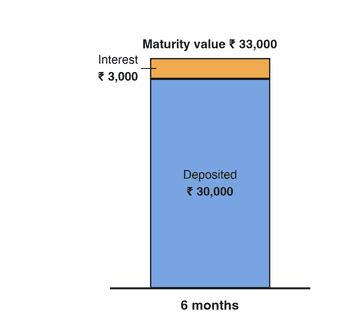
We first find the total sum deposited: ₹ 5,000 in each of the 6 months.
Total sum deposited=5,000×6=30,000
Then we use the rule in the Reason with the maturity value of ₹ 33,000.
Interest=33,000−30,000=3,000
So the interest is ₹ 3,000, and the Assertion is true. The figure shows the maturity value split into the deposits and the interest.
Step 3 — Decide whether the Reason explains the Assertion.
The ₹ 3,000 in the Assertion is found directly by using the rule in the Reason, so the Reason is the correct reason for the Assertion.
Why the other options are wrong:
- (A) A is true, R is false: the Reason is the basic rule for the interest of a recurring (cumulative) deposit, so it is not false.
- (B) A is false, R is true: the Assertion is not false: ₹ 33,000 − ₹ 30,000 is ₹ 3,000.
- (D) Both A and R are true and R is the incorrect reason for A: the Reason is not an incorrect reason; the Assertion is worked out directly from it.
Therefore, both the Assertion and the Reason are true and the Reason is the correct reason for the Assertion, option (C).
