Solution:
Concept: In a recurring deposit (R.D.) account the same sum is paid in every month. The first instalment earns interest for n months, the next for one month less, and so on down to 1 month for the last. So the interest is simple interest on one instalment for n(n + 1)/2 months in all, divided by 12 because the rate is per annum. The maturity value is the total money deposited plus this interest. We find the maturity value of each account separately and then compare them.
Given: A deposits ₹ 1,200 per month for 3 years; B deposits ₹ 1,500 per month for 2½ years; rate of interest = 10% per annum for both.
Step 1 — Write down the formula.
Let ₹ P be the monthly instalment, n the number of months and r% the rate of interest per annum. The interest I on the whole deposit is given by this formula:
I=P×2×12n(n+1)×100r
The maturity value (the money received at the end) is the total money deposited plus the interest:
Maturity value=P×n+I
Step 2 — Change both times into months.
A pays for 3 years and B for 2½ years, with 12 instalments in each year.
n for A=3×12=36
n for B=2.5×12=30
Step 3 — Find the interest for A.
We put P = 1,200, n = 36 and r = 10 in the formula.
I=1,200×2×1236×37×10010=1,200×241,332×10010=1,200×55.5×10010=66,600×10010=6,660
So A earns ₹ 6,660 as interest.
Step 4 — Find the maturity value for A.
First we find the money A deposits, then we add the interest.
Money deposited by A=1,200×36=43,200
Maturity value for A=43,200+6,660=49,860
So A receives ₹ 49,860 on maturity.
Step 5 — Find the interest for B.
We put P = 1,500, n = 30 and r = 10 in the formula.
I=1,500×2×1230×31×10010=1,500×24930×10010=1,500×38.75×10010=58,125×10010=5,812.50
So B earns ₹ 5,812.50 as interest.
Step 6 — Find the maturity value for B.
Again we find the money deposited and add the interest.
Money deposited by B=1,500×30=45,000
Maturity value for B=45,000+5,812.50=50,812.50
So B receives ₹ 50,812.50 on maturity.
Step 7 — Compare the two amounts.
B's maturity value is the larger, so we subtract A's from it.
Difference=50,812.50−49,860=952.50
The figure shows the two maturity values side by side.
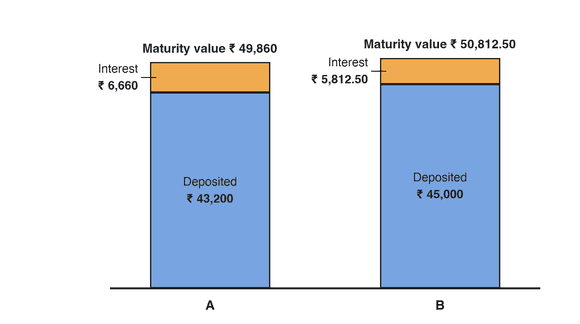
Check: B deposits ₹ 1,800 more than A but earns ₹ 847.50 less interest, because his money stays in the bank for a shorter time. The net difference is the same.
Difference=1,800−847.50=952.50
Watch out: Compare the maturity values, not just the interests. A earns more interest, but B gets more money back.
Therefore, B will get more on maturity, by ₹ 952.50.
