
Opening your dashboard
Class 10 Maths Chapter 2 Banking: Previous Year Questions
22 questions on Chapter 2, each solved step by step. Class 10 Maths, ICSE 2026-27.
22 questions with solutions
1–4 marks · Mixed difficulty
The first 21 solutions are on this page. This chapter is a long one, so the rest open on their own page to keep this one quick to load.
- 13 marks
Question 1
Mohan has a recurring deposit account in a bank for 2 years at 6 % p.a. simple interest. If he gets ₹ 1200 as interest at the time of maturity, find:
(i) the monthly instalment
(ii) the amount of maturity.
Solve with AIWritten solution
Solution:
Concept: In a recurring deposit (R.D.) account a fixed sum ₹ is deposited every month for months at % per annum simple interest. The first instalment stays in the bank for months, the second for months, …, the last for 1 month, so the interest is
The maturity value is the total money deposited () plus the interest.
Given: Time = 2 years; rate = 6% p.a.; interest = ₹ 1,200.
Step 1 — Change the time to months.
The formula needs the time in months, and there are 12 months in a year.
Step 2 — Find the monthly instalment (part i).
We put , and in the formula and solve for the unknown .
So the monthly instalment is ₹ 800.
Step 3 — Find the maturity value (part ii).
The total deposited is 800 × 24 = ₹ 19,200. The maturity value is this plus the interest.
Check: With ₹ 800 a month for 24 months at 6%, the formula gives back the interest.
Watch out: The time in the formula must be in months. Change years to months (× 12) before putting in.
Therefore, (i) the monthly instalment is ₹ 800 and (ii) the amount of maturity is ₹ 20,400.
- 23 marks
Question 2
Mr. Richard has a recurring deposit account in a bank for 3 years at 7.5% p. a. Simple interest. If he gets ₹ 8325 as interest at the time of maturity, find:
(i) The monthly deposit
(ii) The maturity value.
Solve with AIWritten solution
Solution:
Concept: In a recurring deposit (R.D.) account a fixed sum ₹ is deposited every month for months at % per annum simple interest. The first instalment stays in the bank for months, the second for months, …, the last for 1 month, so the interest is
The maturity value is the total money deposited () plus the interest.
Given: Time = 3 years; rate = 7.5% p.a.; interest = ₹ 8,325.
Step 1 — Change the time to months.
The formula needs the time in months, and there are 12 months in a year.
Step 2 — Find the monthly deposit (part i).
We put , and in the formula and solve for .
So the monthly deposit is ₹ 2,000.
Step 3 — Find the maturity value (part ii).
The total deposited is 2,000 × 36 = ₹ 72,000. The maturity value is this plus the interest.
Check: With ₹ 2,000 a month for 36 months at 7.5%, the formula gives back the interest.
Watch out: The time in the formula must be in months. Change years to months (× 12) before putting in.
Therefore, (i) the monthly deposit is ₹ 2,000 and (ii) the maturity value is ₹ 80,325.
- 33 marks
Question 3
Sonia had a recurring deposit account in a bank and deposited ₹ 600 per month for 2½ years. If the rate of interest was 10% p.a., find the maturity value of this account.
Solve with AIWritten solution
Solution:
Concept: In a recurring deposit (R.D.) account a fixed sum ₹ is deposited every month for months at % per annum simple interest. The first instalment stays in the bank for months, the second for months, …, the last for 1 month, so the interest is
The maturity value is the total money deposited () plus the interest.
Given: = ₹ 600 per month; time = years; rate = 10% p.a.
Step 1 — Change the time to months.
Two and a half years is 2.5 × 12 = 30 months, so .
Step 2 — Find the interest.
We put , and in the formula.
So the interest is ₹ 2,325.
Step 3 — Find the total deposited.
Sonia pays ₹ 600 in each of the 30 months.
Step 4 — Find the maturity value.
The maturity value is the money deposited plus the interest.
Check: On average an instalment stays in the bank for (30 + 1) ÷ 2 = 15.5 months, so the interest is 10% a year on ₹ 18,000 for 15.5 months.
Watch out: The time in the formula must be in months. Change years to months (× 12) before putting in.
Therefore, the maturity value of the account is ₹ 20,325.
- 43 marks
Question 4
Priyanka has a recurring deposit account of ₹ 1,000 per month at 10% per annum. If she gets ₹ 5,550 as interest at the time of maturity, find the total time for which the account was held.
Solve with AIWritten solution
Solution:
Concept: In a recurring deposit (R.D.) account a fixed sum ₹ is deposited every month for months at % per annum simple interest. The first instalment stays in the bank for months, the second for months, …, the last for 1 month, so the interest is
Given: = ₹ 1,000 per month; rate = 10% p.a.; interest = ₹ 5,550.
Step 1 — Form the equation.
The time is unknown, so we let it be months, put the known values in the formula and make the subject.
Step 2 — Solve the quadratic equation.
We open the bracket and take everything to one side.
We need two numbers whose product is 1,332 and whose difference is 1. They are 37 and 36, so we split the middle term:
Taking out the common factor from each pair:
So or . The number of months cannot be negative, so .
Step 3 — Change to years.
There are 12 months in a year, so we divide the number of months by 12.
Check: For 36 months the formula gives back the interest.
Watch out: Reject the negative root: a number of months can never be negative.
Therefore, the account was held for 3 years (36 months).
- 53 marks
Question 5
Rekha opened a recurring deposit account for 20 months. The rate of interest is 9% per annum and Rekha receives ₹ 441 as interest at the time of maturity.
Find the amount Rekha deposited each month.
Solve with AIWritten solution
Solution:
Concept: In a recurring deposit (R.D.) account a fixed sum ₹ is deposited every month for months at % per annum simple interest. The first instalment stays in the bank for months, the second for months, …, the last for 1 month, so the interest is
Given: Time = 20 months; rate = 9% p.a.; interest = ₹ 441.
Step 1 — Put the values in the formula.
The time is already in months, so is 20. We put the interest 441, the 20 months and the rate 9 in the formula and solve for .
Check: With ₹ 280 a month the formula gives back the interest.
Watch out: Use , not : the first instalment earns for 20 months and the last for 1 month.
Therefore, Rekha deposited ₹ 280 every month.
- 63 marks
Question 6
Mr. Sona has a recurring deposit account and deposits ₹ 750 per month for 2 years.
If he gets ₹ 19125 at the time of maturity, find the rate of interest.
Solve with AIWritten solution
Solution:
Concept: In a recurring deposit (R.D.) account a fixed sum ₹ is deposited every month for months at % per annum simple interest. The first instalment stays in the bank for months, the second for months, …, the last for 1 month, so the interest is
The maturity value is the total money deposited () plus the interest. So the interest is the maturity value minus the money deposited.
Given: = ₹ 750 per month; time = 2 years; maturity value = ₹ 19,125.
Step 1 — Change the time to months.
The formula needs the time in months, and there are 12 months in a year.
Step 2 — Find the total deposited.
Mr. Sona pays ₹ 750 in each of the 24 months.
Step 3 — Find the interest.
The interest is what he receives over and above his own deposits.
Step 4 — Find the rate.
We put , and in the formula; the rate is the unknown.
Check: At 6% the formula gives back the interest, and ₹ 18,000 + ₹ 1,125 = ₹ 19,125.
Watch out: ₹ 19,125 is the maturity value, not the interest. Take away the ₹ 18,000 deposited first.
Therefore, the rate of interest is 6% per annum.
- 71 mark
Question 7
Mohit opened a Recurring deposit account in a bank for 2 years. He deposits ₹1000 every month and receives ₹25500 on maturity. The interest he earned in 2 years is
Solve with AIAnswer
(A) ₹13500
(B) ₹3000
(C) ₹24000
- Correct
(D) ₹1500
Answer: (D) ₹1500
Concept: The maturity value is the total money deposited () plus the interest. So the interest is the maturity value minus the money deposited.
Step 1 — Change the time to months.
The formula needs the time in months, and there are 12 months in a year. Mohit makes one deposit each month.
Step 2 — Find the total deposited.
He pays ₹ 1,000 in each of the 24 months.
Step 3 — Find the interest.
The interest is the maturity value minus his own deposits.
Check: ₹ 24,000 + ₹ 1,500 = ₹ 25,500, the amount received on maturity.
Watch out: Take away all 24 deposits, not just one year's worth.
Why the other options are wrong:
- (A) ₹13500: ₹ 13,500 subtracts only one year of deposits (25,500 − 12,000). Mohit deposits for 24 months.
- (B) ₹3000: ₹ 3,000 is double the interest (2 × 1,500), as if ₹ 1,500 were earned in each year.
- (C) ₹24000: ₹ 24,000 is the total money deposited (1,000 × 24), not the interest.
Therefore, the interest earned in 2 years is ₹ 1,500, option (D).
- 81 mark
Question 8
Joseph has a recurring deposit account in a bank for two years at the rate of 8% per annum simple interest.
(i) If at the time of maturity Joseph receives ₹ 2000 as interest then the monthly installment is
Solve with AIAnswer
(A) ₹ 1200
(B) ₹ 600
- Correct
(C) ₹ 1000
(D) ₹ 1600
Answer: (C) ₹ 1000
Concept: In a recurring deposit (R.D.) account a fixed sum ₹ is deposited every month for months at % per annum simple interest. The first instalment stays in the bank for months, the second for months, …, the last for 1 month, so the interest is
Step 1 — Change the time to months.
The formula needs the time in months, and there are 12 months in a year.
Step 2 — Find the monthly instalment.
We put , and in the formula and solve for .
Check: With ₹ 1,000 a month the formula gives back the interest.
Watch out: The time in the formula must be in months. Change years to months (× 12) before putting in.
Why the other options are wrong:
- (A) ₹ 1200: ₹ 1,200 a month would earn 1,200 × 25 × 8/100 = ₹ 2,400, more than ₹ 2,000.
- (B) ₹ 600: ₹ 600 a month would earn only 600 × 25 × 8/100 = ₹ 1,200.
- (D) ₹ 1600: ₹ 1,600 a month would earn 1,600 × 25 × 8/100 = ₹ 3,200, more than ₹ 2,000.
Therefore, the monthly instalment is ₹ 1,000, option (C).
- 91 mark
Question 9
Joseph has a recurring deposit account in a bank for two years at the rate of 8% per annum simple interest. At the time of maturity Joseph receives ₹ 2000 as interest (given in part (i)).
(ii) The total amount deposited in the bank
Solve with AIAnswer
(A) ₹ 25000
- Correct
(B) ₹ 24000
(C) ₹ 26000
(D) ₹ 23000
Answer: (B) ₹ 24000
Concept: In a recurring deposit (R.D.) account a fixed sum ₹ is deposited every month for months at % per annum simple interest. The first instalment stays in the bank for months, the second for months, …, the last for 1 month, so the interest is
The total amount deposited is ; the interest is not part of it.
Step 1 — Find the monthly instalment.
As in the first part of this question, we put , and in the formula and solve for .
Step 2 — Find the total deposited.
Joseph pays ₹ 1,000 in each of the 24 months.
Watch out: Deposits are counted times. The appears only inside the interest formula.
Why the other options are wrong:
- (A) ₹ 25000: ₹ 25,000 multiplies by 25, the of the interest formula, instead of by .
- (C) ₹ 26000: ₹ 26,000 is the maturity value, 24,000 + 2,000. It includes the interest, which Joseph did not deposit.
- (D) ₹ 23000: ₹ 23,000 counts one instalment too few: 1,000 × 23.
Therefore, the total amount deposited is ₹ 24,000, option (B).
- 101 mark
Question 10
Joseph has a recurring deposit account in a bank for two years at the rate of 8% per annum simple interest. At the time of maturity Joseph receives ₹ 2000 as interest (given in part (i)).
(iii) The amount Joseph receives on maturity is
Solve with AIAnswer
(A) ₹ 27000
(B) ₹ 25000
- Correct
(C) ₹ 26000
(D) ₹ 28000
Answer: (C) ₹ 26000
Concept: In a recurring deposit (R.D.) account a fixed sum ₹ is deposited every month for months at % per annum simple interest. The first instalment stays in the bank for months, the second for months, …, the last for 1 month, so the interest is
The maturity value is the total money deposited () plus the interest.
Step 1 — Find the monthly instalment and the total deposited.
As in the first part of this question, putting the interest 2,000, the 24 months and the rate 8 in the formula gives a monthly instalment of ₹ 1,000. Joseph pays it in each of the 24 months.
Step 2 — Find the maturity value.
He receives his deposits plus the interest of ₹ 2,000.
Watch out: Add the interest only once.
Why the other options are wrong:
- (A) ₹ 27000: ₹ 27,000 adds ₹ 3,000 to the ₹ 24,000 deposited, but the interest is only ₹ 2,000.
- (B) ₹ 25000: ₹ 25,000 adds one more instalment of ₹ 1,000 in place of the interest of ₹ 2,000.
- (D) ₹ 28000: ₹ 28,000 adds the interest twice: 24,000 + 2 × 2,000.
Therefore, Joseph receives ₹ 26,000 on maturity, option (C).
- 111 mark
Question 11
Joseph has a recurring deposit account in a bank for two years at the rate of 8% per annum simple interest.
(iv) If the monthly installment is ₹ 100 and the rate of interest is 8%, in how many months Joseph will receive ₹ 52 as interest?
Solve with AIAnswer
(A) 18
(B) 30
- Correct
(C) 12
(D) 6
Answer: (C) 12
Concept: In a recurring deposit (R.D.) account a fixed sum ₹ is deposited every month for months at % per annum simple interest. The first instalment stays in the bank for months, the second for months, …, the last for 1 month, so the interest is
Step 1 — Form the equation.
The number of months is unknown, so we let it be , put , and in the formula, and make the subject.
Step 2 — Solve the quadratic equation.
We open the bracket and take everything to one side.
We need two numbers whose product is 156 and whose difference is 1. They are 13 and 12, so we split the middle term:
Taking out the common factor from each pair:
So or . The number of months cannot be negative, so .
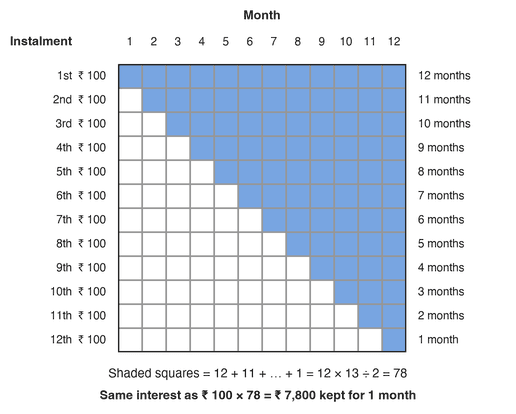
Check: For 12 months the formula gives back the interest.
Watch out: Reject the negative root: a number of months can never be negative.
Why the other options are wrong:
- (A) 18: 18 months would give 100 × 14.25 × 8/100 = ₹ 114, more than ₹ 52.
- (B) 30: 30 months would give 100 × 38.75 × 8/100 = ₹ 310, far more than ₹ 52.
- (D) 6: 6 months would give only 100 × 1.75 × 8/100 = ₹ 14.
Therefore, Joseph receives ₹ 52 as interest in 12 months, option (C).
- 121 mark
Question 12
Naveen deposits ₹ 800 every month in a recurring deposit account for 6 months. If he receives ₹ 4884 at the time of maturity, then the interest he earns is :
Solve with AIAnswer
- Correct
(A) ₹ 84
(B) ₹ 42
(C) ₹ 24
(D) ₹ 284
Answer: (A) ₹ 84
Concept: The maturity value is the total money deposited () plus the interest. So the interest is the maturity value minus the money deposited.
Step 1 — Find the total deposited.
Naveen pays ₹ 800 in each of the 6 months.
Step 2 — Find the interest.
The interest is what he receives over and above his deposits.
Check: ₹ 4,800 + ₹ 84 = ₹ 4,884, the amount Naveen receives.
Why the other options are wrong:
- (B) ₹ 42: ₹ 42 is only half of the interest (84 ÷ 2).
- (C) ₹ 24: ₹ 24 would make the maturity value 4,800 + 24 = ₹ 4,824, not ₹ 4,884.
- (D) ₹ 284: ₹ 284 would make the maturity value 4,800 + 284 = ₹ 5,084, not ₹ 4,884.
Therefore, the interest Naveen earns is ₹ 84, option (A).
- 134 marks
Question 13
Salman deposits ₹ 1000 every month in a recurring deposit account for 2 years. If he receives ₹ 26000 on maturity, find :
(a) the total interest Salman earns.
(b) the rate of interest.
Solve with AIWritten solution
Solution:
Concept: In a recurring deposit (R.D.) account a fixed sum ₹ is deposited every month for months at % per annum simple interest. The first instalment stays in the bank for months, the second for months, …, the last for 1 month, so the interest is
The maturity value is the total money deposited () plus the interest. So the interest is the maturity value minus the money deposited.
Given: = ₹ 1,000 per month; time = 2 years; maturity value = ₹ 26,000.
Step 1 — Change the time to months.
The formula needs the time in months, and there are 12 months in a year.
Step 2 — Find the total deposited.
Salman pays ₹ 1,000 in each of the 24 months.
Step 3 — Find the interest (part a).
The interest is the maturity value minus his own deposits.
Step 4 — Find the rate (part b).
We put , and in the formula; the rate is the unknown.
Check: At 8% the formula gives back the interest.
Watch out: ₹ 26,000 is the maturity value, not the interest.
Therefore, (a) Salman earns ₹ 2,000 as interest and (b) the rate of interest is 8% per annum.
- 143 marks
Question 14
Suresh has a recurring deposit account in a bank. He deposits ₹2000 per month and the bank pays interest at the rate of 8% per annum. If he gets ₹1040 as interest at the time of maturity, find in years total time for which the account was held.
Solve with AIWritten solution
Solution:
Concept: In a recurring deposit (R.D.) account a fixed sum ₹ is deposited every month for months at % per annum simple interest. The first instalment stays in the bank for months, the second for months, …, the last for 1 month, so the interest is
Given: = ₹ 2,000 per month; rate = 8% p.a.; interest = ₹ 1,040.
Step 1 — Form the equation.
The time is unknown, so we let it be months, put the known values in the formula and make the subject.
Step 2 — Solve the quadratic equation.
We open the bracket and take everything to one side.
We need two numbers whose product is 156 and whose difference is 1. They are 13 and 12, so we split the middle term:
Taking out the common factor from each pair:
So or . The number of months cannot be negative, so .
Step 3 — Change to years.
There are 12 months in a year, so we divide the number of months by 12.
Check: For 12 months the formula gives back the interest.
Watch out: Reject the negative root: a number of months can never be negative.
Therefore, the account was held for 1 year (12 months).
- 151 mark
Question 15
Mr. Anuj deposits ₹500 per month for 18 months in a recurring deposit account at a certain rate. If he earns ₹570 as interest at the time of maturity, then his matured amount is:
Solve with AIAnswer
- Correct
(A) ₹
(B) ₹
(C) ₹
(D) ₹
Answer: (A) ₹
Concept: The maturity value is the total money deposited () plus the interest.
Step 1 — Find the money deposited.
Mr. Anuj pays ₹ 500 in each of the 18 months, so he deposits ₹ (500 × 18) in all.
Step 2 — Add the interest.
The matured amount is the money deposited plus the interest of ₹ 570, that is ₹ (500 × 18 + 570).
Watch out: The and belong to the interest formula only; the deposits are just .
Why the other options are wrong:
- (B) ₹: it counts 19 instalments, but only 18 are paid. It works out to ₹ 10,070.
- (C) ₹: it multiplies by , a part of the interest formula, not of the money deposited. It works out to ₹ 1,71,570.
- (D) ₹: it uses , again a part of the interest formula. It works out to ₹ 86,070.
Therefore, the matured amount is ₹ (500 × 18 + 570) = ₹ 9,570, option (A).
- 164 marks
Question 16
Mrs. Rao deposited ₹ 250 per month in a recurring deposit account for a period of 3 years. She received ₹ 10,110 at the time of maturity. Find:
(a) the rate of interest.
(b) how much more interest Mrs. Rao will receive if she had deposited ₹50 more per month at the same rate of interest and for the same time.
Solve with AIWritten solution
Solution:
Concept: In a recurring deposit (R.D.) account a fixed sum ₹ is deposited every month for months at % per annum simple interest. The first instalment stays in the bank for months, the second for months, …, the last for 1 month, so the interest is
The maturity value is the total money deposited () plus the interest. So the interest is the maturity value minus the money deposited.
Given: = ₹ 250 per month; time = 3 years; maturity value = ₹ 10,110.
Step 1 — Change the time to months.
The formula needs the time in months, and there are 12 months in a year.
Step 2 — Find the interest.
Mrs. Rao deposits 250 × 36 = ₹ 9,000. The interest is the maturity value minus her deposits.
Step 3 — Find the rate (part a).
We put , and in the formula; the rate is the unknown.
Step 4 — Find the new interest.
With ₹ 50 more, the instalment is 250 + 50 = ₹ 300 a month, for the same 36 months at the same 8%.
Step 5 — Find the extra interest (part b).
We subtract the old interest from the new one.

Check: The extra ₹ 50 a month earns interest on its own, which gives the same answer by a shorter way.
Watch out: ₹ 10,110 is the maturity value, not the interest. Take away the ₹ 9,000 deposited first.
Therefore, (a) the rate of interest is 8% per annum and (b) Mrs. Rao would receive ₹ 222 more interest.
- 171 mark
Question 17
Mr. Rahul deposited ₹ 11,700 in a recurring deposit account for 1 years. The amount deposited by him per month is :
Solve with AIAnswer
- Correct
(A) ₹ 650
(B) ₹ 780
(C) ₹ 6,500
(D) ₹ 7,800
Answer: (A) ₹ 650
Concept: In a recurring deposit the same sum is paid every month, so the total deposited is the monthly sum × the number of months.
Step 1 — Change the time to months.
The formula needs the time in months, and there are 12 months in a year. Mr. Rahul makes one deposit each month.
Step 2 — Find the monthly deposit.
We divide the total deposited by the number of months.
Check: 650 × 18 = ₹ 11,700, the total deposited.
Watch out: Divide by the number of months (18), not by the number of years (1.5).
Why the other options are wrong:
- (B) ₹ 780: ₹ 780 divides by 15 (11,700 ÷ 15), taking the time as 15 months instead of 18.
- (C) ₹ 6,500: ₹ 6,500 divides by 1.8 instead of 18 (11,700 ÷ 1.8), a slip of the decimal point.
- (D) ₹ 7,800: ₹ 7,800 divides by 1.5, the time in years. That is the deposit per year, not per month.
Therefore, Mr. Rahul deposited ₹ 650 per month, option (A).
- 183 marks
Question 18
Mr. Anil has a recurring deposit account. He deposits a certain amount of money per month for 2 years. If he received an interest whose value is the double of the deposit made per month, then find the rate of interest.
Solve with AIWritten solution
Solution:
Concept: In a recurring deposit (R.D.) account a fixed sum ₹ is deposited every month for months at % per annum simple interest. The first instalment stays in the bank for months, the second for months, …, the last for 1 month, so the interest is
Given: Time = 2 years; the interest is double the monthly deposit, so .
Step 1 — Change the time to months.
The formula needs the time in months, and there are 12 months in a year.
Step 2 — Put the values in the formula.
We put and in the formula. The monthly deposit is unknown, but it will cancel.
Step 3 — Solve for r.
We divide both sides by (which is not zero) and multiply by 4.
Check: At 8%, ₹ 100 a month for 24 months earns double the deposit.
Watch out: The monthly deposit is not needed: it cancels from both sides.
Therefore, the rate of interest is 8% per annum.
- 191 mark
Question 19
A and B opened a recurring deposit account in a bank which is paying simple interest at 9% per annum. A deposited ₹ 1,500 for one year and B deposited ₹ 1,200 for 15 months. The amount invested by :
Solve with AIAnswer
(A) A is ₹ 27 more than B
(B) A is ₹ 300 more than B
(C) A is ₹ 300 less than B
- Correct
(D) Both A and B are same (₹ 18,000)
Answer: (D) Both A and B are same (₹ 18,000)
Concept: The amount invested in a recurring deposit is the monthly deposit × the number of months. The rate of interest affects only the interest, not the amount invested.
Step 1 — Find A's total.
A deposits ₹ 1,500 every month for one year, that is 12 months.
Step 2 — Find B's total.
B deposits ₹ 1,200 every month for 15 months.
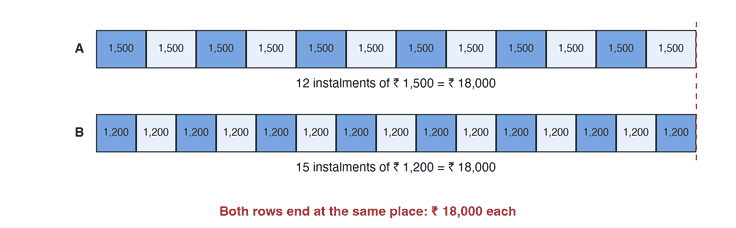
Step 3 — Compare.
Both totals are ₹ 18,000, so A and B invested the same amount.
Watch out: Compare the totals, not the monthly deposits: B pays less each month but for 3 more months.
Why the other options are wrong:
- (A) A is ₹ 27 more than B: ₹ 27 is 9% of ₹ 300. It brings in the rate of interest, which has nothing to do with the amount invested.
- (B) A is ₹ 300 more than B: ₹ 300 is the gap between the monthly deposits (1,500 − 1,200), not between the totals.
- (C) A is ₹ 300 less than B: it uses the same ₹ 300 gap between the monthly deposits, taken the other way round; the totals have no gap at all.
Therefore, A and B invested the same amount, ₹ 18,000 each, option (D).
- 203 marks
Question 20
Rohit and Vinay both opened a recurring deposit account in a bank for 2 years at 8% simple interest. Vinay deposited ₹ 300 per month. On maturity, Rohit’s interest was ₹ 800 more than Vinay’s interest. Find:
(a) interest earned by Vinay.
(b) sum deposited by Rohit every month.
Solve with AIWritten solution
Solution:
Concept: In a recurring deposit (R.D.) account a fixed sum ₹ is deposited every month for months at % per annum simple interest. The first instalment stays in the bank for months, the second for months, …, the last for 1 month, so the interest is
Given: For both, time = 2 years and = 8% p.a.; Vinay deposits ₹ 300 per month; Rohit's interest = Vinay's interest + ₹ 800.
Step 1 — Change the time to months.
The formula needs the time in months (the same for both), and there are 12 months in a year.
Step 2 — Find Vinay's interest (part a).
We put , and in the formula.
Step 3 — Find Rohit's interest.
Rohit's interest is ₹ 800 more than Vinay's.
Step 4 — Find Rohit's monthly deposit (part b).
We put , and in the formula and solve for .
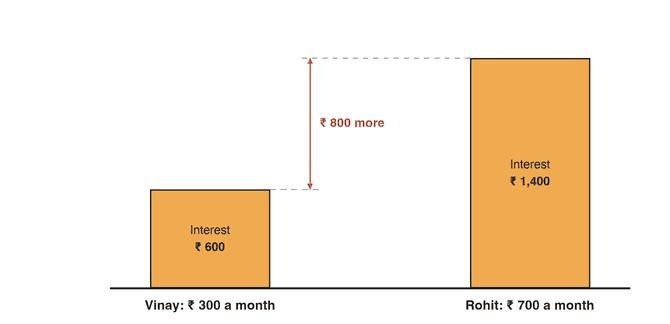
Check: With ₹ 700 a month Rohit earns ₹ 1,400, and 1,400 − 600 = ₹ 800, as given.
Watch out: ₹ 800 is the difference in the interest, not in the monthly deposits.
Therefore, (a) Vinay earned ₹ 600 as interest and (b) Rohit deposited ₹ 700 every month.
- 211 mark
Question 21
A person deposited ₹500 per month in a recurring deposit account for one year at % per annum. The rate of interest is revised to %. The interest earned by the person compared to the original amount of interest will be:
Solve with AIAnswer
(A) one-fourth
(B) unchanged
(C) half
- Correct
(D) double
Answer: (D) double
Concept: In a recurring deposit (R.D.) account a fixed sum ₹ is deposited every month for months at % per annum simple interest. The first instalment stays in the bank for months, the second for months, …, the last for 1 month, so the interest is
For fixed and , the interest is directly proportional to the rate .
Step 1 — Write the original interest.
We put and in the formula, keeping the rate as .
Step 2 — Write the new interest.
Only the rate changes, to .
Step 3 — Compare.
We divide the new interest by the original one.
Check: At 6% the interest is 32.5 × 6 = ₹ 195, and at 12% it is 32.5 × 12 = ₹ 390, which is double.
Why the other options are wrong:
- (A) one-fourth: one-fourth would need the rate to fall to a quarter (); here the rate goes up.
- (B) unchanged: unchanged would need the same rate; a different rate on the same deposits changes the interest.
- (C) half: half would need the rate to be halved (); here it is doubled.
Therefore, the interest earned will be double the original interest, option (D).
- 224 marks
Question 22
Anamika deposited ₹300 per month in a cumulative deposit account with a bank for 3 years. Her brother Sanjeev started depositing ₹500 per month for 2 years in the same scheme. The banks paid 10% simple interest per annum to both. At the time of maturity, find:
(a) the interest earned by Anamika.
(b) who got more money as interest and how much?