Solution:
Concept: In a recurring deposit (R.D.) account a fixed sum ₹ P is deposited every month for n months at r% per annum simple interest. The first instalment stays in the bank for n months, the second for n−1 months, …, the last for 1 month, so the interest is
I=P×2×12n(n+1)×100r
Given: For both, time = 2 years and r = 8% p.a.; Vinay deposits ₹ 300 per month; Rohit's interest = Vinay's interest + ₹ 800.
Step 1 — Change the time to months.
The formula needs the time in months (the same for both), and there are 12 months in a year.
Number of months=2×12=24
Step 2 — Find Vinay's interest (part a).
We put P=300, n=24 and r=8 in the formula.
Vinay’s interest=300×2×1224×25×1008=300×25×1008=600
Step 3 — Find Rohit's interest.
Rohit's interest is ₹ 800 more than Vinay's.
Rohit’s interest=600+800=1,400
Step 4 — Find Rohit's monthly deposit (part b).
We put I=1,400, n=24 and r=8 in the formula and solve for P.
1,4001,400PP=P×2×1224×25×1008=P×25×1008=25×81,400×100=700
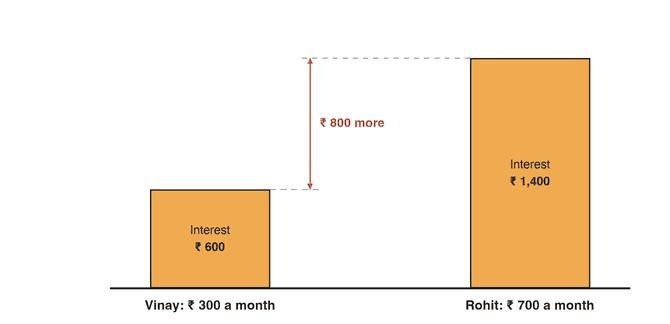
Check: With ₹ 700 a month Rohit earns ₹ 1,400, and 1,400 − 600 = ₹ 800, as given.
Rohit’s interest=700×2×1224×25×1008=700×25×1008=1,400
Watch out: ₹ 800 is the difference in the interest, not in the monthly deposits.
Therefore, (a) Vinay earned ₹ 600 as interest and (b) Rohit deposited ₹ 700 every month.
