
Question 191 markMCQAsked 2026Easy
A and B opened a recurring deposit account in a bank which is paying simple interest at 9% per annum. A deposited ₹ 1,500 for one year and B deposited ₹ 1,200 for 15 months. The amount invested by :
Confirming your payment
Sign up now and get 250 free tokens.
Previous Year Questions · Question 19 of 22
A and B opened a recurring deposit account in a bank which is paying simple interest at 9% per annum. A deposited ₹ 1,500 for one year and B deposited ₹ 1,200 for 15 months. The amount invested by :
(A) A is ₹ 27 more than B
(B) A is ₹ 300 more than B
(C) A is ₹ 300 less than B
(D) Both A and B are same (₹ 18,000)
Answer: (D) Both A and B are same (₹ 18,000)
Concept: The amount invested in a recurring deposit is the monthly deposit × the number of months. The rate of interest affects only the interest, not the amount invested.
Step 1 — Find A's total.
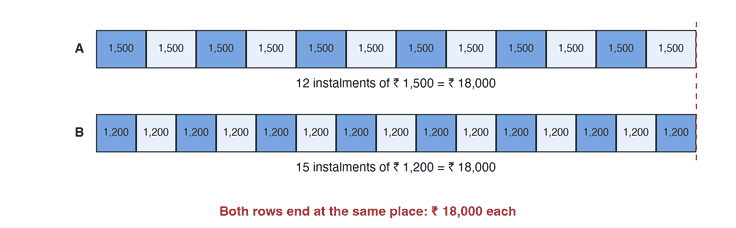
A deposits ₹ 1,500 every month for one year, that is 12 months.
Step 2 — Find B's total.
B deposits ₹ 1,200 every month for 15 months.
Step 3 — Compare.
Both totals are ₹ 18,000, so A and B invested the same amount.
Watch out: Compare the totals, not the monthly deposits: B pays less each month but for 3 more months.
Why the other options are wrong:
Therefore, A and B invested the same amount, ₹ 18,000 each, option (D).