
Opening your dashboard
Class 10 Maths Chapter 13: Section Formula and Mid-Point Formula Solutions
67 textbook questions with step-by-step answers, free to read, for ICSE 2026-27.
Get talked through Ch 13, not just shown the answer
Reading a finished solution is not the same as being able to do it. The AI tutor takes one question at a time and works it with you, in your own words, until you can.
- Ask it out loud, in your own words
- It gives you the next step, not the answer
- Stuck on part (ii)? Start there
67 questions with solutions
1–3 marks · Mixed difficulty
The first 10 solutions are on this page. This chapter is a long one, so the rest open on their own page to keep this one quick to load.
- 11 mark
Question 1
A point P divides the line segment joining the points A(1, 3) and B(5, 9) in the ratio 1 : 2, the co-ordinates of the point P are :
Solve with AIAnswer
- Correct
(A)
(B)
(C)
(D)
Answer: (A)
Concept: The section formula: the point P that divides the join of and internally in the ratio (so that AP : PB is ) is . Notice the cross pattern: multiplies the co-ordinate of the far end B, and multiplies the co-ordinate of the near end A.
Step 1 — Find the co-ordinates of P.
We put , (point A), , (point B), and into the section formula, one co-ordinate at a time.
So the point P is .
Step 2 — Check that P lies between A and B.
A point that divides AB internally must lie between A and B, so its -co-ordinate lies between 1 and 5 and its -co-ordinate between 3 and 9. Here is about 2.33 and 5 is between 3 and 9, and P is closer to A, as a 1 : 2 split should be.
Watch out: In the section formula goes with the co-ordinates of the second point B and with those of the first point A. Swapping them gives the point that divides the segment in the reverse ratio.
Why the other options are wrong:
- (B) : is greater than 5, the -co-ordinate of B, so this point is not even between A and B.
- (C) : the -co-ordinate is right, but is less than 3, the -co-ordinate of A, so the point is not between A and B.
- (D) : the -co-ordinate is right, but the section formula gives (Step 1), not .
Therefore, the co-ordinates of P are , option (A).
- 21 mark
Question 2
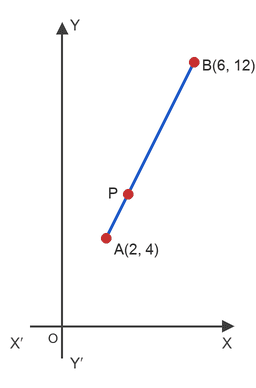
AB is a line segment with A = (2, 4) and B = (6, 12). Point P lies on the line segment AB so that P = (3, ), then the ratio AP : PB is:
 Solve with AI
Answer
(A) 3 : 2
(B) 2 : 3
(C) 3 : 1
- Correct
(D) 1 : 3
Answer: (D) 1 : 3
Concept: When the ratio is unknown, take it as . By the section formula, the dividing point is then , which has only one unknown, . Any point on the -axis has -co-ordinate 0, and any point on the -axis has -co-ordinate 0.
Step 1 — Choose the co-ordinate we know.
The -co-ordinate of P is the unknown , but its -co-ordinate, 3, is known. So we work with the -co-ordinates of A(2, 4) and B(6, 12).
Step 2 — Find the ratio.
Let the point divide AB in the ratio . By the section formula, its -co-ordinate is . The -co-ordinate of P is 3. So we set this equal to 3 and solve for .
So the ratio is . Multiplying both terms by 3 gives .
Step 3 — Check with the horizontal distances.
Along the -direction, P is unit from A and units from B. Since A, P and B lie on one straight line, AP : PB is the same as 1 : 3.
Watch out: AP : PB compares the part next to A with the part next to B. 3 : 1 would put P three times as far from A as from B.
Why the other options are wrong:
- (A) 3 : 2: with the ratio 3 : 2 the -co-ordinate of P would be , not 3.
- (B) 2 : 3: with the ratio 2 : 3 the -co-ordinate of P would be , not 3.
- (C) 3 : 1: 3 : 1 is the ratio turned round (PB : AP). It would make the -co-ordinate of P equal to , which is 5, not 3.
Therefore, AP : PB = 1 : 3, option (D).
- 31 mark
Question 3
The ratio in which the join of (2, 4) and (10, 12) is divided by the line is :
Solve with AIAnswer
(A) 3 : 5
- Correct
(B) 5 : 3
(C) 1 : 5
(D) 3 : 1
Answer: (B) 5 : 3
Concept: When the ratio is unknown, take it as . By the section formula, the dividing point is then , which has only one unknown, . Any point on the -axis has -co-ordinate 0, and any point on the -axis has -co-ordinate 0.
Step 1 — Decide which co-ordinate matters.
The first point is (2, 4) and the second point is (10, 12). The dividing point is fixed by its -co-ordinate, so only the -co-ordinates 2 and 10 are needed.
Step 2 — Find the ratio.
Let the point divide the join in the ratio . By the section formula, its -co-ordinate is . Every point on the line has -co-ordinate 7. So we set this equal to 7 and solve for .
So the ratio is . Multiplying both terms by 3 gives .
Watch out: The ratio is , not alone. When is a fraction such as , multiply both terms by its denominator to write the ratio in whole numbers (5 : 3).
Why the other options are wrong:
- (A) 3 : 5: with the ratio 3 : 5 the -co-ordinate of the dividing point would be , not 7.
- (C) 1 : 5: with the ratio 1 : 5 the -co-ordinate of the dividing point would be , not 7.
- (D) 3 : 1: with the ratio 3 : 1 the -co-ordinate of the dividing point would be , not 7.
Therefore, the ratio is 5 : 3, option (B).
- 41 mark
Question 4
The line divides the join of points (6, 7) and (4, −1) in the ratio :
Solve with AIAnswer
- Correct
(A) 3 : 5
(B) 5 : 3
(C) 1 : 5
(D) 5 : 1
Answer: (A) 3 : 5
Concept: When the ratio is unknown, take it as . By the section formula, the dividing point is then , which has only one unknown, . Any point on the -axis has -co-ordinate 0, and any point on the -axis has -co-ordinate 0.
Step 1 — Decide which co-ordinate matters.
The first point is (6, 7) and the second point is (4, −1). The dividing point is fixed by its -co-ordinate, so only the -co-ordinates 7 and −1 are needed.
Step 2 — Find the ratio.
Let the point divide the join in the ratio . By the section formula, its -co-ordinate is . Every point on the line has -co-ordinate 4. So we set this equal to 4 and solve for .
So the ratio is . Multiplying both terms by 5 gives .
Watch out: The ratio is , not alone. When is a fraction such as , multiply both terms by its denominator to write the ratio in whole numbers (5 : 3).
Why the other options are wrong:
- (B) 5 : 3: with the ratio 5 : 3 the -co-ordinate of the dividing point would be , not 4.
- (C) 1 : 5: with the ratio 1 : 5 the -co-ordinate of the dividing point would be , not 4.
- (D) 5 : 1: with the ratio 5 : 1 the -co-ordinate of the dividing point would be , not 4.
Therefore, the ratio is 3 : 5, option (A).
- 51 mark
Question 5
The ratio in which the join of points (−2, 5) and (5, −2) is divided by -axis is :
Solve with AIAnswer
(A) 3 : 5
- Correct
(B) 2 : 5
(C) 5 : 3
(D) 5 : 2
Answer: (B) 2 : 5
Concept: When the ratio is unknown, take it as . By the section formula, the dividing point is then , which has only one unknown, . Any point on the -axis has -co-ordinate 0, and any point on the -axis has -co-ordinate 0.
Step 1 — Decide which co-ordinate matters.
The first point is (−2, 5) and the second point is (5, −2). The dividing point is fixed by its -co-ordinate, so only the -co-ordinates −2 and 5 are needed.
Step 2 — Find the ratio.
Let the point divide the join in the ratio . By the section formula, its -co-ordinate is . Every point on the -axis has -co-ordinate 0. So we set this equal to 0 and solve for .
So the ratio is . Multiplying both terms by 5 gives .
Watch out: On the -axis it is the -co-ordinate that is 0, and on the -axis it is the -co-ordinate that is 0. Mixing these up is the most common slip in this chapter.
Why the other options are wrong:
- (A) 3 : 5: with the ratio 3 : 5 the -co-ordinate of the dividing point would be , not 0.
- (C) 5 : 3: with the ratio 5 : 3 the -co-ordinate of the dividing point would be , not 0.
- (D) 5 : 2: with the ratio 5 : 2 the -co-ordinate of the dividing point would be , not 0.
Therefore, the ratio is 2 : 5, option (B).
- 63 marks
Question 6
In what ratio does the point (1, ) divide the join of (−1, 4) and (4, −1) ? Also, find the value of .
Solve with AIWritten solution
Solution:
Concept: When the ratio is unknown, take it as . By the section formula, the dividing point is then , which has only one unknown, . Any point on the -axis has -co-ordinate 0, and any point on the -axis has -co-ordinate 0.
Step 1 — Name the points.
Let A be (−1, 4) and B be (4, −1). The point (1, ) has a known -co-ordinate, 1, so we find the ratio from the -co-ordinates first.
Step 2 — Find the ratio.
Let the point divide AB in the ratio . By the section formula, its -co-ordinate is . The -co-ordinate of the point (1, ) is 1. So we set this equal to 1 and solve for .
So the ratio is . Multiplying both terms by 3 gives .
Step 3 — Find the other co-ordinate.
Now that the ratio is known, we use the section formula with and , and . (The -co-ordinate is worked out too, as a check: it must come out as 1.)
So the point P is (1, 2).
Comparing (1, 2) with (1, ) gives .
Watch out: The ratio is , not alone. When is a fraction such as , multiply both terms by its denominator to write the ratio in whole numbers (5 : 3).
Therefore, the point divides the join in the ratio 2 : 3, and .
- 73 marks
Question 7
In what ratio does the point (, 6) divide the join of (−4, 3) and (2, 8) ? Also, find the value of .
Solve with AIWritten solution
Solution:
Concept: When the ratio is unknown, take it as . By the section formula, the dividing point is then , which has only one unknown, . Any point on the -axis has -co-ordinate 0, and any point on the -axis has -co-ordinate 0.
Step 1 — Name the points.
Let A be (−4, 3) and B be (2, 8). This time the -co-ordinate of the point (, 6) is known, so we find the ratio from the -co-ordinates.
Step 2 — Find the ratio.
Let the point divide AB in the ratio . By the section formula, its -co-ordinate is . The -co-ordinate of the point (, 6) is 6. So we set this equal to 6 and solve for .
So the ratio is . Multiplying both terms by 2 gives .
Step 3 — Find the other co-ordinate.
Now that the ratio is known, we use the section formula with and , and . (The -co-ordinate is worked out too, as a check: it must come out as 6.)
So the point P is .
Comparing with (, 6) gives .
Watch out: Use the co-ordinate that is known (here ). Using the -co-ordinates would bring in the unknown as well as .
Therefore, the point divides the join in the ratio 3 : 2, and .
- 83 marks
Question 8
In what ratio is the join of (4, 3) and (2, −6) divided by the -axis ? Also, find the co-ordinates of the point of intersection.
Solve with AIWritten solution
Solution:
Concept: When the ratio is unknown, take it as . By the section formula, the dividing point is then , which has only one unknown, . Any point on the -axis has -co-ordinate 0, and any point on the -axis has -co-ordinate 0.
Step 1 — Name the points.
Let A be (4, 3) and B be (2, −6). The -axis cuts AB at a point whose -co-ordinate is 0, so we work with the -co-ordinates 3 and −6. (A is above the axis and B is below it, so the axis really does cut the segment between them.)
Step 2 — Find the ratio.
Let the point divide AB in the ratio . By the section formula, its -co-ordinate is . The point lies on the -axis, where every -co-ordinate is 0. So we set this equal to 0 and solve for .
So the ratio is . Multiplying both terms by 2 gives .
Step 3 — Find the other co-ordinate.
Now that the ratio is known, we use the section formula with and , and . (The -co-ordinate is worked out too, as a check: it must come out as 0.)
So the point P is .
Watch out: On the -axis it is the -co-ordinate that is 0, and on the -axis it is the -co-ordinate that is 0. Mixing these up is the most common slip in this chapter.
Therefore, the -axis divides the join in the ratio 1 : 2, and the point of intersection is .
- 93 marks
Question 9
Find the ratio in which the join of (−4, 7) and (3, 0) is divided by the -axis. Also, find the co-ordinates of the point of intersection.
Solve with AIWritten solution
Solution:
Concept: When the ratio is unknown, take it as . By the section formula, the dividing point is then , which has only one unknown, . Any point on the -axis has -co-ordinate 0, and any point on the -axis has -co-ordinate 0.
Step 1 — Name the points.
Let A be (−4, 7) and B be (3, 0). The -axis cuts AB at a point whose -co-ordinate is 0, so we work with the -co-ordinates −4 and 3, which lie on opposite sides of 0.
Step 2 — Find the ratio.
Let the point divide AB in the ratio . By the section formula, its -co-ordinate is . The point lies on the -axis, where every -co-ordinate is 0. So we set this equal to 0 and solve for .
So the ratio is . Multiplying both terms by 3 gives .
Step 3 — Find the other co-ordinate.
Now that the ratio is known, we use the section formula with and , and . (The -co-ordinate is worked out too, as a check: it must come out as 0.)
So the point P is (0, 3).
Watch out: On the -axis it is the -co-ordinate that is 0, and on the -axis it is the -co-ordinate that is 0. Mixing these up is the most common slip in this chapter.
Therefore, the -axis divides the join in the ratio 4 : 3, and the point of intersection is (0, 3).
- 103 marks
Question 10
Points A, B, C and D divide the line segment joining the point (5, −10) and the origin in five equal parts. Find the co-ordinates of B and D.
Solve with AIWritten solution
Solution:
Concept: The section formula: the point P that divides the join of and internally in the ratio (so that AP : PB is ) is . Notice the cross pattern: multiplies the co-ordinate of the far end B, and multiplies the co-ordinate of the near end A.
Step 1 — Understand the five equal parts.
Call the point (5, −10) Q and the origin O(0, 0). Going from Q to O, the four points A, B, C and D cut QO into five equal parts, in this order:
So B is 2 parts from Q and 3 parts from O, and D is 4 parts from Q and 1 part from O.
Step 2 — Find B.
B is the end of the second part, so QB : BO is 2 : 3. We put , (point Q), , (point O), and into the section formula.
So the point B is (3, −6).
Step 3 — Find D.
D is the end of the fourth part, so QD : DO is 4 : 1. We use the same end points with and .
So the point D is (1, −2).
Step 4 — Check with equal steps.
Each part is one-fifth of the journey from (5, −10) to (0, 0), that is a step of −1 in and +2 in . Stepping from Q gives A(4, −8), B(3, −6), C(2, −4) and D(1, −2), which agrees with Steps 2 and 3.
Watch out: The letters A, B, C, D are taken in order starting from (5, −10), the first point named in the question. Counting from the origin instead would swap the answers to B(2, −4) and D(4, −8).
Therefore, B(3, −6) and D(1, −2).
- 113 marks
Question 11
The line joining the points A (−3, −10) and B (−2, 6) is divided by the point P such that . Find the co-ordinates of P.
- 123 marks
Question 12
P is a point on the line joining A (4, 3) and B (−2, 6) such that 5AP = 2BP. Find the co-ordinates of P.
- 133 marks
Question 13
Calculate the ratio in which the line joining the points (−3, −1) and (5, 7) is divided by the line . Also, find the co-ordinates of the point of intersection.
- 143 marks
Question 14
Calculate the ratio in which the line joining A (6, 5) and B (4, −3) is divided by the line .
- 153 marks
Question 15
The point P (5, −4) divides the line segment AB, as shown in the figure, in the ratio 2 : 5. Find the co-ordinates of points A and B. Given AP is smaller than BP.

- 163 marks
Question 16
Find the co-ordinates of the points of trisection of the line joining the points (−3, 0) and (6, 6).
- 173 marks
Question 17
Show that the line segment joining the points (−5, 8) and (10, −4) is trisected by the co-ordinate axes.
- 183 marks
Question 18
Show that A (3, −2) is a point of trisection of the line-segment joining the points (2, 1) and (5, −8). Also, find the co-ordinates of the other point of trisection.
- 193 marks
Question 19
The line segment joining the points M (5, 7) and N (−3, 2) is intersected by the -axis at point L. Write down the abscissa of L. Hence, find the ratio in which L divides MN. Also, find the co-ordinates of L.
- 203 marks
Question 20
A (−3, 4), B (3, −1) and C (−2, 4) are the vertices of a triangle ABC.
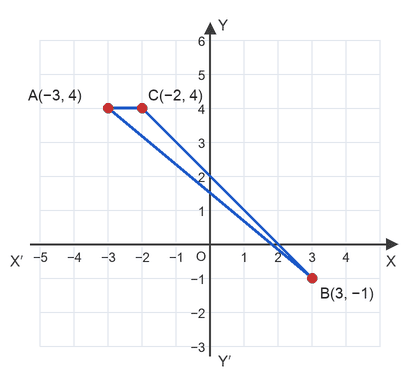
Find the length of line segment AP, where point P lies inside BC, such that BP : PC = 2 : 3.
- 213 marks
Question 21
The line segment joining A(2, 3) and B(6, −5) is intercepted by -axis at the point K. Write down the ordinate of the point K. Hence, find the ratio in which K divides AB. Also, find the co-ordinates of the point K.
- 223 marks
Question 22
The line segment joining A(4, 7) and B(−6, −2) is intercepted by the -axis at the point K. Write down the abscissa of the point K. Hence, find the ratio in which K divides AB. Also, find the co-ordinates of the point K.
- 233 marks
Question 23
The line joining P(−4, 5) and Q(3, 2) intersects the -axis at point R. PM and QN are perpendiculars from P and Q on the -axis.
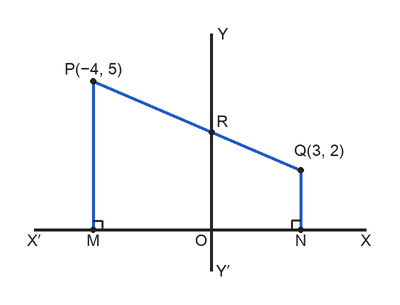
Find:
(i) the ratio PR : RQ.
(ii) the co-ordinates of R.
(iii) the area of the quadrilateral PMNQ.
- 243 marks
Question 24
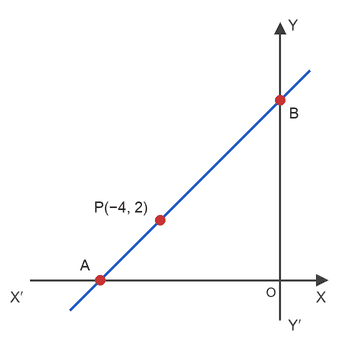
In the given figure, line APB meets the -axis at point A and -axis at point B. P is the point (−4, 2) and AP : PB = 1 : 2. Find the co-ordinates of A and B.
- 253 marks
Question 25
Given a line segment AB joining the points A(−4, 6) and B(8, −3). Find :
(i) the ratio in which AB is divided by the -axis.
(ii) find the co-ordinates of the point of intersection.
(iii) the length of AB.
- 263 marks
Question 26
If P(, ) divides the line segment joining the points A(, ) and B(5, ) in the ratio 3 : 1, find the values of and .
- 271 mark
Question 27
Point A (3, 4) is the centre of a circle. If one of its diameters has one end as (7, 8); the other end of this diameter is :
- 281 mark
Question 28
Point A lies on -axis and point B lies on -axis. If P(2, −2) bisects the line segment AB, the co-ordinates of A are :
- 291 mark
Question 29
In parallelogram ABCD, A = (6, 0), B = (12, −4) and C = (4, −4); then the co-ordinates of vertex D are :

- 301 mark
Question 30
The point P(2, −7) is reflected in the point (0, 3); the co-ordinates of the image of point P are :
- 311 mark
Question 31
The co-ordinates of the centroid of a triangle with vertices (−6, −3), (0, 0) and (12, −6) are :
- 323 marks
Question 32
Points A and B have co-ordinates (3, 5) and (, ) respectively. The mid-point of AB is (2, 3). Find the values of and .
- 333 marks
Question 33
Given M is the mid-point of AB, find the co-ordinates of :
(i) A; if M = (1, 7) and B = (−5, 10),
(ii) B; if A = (3, −1) and M = (−1, 3).
- 343 marks
Question 34
P (−3, 2) is the mid-point of line segment AB as shown in the given figure. Find the co-ordinates of points A and B.

- 353 marks
Question 35
(−5, 2), (3, −6) and (7, 4) are the vertices of a triangle. Find the length of its median through the vertex (3, −6).
- 363 marks
Question 36
Given a line ABCD in which AB = BC = CD, B = (0, 3) and C = (1, 8). Find the co-ordinates of A and D.
- 373 marks
Question 37
A (2, 5), B (1, 0), C (−4, 3) and D (−3, 8) are the vertices of quadrilateral ABCD.
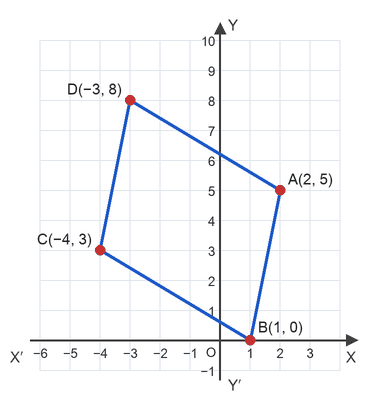
Find the co-ordinates of the mid-points of AC and BD. Give a special name to the quadrilateral.
- 383 marks
Question 38
P (4, 2) and Q (−1, 5) are the vertices of parallelogram PQRS and (−3, 2) are the co-ordinates of the point of intersection of its diagonals.

Find co-ordinates of R and S.
- 393 marks
Question 39
The points (2, −1), (−1, 4) and (−2, 2) are mid-points of the sides of a triangle. Find its vertices.
- 403 marks
Question 40
Points A (−5, ), B (, 7) and C (1, −3) are collinear (i.e. lie on the same straight line) such that AB = BC. Calculate the values of and .
- 413 marks
Question 41
Points P (, −4), Q (−2, ) and R (0, 2) are collinear. If Q lies between P and R, such that PR = 2QR, calculate the values of and .
- 423 marks
Question 42
The co-ordinates of the centroid of a triangle PQR are (2, −5). If Q = (−6, 5) and R = (11, 8); calculate the co-ordinates of vertex P.
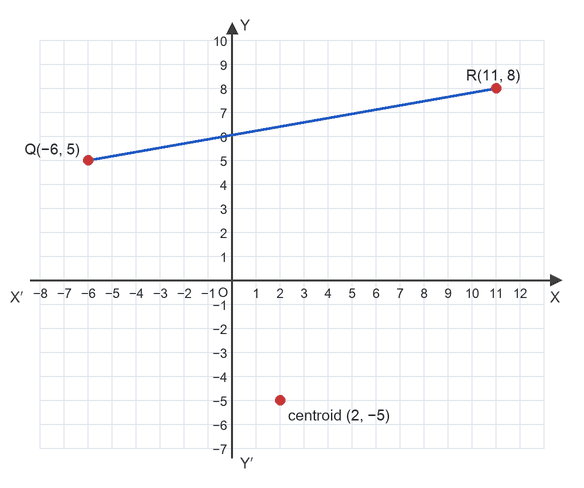
- 433 marks
Question 43
A (5, ), B (−4, 3) and C (, −2) are the vertices of the triangle ABC whose centroid is the origin. Calculate the values of and .
- 441 mark
Question 44
If P(4, 3) is mid-point of line segment AB, then

- 451 mark
Question 45
Points A and B have co-ordinates (4, ) and (, 8). The mid-point of AB = (0, 0); the values of and are :
- 461 mark
Question 46
Two vertices of a triangle are (−5, 3) and (4, −7). If centroid of the triangle is (−1, 2) then the third vertex is :
- 471 mark
Question 47
Points A, B, C and D divide the join of O(0, 0) and P(0, 10) into five equal parts. The co-ordinates of point D are :
- 481 mark
Question 48
Line segment joining points (4, 3) and (1, −2) is divided by the point (, 0) in the ratio:
- 491 mark
Question 49
The point P divides the line segment joining the points (1, 2) and (−1, 2) internally in the ratio 1 : 2.
Assertion (A) : The co-ordinates of point P = (1, 6).
Reason (R) : If point P divides line segment joining the points and in the ratio then
- 501 mark
Question 50
Point P(, ) is equidistant from points A(7, 1) and B(3, 5).
Statement (1) : and .
Statement (2) :
- 513 marks
Question 51
Given a triangle ABC in which A = (4, −4), B = (0, 5) and C = (5, 10).

A point P lies on BC such that BP : PC = 3 : 2. Find the length of line segment AP.
- 523 marks
Question 52
A(20, 0) and B(10, −20) are two fixed points. Find the co-ordinates of the point P in AB such that : 3PB = AB. Also, find the co-ordinates of some other point Q in AB such that : AB = 6 AQ.
- 533 marks
Question 53
A(−8, 0), B(0, 16) and C(0, 0) are the vertices of a triangle ABC. Point P lies on AB and Q lies on AC such that AP : PB = 3 : 5 and AQ : QC = 3 : 5.
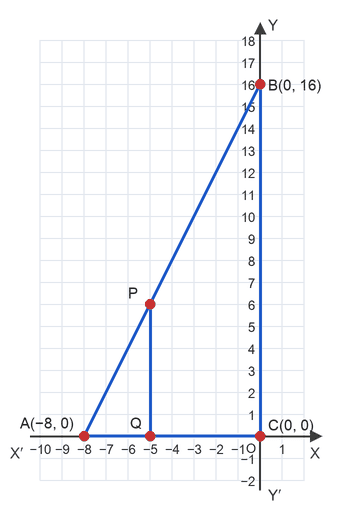
Show that : PQ BC.
- 543 marks
Question 54
A line segment joining A and B(, 5) is divided in the ratio 1 : 3 at P, the point where the line segment AB intersects the -axis.
(i) Calculate the value of ''.
(ii) Calculate the co-ordinates of 'P'.
- 553 marks
Question 55
In what ratio is the line joining A(0, 3) and B(4, −1) divided by the -axis ? Write the co-ordinates of the point where AB intersects the -axis.
- 563 marks
Question 56
The mid-point of the line segment AB, as shown in diagram, is C(4, −3). Write down the co-ordinates of A and B.
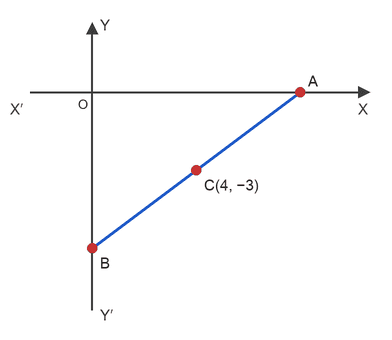
- 573 marks
Question 57
AB is a diameter of a circle with centre C = (−2, 5). If A = (3, −7), find
(i) the length of radius AC.
(ii) the coordinates of B.
- 583 marks
Question 58
The mid-point of the line segment joining (, ) and (−4, ) is (2, ). Find the values of and .
- 593 marks
Question 59
(i) Write down the co-ordinates of the point P that divides the line joining A(−4, 1) and B(17, 10) in the ratio 1 : 2.
(ii) Calculate the distance OP, where O is the origin.
(iii) In what ratio does the -axis divide the line AB ?
- 603 marks
Question 60
Prove that the points A(−5, 4); B(−1, −2) and C(5, 2) are the vertices of an isosceles right-angled triangle. Find the co-ordinates of D so that ABCD is a square.
- 613 marks
Question 61
M is the mid-point of the line segment joining the points A(−3, 7) and B(9, −1). Find the co-ordinates of point M. Further, if R(2, 2) divides the line segment joining M and the origin in the ratio , find the ratio .
- 623 marks
Question 62
Calculate the ratio in which the line joining A(−4, 2) and B(3, 6) is divided by point P(, 3). Also, find (i) (ii) length of AP.
- 633 marks
Question 63
Find the ratio in which the line divides the line segment joining the points P(2, −2) and Q(3, 7).
- 643 marks
Question 64
If the abscissa of a point P is 2, find the ratio in which this point divides the line segment joining the points (−4, 3) and (6, 3). Also, find the co-ordinates of point P.
- 653 marks
Question 65
Find the image of the point A(5, −3) under reflection in the point P(−1, 3).
- 663 marks
Question 66
M is the mid-point of the line segment joining the points A(0, 4) and B(6, 0). M also divides the line segment OP in the ratio 1 : 3. Find :
(i) co-ordinates of M
(ii) co-ordinates of P
(iii) length of BP
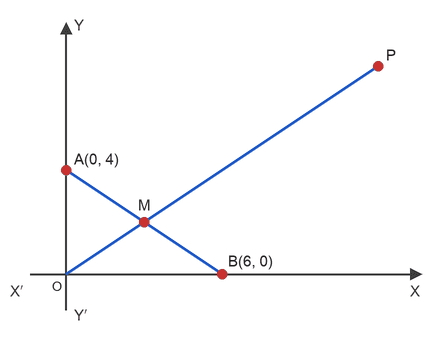
- 673 marks
Question 67
A(3, 1), B(, 4) and C(1, ) are vertices of triangle ABC and G(3, 4) is its centroid. Find the values of and . Also, find the length of side BC.
What Class 10 Maths Ch 13 covers
The sections of the chapter, in the order the book takes them. Every question above comes from one of these.
- 01The Section Formula
- 02Points of Trisection
- 03Mid-Point Formula
- 04Centroid of a Triangle
More ways to study this chapter
The same chapter asked three other ways. Practise it, revise it, and see what the board has set on Ch 13 before.
- Competency-Based Questions (CBQ)Case study questions: a situation, and the part of the chapter that answers it.40questionsOpen
- Previous Year QuestionsQuestions that have actually appeared in board papers, each tagged with its year.12questionsOpen
- Practice QuestionsExtra questions per chapter, for when one attempt at a method is not enough.42questionsOpen
Ch 13 in past ICSE papers
The same chapter as the board has actually asked it. These are worded differently from the textbook exercise, which is the point of reading them.
- 14 marks
Board paper question 1
P(1,–2) is a point on the line segment A(3,–6) and B(x, y) such that AP : PB is equal to 2 : 3. Find the coordinates of B.
Solve with AIWritten solution
Solution:
Concept: Section formula: the point P that divides the join of A and B internally in the ratio (so that AP : PB ) is . Notice that multiplies the FAR end B and the near end A.
Given: P(1, −2) lies on AB with A(3, −6), B(x, y) and AP : PB = 2 : 3.
Step 1 — Note the values for the section formula.
P divides AB so that AP : PB is 2 : 3. Hence and , the first end is A(3, −6) and the second end is the unknown point B(x, y).
Step 2 — Use the x-coordinate of P.
The x-coordinate of P is 1. Putting the values into the x-part of the section formula gives an equation in x, which we solve:
Step 3 — Use the y-coordinate of P.
The y-coordinate of P is −2. In the same way, the y-part of the formula gives an equation in y:
Check: Put B(−2, 4) back into the section formula. It must give P(1, −2):
Watch out: goes with the far end B and with the near end A. Swapping them gives the point for the ratio the wrong way round.
Therefore, the coordinates of B are .
- 23 marks
Board paper question 2
M and N are two points on the X axis and Y axis respectively. P(3, 2) divides the line segment MN in the ratio 2 : 3.

Find:
(i) the coordinates of M and N.
(ii) slope of the line MN.
Solve with AIWritten solution
Solution:
Concept: Section formula: the point P that divides the join of A and B internally in the ratio (so that AP : PB ) is . Notice that multiplies the FAR end B and the near end A. The slope of the line through and is .
Given: M on the x-axis, N on the y-axis, P(3, 2) divides MN in the ratio 2 : 3.
Step 1 — Name the unknown points.
M is on the x-axis, so its y-coordinate is 0; call it M(a, 0). N is on the y-axis, so its x-coordinate is 0; call it N(0, b).
Step 2 — Find a from the x-coordinate of P.
P(3, 2) divides MN in the ratio 2 : 3, so goes with N and goes with M. The x-part of the section formula gives:
Step 3 — Find b from the y-coordinate of P.
The y-part of the formula gives:
So M is (5, 0) and N is (0, 5).
Step 4 — Find the slope of MN.
The slope of the line through M(5, 0) and N(0, 5) is the rise divided by the run:
Watch out: The ratio 2 : 3 is MP : PN, so the 2 multiplies the coordinates of N (the far end) and the 3 those of M.
Therefore, (i) M(5, 0) and N(0, 5); (ii) the slope of MN is −1.
- 34 marks
Board paper question 3
In what ratio is the line joining and divided by the -axis ? Also find the coordinates of the point of intersection.
Solve with AIWritten solution
Solution:
Concept: A point on the x-axis has y-coordinate 0, and a point on the y-axis has x-coordinate 0. To find the ratio in which an axis cuts a segment, call the ratio , write the coordinate that must be 0 by the section formula and solve for .
Given: P(5, 3) and Q(−5, 3).
Step 1 — Let the ratio be k : 1.
Suppose the y-axis cuts PQ at a point R with PR : RQ = k : 1. Every point on the y-axis has x-coordinate 0, so the x-part of the section formula for R must equal 0:
So the ratio is 1 : 1, which means the y-axis cuts PQ at its mid-point.
Step 2 — Find the point of intersection.
With the ratio 1 : 1 the point is the mid-point of PQ:
Watch out: The y-axis is the line x = 0, so it is the x-coordinate that must be set to 0, not the y-coordinate.
Therefore, the y-axis divides PQ in the ratio 1 : 1, at the point .
- 41 mark
Board paper question 4
A(1, 4), B (4, 1) and C (, 4) are the vertices of . If the centroid of the triangle is G (4, 3) then is equal to
Solve with AIAnswer
(A) 2
(B) 1
- Correct
(C) 7
(D) 4
Answer: (C) 7
Concept: The centroid G of a triangle with vertices , , is the point where the medians meet: . Each coordinate is the average of the three vertex coordinates.
Step 1 — Use the x-coordinate of the centroid.
The x-coordinate of G is the average of the three x-coordinates 1, 4 and x, and it is given as 4:
Step 2 — Check with the y-coordinate.
The y-coordinates 4, 1 and 4 must average to 3, the y-coordinate of G:
This agrees, so the data fit.
Watch out: Divide the sum by 3 (the number of vertices), not by 2 as for a mid-point.
Why the other options are wrong:
- (A) 2: with x = 2 the average of the x-coordinates is , not 4.
- (B) 1: with x = 1 the three x-coordinates 1, 4 and 1 add up to 6, and their average is 2, not 4.
- (D) 4: with x = 4 the x-coordinates add up to 9, so their average is 3, not 4.
Therefore, x = 7, option (C).
- 52 marks
Board paper question 5
Find a point P which divides internally the line segment joining the points A (–3, 9) and B (1, –3) in the ratio 1 : 3.
Solve with AIWritten solution
Solution:
Concept: Section formula: the point P that divides the join of A and B internally in the ratio (so that AP : PB ) is . Notice that multiplies the FAR end B and the near end A.
Given: A(−3, 9), B(1, −3) and AP : PB = 1 : 3.
Step 1 — Note the values.
P divides AB internally with AP : PB in the ratio 1 : 3. Hence goes with B(1, −3) and goes with A(−3, 9).
Step 2 — Find the x-coordinate of P.
The x-part of the section formula gives:
Step 3 — Find the y-coordinate of P.
The y-part of the section formula gives:
Check: P should be a quarter of the way from A to B. From A to B, x goes up by 4 and y goes down by 12; a quarter of that moves A(−3, 9) by +1 and −3, which gives (−2, 6). ✓
Watch out: goes with the far end B and with the near end A. Swapping them gives the point for the ratio the wrong way round.
Therefore, P is .
- 61 mark
Board paper question 6
The coordinates of the vertices of are respectively , and . The centroid G of is :
Solve with AIAnswer
- Correct
(A)
(B)
(C)
(D)
Answer: (A)
Concept: The centroid G of a triangle with vertices , , is the point where the medians meet: . Each coordinate is the average of the three vertex coordinates.
Step 1 — Add and average the x-coordinates.
The x-coordinates of the vertices are −4, 6 and 4:
Step 2 — Add and average the y-coordinates.
The y-coordinates are −2, 2 and 6:
Watch out: Keep the signs: −4 and −2 are negative, so they reduce the sums.
Why the other options are wrong:
- (B) : its y-coordinate is 3, but the y-coordinates add up to 6 and .
- (C) : both its coordinates are 3, but each sum is 6, so each coordinate is 2.
- (D) : both coordinate sums (6 and 6) are positive, so neither coordinate of G can be 0 or negative.
Therefore, G is (2, 2), option (A).
All 12 board paper questions for this chapter, solved the same way.
Class 10 Maths Ch 13 questions students ask
How many questions are there in Class 10 Maths Ch 13?
67 questions. Every one is solved step by step on this page.
Are these Class 10 Maths solutions free?
Yes. Every question and its full working is free to read, with no account needed.
Can I download the Class 10 Maths Ch 13 solutions as a PDF?
There is no PDF to download. Every solution is on this page instead, which means it is searchable, always the current syllabus, and readable on a phone. Use your browser's print option if you want it on paper.