
Question 373 marksMedium
A (2, 5), B (1, 0), C (−4, 3) and D (−3, 8) are the vertices of quadrilateral ABCD.
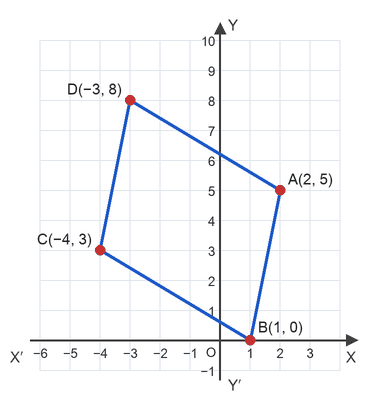
Find the co-ordinates of the mid-points of AC and BD. Give a special name to the quadrilateral.
Confirming your payment
Sign up now and get 250 free tokens.
Section Formula and Mid-Point Formula · Question 37 of 67
A (2, 5), B (1, 0), C (−4, 3) and D (−3, 8) are the vertices of quadrilateral ABCD.
Find the co-ordinates of the mid-points of AC and BD. Give a special name to the quadrilateral.
Solution:
Concept: The mid-point formula: the mid-point of the join of and is . Each co-ordinate of the mid-point is the average of the two end co-ordinates. It is the section formula with the ratio 1 : 1. A quadrilateral whose diagonals bisect each other (have the same mid-point) is a parallelogram.
Step 1 — Mid-point of AC.
The diagonals of ABCD are AC and BD. For AC we use A(2, 5) and C(−4, 3).
So the mid-point of AC is (−1, 4).
Step 2 — Mid-point of BD.
For BD we use B(1, 0) and D(−3, 8).
So the mid-point of BD is (−1, 4).
Step 3 — Name the quadrilateral.
The diagonals AC and BD have the same mid-point (−1, 4), so they bisect each other. A quadrilateral whose diagonals bisect each other is a parallelogram.
Step 4 — Check whether it is a special parallelogram.
A rhombus would need equal adjacent sides, and a rectangle would need equal diagonals. We use the distance formula to test both.
AB and BC are not equal, so ABCD is not a rhombus (or a square). AC and BD are not equal, so it is not a rectangle either.
Watch out: Having one pair of equal-looking sides is not enough; the test for a parallelogram here is that the diagonals share their mid-point.
Therefore, the mid-points of AC and BD are both (−1, 4), and ABCD is a parallelogram.