
Opening your dashboard
Class 10 Maths Chapter 13 Section Formula and Mid-Point Formula: Previous Year Questions
12 questions on Chapter 13, each solved step by step. Class 10 Maths, ICSE 2026-27.
12 questions with solutions
1–4 marks · Mixed difficulty
- 14 marks
Question 1
P(1,–2) is a point on the line segment A(3,–6) and B(x, y) such that AP : PB is equal to 2 : 3. Find the coordinates of B.
Solve with AIWritten solution
Solution:
Concept: Section formula: the point P that divides the join of A and B internally in the ratio (so that AP : PB ) is . Notice that multiplies the FAR end B and the near end A.
Given: P(1, −2) lies on AB with A(3, −6), B(x, y) and AP : PB = 2 : 3.
Step 1 — Note the values for the section formula.
P divides AB so that AP : PB is 2 : 3. Hence and , the first end is A(3, −6) and the second end is the unknown point B(x, y).
Step 2 — Use the x-coordinate of P.
The x-coordinate of P is 1. Putting the values into the x-part of the section formula gives an equation in x, which we solve:
Step 3 — Use the y-coordinate of P.
The y-coordinate of P is −2. In the same way, the y-part of the formula gives an equation in y:
Check: Put B(−2, 4) back into the section formula. It must give P(1, −2):
Watch out: goes with the far end B and with the near end A. Swapping them gives the point for the ratio the wrong way round.
Therefore, the coordinates of B are .
- 23 marks
Question 2
M and N are two points on the X axis and Y axis respectively. P(3, 2) divides the line segment MN in the ratio 2 : 3.

Find:
(i) the coordinates of M and N.
(ii) slope of the line MN.
Solve with AIWritten solution
Solution:
Concept: Section formula: the point P that divides the join of A and B internally in the ratio (so that AP : PB ) is . Notice that multiplies the FAR end B and the near end A. The slope of the line through and is .
Given: M on the x-axis, N on the y-axis, P(3, 2) divides MN in the ratio 2 : 3.
Step 1 — Name the unknown points.
M is on the x-axis, so its y-coordinate is 0; call it M(a, 0). N is on the y-axis, so its x-coordinate is 0; call it N(0, b).
Step 2 — Find a from the x-coordinate of P.
P(3, 2) divides MN in the ratio 2 : 3, so goes with N and goes with M. The x-part of the section formula gives:
Step 3 — Find b from the y-coordinate of P.
The y-part of the formula gives:
So M is (5, 0) and N is (0, 5).
Step 4 — Find the slope of MN.
The slope of the line through M(5, 0) and N(0, 5) is the rise divided by the run:
Watch out: The ratio 2 : 3 is MP : PN, so the 2 multiplies the coordinates of N (the far end) and the 3 those of M.
Therefore, (i) M(5, 0) and N(0, 5); (ii) the slope of MN is −1.
- 34 marks
Question 3
In what ratio is the line joining and divided by the -axis ? Also find the coordinates of the point of intersection.
Solve with AIWritten solution
Solution:
Concept: A point on the x-axis has y-coordinate 0, and a point on the y-axis has x-coordinate 0. To find the ratio in which an axis cuts a segment, call the ratio , write the coordinate that must be 0 by the section formula and solve for .
Given: P(5, 3) and Q(−5, 3).
Step 1 — Let the ratio be k : 1.
Suppose the y-axis cuts PQ at a point R with PR : RQ = k : 1. Every point on the y-axis has x-coordinate 0, so the x-part of the section formula for R must equal 0:
So the ratio is 1 : 1, which means the y-axis cuts PQ at its mid-point.
Step 2 — Find the point of intersection.
With the ratio 1 : 1 the point is the mid-point of PQ:
Watch out: The y-axis is the line x = 0, so it is the x-coordinate that must be set to 0, not the y-coordinate.
Therefore, the y-axis divides PQ in the ratio 1 : 1, at the point .
- 41 mark
Question 4
A(1, 4), B (4, 1) and C (, 4) are the vertices of . If the centroid of the triangle is G (4, 3) then is equal to
Solve with AIAnswer
(A) 2
(B) 1
- Correct
(C) 7
(D) 4
Answer: (C) 7
Concept: The centroid G of a triangle with vertices , , is the point where the medians meet: . Each coordinate is the average of the three vertex coordinates.
Step 1 — Use the x-coordinate of the centroid.
The x-coordinate of G is the average of the three x-coordinates 1, 4 and x, and it is given as 4:
Step 2 — Check with the y-coordinate.
The y-coordinates 4, 1 and 4 must average to 3, the y-coordinate of G:
This agrees, so the data fit.
Watch out: Divide the sum by 3 (the number of vertices), not by 2 as for a mid-point.
Why the other options are wrong:
- (A) 2: with x = 2 the average of the x-coordinates is , not 4.
- (B) 1: with x = 1 the three x-coordinates 1, 4 and 1 add up to 6, and their average is 2, not 4.
- (D) 4: with x = 4 the x-coordinates add up to 9, so their average is 3, not 4.
Therefore, x = 7, option (C).
- 52 marks
Question 5
Find a point P which divides internally the line segment joining the points A (–3, 9) and B (1, –3) in the ratio 1 : 3.
Solve with AIWritten solution
Solution:
Concept: Section formula: the point P that divides the join of A and B internally in the ratio (so that AP : PB ) is . Notice that multiplies the FAR end B and the near end A.
Given: A(−3, 9), B(1, −3) and AP : PB = 1 : 3.
Step 1 — Note the values.
P divides AB internally with AP : PB in the ratio 1 : 3. Hence goes with B(1, −3) and goes with A(−3, 9).
Step 2 — Find the x-coordinate of P.
The x-part of the section formula gives:
Step 3 — Find the y-coordinate of P.
The y-part of the section formula gives:
Check: P should be a quarter of the way from A to B. From A to B, x goes up by 4 and y goes down by 12; a quarter of that moves A(−3, 9) by +1 and −3, which gives (−2, 6). ✓
Watch out: goes with the far end B and with the near end A. Swapping them gives the point for the ratio the wrong way round.
Therefore, P is .
- 61 mark
Question 6
The coordinates of the vertices of are respectively , and . The centroid G of is :
Solve with AIAnswer
- Correct
(A)
(B)
(C)
(D)
Answer: (A)
Concept: The centroid G of a triangle with vertices , , is the point where the medians meet: . Each coordinate is the average of the three vertex coordinates.
Step 1 — Add and average the x-coordinates.
The x-coordinates of the vertices are −4, 6 and 4:
Step 2 — Add and average the y-coordinates.
The y-coordinates are −2, 2 and 6:
Watch out: Keep the signs: −4 and −2 are negative, so they reduce the sums.
Why the other options are wrong:
- (B) : its y-coordinate is 3, but the y-coordinates add up to 6 and .
- (C) : both its coordinates are 3, but each sum is 6, so each coordinate is 2.
- (D) : both coordinate sums (6 and 6) are positive, so neither coordinate of G can be 0 or negative.
Therefore, G is (2, 2), option (A).
- 74 marks
Question 7
A and B are two points on the x-axis and y-axis respectively.
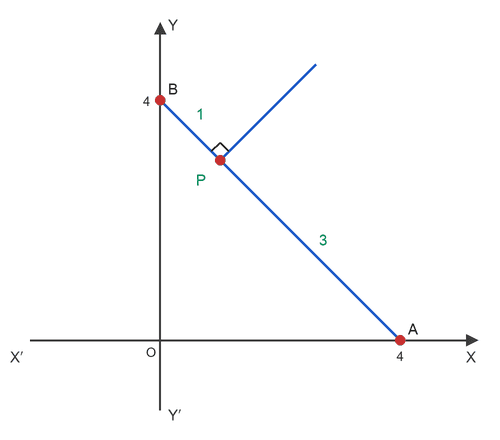
(a) Write down the co-ordinates of A and B.
(b) P is a point on AB such that . Using section formula find the coordinates of point P.
(c) Find the equation of a line passing through P and perpendicular to AB.
Solve with AIWritten solution
Solution:
Concept: Section formula: the point P that divides the join of A and B internally in the ratio (so that AP : PB ) is . Notice that multiplies the FAR end B and the near end A. The slope of the line through and is . The line through with slope is . Two lines with slopes , are perpendicular when .
Given: A on the x-axis, B on the y-axis (from the graph), AP : PB = 3 : 1.
Step 1 — Read A and B from the graph.
A is on the x-axis at 4, so A is (4, 0). B is on the y-axis at 4, so B is (0, 4).
Step 2 — Find P by the section formula.
AP : PB = 3 : 1, so goes with B(0, 4) and goes with A(4, 0):
So P is (1, 3).
Step 3 — Find the slope of AB and of the perpendicular.
The slope of AB comes from A(4, 0) and B(0, 4). The required line is perpendicular to AB, so its slope m satisfies :
Step 4 — Write the equation of the line through P.
We use the point-slope form with P(1, 3) and slope 1, then tidy it up:
Check: P(1, 3) satisfies , because . ✓
Watch out: AP : PB = 3 : 1 puts P nearer to B, so P must be closer to (0, 4) than to (4, 0). Check that your P is.
Therefore, (a) A(4, 0) and B(0, 4); (b) P(1, 3); (c) the line is .
- 84 marks
Question 8
In the given diagram, ABC is a triangle, where and . D is a point on AC.
(a) Write down the coordinates of A and D.
(b) Find the coordinates of the centroid of .
(c) If D divides AC in the ratio , find the value of .
(d) Find the equation of the line BD.
 Solve with AI
Written solution
Solution:
Concept: Section formula: the point P that divides the join of A and B internally in the ratio (so that AP : PB ) is . Notice that multiplies the FAR end B and the near end A. The centroid G of a triangle with vertices , , is the point where the medians meet: . The slope of the line through and is . The line through with slope is .
Given: B(4, −4), C(−4, −2); A on the y-axis and D on the x-axis (from the graph).
Step 1 — Read A and D from the graph.
A is on the y-axis at 6, so A is (0, 6). D is on the x-axis at −3, so D is (−3, 0).
Step 2 — Find the centroid.
The centroid's coordinates are the averages of the vertex coordinates of A(0, 6), B(4, −4) and C(−4, −2):
So the centroid is the origin (0, 0).
Step 3 — Find k.
D divides AC in the ratio k : 1, so goes with C(−4, −2) and goes with A(0, 6). The x-coordinate of D is −3:
The y-coordinate agrees with this value:
Step 4 — Find the slope of BD.
The line BD passes through B(4, −4) and D(−3, 0):
Step 5 — Write the equation of BD.
The point-slope form through D(−3, 0) is cleared of fractions by multiplying by 7:
Check: B(4, −4) must also satisfy the equation; it does:
Watch out: In 'D divides AC in the ratio k : 1', k multiplies C (the far end from A), not A.
Therefore, (a) A(0, 6), D(−3, 0); (b) centroid (0, 0); (c) k = 3; (d) BD is .
- 91 mark
Question 9
The line segment joining and is divided by the x-axis in the ratio :
Solve with AIAnswer
- Correct
(A)
(B)
(C)
(D)
Answer: (A)
Concept: A point on the x-axis has y-coordinate 0, and a point on the y-axis has x-coordinate 0. To find the ratio in which an axis cuts a segment, call the ratio , write the coordinate that must be 0 by the section formula and solve for .
Step 1 — Let the ratio be k : 1.
Let the x-axis cut AB at P with AP : PB = k : 1. Every point of the x-axis has y-coordinate 0, so the y-part of the section formula must be 0:
Step 2 — Write the ratio in whole numbers.
The ratio becomes 1 : 4 when both parts are multiplied by 4.
Watch out: For the x-axis it is the y-coordinates (2 and −8) that matter. A is 2 units above the axis and B is 8 units below it, which also shows the ratio 2 : 8 = 1 : 4.
Why the other options are wrong:
- (B) : 3 : 7 comes from the x-coordinates (distances 7 and 3 from the y-axis), which decide where the y-axis cuts, not the x-axis.
- (C) : 4 : 1 is the ratio upside down; the axis is nearer to A (2 units) than to B (8 units), so AP is the smaller part.
- (D) : 7 : 3 also uses the x-coordinates, and the wrong way round as well.
Therefore, the x-axis divides AB in the ratio 1 : 4, option (A).
- 101 mark
Question 10
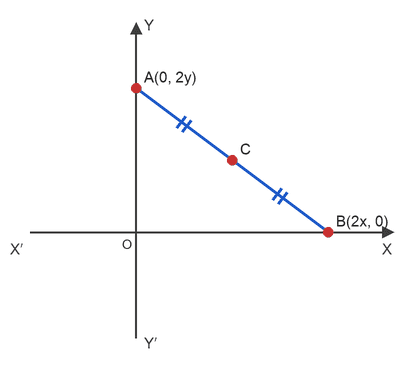
In the given diagram, is a right-angled triangle and C is the mid-point of AB. The coordinates of the point which is equidistant from the three vertices of is :
 Solve with AI
Answer
- Correct
(A)
(B)
(C)
(D)
Answer: (A)
Concept: The point equidistant from the three vertices of a triangle is its circumcentre. In a right-angled triangle the circumcentre is the mid-point of the hypotenuse. The mid-point of and is .
Step 1 — Use the right angle.
∠AOB = 90°, so AB is the hypotenuse of right ΔAOB. A right angle in a semicircle means the circle through O, A and B has AB as its diameter. The centre of that circle, the mid-point of AB, is the same distance from all three vertices.
Step 2 — Find the mid-point C of AB.
From the figure A is (0, 2y) and B is (2x, 0):
Step 3 — Check the three distances.
From C(x, y), each distance is half the hypotenuse:
In the same way CB , so C is equidistant from O, A and B.
Watch out: The letters x and y here are parts of the coordinates of A(0, 2y) and B(2x, 0), not the axes.
Why the other options are wrong:
- (B) : (y, x) swaps the coordinates; that point is not on AB unless x = y.
- (C) : halves the mid-point again; it is the mid-point of OC, not equidistant from the vertices.
- (D) : is the centroid , which is not equidistant from the vertices.
Therefore, the point is C(x, y), option (A).
- 113 marks
Question 11
and are two end points of a line segment. If AB intersects the x-axis at P, find the :
(a) ratio in which 'P' divides AB.
(b) coordinates of point P.
Solve with AIWritten solution
Solution:
Concept: A point on the x-axis has y-coordinate 0, and a point on the y-axis has x-coordinate 0. To find the ratio in which an axis cuts a segment, call the ratio , write the coordinate that must be 0 by the section formula and solve for .
Given: A(−10, −2), B(2, 10); AB meets the x-axis at P.
Step 1 — Let the ratio be k : 1.
Let P divide AB in the ratio k : 1, so goes with B(2, 10) and with A(−10, −2). P is on the x-axis, so its y-coordinate is 0:
So the ratio is .
Step 2 — Find the x-coordinate of P.
With the x-part of the section formula gives:
The y-coordinate is 0, so P is (−8, 0).
Check: The slope from A to P, , equals the slope from A to B, , so P is on AB. ✓
Watch out: On the x-axis it is the y-coordinate that is 0. Setting the x-coordinate to 0 finds where AB meets the y-axis instead.
Therefore, (a) P divides AB in the ratio 1 : 5; (b) P is .
- 124 marks
Question 12
The coordinates of the vertex of are , and . The coordinates of the centroid G of is . Find the:
(a) coordinates of the vertex A.
(b) equation of median through the vertex C.
Solve with AIWritten solution
Solution:
Concept: The centroid G of a triangle with vertices , , is the point where the medians meet: . Each coordinate is the average of the three vertex coordinates. A median joins a vertex to the mid-point of the opposite side. The slope of the line through and is . The line through with slope is .
Given: A(a, b), B(5, −3), C(−5, 3) and centroid .
Step 1 — Find a from the centroid.
The x-coordinate of G is the average of a, 5 and −5:
Step 2 — Find b from the centroid.
The y-coordinate of G is the average of b, −3 and 3:
So A is (2, 1).
Step 3 — Find the mid-point M of AB.
The median through C goes to the mid-point M of the opposite side AB, with A(2, 1) and B(5, −3):
Step 4 — Find the slope of CM.
The median passes through C(−5, 3) and :
Step 5 — Write the equation of the median.
The point-slope form through C(−5, 3) is cleared of fractions by multiplying by 17:
Check: The centroid lies on every median, so G must satisfy the equation; it does:
Watch out: The median through C goes to the mid-point of AB, the side opposite C, not of AC or BC.
Therefore, (a) A is ; (b) the median through C is .