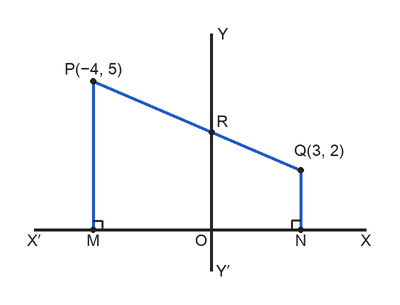
Solution:
Concept: When the ratio is unknown, take it as k:1. By the section formula, the dividing point is then (k+1kx2+x1,k+1ky2+y1), which has only one unknown, k. Any point on the x-axis has y-co-ordinate 0, and any point on the y-axis has x-co-ordinate 0. The area of a trapezium is 21 × (sum of the parallel sides) × (distance between them).
Step 1 — Part (i): find PR : RQ.
Let R divide PQ in the ratio k:1. By the section formula, its x-co-ordinate is k+1kx2+x1. R lies on the y-axis, so its x-co-ordinate is 0. So we set this equal to 0 and solve for k.
k+13k−4=0
3k−4=0
3k=4
k=34
So the ratio is 34:1. Multiplying both terms by 3 gives 4:3.
Step 2 — Part (ii): find R.
We use the section formula with P(−4, 5), Q(3, 2), m1=4 and m2=3.
x=m1+m2m1x2+m2x1=4+34×3+3×(−4)=712−12=70=0
y=m1+m2m1y2+m2y1=4+34×2+3×5=78+15=723
So the point R is (0,723).
Step 3 — Part (iii): describe PMNQ.
The perpendiculars from P(−4, 5) and Q(3, 2) to the x-axis meet it at M(−4, 0) and N(3, 0). PM and QN are both vertical, so they are parallel, and PMNQ is a trapezium. Its parallel sides are PM = 5 units and QN = 2 units (the heights of P and Q), and the distance between them is MN = 3 − (−4), which is 7 units.
Step 4 — Part (iii): find the area.
We use the trapezium formula.
Area=21×(5+2)×7=21×49=24.5
So the area is 24.5 square units.
Watch out: PM and QN are the lengths of the perpendiculars, that is the y-co-ordinates 5 and 2. MN is found from the x-co-ordinates.
Therefore, (i) PR : RQ = 4 : 3; (ii) R = (0,723); (iii) area of PMNQ = 24.5 square units.