
Opening your dashboard
Class 10 Biology Chapter 13: The Reproductive System Solutions
51 textbook questions with step-by-step answers, free to read, for ICSE 2026-27.
Get talked through Ch 13, not just shown the answer
Reading a finished solution is not the same as being able to do it. The AI tutor takes one question at a time and works it with you, in your own words, until you can.
- Ask it out loud, in your own words
- It gives you the next step, not the answer
- Stuck on part (ii)? Start there
51 questions with solutions
1–12 marks · Mixed difficulty
- 11 mark
Question 1
Tick-mark the correct meaning of reproduction
Solve with AIAnswer
(A) increase in population
(B) increase in the number of parents
- Correct
(C) production of new individuals of the same kind.
(D) production of identical individuals
Answer: (C) production of new individuals of the same kind.
Concept: Reproduction is the formation of new individuals of the same kind by sexual or asexual means; the young can in turn reproduce. It keeps each kind of living thing going on earth.
Step 1 — Pick out the key words.
The meaning must say 'new individuals' and 'of the same kind': humans produce human babies, Amoeba produces more Amoeba.
Step 2 — Test the options.
Only option (C) says exactly this; the others give a result of reproduction or a special case.
Watch out: An increase in numbers is a result of reproduction, not its meaning.
Why the other options are wrong:
- (A) increase in population: a rise in population can result from reproduction, but it is not what reproduction means.
- (B) increase in the number of parents: reproduction produces offspring, not more parents.
- (D) production of identical individuals: offspring need not be identical; in sexual reproduction they show variation.
Therefore, reproduction means the production of new individuals of the same kind, option (C).
- 24 marks
Question 2
State very briefly the chief function of each of the following :
(i) Seminal vesicles
(ii) Prostate gland
(iii) Cowper's gland
(iv) Sperm duct (vas deferens)
Solve with AIWritten solution
Solution:
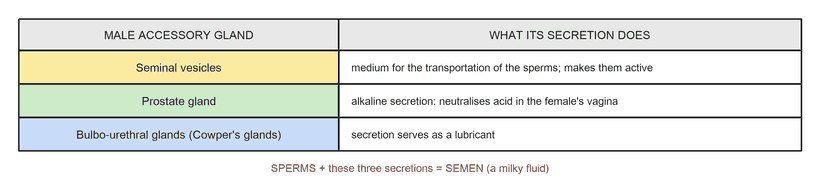
Concept: The three male accessory glands add their secretions to the sperms to form semen; the sperm duct only carries the sperms.
Step 1 — Seminal vesicles.
Their secretion is the medium in which the sperms are carried. Sperms are sluggish in the sperm duct and become active when this fluid is added.
Step 2 — Prostate gland.
It pours an alkaline secretion into the semen in the urethra, which neutralises the acidity of the urethra and of the female's vagina, so the sperms survive.
Step 3 — Cowper's glands.
Also called bulbo-urethral glands, their secretion is a lubricant.
Step 4 — Sperm duct (vas deferens).
It carries the sperms from the epididymis up into the abdomen to the urethra.
Watch out: The sperm duct is a tube, not a gland; it adds no secretion of its own.
Therefore, seminal vesicles give the transport medium, the prostate neutralises acidity, Cowper's glands lubricate, and the sperm duct carries the sperms.
- 35 marks
Question 3
State whether the following statements are True (T) or False (F) :
(i) One egg is released from each of the two ovaries every month. T/F
(ii) The enlarged mature follicle bursts to release the egg. T/F
(iii) The egg is passed down through the oviduct by muscular contractions. T/F
(iv) Clitoris is equivalent to the male penis. T/F
(v) The vagina is a muscular tube. T/F
Solve with AIWritten solution
Solution:
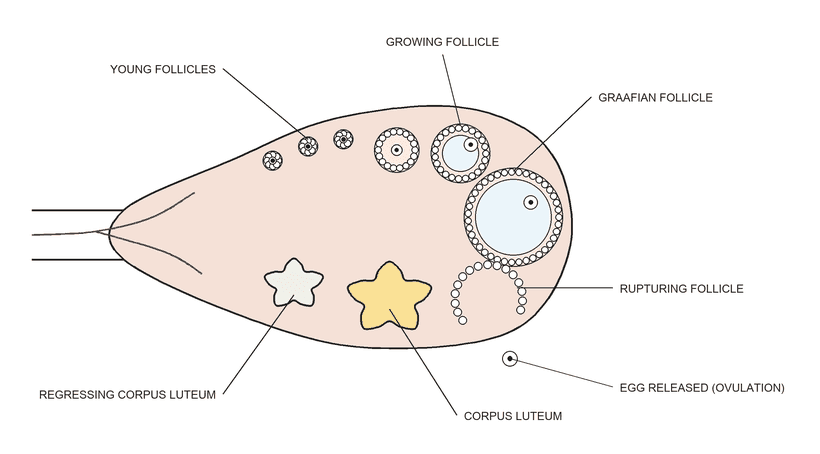
Concept: Normally only one egg matures in a month, the two ovaries taking turns. The ripe Graafian follicle bursts to release it (ovulation).
Step 1 — Statement (i).
Only one egg is released in a month, alternately from the two ovaries, so each ovary releases an egg every other month.
False.
Step 2 — Statement (ii).
The enlarged, fluid-filled Graafian follicle bulges on the ovary's surface and bursts to set the egg free.
True.
Step 3 — Statement (iii).
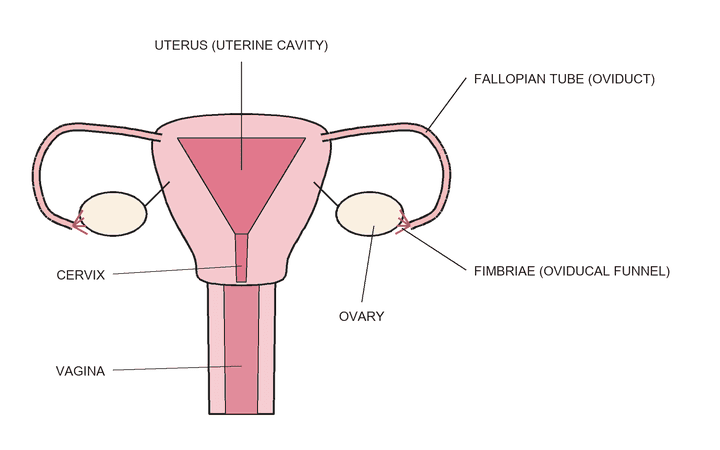
The funnel's cilia pick up the egg, then waves of muscular contraction (peristalsis) of the oviduct wall move it towards the uterus.
True.
Step 4 — Statement (iv).
The small erectile clitoris at the top of the vulva corresponds to the male penis.
True.
Step 5 — Statement (v).
The vagina is a muscular tube, about 10–15 cm long, from the cervix to the outside.
True.
Watch out: 'each of the two ovaries every month' would mean two eggs a month; only one is released.
Therefore, (i) F, (ii) T, (iii) T, (iv) T, (v) T.
- 42 marks
Question 4
Name the three main regions of the human sperm, and briefly mention the function of each.
Solve with AIWritten solution
Solution:
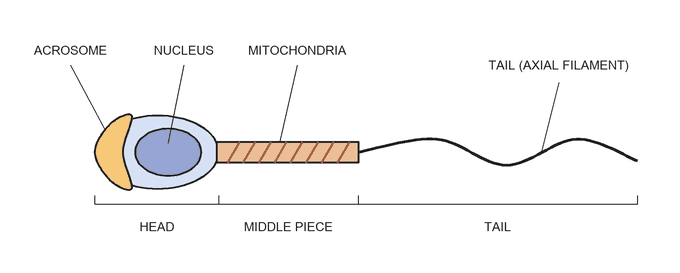
Concept: A human sperm has three main regions: head, middle piece and tail; each region has one job in reaching and entering the egg.
Step 1 — Head.
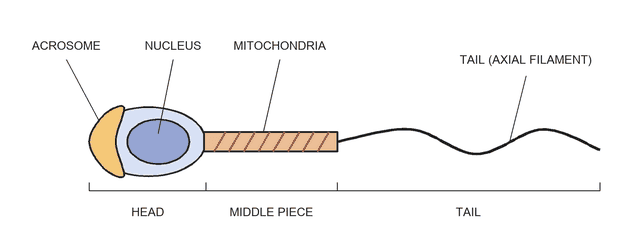
It holds the nucleus with 23 chromosomes (22 + X or 22 + Y), the father's share of genes. The acrosome at its tip releases an enzyme (hyaluronidase) that dissolves the egg's covering so the sperm can enter.
Step 2 — Middle piece.
Its mitochondria release the energy the sperm needs to swim.
Step 3 — Tail.
Its lashing movements drive the sperm forward towards the egg.
Watch out: Only the head enters the egg at fertilisation; the tail is left outside.
Therefore, the head carries the nucleus and acrosome, the middle piece gives energy, and the tail moves the sperm.
- 54 marks
Question 5
Name the following :
(i) Three accessory glands of human male reproductive system.
(ii) Two hormones secreted from placenta.
(iii) Two types of twins.
(iv) Two layers of the wall of uterus.
Solve with AIWritten solution
Solution:
Concept: These are named structures and hormones of the chapter; give exactly the number asked for.
Step 1 — Part (i).
Seminal vesicles, prostate gland and Cowper's (bulbo-urethral) glands.
Step 2 — Part (ii).
Oestrogen and progesterone; the placenta also works as an endocrine gland.
Step 3 — Part (iii).
Identical twins (from one egg) and fraternal twins (from two eggs).
Step 4 — Part (iv).
The inner lining, endometrium, and the outer muscular wall (myometrium).
Therefore, (i) seminal vesicles, prostate, Cowper's glands; (ii) oestrogen, progesterone; (iii) identical, fraternal; (iv) endometrium, muscular wall.
- 61 mark
Question 6
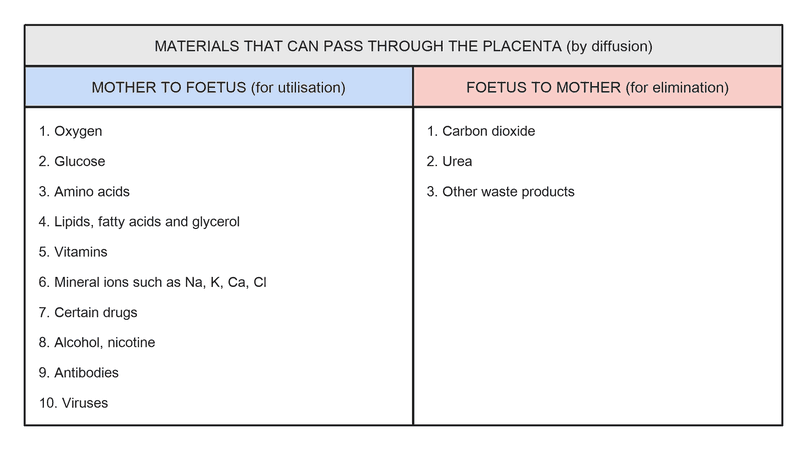
List the substances which the foetus receives from the mother through placenta.
Solve with AIWritten solution
Solution:
Concept: All that the foetus needs passes from the mother's blood into its blood by diffusion across the placenta; the two bloods never mix.
Step 1 — Nutrients and oxygen.
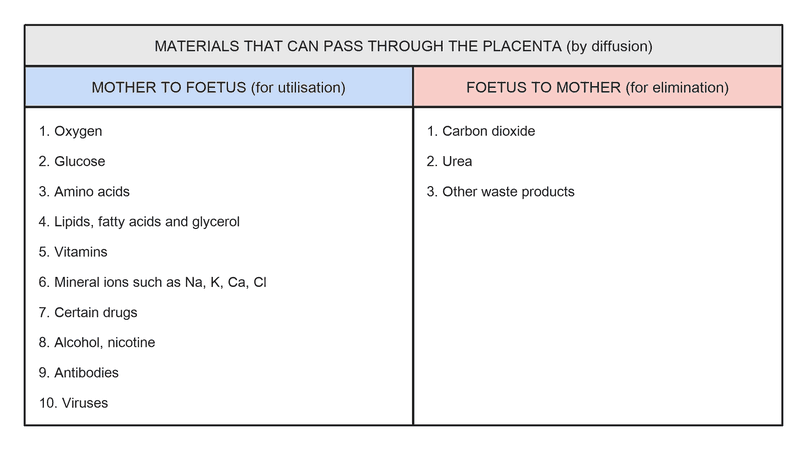
Oxygen, glucose, amino acids, lipids (fatty acids and glycerol), vitamins and mineral ions (Na, K, Ca, Cl).
Step 2 — Protection.
Antibodies, which protect the foetus against some infections.
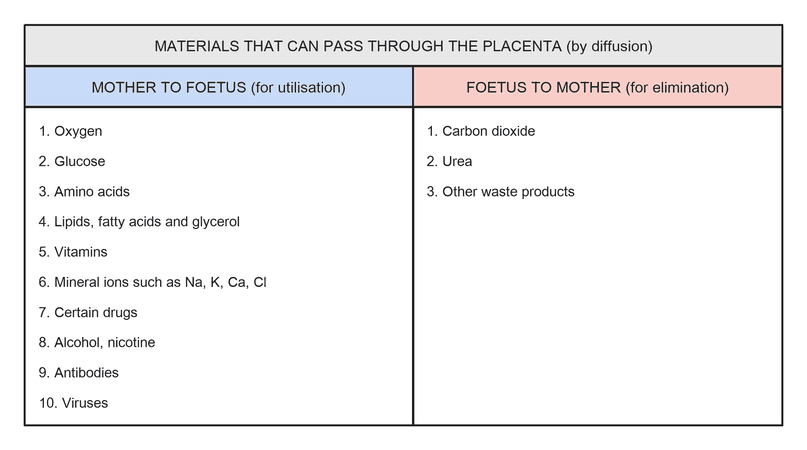
Harmful substances such as alcohol, nicotine, some drugs and some viruses (for example HIV) can also cross, which is why the mother must avoid them.
Watch out: The mother's blood cells do not pass; only dissolved substances diffuse across.
Therefore, the foetus receives oxygen, glucose, amino acids, lipids, vitamins, mineral ions and antibodies.
- 72 marks
Question 7
How are carbon dioxide and urea, excreted by the foetus, removed?
Solve with AIWritten solution
Solution:
Concept: The placenta is also the excretory link between foetus and mother: wastes leave the foetal blood by diffusion.
Step 1 — Carried to the placenta.
Carbon dioxide and urea travel in the foetal blood through the umbilical arteries of the cord to the placenta.
Step 2 — Diffuse into the mother's blood.
In the placental villi the foetal capillaries lie close to the mother's blood spaces. CO₂ and urea are more concentrated in the foetal blood, so they diffuse into the mother's blood; the two bloods never mingle.
Step 3 — Removed by the mother.
The mother gets rid of them with her own wastes: through her lungs and urea through her kidneys.

Watch out: The foetus has no working lungs or urine outlet of its own for these wastes; everything goes through the placenta.
Therefore, carbon dioxide and urea diffuse across the placenta into the mother's blood and are removed by her lungs and kidneys.
- 86 marks
Question 8
Write one sentence each using the following terms pertaining to reproduction in humans.
(i) Gestation
(ii) 280 days
(iii) Head first
(iv) Placenta
(v) After-birth
(vi) Tied and cut
Solve with AIWritten solution
Solution:
Concept: Each sentence must use the term with its correct meaning; all six terms belong to pregnancy and birth (parturition).
Step 1 — Gestation.
The full period of development of the embryo in the uterus is called gestation.
Step 2 — 280 days.
In humans, gestation lasts about 280 days (nearly 40 weeks).
Step 3 — Head first.
At birth, strong contractions of the uterus muscles push the baby out, usually head first.
Step 4 — Placenta.
The placenta joins the foetal membranes to the uterine wall, and through it the foetus gets food and oxygen and gives up its wastes.
Step 5 — After-birth.
About 15 minutes after the baby is born, the placenta separates from the uterus and is expelled as the after-birth.
Step 6 — Tied and cut.
After birth the umbilical cord is tied and cut to separate the baby from the placenta.
Therefore, the six sentences are as written in Steps 1 to 6.
- 91 mark
Question 9
Does the foetus inside the mother's uterus breathe ? Yes/No
Solve with AIWritten solution
Solution:
Concept: The foetus floats in amniotic fluid and its lungs are not in use; the placenta does the work of its lungs.
Step 1 — How the foetus gets oxygen.
Oxygen diffuses from the mother's blood into the foetal blood in the placenta and reaches the foetus through the umbilical cord; CO₂ goes back the same way.

Step 2 — Conclusion.
So the foetus does not breathe air. It starts breathing only after birth, when its first cry clears the air passages.
Watch out: The foetus does respire (its cells use oxygen), but it does not breathe.
Therefore, No, the foetus does not breathe; it gets oxygen from the mother's blood through the placenta.
- 104 marks
Question 10
Mention if the following statements are True (T) or False (F) :
(i) Placenta produces certain hormones. T/F
(ii) Amniotic fluid serves to provide oxygen to the foetus. T/F
(iii) Heart and blood vessels have been formed by the end of five weeks of pregnancy. T/F
(iv) Mother's blood flows into the foetus through placenta. T/F
Solve with AIWritten solution
Solution:
Concept: The placenta is an exchange organ and an endocrine gland, but the mother's blood and the foetus's blood never mix.
Step 1 — Statement (i).
The placenta secretes oestrogen and progesterone.
True.
Step 2 — Statement (ii).
Amniotic fluid protects the foetus from shocks; oxygen comes through the placenta.
False.
Step 3 — Statement (iii).
By the end of five weeks the heart and blood vessels have formed; limbs form later.
True.
Step 4 — Statement (iv).
The mother's blood never flows into the foetus; substances only diffuse across the placenta. If the bloods were joined, the mother's higher blood pressure would damage the delicate foetal tissues.
False.
Watch out: The foetus gets oxygen from the placenta, not from the amniotic fluid.
Therefore, (i) T, (ii) F, (iii) T, (iv) F.
- 115 marks
Question 11
Complete the following by filling in the blanks 1 to 5 with appropriate words:
The human female gonads are ovaries. A maturing egg in the ovary is present in a sac of cells called ..........(1). As the egg grows larger, the follicle enlarges and gets filled with a fluid and is now called the ..........(2) follicle. The process of releasing the egg from the ovary is called ..........(3). The ovum is picked up by the oviducal funnel and fertilization takes place in the ..........(4). In about a weak the blastocyst gets fixed in the endometrium of the uterus and this process is called ..........(5).
Solve with AIWritten solution
Solution:
Concept: Follow the egg in order: its sac in the ovary, its release, fertilisation, and its fixing in the uterus.
Step 1 — Blanks (1) and (2).
The sac of cells round a maturing egg is a follicle; when it enlarges and fills with fluid it is the Graafian follicle.
Step 2 — Blank (3).
Release of the egg from the ovary is ovulation.
Step 3 — Blank (4).
The funnel passes the egg into the oviduct (Fallopian tube), where fertilisation happens.
Step 4 — Blank (5).
The blastocyst fixing itself in the endometrium is implantation.

Therefore, the blanks are (1) follicle, (2) Graafian, (3) ovulation, (4) oviduct (Fallopian tube), (5) implantation.
- 121 mark
Question 12
The male accessory gland whose secretion neutralizes the acidity of the urethra and vagina is:
Solve with AIAnswer
(A) Seminal vesicle
- Correct
(B) Prostate gland
(C) Seminiferous tubule
(D) Bulbo-urethral gland
Answer: (B) Prostate gland
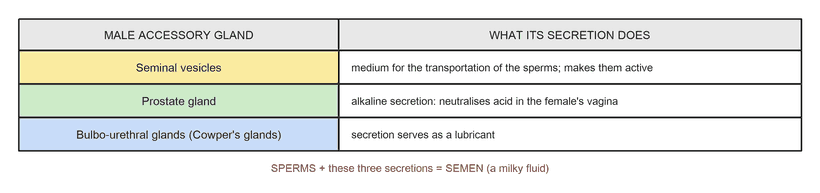
Concept: Only an alkaline secretion can neutralise acidity. The prostate gland pours an alkaline secretion into the semen as it passes through the urethra.
Step 1 — Find the property needed.
Neutralising the acid in the urethra and vagina needs an alkali.
Step 2 — Match the gland.
Of the male accessory glands, the prostate (round the urethra just below the bladder) makes the alkaline secretion.
Watch out: A seminiferous tubule is not an accessory gland at all; it makes sperms inside the testis.
Why the other options are wrong:
- (A) Seminal vesicle: the seminal vesicle secretion is the medium that carries and activates the sperms.
- (C) Seminiferous tubule: seminiferous tubules lie in the testis and produce sperms; they are not accessory glands.
- (D) Bulbo-urethral gland: the bulbo-urethral (Cowper's) gland secretion is a lubricant.
Therefore, the gland whose secretion neutralises acidity is the prostate gland, option (B).
- 131 mark
Question 13
The onset of menstruation in women is called :
Solve with AIAnswer
(A) Parturition
(B) Menopause
(C) Ovulation
- Correct
(D) Menarche
Answer: (D) Menarche
Concept: Menarche is the first menstruation of a girl, at about 13 years ('arche' = beginning).
Step 1 — What is asked.
The beginning of menstruation, not its end and not an event within a cycle.
Step 2 — Place it in life.
The reproductive years start with menarche and end with menopause at about 45–50 years.
Watch out: Menarche (start) and menopause (stop) are easily confused.
Why the other options are wrong:
- (A) Parturition: parturition is the birth of the baby.
- (B) Menopause: menopause is the permanent stopping of menstruation.
- (C) Ovulation: ovulation is the release of the egg from the ovary.
Therefore, the onset of menstruation is called menarche, option (D).
- 141 mark
Question 14
In the human menstrual cycle, the ovulation occurs around :
Solve with AIAnswer
(A) 7 days
(B) 21 days
(C) 28 days
- Correct
(D) 14 days
Answer: (D) 14 days
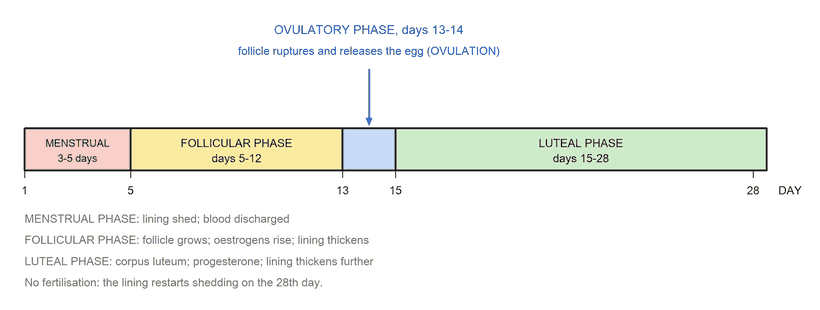
Concept: In a 28-day menstrual cycle the ovulatory phase falls on days 13–14, when the Graafian follicle bursts and releases the egg.
Step 1 — Count from day 1.
Day 1 is the first day of menstrual flow.
Step 2 — Recall the phases.
Menstrual phase about days 1–5; follicular phase days 5–12; ovulatory phase days 13–14; luteal phase days 15–28.
Step 3 — Conclude.
So ovulation occurs around day 14, the middle of the cycle.
Why the other options are wrong:
- (A) 7 days: day 7 is in the follicular phase, while the follicle is still growing.
- (B) 21 days: day 21 is in the luteal phase, after ovulation.
- (C) 28 days: day 28 is the end of the cycle, just before the next menstruation.
Therefore, ovulation occurs around day 14, option (D).
- 151 mark
Question 15
Fertilization takes place in :
Solve with AIAnswer
- Correct
(A) Fallopian tube
(B) Uterus
(C) Vas deferens
(D) Vagina
Answer: (A) Fallopian tube
Concept: Fertilisation is the fusion of a sperm with the ovum to form a zygote. It takes place in the oviduct (Fallopian tube).
Step 1 — Where the egg goes.
After ovulation the funnel picks up the egg and passes it into the oviduct.
Step 2 — Where the sperms go.
Sperms released in the vagina swim through the cervix and uterus up into the oviducts.
Step 3 — Where they meet.
They meet the egg in the oviduct, and one sperm fertilises it there.

Watch out: The uterus is where the embryo grows, not where fertilisation happens.
Why the other options are wrong:
- (B) Uterus: the uterus receives the already fertilised egg (blastocyst) for implantation.
- (C) Vas deferens: the vas deferens is the male sperm duct.
- (D) Vagina: the vagina is where sperms are deposited; they must swim up to the egg.
Therefore, fertilisation takes place in the Fallopian tube, option (A).
- 161 mark
Question 16
The packing tissues between the coils of the seminiferous tubules are called as :
Solve with AIAnswer
- Correct
(A) Leydig cells
(B) Hymen
(C) Graafian follicle
(D) Clitoris
Answer: (A) Leydig cells
Concept: Between the coiled seminiferous tubules of the testis lies packing tissue called interstitial cells or Leydig cells ('interstitial' = filling in between).
Step 1 — Match the description.
'Packing tissue between the coils of the seminiferous tubules' describes the interstitial cells.
Step 2 — Their other name and job.
They are the Leydig cells, which secrete testosterone.

Why the other options are wrong:
- (B) Hymen: the hymen is a thin membrane partly closing the vaginal opening.
- (C) Graafian follicle: the Graafian follicle is the mature egg-holding follicle of the ovary.
- (D) Clitoris: the clitoris is a small erectile organ of the vulva.
Therefore, the packing tissue is the Leydig cells, option (A).
- 171 mark
Question 17
Which of the following cannot pass readily through the placenta to the foetus ?
Solve with AIAnswer
(A) Antibodies
(B) Amino acids
(C) Alcohol
- Correct
(D) Haemoglobin
Answer: (D) Haemoglobin
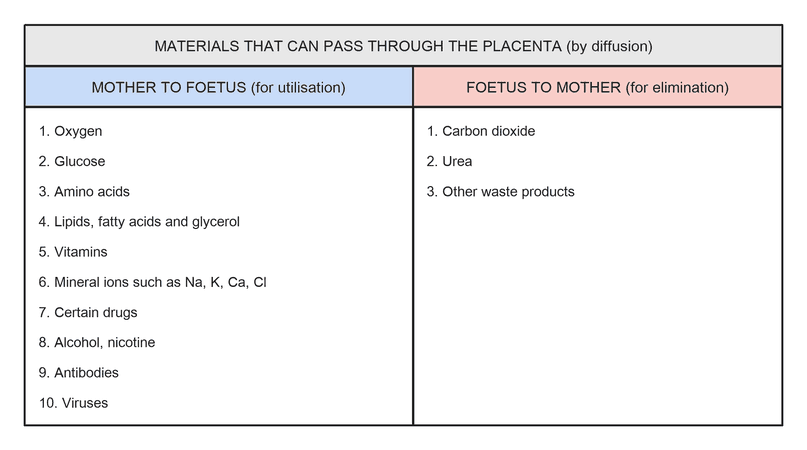
Concept: Substances cross the placenta by diffusion. The foetal blood comes close to the mother's blood but never mixes with it, so her blood cells, and the haemoglobin inside them, stay on her side.
Step 1 — List what does pass.
Oxygen, glucose, amino acids, lipids, vitamins, minerals, antibodies, and also alcohol, nicotine and some drugs and viruses.
Step 2 — Check haemoglobin.
Haemoglobin is the pigment inside red blood cells. The cells do not cross, so it cannot pass; only the oxygen it carries diffuses across.
Watch out: Oxygen passes, but haemoglobin, which carries it, does not.
Why the other options are wrong:
- (A) Antibodies: antibodies do pass from mother to foetus.
- (B) Amino acids: amino acids pass as nutrients.
- (C) Alcohol: alcohol passes readily, which is why it can harm the foetus.
Therefore, haemoglobin cannot pass readily through the placenta, option (D).
- 181 mark
Question 18
The thin-walled sac of skin in which testis descends is :
Solve with AIAnswer
(A) Seminal vesicle
(B) Vas deferens
- Correct
(C) Scrotal sac
(D) Epididymis
Answer: (C) Scrotal sac
Concept: The testes hang outside the abdomen in a thin-walled sac of skin, the scrotum (scrotal sacs).
Step 1 — Descent.
In the embryo the testes lie in the abdomen; shortly before birth they move down into the scrotum.
Step 2 — Why outside.
There the testes are 2–3 °C cooler than the body, which sperm formation needs.
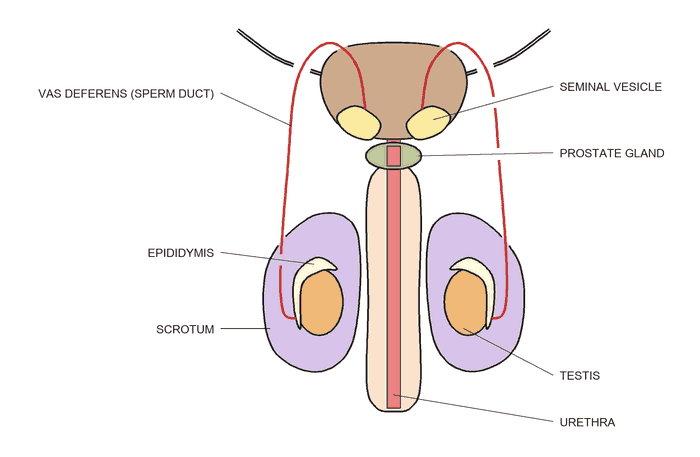
Why the other options are wrong:
- (A) Seminal vesicle: the seminal vesicle is an accessory gland near the bladder.
- (B) Vas deferens: the vas deferens is the sperm duct, a tube.
- (D) Epididymis: the epididymis is a coiled tube on the testis that stores sperms.
Therefore, the sac is the scrotal sac, option (C).
- 191 mark
Question 19
The outermost layer of uterine wall around the foetus is :
Solve with AIAnswer
(A) Choroid
(B) Allantois
- Correct
(C) Chorion
(D) Amnion
Answer: (C) Chorion
Concept: Membranes form round the developing embryo: the amnion is the inner sac next to the embryo, and the chorion lies outside it, against the wall of the uterus.
Step 1 — Work outwards.
Foetus → amniotic fluid → amnion → chorion → uterine wall.
Step 2 — Pick the outermost.
So the chorion is the outermost covering around the foetus, next to the uterine wall.
Watch out: Choroid (eye) and chorion (foetal membrane) sound alike.
Why the other options are wrong:
- (A) Choroid: the choroid is a layer of the eyeball.
- (B) Allantois: the allantois forms the embryo's part of the placenta; it is not the outermost covering.
- (D) Amnion: the amnion is the inner sac holding the amniotic fluid.
Therefore, the outermost layer around the foetus is the chorion, option (C).
- 201 mark
Question 20
The period of pregnancy is called :
Solve with AIAnswer
(A) Parturition
(B) Implantation
(C) Copulation
- Correct
(D) Gestation
Answer: (D) Gestation
Concept: The full period of development of the embryo in the uterus is gestation; in humans about 280 days.
Step 1 — Period or event?.
The question asks for a period of time, not a single event.
Step 2 — Match.
Pregnancy runs from implantation to birth; this whole period is gestation, about 40 weeks.
Why the other options are wrong:
- (A) Parturition: parturition is the birth at the end of gestation.
- (B) Implantation: implantation is the fixing of the blastocyst, which only starts pregnancy.
- (C) Copulation: copulation is the act of mating.
Therefore, the period of pregnancy is called gestation, option (D).
- 211 mark
Question 21
The canal through which each testis descends into the scrotum just before the birth of a male baby is :
Solve with AIAnswer
(A) Vas deferens
(B) Epididymis
(C) Efferent duct
- Correct
(D) Inguinal canal
Answer: (D) Inguinal canal
Concept: The inguinal canal is the passage through which each testis, with its duct, vessels and nerves, moves down from the abdomen into the scrotum.
Step 1 — Descent.
Shortly before birth the testes pass down through the inguinal canals into the scrotum.
Step 2 — Later use.
The sperm duct from each testis runs back up into the abdomen through the same canal.
Step 3 — Hernia.
If the intestine is pushed into the scrotum through this canal, the condition is a hernia.
Watch out: The vas deferens passes through the inguinal canal but is not the canal.
Why the other options are wrong:
- (A) Vas deferens: the vas deferens is the sperm duct.
- (B) Epididymis: the epididymis stores and matures sperms.
- (C) Efferent duct: the efferent ducts carry sperms from the testis to the epididymis.
Therefore, the canal is the inguinal canal, option (D).
- 221 mark
Question 22
The following questions are Assertion-Reason based questions. Choose the answer based on the codes given below.
(1) A is True and R is False (2) A is False and R is True (3) Both A and R are True (4) Both A and R are False
Assertion (A): The placenta is a vital organ during pregnancy, responsible for providing nutrients and oxygen to the developing foetus.
Reason (R): The placenta develops from the fusion of the zygote and the endometrial lining, forming a specilized tissue structure that facilitates the exchange of substances between the maternal and foetal bloodstreams.
Solve with AIAnswer
(A) (1) A is True and R is False
(B) (2) A is False and R is True
- Correct
(C) (3) Both A and R are True
(D) (4) Both A and R are False
Answer: (C) (3) Both A and R are True
Concept: The placenta is formed partly by the embryo and partly by the uterine wall; through it the foetus gets food and oxygen and gives up wastes.
Step 1 — Judge the Assertion.
The Assertion is true. Food and oxygen diffuse from the mother's blood into the foetal blood through the placenta.
Step 2 — Judge the Reason.
The Reason is true. The placenta is made of two interlocking sets of villi, one from the uterine wall (endometrium) and one from the embryo (which came from the zygote). It lets substances pass between the two bloods without their mixing. The word 'fusion' is loose, but the statement is taken as true.
Step 3 — Choose the code.
Both A and R are true, so the code is (3).
Why the other options are wrong:
- (A) (1) A is True and R is False: the Reason is true: the placenta has an embryonic and a maternal part.
- (B) (2) A is False and R is True: the Assertion is true.
- (D) (4) Both A and R are False: neither statement is false.
Therefore, the answer is option (C): both A and R are true.
- 231 mark
Question 23
The following questions are Assertion-Reason based questions. Choose the answer based on the codes given below.
(1) A is True and R is False (2) A is False and R is True (3) Both A and R are True (4) Both A and R are False
Assertion (A): Leydig cells produce oestrogen and progesterone.
Reason (R): Leydig cells are also called as interstitial cells which are located as packing tissues between the coils of seminiferous tubules.
Solve with AIAnswer
(A) (1) A is True and R is False
- Correct
(B) (2) A is False and R is True
(C) (3) Both A and R are True
(D) (4) Both A and R are False
Answer: (B) (2) A is False and R is True
Concept: Leydig (interstitial) cells of the testis secrete testosterone.
Step 1 — Judge the Assertion.
The Assertion is false. Leydig cells secrete the male hormone testosterone. Oestrogen and progesterone are female hormones (ovary and placenta).
Step 2 — Judge the Reason.
The Reason is true. Leydig cells are also called interstitial cells; they are the packing tissue between the coils of the seminiferous tubules.
Step 3 — Choose the code.
A is false and R is true, so the code is (2).
Watch out: Leydig cells are in the testis, so they make a male hormone.
Why the other options are wrong:
- (A) (1) A is True and R is False: the Assertion is the false one, not the Reason.
- (C) (3) Both A and R are True: the Assertion is false.
- (D) (4) Both A and R are False: the Reason correctly describes Leydig cells.
Therefore, the answer is option (B): A is false and R is true.
- 241 mark
Question 24
The following questions are Assertion-Reason based questions. Choose the answer based on the codes given below.
(1) A is True and R is False (2) A is False and R is True (3) Both A and R are True (4) Both A and R are False
Assertion (A): Prostate gland pours an alkaline secretion which neutralizes the acidic pH of the vagina.
Reason (R): Prostate gland is a lobulated gland located between the posterior surface of the urinary bladder and the rectum.
Solve with AIAnswer
- Correct
(A) (1) A is True and R is False
(B) (2) A is False and R is True
(C) (3) Both A and R are True
(D) (4) Both A and R are False
Answer: (A) (1) A is True and R is False
Concept: The prostate surrounds the urethra just below the bladder and makes an alkaline secretion.
Step 1 — Judge the Assertion.
The Assertion is true. The prostate's alkaline secretion neutralises the acid in the vagina.
Step 2 — Judge the Reason.
The Reason is false. The prostate is a bilobed gland that surrounds the urethra just below the bladder. The glands between the back of the bladder and the rectum are the seminal vesicles.
Step 3 — Choose the code.
A is true and R is false, so the code is (1).
Watch out: The position given in R belongs to the seminal vesicles.
Why the other options are wrong:
- (B) (2) A is False and R is True: the Assertion is the true one.
- (C) (3) Both A and R are True: the Reason describes the seminal vesicles, not the prostate.
- (D) (4) Both A and R are False: the Assertion is true.
Therefore, the answer is option (A): A is true and R is false.
- 251 mark
Question 25
The following questions are Assertion-Reason based questions. Choose the answer based on the codes given below.
(1) A is True and R is False (2) A is False and R is True (3) Both A and R are True (4) Both A and R are False
Assertion (A): Fertilization of the ovum and sperm occurs in the sperm duct of the female reproductive system.
Reason (R): Vas deferens carries sperms from the epididymis to the urethra of the male reproductive system.
Solve with AIAnswer
(A) (1) A is True and R is False
- Correct
(B) (2) A is False and R is True
(C) (3) Both A and R are True
(D) (4) Both A and R are False
Answer: (B) (2) A is False and R is True
Concept: Fertilisation happens in the female's oviduct; the sperm duct is a male organ.
Step 1 — Judge the Assertion.
The Assertion is false. The sperm duct belongs to the male; fertilisation takes place in the oviduct (Fallopian tube) of the female.
Step 2 — Judge the Reason.
The Reason is true. The vas deferens (sperm duct) carries sperms from the epididymis up into the abdomen to the urethra.
Step 3 — Choose the code.
A is false and R is true, so the code is (2).
Watch out: The female has no sperm duct.
Why the other options are wrong:
- (A) (1) A is True and R is False: the Assertion is the false one.
- (C) (3) Both A and R are True: the Assertion is false.
- (D) (4) Both A and R are False: the Reason is a correct statement.
Therefore, the answer is option (B): A is false and R is true.
- 265 marks
Question 26
Name these :
(a) 3 accessory glands of the human male reproductive system.
(b) 2 hormones secreted from the corpus luteum.
(c) 4 phases of the menstrual cycle.
(d) 2 types of twins.
(e) 3 membranous, protective layers around the foetus.
Solve with AIWritten solution
Solution:
Concept: Short recall answers; give exactly the number of names asked for.
Step 1 — Part (a).
Seminal vesicles, prostate gland, Cowper's (bulbo-urethral) glands.
Step 2 — Part (b).
Progesterone and oestrogen. The corpus luteum is the yellow body left from the follicle after ovulation.
Step 3 — Part (c).
Menstrual, follicular, ovulatory and luteal phases.

Step 4 — Part (d).
Identical (monozygotic) and fraternal (dizygotic) twins.
Step 5 — Part (e).
Amnion, chorion and allantois.
Therefore, the names are as listed in parts (a) to (e).
- 275 marks
Question 27
Rewrite the terms in the correct order so as to be in a logical sequence.
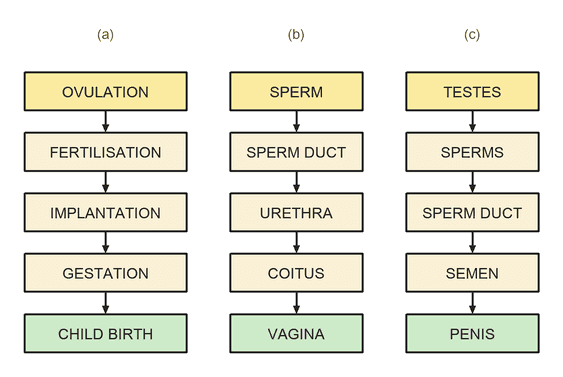
(a) Implantation, ovulation, child birth, gestation, fertilisation.
(b) Sperm duct, coitus, sperm, vagina, urethra.
(c) Sperm duct, penis, testes, sperms, semen.
(d) Puberty, menopause, menstruals, menarche, reproductive age.
(e) Graafian follicle, ostium, uterus, fallopian tube, ovum.
Solve with AIWritten solution
Solution:
Concept: Arrange each set in the order in which the events happen, or the path the cells take, in the body.
Step 1 — Set (a).
The egg is released, fertilised, fixed in the uterus, develops, and is born.
Ovulation → fertilisation → implantation → gestation → child birth.
Step 2 — Set (b).
Sperms go through the sperm duct and urethra, and in coitus are placed in the vagina.
Sperm → sperm duct → urethra → coitus → vagina.
Step 3 — Set (c).
Testes make sperms, the sperm duct carries them, gland secretions form semen, which leaves by the penis.
Testes → sperms → sperm duct → semen → penis.
Step 4 — Set (d).
Puberty brings the first menstruation, then regular cycles through the reproductive years, which end at menopause.
Puberty → menarche → menstruals → reproductive age → menopause.
Step 5 — Set (e).
The Graafian follicle releases the ovum, which enters the ostium (opening) of the funnel, passes down the Fallopian tube and reaches the uterus.
Graafian follicle → ovum → ostium → Fallopian tube → uterus.

Watch out: In (b) the sperms pass through the urethra before coitus places them in the vagina.
Therefore, the five sequences are as written in Steps 1 to 5.
- 285 marks
Question 28
Give appropriate terms for the following processes:
(a) The onset of reproductive phase in a female.
(b) Rupture of follicle and release of ovum from the ovary.
(c) Monthly discharge of blood and disintegrated tissues in human female.
(d) Process of fusion of ovum and sperm.
(e) Fixing of developing zygote (blastocyst) on the uterine wall.
Solve with AIWritten solution
Solution:
Concept: Each process has one technical term.
Step 1 — Process (a).
The start of the reproductive phase in a girl, marked by the first menstruation: menarche (puberty).
Step 2 — Process (b).
Bursting of the Graafian follicle to release the egg: ovulation.
Step 3 — Process (c).
Monthly shedding of the uterine lining with blood: menstruation.
Step 4 — Process (d).
Fusion of sperm and ovum to form a zygote: fertilisation.
Step 5 — Process (e).
Fixing of the blastocyst in the uterine wall, which starts pregnancy: implantation.
Therefore, (a) menarche, (b) ovulation, (c) menstruation, (d) fertilisation, (e) implantation.
- 296 marks
Question 29
Match the items in column I with those in column II and write down the matching pairs (some may not match).
Column I Column II (a) Acrosome (i) An embryo which looks like human baby (b) Gestation (ii) Luteinizing hormone (c) Menopause (iii) Ovum producing cells (d) Foetus (iv) Semen (e) Oogenesis (v) Spermatozoa (f) Ovulation (vi) Complete stoppage of menstrual cycle (vii) Time taken by a fertilised egg till the delivery of baby. Solve with AIWritten solution
Solution:
Concept: Pair each term with its meaning or the thing it belongs to. Column II has one extra item.
Step 1 — (a) Acrosome.
The acrosome is the cap on the head of the sperm: (v) spermatozoa.
Step 2 — (b) Gestation.
(vii) time from fertilisation to the delivery of the baby (about 280 days).
Step 3 — (c) Menopause.
(vi) complete stoppage of the menstrual cycle.
Step 4 — (d) Foetus.
(i) an embryo that looks like a human baby.
Step 5 — (e) Oogenesis.
(iii) ovum-producing cells: oogenesis is the forming of ova from these cells.
Step 6 — (f) Ovulation.
(ii) luteinizing hormone: LH from the pituitary brings about the release of the ovum.
(iv) Semen is left unmatched.
Therefore, (a)–(v), (b)–(vii), (c)–(vi), (d)–(i), (e)–(iii), (f)–(ii).
- 305 marks
Question 30
Given below are some groups of terms. In each group, one pair indicates the relationship between the two terms. Rewrite and complete the second pair on a similar basis.
(a) Sperm : Spermatogenesis :: Ovum : ..........
(b) Female gonad : Ovaries :: Male gonad : ..........
(c) Follicle cells : Ova :: .......... : Sperms
(d) Leydig cells : Testosterone : .......... : Oestrogen
(e) Follicular phase : 5-12 days :: Luteal phase : .......... days.
Solve with AIWritten solution
Solution:
Concept: Find how the first pair is related and keep the same relationship in the second pair.
Step 1 — Pair (a).
A gamete and the process that forms it: Ovum : oogenesis.
Step 2 — Pair (b).
Gonad and its name: Male gonad : testes.
Step 3 — Pair (c).
Structure and the gametes formed in it: Seminiferous tubules : sperms.
Step 4 — Pair (d).
Cells and the hormone they secrete: Follicle cells (Graafian follicle) : oestrogen.
Step 5 — Pair (e).
Phase of the cycle and its days: Luteal phase : 15–28 days.
Therefore, the answers are oogenesis, testes, seminiferous tubules, follicle cells and 15–28.
- 315 marks
Question 31
Choose the odd one out from the group of terms given below and write the category for the remaining terms :
(a) Testis, Epididymis, Uterine tube, Sperm duct.
(b) Seminal vesicle, Seminiferous tubule, Prostate gland, Cowper's gland.
(c) Uterus, Ureter, Oviduct, Ovaries.
(d) Choroid, Chorion, Amnion, Allantois.
(e) Zona pellucida, Acrosome, Axial filament, Middle piece.
Solve with AIWritten solution
Solution:
Concept: Find the category that fits three of the four terms; the term outside it is the odd one.
Step 1 — Group (a).
Testis, epididymis and sperm duct are male organs; the uterine tube is the female oviduct.
Odd one: Uterine tube; rest: organs of the male reproductive system.
Step 2 — Group (b).
Seminal vesicle, prostate and Cowper's gland are male accessory glands; seminiferous tubules are inside the testis and make sperms.
Odd one: Seminiferous tubule; rest: male accessory glands.
Step 3 — Group (c).
Uterus, oviduct and ovaries are female reproductive organs; the ureter carries urine.
Odd one: Ureter; rest: organs of the female reproductive system.
Step 4 — Group (d).
Chorion, amnion and allantois are membranes round the embryo; the choroid is a layer of the eye.
Odd one: Choroid; rest: foetal (extra-embryonic) membranes.
Step 5 — Group (e).
Acrosome, axial filament and middle piece are parts of a sperm; the zona pellucida covers the ovum.
Odd one: Zona pellucida; rest: parts of a sperm.
Therefore, the odd ones are uterine tube, seminiferous tubule, ureter, choroid and zona pellucida.
- 325 marks
Question 32
(a) State whether the following statements are TRUE (T) or FALSE (F) :
(i) Fertilisation occurs in vagina. (T/F)
(ii) Uterus is also known as birth canal. (T/F)
(iii) Nutrition and oxygen diffuse from the mother's blood into the foetus's blood through amnion. (T/F)
(b) Rewrite any two of the wrong statements by correcting only one word either at the beginning or at the end of the sentence.
Solve with AIWritten solution
Solution:
Concept: Fertilisation is in the oviduct, the vagina is the birth canal, and exchange between mother and foetus is through the placenta.
Step 1 — Statement (i).
Sperms are only deposited in the vagina; they swim up to the oviduct to meet the egg.
False.
Step 2 — Statement (ii).
The elastic vagina lets the baby pass out at birth, so the vagina, not the uterus, is the birth canal.
False.
Step 3 — Statement (iii).
The amnion only holds the protective amniotic fluid; food and oxygen diffuse through the placenta.
False.
Step 4 — Part (b): correct any two (first or last word).
- Fertilisation occurs in oviduct.
- Vagina is also known as birth canal.
- Nutrition and oxygen diffuse from the mother's blood into the foetus's blood through placenta.
Watch out: Change only the first or the last word, as instructed.
Therefore, all three statements are false; corrected: oviduct, vagina, placenta.
- 336 marks
Question 33
Complete the following table by writing the name of the structure or the function of the given structure :
Structure Function 1. Corpus luteum .......... 2. .......... Produces male gametes in mass 3. Leydig cells .......... 4. .......... Stores the sperms until they mature and become mobile 5. Umbilical cord. .......... 6. Fallopian tube .......... Solve with AIWritten solution
Solution:
Concept: Match each structure with its main job. Rows 2 and 4 ask for the structure; the others ask for the function.
Step 1 — Row 1.
The corpus luteum secretes progesterone (and some oestrogen), which keeps the uterine lining ready for implantation.
Step 2 — Row 2.
Male gametes are made in mass in the seminiferous tubules of the testes (about 400 million sperms in one ejaculation).
Step 3 — Row 3.
Leydig cells secrete the male hormone testosterone.
Step 4 — Row 4.
Sperms are stored until they mature and become motile in the epididymis.
Step 5 — Row 5.
The umbilical cord joins the foetus to the placenta; its vessels carry food and oxygen to the foetus and wastes away.
Step 6 — Row 6.
The Fallopian tube carries the ovum to the uterus, and fertilisation takes place in it.
Therefore, the table is completed as in Steps 1 to 6.
- 3412 marks
Question 34
Given below are the names of certain stages/substances related to reproduction and found in human body. Answer the questions related to them.
(a) Foetus.
- Where is it contained?
- How does it differ from embryo?
(b) Hyaluronidase.
- Is it an enzyme or simply a protein?
- What is its function?
(c) Morula.
- What is this stage?
- Name the stage which comes next to it?
(d) Amniotic fluid.
- Where is it found?
- What are its functions?
(e) Placenta.
- What are the two sources that form placenta?
- Name any two main substances which pass from foetus to mother through placenta.
- Name any two hormones it produces.
(f) Implantation.
- The development stage that undergoes this process.
- The approximate time after fertilisation, when it occurs.
Solve with AIWritten solution
Solution:
Concept: Give a short, exact answer to each bullet, in the order asked.
Step 1 — Foetus.
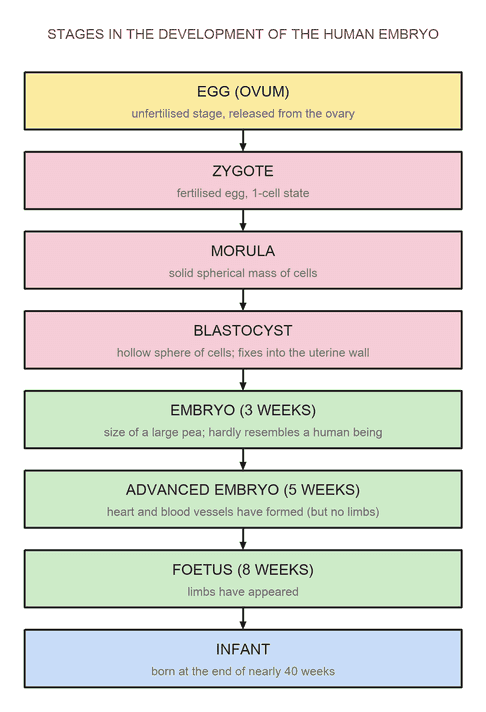
It is contained in the mother's uterus, inside the amnion, surrounded by amniotic fluid. An embryo is the early stage while the body parts are just forming; from about 8 weeks, when the limbs have formed and it looks like a human baby, it is called a foetus.
Step 2 — Hyaluronidase.
It is an enzyme. Released by the acrosome of the sperm, it dissolves the covering of the ovum so the sperm can enter.
Step 3 — Morula.
It is a solid ball of cells formed by repeated division of the zygote. The next stage is the blastocyst, a hollow ball of cells.
Step 4 — Amniotic fluid.
It is in the amniotic sac, between the amnion and the embryo. It protects the embryo from shocks, keeps an even pressure round it, allows it to move and stops it sticking to the amnion.
Step 5 — Placenta.
It is formed from embryonic tissue (villi from the allantois) and the uterine wall. Carbon dioxide and urea pass from foetus to mother. It produces oestrogen and progesterone.
Step 6 — Implantation.
The blastocyst undergoes it, about 7 days after fertilisation.
Watch out: The morula is solid and the blastocyst hollow; do not swap them.
Therefore, the answers to (a)–(f) are as given in Steps 1 to 6.
- 3510 marks
Question 35
Write important functions of the following :
(a) Inguinal canal
(b) Testis
(c) Ovary
(d) Oviduct
(e) Uterus
Solve with AIWritten solution
Solution:
Concept: Give the main functions of each structure.
Step 1 — Inguinal canal.
Lets the testes descend from the abdomen into the scrotum before birth; later the sperm duct, blood vessels and nerves pass through it.
Step 2 — Testis.
Its seminiferous tubules produce sperms; its Leydig cells secrete testosterone.
Step 3 — Ovary.
Produces ova, and secretes oestrogen and progesterone.
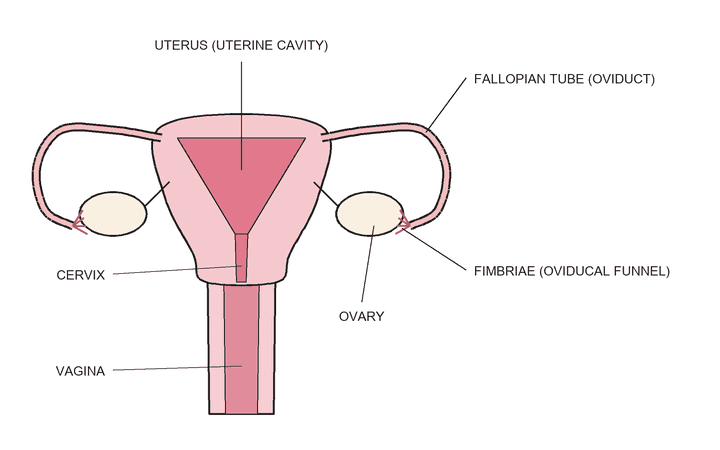
Step 4 — Oviduct.
Its funnel picks up the ovum; fertilisation takes place in it; it moves the egg or zygote to the uterus by peristalsis.
Step 5 — Uterus.
Receives the blastocyst for implantation, protects and nourishes the foetus through the placenta, and its contractions push out the baby at birth.
Watch out: The gonads (testis, ovary) each do two jobs: make gametes and secrete hormones.
Therefore, the functions are as given in Steps 1 to 5.
- 365 marks
Question 36
Write the specific location of each of the following :
(a) Seminal vesicle
(b) Uterus
(c) Placenta
(d) Acrosome
(e) Vagina
Solve with AIWritten solution
Solution:
Concept: State exactly where each part lies, naming the organs next to it.
Step 1 — Seminal vesicle.
Between the back of the urinary bladder and the rectum.
Step 2 — Uterus.
In the pelvic cavity, between the urinary bladder and the rectum.
Step 3 — Placenta.
Attached to the inner wall of the uterus, and joined to the foetus by the umbilical cord.
Step 4 — Acrosome.
At the tip of the head of the sperm.
Step 5 — Vagina.
From the cervix (lower end of the uterus) to the outside, opening into the vulva.
Therefore, the locations are as given in Steps 1 to 5.
- 3712 marks
Question 37
Define the following terms :
(a) Reproduction
(b) Hernia
(c) Ovulation
(d) Puberty
(e) Fertilization
(f) Hymen
Solve with AIWritten solution
Solution:
Concept: A definition is one precise sentence that contains the key words of the term.
Step 1 — Reproduction.
The formation of new individuals of the same kind by sexual or asexual means.
Step 2 — Hernia.
The condition in which, due to pressure in the abdomen, the intestine bulges into the scrotum through the inguinal canal.
Step 3 — Ovulation.
The rupture of the mature Graafian follicle and release of the egg from the ovary (about day 14 of a 28-day cycle).
Step 4 — Puberty.
The period in which the reproductive system matures and becomes able to reproduce (about 10–14 years in girls, 11–15 in boys).
Step 5 — Fertilization.
The fusion of a sperm with an ovum to form a zygote, in the oviduct.
Step 6 — Hymen.
A thin membrane that partly closes the opening of the vagina in young females.
Therefore, the six terms are defined as in Steps 1 to 6.
- 3812 marks
Question 38
Distinguish between the following pairs :
(a) Spermatogenesis and oogenesis
(b) Implantation and gestation
(c) Pregnancy and parturition
(d) Placenta and umbilical cord
(e) Identical and fraternal twins
(f) Menarche and menopause
Solve with AIWritten solution
Solution:
Concept: Compare the two terms of each pair on the same basis: what it is, and where or when it happens.
Step 1 — Spermatogenesis and oogenesis.
Spermatogenesis Oogenesis Formation of sperms Formation of ova In the seminiferous tubules of the testes In the follicles of the ovaries Step 2 — Implantation and gestation.
Implantation Gestation Fixing of the blastocyst in the endometrium Whole period of development in the uterus About a week after fertilisation Lasts about 280 days Step 3 — Pregnancy and parturition.
Pregnancy Parturition The state of carrying the young in the uterus The act of giving birth Begins with implantation Ends the gestation Step 4 — Placenta and umbilical cord.
Placenta Umbilical cord Disc-like organ on the uterine wall Cord joining the foetus to the placenta Exchange of food, gases and wastes; secretes hormones Only carries the foetal blood vessels Step 5 — Identical and fraternal twins.
Identical twins Fraternal twins From one fertilised egg that splits From two eggs fertilised by two sperms Always same sex, look very alike Same or different sex, look like ordinary siblings 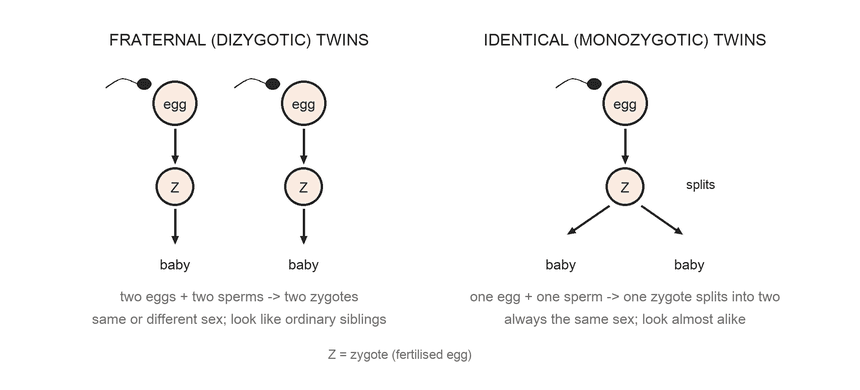
Step 6 — Menarche and menopause.
Menarche Menopause Onset of menstruation Permanent stopping of menstruation At about 13 years At about 45–50 years Watch out: Compare both terms on the same point in each row.
Therefore, the six pairs differ as shown in the tables.
- 393 marks
Question 39
What is the significance of the testes being located in scrotal sacs outside the abdomen. Can there be any abnormal situation regarding their location? If so, what is that and what is the harm caused due to it?
Solve with AIWritten solution
Solution:
Concept: Sperms form only at a temperature a little below body temperature.
Step 1 — Significance.
Cause: the testes hang in the scrotum outside the abdomen. Effect: they stay 2–3 °C cooler than the body, which sperm formation needs. The scrotum also adjusts: in heat it loosens and the testes hang lower; in cold it tightens and draws them up.
Step 2 — Abnormal situation.
Yes. The testes form in the abdomen and normally descend before birth. Sometimes they fail to descend (undescended testes).
Step 3 — Harm.
Cause: the testes stay at the higher body temperature. Effect: sperms cannot mature, so the man is sterile.

Therefore, the scrotum keeps the testes cooler for sperm formation; undescended testes stay too warm and cause sterility.
- 403 marks
Question 40
What are the secondary sexual characteristics in the human male and female respectively ?
Solve with AIWritten solution
Solution:
Concept: Secondary sexual characters are outward features that distinguish male from female but take no direct part in reproduction. They appear at puberty under the sex hormones.
Step 1 — In males (testosterone).
Beard and moustache; hair on chest, pubic region and armpits; deeper voice; stronger, more muscular build; growth of testes and penis.
Step 2 — In females (oestrogens).
Growth of breasts; widening of hips; hair in the pubic region and armpits; increase in size of uterus and vagina.

Therefore, these are the secondary sexual characters of males and females.
- 413 marks
Question 41
What are the accessory reproductive organs?
Solve with AIWritten solution
Solution:
Concept: Accessory organs do not make gametes; they help the gametes to be carried and to meet, and they support the embryo up to birth.
Step 1 — Definition.
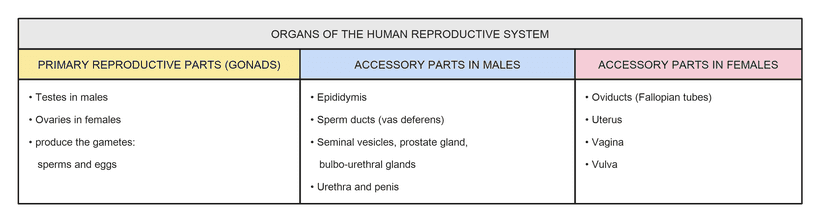
All the ducts, glands and other structures of the reproductive system other than the gonads, which help in the transfer and meeting of the sex cells and in the growth of the embryo up to birth.
Step 2 — In males.
Epididymis, sperm ducts (vas deferens), seminal vesicles, prostate, Cowper's glands, urethra and penis.
Step 3 — In females.
Oviducts (Fallopian tubes), uterus, vagina and vulva.
Watch out: Secondary sexual characters such as the beard or breasts are not accessory reproductive organs.
Therefore, accessory reproductive organs are the ducts, glands and structures (other than the gonads) listed above.
- 422 marks
Question 42
Differentiate between primary and accessory reproductive organs.
Solve with AIWritten solution
Solution:
Concept: Primary organs make the gametes; accessory organs help the gametes meet and support development.
Step 1 — Compare.
Primary reproductive organs Accessory reproductive organs The gonads: testes and ovaries The ducts, glands and other structures of the system Produce gametes and sex hormones Transfer the gametes and support the embryo; produce no gametes Step 2 — Examples.
Accessory organs: sperm duct, seminal vesicles, prostate and penis in males; oviducts, uterus and vagina in females.
Therefore, primary organs (gonads) make gametes, while accessory organs carry them and support development.
- 433 marks
Question 43
Name and describe very briefly, the stages in the development of human embryo.
Solve with AIWritten solution
Solution:
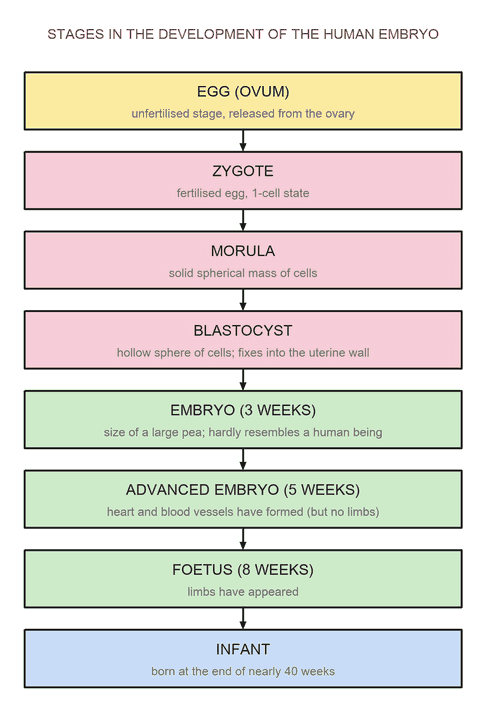
Concept: From the zygote to birth, the human embryo passes through a fixed sequence of stages.
Step 1 — Zygote.
The fertilised egg, a single cell formed in the oviduct.
Step 2 — Morula.
The zygote divides again and again (2, 4, 8, 16 cells) into a solid ball of cells.
Step 3 — Blastocyst.
A hollow ball of cells that reaches the uterus and implants in the endometrium about a week after fertilisation.
Step 4 — Embryo.
Body parts begin to form; at 3 weeks it is about the size of a large pea, and by 5 weeks the heart and blood vessels have formed.
Step 5 — Foetus.
From about 8 weeks the limbs have formed and it looks like a human baby.
Step 6 — Birth.
The baby is born after about 280 days.
Therefore, the stages are zygote, morula, blastocyst (implantation), embryo, foetus and birth.
- 443 marks
Question 44
Is it correct to say that the testes produce testosterone. Discuss ?
Solve with AIWritten solution
Solution:
Concept: The testis has two kinds of tissue doing two different jobs.
Step 1 — The two tissues.
Each testis has seminiferous tubules, which make sperms, and interstitial (Leydig) cells, the packing tissue between the tubules.
Step 2 — Which makes testosterone.
The Leydig cells secrete testosterone, so the testis is both a gamete-making organ and an endocrine gland.
Step 3 — What testosterone does.
It brings about the male secondary sexual characters at puberty, such as a deeper voice and growth of beard and moustache.

Therefore, yes, it is correct, but more exactly it is the interstitial (Leydig) cells of the testes that produce testosterone.
- 456 marks
Question 45
Given below is a diagram of two systems together in the human body.
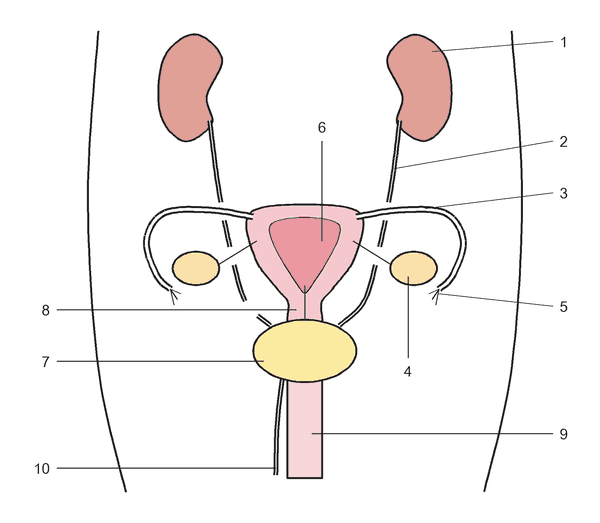
(a) Name the systems.
(b) Name the parts numbered 1-10.
(c) Describe the functions of the parts 3, 4, 5 & 6.
(d) What will happen if the part 3 on both sides gets blocked?
Solve with AIWritten solution
Solution:
Concept: The figure shows the urinary organs together with the female reproductive organs.
Step 1 — Part (a): the systems.
The excretory (urinary) system and the female reproductive system.
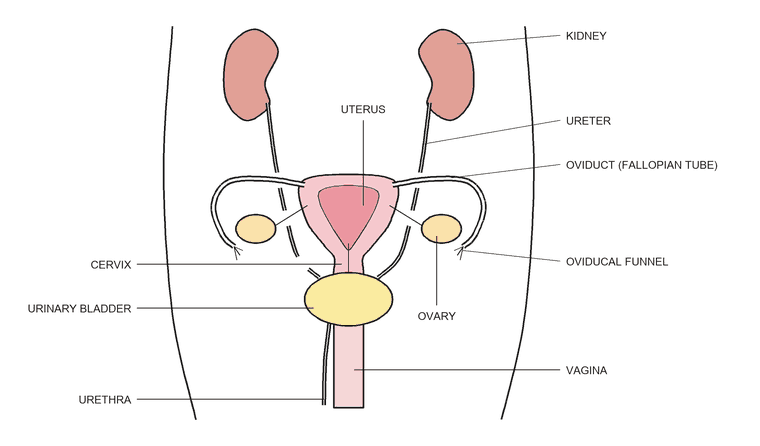
Step 2 — Part (b): the parts.
1 – Kidney; 2 – Ureter; 3 – Oviduct (Fallopian tube); 4 – Ovary; 5 – Oviducal funnel; 6 – Uterus; 7 – Urinary bladder; 8 – Cervix; 9 – Vagina; 10 – Urethra.
Step 3 — Part (c): functions.
3 Oviduct: carries the ovum to the uterus by peristalsis; fertilisation takes place in it. 4 Ovary: produces ova and secretes oestrogen and progesterone. 5 Funnel: its fimbriae pick up the released ovum. 6 Uterus: the blastocyst implants here and the foetus develops till birth.
Step 4 — Part (d): both oviducts blocked.
Cause: sperms cannot reach the egg. Effect: fertilisation cannot take place, so the woman cannot conceive naturally (sterile). Menstruation goes on, because the ovaries still release eggs, which simply degenerate.

Watch out: Part 3 is the oviduct; the ureter (2) carries urine and is a different tube.
Therefore, (a) urinary and female reproductive systems; (b)–(d) as in Steps 2 to 4.
- 467 marks
Question 46
The figure given ahead is an organ system of humans. Study the same and answer the following questions.
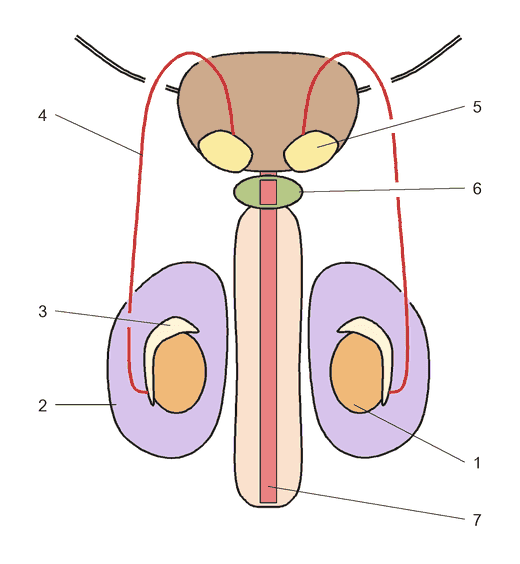
(a) Identify the organ system.
(b) Label the guidelines 1 to 7.
(c) Write one important role of parts 3 and 6.
(d) Name the cells of part 1 that produce testosterone.
(e) What is the significance of the part 1 being located in a separate sac suspended outside the body ?
Solve with AIWritten solution
Solution:
Concept: This is the front view of the male reproductive organs: testes in the scrotum, and sperm ducts running up to the urethra below the bladder.
Step 1 — Part (a).
The human male reproductive system.
Step 2 — Part (b).
1 – Testis; 2 – Scrotum; 3 – Epididymis; 4 – Vas deferens (sperm duct); 5 – Seminal vesicle; 6 – Prostate gland; 7 – Urethra.
Step 3 — Part (c).
3 Epididymis: stores the sperms while they mature and become motile. 6 Prostate: adds an alkaline secretion that neutralises the acid in the vagina.
Step 4 — Part (d).
The interstitial (Leydig) cells, between the seminiferous tubules.
Step 5 — Part (e).
Cause: in the scrotum the testes are 2–3 °C cooler than the body. Effect: sperms can form and mature, which they cannot do at body temperature.

Therefore, (a) male reproductive system; (b)–(e) as in Steps 2 to 5.
- 477 marks
Question 47
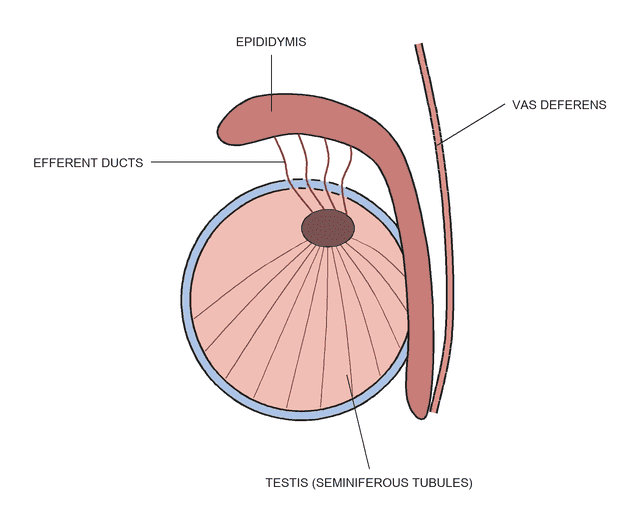
The figure given below is an important gonad of humans. Study the figure and answer the following questions.
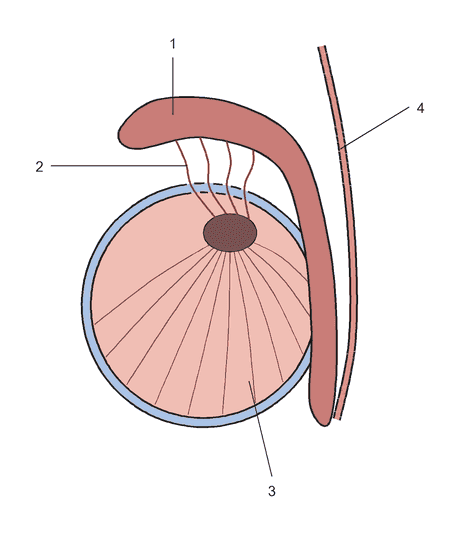
(a) Identify the organ. Write its specific location in the body.
(b) Label the parts shown in the figure as 1 to 4.
(c) Write important functions of parts 2 and 4.
(d) Name one cellular structure and one hormone which are produced in part 3.
(e) Draw a neat and labelled diagram of the cellular structure mentioned by you in (d).
Solve with AIWritten solution
Solution:
Concept: The figure is a section of a testis with its epididymis and sperm duct. Sperms leave the testis by the efferent ducts, are stored in the epididymis and carried away by the vas deferens.
Step 1 — Part (a).
The organ is the testis, lying in the scrotum, outside the abdominal cavity.
Step 2 — Part (b).
1 – Epididymis; 2 – Efferent ducts; 3 – Testis (lobules with seminiferous tubules); 4 – Vas deferens (sperm duct).
Step 3 — Part (c).
2 Efferent ducts: carry sperms from the testis to the epididymis. 4 Vas deferens: carries sperms from the epididymis up to the urethra.

Step 4 — Part (d).
Cellular structure: sperm (made in the seminiferous tubules). Hormone: testosterone (from the Leydig cells).
Step 5 — Part (e).
Labelled diagram of a human sperm (acrosome, nucleus, head, mitochondria, middle piece, tail):
Therefore, (a) testis, in the scrotum; (b)–(e) as in Steps 2 to 5.
- 482 marks
Question 48
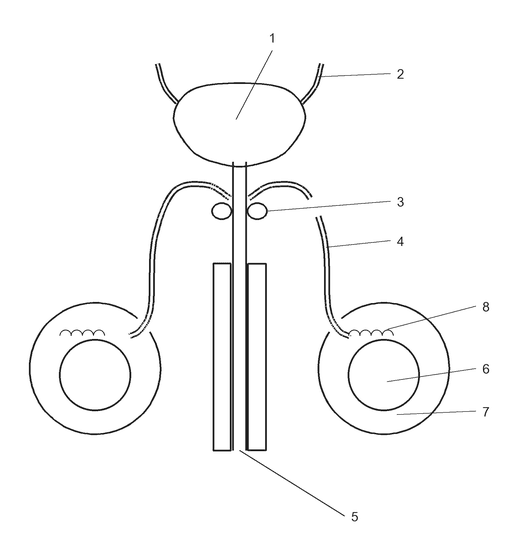
Given below is the outline of the male reproductive system. Name the parts labelled 1 to 8. Also name the corresponding structure of part (4) in female reproductive system.
 Solve with AI
Written solution
Solution:
Concept: Trace the path of the sperms: testis → epididymis → vas deferens → urethra.
Step 1 — Name the parts.
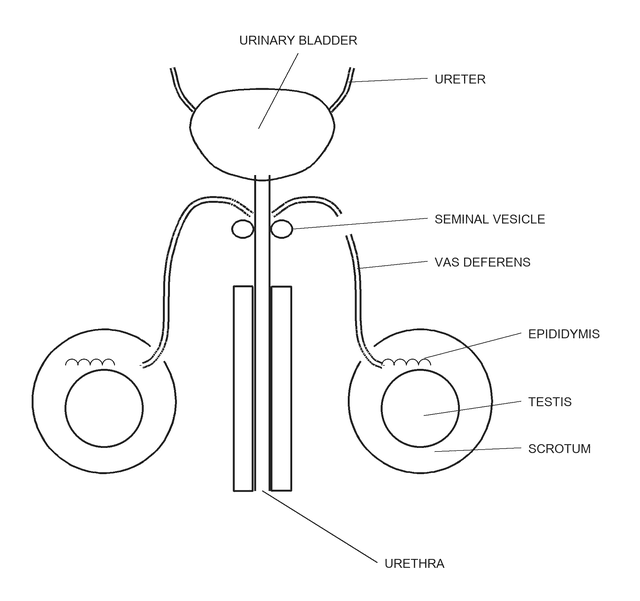
1 – Urinary bladder; 2 – Ureter; 3 – Seminal vesicle; 4 – Vas deferens (sperm duct); 5 – Urethra; 6 – Testis; 7 – Scrotum; 8 – Epididymis.
Step 2 — Tell 2 and 4 apart.
The ureter (2) enters the bladder from above and carries urine; the vas deferens (4) comes up from the testis and carries sperms.
Step 3 — Female counterpart of part 4.
The oviduct (Fallopian tube), which also carries the gametes.
Therefore, the parts are as listed, and part 4 corresponds to the oviduct in the female.
- 496 marks
Question 49
The diagram below is that of a developing human foetus in the womb. Study the same and answer the questions that follow :
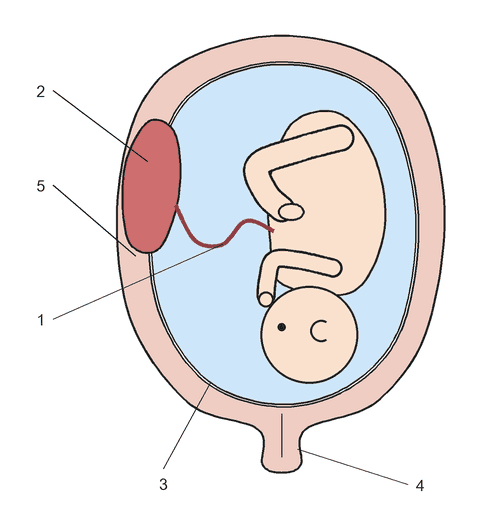
(a) Name the parts '1' to '5' indicated by guidelines.
(b) What term is given to the period of development of the foetus in the womb?
(c) How many days does the foetus take to be fully developed?
(d) Mention two functions of the parts labelled '2' other than its endocrine function.
(e) Name any one hormone produced by the part labelled '2'.
Solve with AIWritten solution
Solution:
Concept: The foetus lies in the amniotic sac and is joined to the placenta by the umbilical cord; the placenta is attached to the uterine wall.
Step 1 — Part (a).
1 – Umbilical cord; 2 – Placenta; 3 – Amnion; 4 – Cervix; 5 – Uterine wall.
Step 2 — Parts (b) and (c).
The period is gestation, about 280 days.
Step 3 — Part (d).
Nutrition and respiration: food and oxygen diffuse from the mother's blood into the foetal blood. Excretion: carbon dioxide and urea pass from the foetal blood into the mother's.
Step 4 — Part (e).
Progesterone (it also makes oestrogen).

Therefore, (a) as named; (b) gestation; (c) about 280 days; (d) nutrition with respiration, and excretion; (e) progesterone.
- 506 marks
Question 50
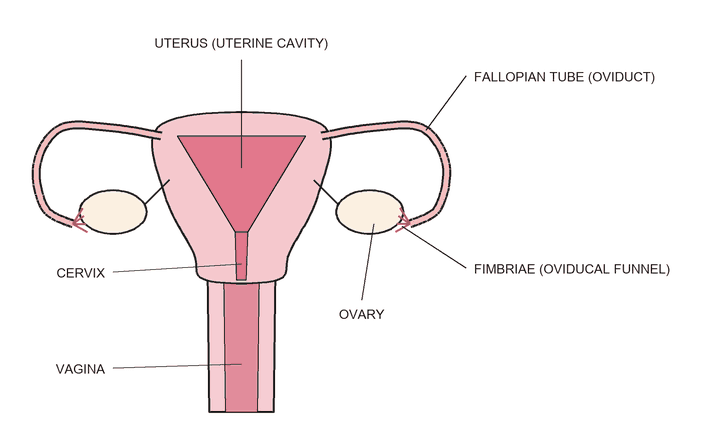
The figure given below is the human female reproductive system. Study the same and answer the followings questions.

(a) Label the guidelines 1 to 6 shown in the figure.
(b) What is the normal gestation period in human ?
(c) Where are the sperms released during coitus ?
(d) Write two important functions of part 2.
(e) Mention the technical term for the fixing of developing zygote to the uterine wall.
Solve with AIWritten solution
Solution:
Concept: This is the front view of the female reproductive organs.
Step 1 — Part (a).
1 – Vagina; 2 – Ovary; 3 – Fimbriae (oviducal funnel); 4 – Fallopian tube; 5 – Uterus; 6 – Cervix.
Step 2 — Part (b).
About 280 days (about 9 months).
Step 3 — Part (c).
Into the vagina, near the cervix.
Step 4 — Part (d).
The ovary produces ova and secretes oestrogen and progesterone.
Step 5 — Part (e).
Implantation, about a week after fertilisation.

Therefore, (a) as named; (b) about 280 days; (c) vagina; (d) ova and hormones; (e) implantation.
- 516 marks
Question 51
The diagram below represents two reproductive cells A and B. Study the same and then answer the questions that follow :
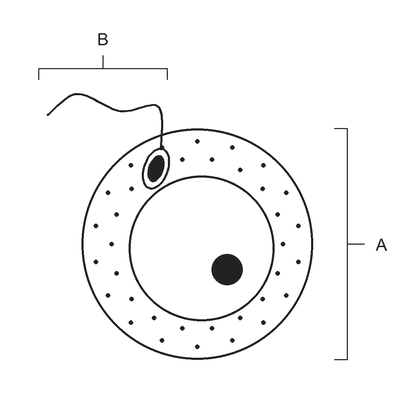
(a) Identify the reproductive cells A and B.
(b) Name the specific part of the reproductive system where the above cells are produced.
(c) Where in the female reproductive system do these cells unite?
(d) Name the main hormones secreted by the (1) ovary (2) testes.
(e) Name an accessory gland found in the male reproductive system and state the function of its secretion.
Solve with AIWritten solution
Solution:
Concept: A is the large round egg; B is a sperm entering it, so the figure shows fertilisation.
Step 1 — Part (a).
A – Ovum (egg); B – Sperm.
Step 2 — Part (b).
The ovum forms in the follicle of the ovary; the sperm in the seminiferous tubules of the testis.
Step 3 — Part (c).
In the oviduct (Fallopian tube).
Step 4 — Part (d).
(1) Ovary: oestrogen and progesterone; (2) testes: testosterone.
Step 5 — Part (e).
Prostate gland: its alkaline secretion neutralises the acid in the vagina. (Also correct: seminal vesicles, whose secretion carries and activates the sperms, or Cowper's glands, whose secretion lubricates.)
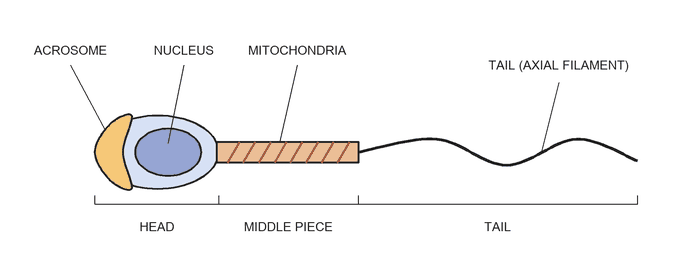
Therefore, (a) A ovum, B sperm; (b) ovary and testis; (c) oviduct; (d) as listed; (e) prostate gland.
What Class 10 Biology Ch 13 covers
The sections of the chapter, in the order the book takes them. Every question above comes from one of these.
- 01Reproduction in General
- 02Reproduction in Humans
- 03Male Reproductive System
- 04Female Reproductive System
- 05Menstrual Cycle
- 06Fertilisation (Union of Egg Nucleus and Sperm Nucleus)
More ways to study this chapter
The same chapter asked three other ways. Practise it, revise it, and see what the board has set on Ch 13 before.
- Competency-Based Questions (CBQ)Case study questions: a situation, and the part of the chapter that answers it.40questionsOpen
- Previous Year QuestionsQuestions that have actually appeared in board papers, each tagged with its year.72questionsOpen
- Practice QuestionsExtra questions per chapter, for when one attempt at a method is not enough.48questionsOpen
Ch 13 in past ICSE papers
The same chapter as the board has actually asked it. These are worded differently from the textbook exercise, which is the point of reading them.
- 11 mark
Board paper question 1
State the main function of the following:
Leydig cells
Solve with AIWritten solution
Solution:
Concept: Each testis has two kinds of working tissue. Its coiled seminiferous tubules make the sperms, and the interstitial (Leydig) cells packed between the tubules make the male hormone testosterone.
Step 1 — See what is asked.
We need the main job of the Leydig cells of the testis.
Step 2 — Recall the fact.
The Leydig (interstitial) cells lie in the spaces between the seminiferous tubules. They are endocrine cells: they pour their hormone straight into the blood.
Step 3 — Name the term.
Their main function is to secrete the male sex hormone testosterone.
Testosterone brings about the male secondary sexual characters at puberty, such as a deeper voice and the growth of a beard and moustache, and it is needed for sperm production.
Watch out: The Leydig cells do not make sperms; the seminiferous tubules do.
Therefore, the main function of the Leydig cells is to secrete the hormone testosterone.
- 21 mark
Board paper question 2
State the main function of the following:
Corpus luteum
Solve with AIWritten solution
Solution:
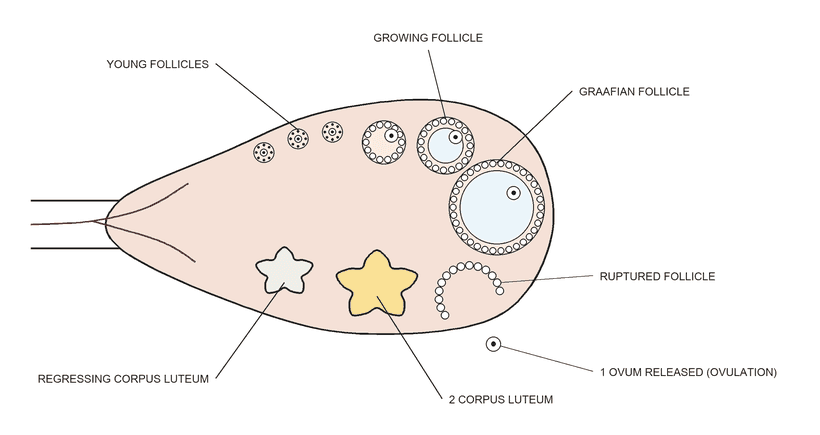
Concept: After ovulation the emptied Graafian follicle in the ovary turns into a yellow, hormone-producing body, the corpus luteum ('yellow body'). It secretes mainly progesterone, with some oestrogen.
Step 1 — See what is asked.
We need the main job of the corpus luteum.
Step 2 — Recall the fact.
The corpus luteum forms in the ovary from the follicle that has just released its egg. It acts as a temporary endocrine gland.
Step 3 — Name the term.
Its main function is to secrete progesterone, which keeps the lining of the uterus (endometrium) thick, soft and full of blood vessels, ready to receive an embryo.
If the egg is fertilised, the corpus luteum goes on making progesterone in early pregnancy; if not, it shrinks and menstruation follows.
Watch out: The corpus luteum (in the ovary) is not the corpus callosum (in the brain).
Therefore, the corpus luteum secretes progesterone, which prepares and keeps the uterine lining ready for the embryo.
- 31 mark
Board paper question 3
Differentiate between the following pairs on the basis of what is mentioned within brackets:
Sperm duct and fallopian tube (function)
Solve with AIWritten solution
Solution:
Concept: Both are ducts that carry a gamete: the sperm duct in the male and the Fallopian tube (oviduct) in the female. Here they are compared only on their function.
Step 1 — Function of the sperm duct.
The sperm duct (vas deferens) carries the sperms from the epididymis, up into the abdomen and on to the urethra.
Step 2 — Function of the Fallopian tube.
The Fallopian tube (oviduct) carries the ovum from the ovary towards the uterus. It is also the place where fertilisation takes place, and the early embryo moves down it.
Step 3 — Put the difference side by side.
The table below compares the two functions side by side.
Sperm duct Fallopian tube Carries sperms from the epididymis to the urethra Carries the ovum from the ovary to the uterus; site of fertilisation Watch out: The Fallopian tube does not carry sperms out of the body; sperms swim up it to meet the egg.
Therefore, the sperm duct carries sperms from the epididymis to the urethra, while the Fallopian tube carries the ovum to the uterus and is the site of fertilisation.
- 41 mark
Board paper question 4
Give the Biological / technical term for the following:
Complete stoppage of menstrual cycle in females.
Solve with AIWritten solution
Solution:
Concept: A woman's reproductive years begin with her first menstruation (menarche) and end when the monthly cycle stops for good, usually at about 45–50 years of age.
Step 1 — See what is asked.
We need the term for the complete, permanent stopping of the menstrual cycle.
Step 2 — Recall the fact.
At the end of the reproductive years the ovaries stop releasing eggs and make much less oestrogen and progesterone, so the uterine lining is no longer built up and shed each month.
Step 3 — Name the term.
The term is menopause ('pause' means stop).
Watch out: Menarche is the START of menstruation; menopause is its permanent STOP.
Therefore, the complete stoppage of the menstrual cycle in females is called menopause.
- 51 mark
Board paper question 5
Give the Biological / technical term for the following:
The canal through which the testes descend into the scrotum just before the birth of a male baby.
Solve with AIWritten solution
Solution:
Concept: In the embryo the testes form inside the abdomen, near the kidneys. Shortly before birth they move down into the scrotum through a passage in the lower abdominal wall.
Step 1 — See what is asked.
We need the name of the canal through which the testes descend into the scrotum.
Step 2 — Recall the fact.
Each testis passes through a short passage in the groin region of the abdominal wall, one on each side.
Step 3 — Name the term.
The term is inguinal canal.
Later the sperm duct, blood vessels and nerves of each testis (the spermatic cord) pass through this canal.
Watch out: The inguinal canal is a passage in the abdominal wall, not a duct that carries sperms.
Therefore, the testes descend into the scrotum through the inguinal canal.
- 61 mark
Board paper question 6
Give scientific reasons for the following statements:
When an ovum gets fertilized, menstrual cycle stops temporarily in a woman.
Solve with AIWritten solution
Solution:
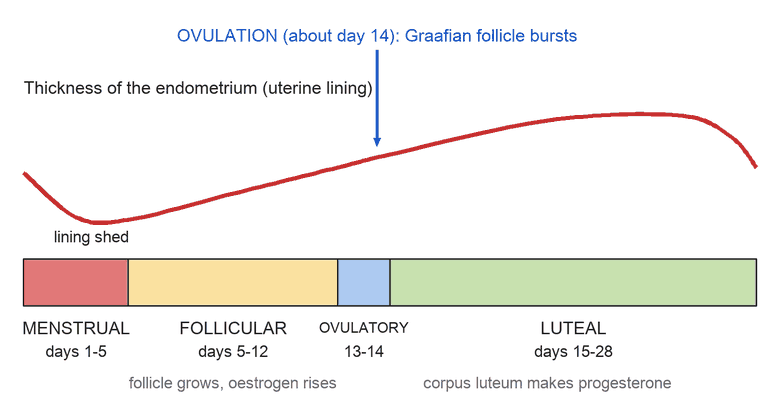
Concept: Menstruation is the shedding of the thick inner lining of the uterus (endometrium) with some blood. The lining stays in place only as long as there is enough progesterone in the blood.
Step 1 — What normally happens.
If the egg is not fertilised, the corpus luteum shrinks after about two weeks and stops making progesterone. Without progesterone the endometrium breaks down and is shed, which is menstruation.
Step 2 — What changes after fertilisation.
When the ovum is fertilised, the young embryo sends a hormonal signal that keeps the corpus luteum alive, so it goes on secreting progesterone.
Step 3 — Effect on the uterus.
Progesterone keeps the endometrium thick and rich in blood vessels, so the lining is not shed and the embryo can implant and grow in it. No new egg is released either.
Step 4 — Why the stop lasts.
Later the placenta itself makes progesterone, so the cycle stays stopped for the whole pregnancy and starts again some time after birth.
Watch out: It is the continued supply of progesterone, not the embryo's weight, that keeps the lining from being shed.
Therefore, menstruation stops during pregnancy because the corpus luteum (and later the placenta) keeps secreting progesterone, which keeps the uterine lining from breaking down.
All 72 board paper questions for this chapter, solved the same way.
Class 10 Biology Ch 13 questions students ask
How many questions are there in Class 10 Biology Ch 13?
51 questions. Every one is solved step by step on this page.
Are these Class 10 Biology solutions free?
Yes. Every question and its full working is free to read, with no account needed.
Can I download the Class 10 Biology Ch 13 solutions as a PDF?
There is no PDF to download. Every solution is on this page instead, which means it is searchable, always the current syllabus, and readable on a phone. Use your browser's print option if you want it on paper.