
Opening your dashboard
Class 10 Biology Chapter 13 The Reproductive System: Competency-Based Questions (CBQ)
40 questions on Chapter 13, each worked through on its own page with the AI tutor. Class 10 Biology, ICSE 2026-27.
40 questions
1–5 marks · Mixed difficulty
- 11 mark
Question 1
Cognitive domain: Application
Rehan put a single Hydra into his aquarium. Within a few weeks there were dozens of them, all almost exactly like the first one. Which feature of this kind of reproduction best explains why the young ones are so alike ?
- 21 mark
Question 2
Cognitive domain: Analysis
Three notes describe the same developing baby inside the uterus at three different times, but they have got mixed up.
Note What was seen X Limbs have appeared; some resemblance with a human being Y A tiny organism about the size of a large pea, hardly resembling a human being Z Heart and blood vessels have formed, but there are no limbs Which is the correct order of the notes, from the earliest to the latest ?
- 31 mark
Question 3
Cognitive domain: Application
In a laboratory study, the sperms of one sample were found to have normal nuclei, middle pieces and tails, but their acrosomes produced no enzyme. Which is the most likely result for these sperms ?
- 41 mark
Question 4
Cognitive domain: Analysis
The graph shows how the thickness of the lining of the uterus changed during one 28-day menstrual cycle of a woman. The egg released in this cycle was not fertilised. P, Q, R and S mark four days of the cycle.
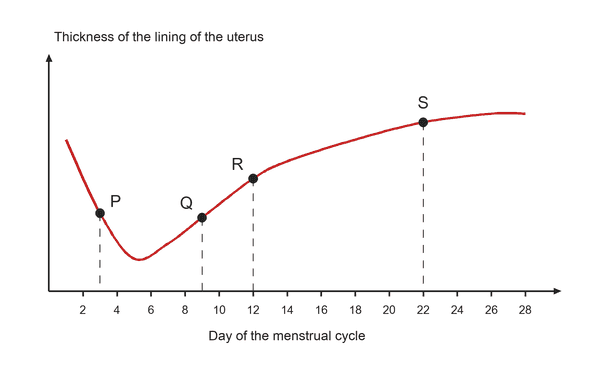
On which of the marked days was a corpus luteum present in her ovary and releasing progesterone ?
- 51 mark
Question 5
Cognitive domain: Understanding
Assertion (A): A foetus is usually not hurt when its mother is jolted in a moving bus.
Reason (R): The amniotic fluid, which fills the space between the amnion and the embryo, protects the embryo from jerks and mechanical shocks.
- 61 mark
Question 6
Cognitive domain: Analysis
Assertion (A): In the human male, urine and semen pass out of the body through the same passage.
Reason (R): The two sperm ducts open into the urinary bladder, where the sperms are stored along with urine.
- 71 mark
Question 7
Cognitive domain: Application
A sperm whose nucleus carried 22 + Y chromosomes fertilised an egg.
Since the nucleus of an egg always carries 22 + ______ chromosomes, the zygote had ______ chromosomes in all, which is the normal number.
- 81 mark
Question 8
Cognitive domain: Understanding
As soon as a baby is born it lets out a sharp cry, and the nurse says this is a good sign. A few minutes later the cord is tied and cut.
The cry clears the baby's ______ passage, which the baby now needs because oxygen will no longer reach it from the mother through the ______.
- 91 mark
Question 9
Cognitive domain: Application
Mrs. Sen had 12 menstrual cycles last year, and an egg was released in every cycle.
As normally only one egg matures in each ovary every alternate month, her right ovary released about ______ eggs in that year, each from a ripe ______ follicle.
- 102 marks
Question 10
Cognitive domain: Understanding
During fertilisation only the head of the sperm penetrates the egg; the tail is left behind. Yet the child inherits characters from the father as well as from the mother.
Explain why leaving the tail outside makes no difference to what the child inherits, and state what the parts behind the head had already done.
- 112 marks
Question 11
Cognitive domain: Application
The ovaries and the uterus of a woman are healthy, but her pituitary gland secretes very little FSH and LH.
Predict the effect of this on (i) the release of eggs from her ovaries and (ii) the formation of the corpus luteum and its hormone. Give reasons.
- 122 marks
Question 12
Cognitive domain: Evaluation
Mitali says : "A hen's egg and a human ovum are exactly the same kind of thing. The hen's egg is only much bigger."
Judge Mitali's statement, using what your chapter says about the terms ovum and egg.
- 135 marks
Question 13
Cognitive domain: Analysis
Case: A medical student compared the blood flowing through the two kinds of blood vessels of the umbilical cord of a foetus. Her notes are given below.
Substance Blood flowing from the foetus to the placenta Blood returning from the placenta to the foetus Oxygen Low High Glucose Low High Carbon dioxide High Low Urea High Low Mother's red blood cells None None (a) Name the kind of blood vessel of the umbilical cord that carries each of the two streams of blood. What is unusual about the blood in the artery of the cord ?
(b) Explain the change in the amounts of oxygen and urea between the two columns. Name the process by which the substances move.
(c) Explain why no red blood cells of the mother are found in either stream, although the two bloods come very close together in the placenta. Give one reason why this is important for the foetus.
(d) The mother has antibodies in her blood. Would you expect them in the blood returning to the foetus ? Name two other useful substances, not in the table, that reach the foetus in the same way.
- 144 marks
Question 14
Cognitive domain: Evaluation
Case: A maternity hospital recorded 12 pairs of twins in one year. Tests showed which pairs had developed from two eggs and which from one egg.
Kind of twins Both boys Both girls One boy and one girl Total pairs Fraternal 3 2 4 9 Identical 2 1 0 3 (a) Calculate the percentage of the twin pairs that were fraternal. Does it agree with the figure given in your chapter ?
(b) A nurse says : "Whenever both the twins are boys, or both are girls, they are identical twins." Judge this statement, using the data.
(c) A visitor says : "There is a zero in the table only by chance. In a bigger hospital some identical twins would be a boy and a girl." Judge this statement, with a reason.
(d) A student says : "Identical twins are the same in every respect." Is this fully correct ? Support your answer.
- 155 marks
Question 15
Cognitive domain: Creativity
Case: For a Class 8 lesson, your group has to show with a simple demonstration how the amniotic fluid protects the developing baby from jerks. You have two identical clear plastic jars with tight lids, two raw eggs, water, and a tray.
(a) Design the demonstration, making use of both jars. State what is done to each jar and why two jars are needed.
(b) State what you expect to see, and the conclusion to be drawn.
(c) Say what the egg, the water and the wall of the jar stand for in the mother's body.
(d) State two functions of the amniotic fluid that this demonstration does not show, and one way in which the model is unlike the real thing.
- 161 mark
Question 16
CISCE Competency-Focused Practice Questions (2024) · Cognitive domain: Analysis
Assertion: Seminiferous tubules produce sperms.
Reason: Seminiferous tubules secrete Oxytocin, which aids in the production of sperm.
- 172 marks
Question 17
CISCE Competency-Focused Practice Questions (2024) · Cognitive domain: Evaluate
Explain the function of corpus luteum when:
(a) ovum is fertilised.
(b) ovum is not fertilised.
- 182 marks
Question 18
CISCE Competency-Focused Practice Questions (2024) · Cognitive domain: Analysis & Application
Shruti’s mother gave birth to two male babies. Both the babies had a strong resemblance to each other. The doctor said that they have been formed from a single ovum.
(a) What kind of twins are they?
(b) Why are they of the same gender?
- 192 marks
Question 19
CISCE Competency-Focused Practice Questions (2024) · Cognitive domain: Understanding & Application
Mention the significance of the Testes being located inside the scrotum.
- 202 marks
Question 20
CISCE Competency-Focused Practice Questions (2024) · Cognitive domain: Analysis
A pregnant lady is suffering from viral fever. Will the foetus be infected?
- 211 mark
Question 21
Cognitive domain: Analysis
The figure shows the human male reproductive organs, with parts lettered P to V.

A doctor examines a man whose testes make sperms normally; normal sperms are found stored in the coiled tube R. His semen is a normal milky fluid and its amount is normal, but it contains no sperms at all. Which part is most likely to be blocked (on both sides, if the part is one of a pair) ?
- 221 mark
Question 22
Cognitive domain: Application
The figure shows the human female reproductive organs seen from the front, with parts lettered P to U.
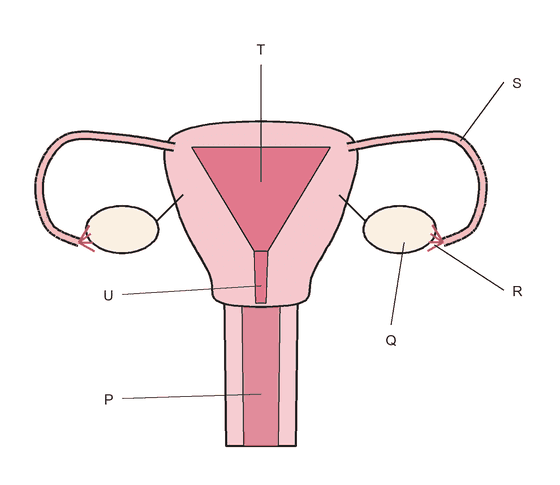
Which option names the part into which the sperms are released during copulation, and the part in whose lining the blastocyst is later fixed ?
- 231 mark
Question 23
Cognitive domain: Application
Sonal has a regular -day menstrual cycle, and the menstrual flow of her last cycle began on June. On June, four students describe what is going on in her body. Whose description is correct ?
- 241 mark
Question 24
Cognitive domain: Analysis
A new disease-causing germ (hypothetical) spreads through two lakes. In lake X, a small animal reproduces only by budding, from one parent. In lake Y, a similar animal reproduces only through eggs and sperms of two parents. A scientist says that, in one of the lakes, it is more likely that the young ones differ from one another, so that some resist the germ better than others. Which lake is it, and why ?
- 251 mark
Question 25
Cognitive domain: Application
A woman of has to have her uterus removed by surgery because of a disease of the uterus. Both her ovaries and her oviducts are healthy and are left in place. Which statement describes her body after the operation ?
- 261 mark
Question 26
Cognitive domain: Analysis
The graph shows the relative levels of two ovarian hormones, P and Q, during one -day menstrual cycle of a woman whose egg was not fertilised. (Simplified graph, hypothetical data.)
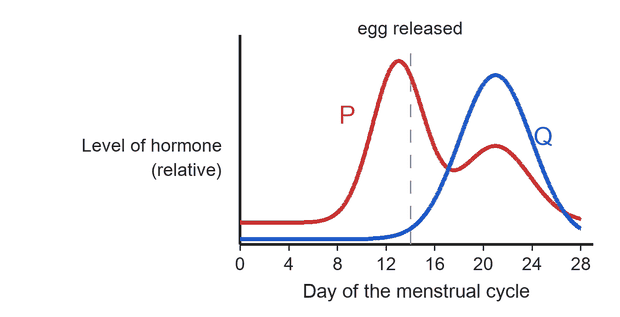
Which option names the two hormones and their source in the ovary correctly ?
- 271 mark
Question 27
Cognitive domain: Understanding
Assertion (A): At puberty, a girl's mammary glands grow, her hips become wider and her uterus and vagina become larger.
Reason (R): At puberty, the ovaries begin to release oestrogens into the blood, and these hormones bring about the bodily changes.
- 281 mark
Question 28
Cognitive domain: Analysis
Assertion (A): The placenta is formed entirely from the tissue of the mother's uterine wall.
Reason (R): The placenta is made of two sets of finger-like villi, one given out by the uterine wall and the other by an extension of the embryo, and the two sets interlock but never open into each other.
- 292 marks
Question 29
Cognitive domain: Application
Meena's last menstrual flow began on February . Her doctor counts the days of gestation from that first day. (Hypothetical case.)
(i) On what date is the birth expected ?
(ii) Name the muscular organ whose powerful contractions push the baby out at birth, and say which part of the baby normally comes out first.
- 302 marks
Question 30
Cognitive domain: Creativity
Aarav has to explain to his sister, aged , how identical twins and fraternal twins are formed. Create one everyday comparison for each kind of twins, for example with things in a kitchen or a school bag. For each comparison, say what its main parts stand for.
- 312 marks
Question 31
Cognitive domain: Analysis
Your chapter says that secondary sexual characters serve as sex clues, which help animals to identify and attract a partner. Read the three cases.
P: On dark, rainy nights the male frogs of a pond croak loudly, and the female frogs move towards the sound.
Q: A female moth gives out a smell, and male moths fly towards her from far away.
R: In the breeding season, the male of a small pond fish develops a bright red belly, and the females swim towards the red-bellied males.
(i) Name the kind of sex clue used in each case, from the kinds listed in your chapter.
(ii) Explain why a sound clue suits the frogs in case P better than a colour clue would.
- 322 marks
Question 32
Cognitive domain: Understanding
The penis is a soft organ at most times, but under sexual stimulation it becomes rigid and erect.
(i) Explain what happens inside the penis to make it rigid.
(ii) Explain why the blood stays in the penis and does not drain away through the veins during this time.
- 332 marks
Question 33
Cognitive domain: Understanding
A sperm swims with the help of its tail, but the egg has no tail and cannot swim. Yet after it is released from the ovary, the egg enters the oviduct and is carried along it towards the uterus.
(i) Which part of the oviduct receives the released egg from the ovary, and what in this part helps to pick it up ?
(ii) What moves the egg along the oviduct towards the uterus ?
- 343 marks
Question 34
Cognitive domain: Application
The chapter says that sperms are produced at a temperature to lower than that of the body, and that the skin of the scrotum helps to keep it so.
(a) The body temperature of a man is . Between which two temperatures are his sperms made ?
(b) The skin of a boy's scrotum is loose on a very hot afternoon and folded on a cold morning. State what happens to the position of the testes on each occasion, and how this helps the sperms.
(c) A man wears very tight clothing for many hours every day, which holds his testes against his body. Predict, with a reason, what is likely to happen to the maturation of his sperms.
- 353 marks
Question 35
Cognitive domain: Evaluation
At a school health check, the changes noted in four children are given in the table. (Hypothetical data.)
Child Sex Age (years) Change noted Asha Girl Breasts have just begun to enlarge Bilal Boy Testes have just begun to enlarge Chitra Girl Breasts have grown fuller; hips are wider Dev Boy Voice has deepened; a moustache is growing (a) Name the hormone that brought about the changes in Chitra, and the hormone that brought about those in Dev. Name the part that secretes each.
(b) The chapter names a first sign of puberty for girls and for boys, with an age. Say whether the changes in Asha and Bilal fit this.
(c) Chitra's friend Esha is years old and shows no change yet. Her mother is worried. Judge, using the chapter, whether Esha is likely to be abnormal.
- 363 marks
Question 36
Cognitive domain: Evaluation
A student made this chart to revise the four phases of a -day menstrual cycle. Three of its entries are wrong.
Phase Days Main event Menstrual phase to days The thickened innermost lining of the uterus is shed with blood Follicular phase to The follicle grows, and the oestrogens it secretes make the lining of the uterus thinner Ovulatory phase to The corpus luteum ruptures and releases the egg Luteal phase to The emptied follicle turns into the corpus luteum, which secretes FSH and LH Find the three wrong entries and write each one correctly.
- 373 marks
Question 37
Cognitive domain: Application
A teacher has four picture cards that show the same part of the ovary of a woman with a regular -day cycle, on days , , and of one cycle. The cards P, Q, R and S have been mixed up. (Hypothetical case.)
Card What is seen P A yellow mass of cells with no egg in it, where a sac used to be Q A large fluid-filled sac with a ripe egg, bulging over the surface of the ovary R A small sac of cells with a tiny egg, just beginning to grow S A burst sac on the surface of the ovary, with an egg just released from it (a) Arrange the four cards in the order of the days, , , and , and name the structure on each card.
(b) Name the hormone secreted by the structure on card Q, and the hormones secreted by the structure on card P.
(c) Name the process shown on card S. Which part of the female system picks up the egg next ?
- 385 marks
Question 38
Cognitive domain: Evaluation
Case: A single bacterium in a culture dish is kept in conditions that favour its growth. It divides by binary fission into two bacteria every minutes, and each new bacterium goes on dividing at the same rate. The count was noted at the end of every hour. (Hypothetical data.)
Time (hours) Number of bacteria (a) How many times did each bacterium divide in every hour ? Find the number of bacteria at the end of hours, if the same rate goes on.
(b) Give two features of this pattern of reproduction, from the chapter, that explain why so many bacteria are made in a short time, and one feature that explains why all of them are alike.
(c) A student says: "Asexual reproduction is better than sexual reproduction, because one bacterium gives in hours but a woman has one baby in days. Humans should reproduce like bacteria." Evaluate this statement, giving two points from the chapter.
- 395 marks
Question 39
Cognitive domain: Creativity
Case: For the school science exhibition, your group must build a simple working model to show that substances pass between the blood of the mother and the blood of the foetus in the placenta, although the two bloods never mix. You have a clear plastic box, a piece of fine muslin cloth, strong thread, water, two food dyes (blue and yellow), some rice grains and a spoon.
(a) Describe how you will set up the model. State what you put in each half of the box, and what each item stands for.
(b) State what you expect to see after about minutes, and how each observation matches what happens in the placenta.
(c) State two ways in which your model is unlike a real placenta.
- 404 marks
Question 40
Cognitive domain: Analysis
Case: The chapter says that a single ejaculation of the human male contains about million sperms. A teacher showed the class how the number of sperms falls on the way to the egg. (Simplified, hypothetical data.)
Place Number of sperms present Released into the vagina million Entered the uterus million Reached the upper part of an oviduct Gathered around the egg Inside the egg (a) What percentage of the sperms released entered the uterus ? How many times fewer sperms were in the upper part of the oviduct than in the uterus ?
(b) Give two reasons from the chapter for the great fall in the number of sperms, and say what happens to the sperms around the egg after one has entered.
(c) A student says: "Only one sperm is needed, so a man needs to make only a few sperms." Evaluate this, using the data.