Solution:
Concept: Compare the two terms of each pair on the same basis: what it is, and where or when it happens.
Step 1 — Spermatogenesis and oogenesis.
| Spermatogenesis | Oogenesis |
|---|
| Formation of sperms | Formation of ova |
| In the seminiferous tubules of the testes | In the follicles of the ovaries |
Step 2 — Implantation and gestation.
| Implantation | Gestation |
|---|
| Fixing of the blastocyst in the endometrium | Whole period of development in the uterus |
| About a week after fertilisation | Lasts about 280 days |
Step 3 — Pregnancy and parturition.
| Pregnancy | Parturition |
|---|
| The state of carrying the young in the uterus | The act of giving birth |
| Begins with implantation | Ends the gestation |
Step 4 — Placenta and umbilical cord.
| Placenta | Umbilical cord |
|---|
| Disc-like organ on the uterine wall | Cord joining the foetus to the placenta |
| Exchange of food, gases and wastes; secretes hormones | Only carries the foetal blood vessels |
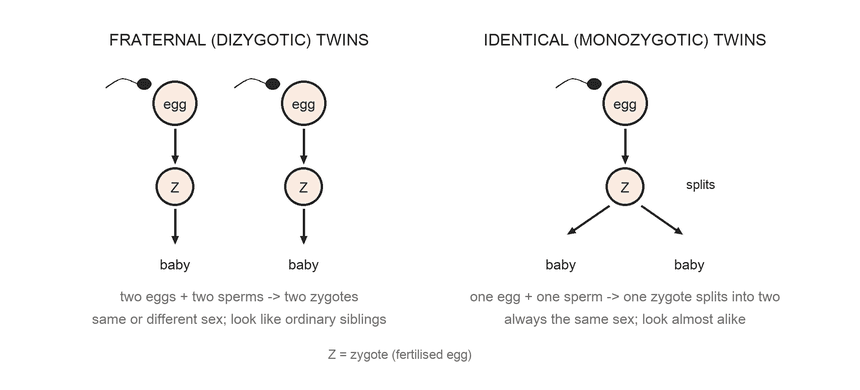
Step 5 — Identical and fraternal twins.
| Identical twins | Fraternal twins |
|---|
| From one fertilised egg that splits | From two eggs fertilised by two sperms |
| Always same sex, look very alike | Same or different sex, look like ordinary siblings |
Step 6 — Menarche and menopause.
| Menarche | Menopause |
|---|
| Onset of menstruation | Permanent stopping of menstruation |
| At about 13 years | At about 45–50 years |
Watch out: Compare both terms on the same point in each row.
Therefore, the six pairs differ as shown in the tables.
