
Opening your dashboard
Class 12 Chemistry Chapter 14 Biomolecules: Previous Year Questions
13 questions on Chapter 14, each solved step by step. Class 12 Chemistry, ICSE 2026-27.
13 questions with solutions
1–5 marks · Mixed difficulty
- 15 marks
Question 1
Match the following:
(i) Disaccharide (a) Lucas reagent (ii) Carbylamine (b) Condensation polymer (iii) Dacron (c) Obnoxious smell (iv) Low spin complex, (d) Sucrose (v) Anhydrous + conc. (e) Hexaamminecobalt(III) ion Solve with AIWritten solution
Solution:
Key idea: Each item on the left comes from a different chapter (biomolecules, amines, polymers, coordination compounds, alcohols). We match each one with the item on the right that it is, gives or is made of.
Step 1 — Match (i) Disaccharide.
A disaccharide gives two monosaccharide units on hydrolysis. Sucrose is a disaccharide: it is hydrolysed to glucose and fructose. So (i) matches (d).
Step 2 — Match (ii) Carbylamine.
In the carbylamine reaction, a primary amine is warmed with chloroform and alcoholic potassium hydroxide. It gives an isocyanide (carbylamine), which has a very unpleasant (obnoxious) smell. For ethylamine:
So (ii) matches (c).
Step 3 — Match (iii) Dacron.
Dacron (terylene) is a polyester made from ethylene glycol and terephthalic acid. Each ester link forms with the loss of a water molecule, so it is a condensation polymer. So (iii) matches (b).
Step 4 — Match (iv) Low spin complex, d²sp³.
In the hexaamminecobalt(III) ion, , cobalt is in the +3 state with the configuration 3d⁶. Ammonia is a strong field ligand, so the six d electrons pair up in three d orbitals and two inner 3d orbitals stay empty. These two 3d orbitals, one 4s and three 4p orbitals give d²sp³ hybridisation, and the complex is low spin (diamagnetic). So (iv) matches (e).
Step 5 — Match (v) Anhydrous ZnCl₂ + conc. HCl.
A solution of anhydrous zinc chloride in concentrated hydrochloric acid is called Lucas reagent. It is used to tell primary, secondary and tertiary alcohols apart by how quickly turbidity appears. So (v) matches (a).
Therefore, (i) matches (d), (ii) matches (c), (iii) matches (b), (iv) matches (e) and (v) matches (a).
- 24 marks
Question 2
Give balanced equations for the following reactions:
(i) How will you convert ethyl amine to methyl amine?
(ii) What is the effect of denaturation on the structure of proteins?
(iii) Name the nitrogen base residues present in DNA.
Solve with AIWritten solution
Solution:
Key idea: Part (i) is a "stepping down" conversion (one carbon fewer), done through acetamide and the Hofmann bromamide reaction. Parts (ii) and (iii) are short theory answers about proteins and nucleic acids.
Step 1 — Part (i): plan the route.
Ethylamine has two carbon atoms and methylamine has one. The Hofmann bromamide reaction turns an amide into an amine with one carbon atom fewer, so we first convert ethylamine into acetamide, .
Step 2 — Part (i): ethylamine to ethanol.
Ethylamine reacts with nitrous acid (from sodium nitrite and dilute HCl, kept cold) to give ethanol and nitrogen gas.
This is the simplified equation used at this level; in practice primary aliphatic amines also give some other products (such as alkenes) with nitrous acid.
Step 3 — Part (i): ethanol to acetic acid.
Ethanol is oxidised by acidified potassium dichromate, which supplies oxygen, written as [O].
Step 4 — Part (i): acetic acid to acetamide.
Acetic acid reacts with ammonia to form ammonium acetate, which loses water on heating to give acetamide.
Step 5 — Part (i): acetamide to methylamine.
In the Hofmann bromamide reaction, acetamide is warmed with bromine and sodium hydroxide. The carbonyl carbon is lost as sodium carbonate, so the amine has one carbon fewer.
Step 6 — Part (ii): effect of denaturation.
When a protein is heated, or its pH is changed, the hydrogen bonds and other weak forces that hold its folded shape are broken. The helices and sheets unfold (secondary structure lost) and the folded three-dimensional shape is lost (tertiary structure lost). The peptide bonds are not broken, so the primary structure (the order of amino acids) stays the same. The protein loses its biological activity; for example, egg white coagulates on boiling.
Step 7 — Part (iii): nitrogen bases in DNA.
DNA contains four nitrogen bases: the purines adenine (A) and guanine (G), and the pyrimidines cytosine (C) and thymine (T).
Therefore, (i) ethylamine is converted to methylamine by the sequence ethylamine → ethanol → acetic acid → acetamide → methylamine (Hofmann bromamide reaction in the last step), (ii) denaturation destroys the secondary and tertiary structure of a protein but leaves its primary structure intact, so it loses its biological activity, and (iii) DNA contains adenine, guanine, cytosine and thymine.
- 31 mark
Question 3
Fill in the blanks by choosing the appropriate word/words from those given in the brackets:
(iodoform, acetaldehyde, positive, greater, acidic, acetone, disaccharide, negative, increases, glucose, decreases, chloroform, polysaccharide, lactose, lesser, basic, cationic hydrolysis, anionic hydrolysis)
Sucrose is a ______ and yields upon hydrolysis, a mixture of ______ and fructose.
Solve with AIWritten solution
Solution:
Key idea: A disaccharide is a carbohydrate that gives two monosaccharide molecules on hydrolysis.
Step 1 — Fill the first blank.
One molecule of sucrose is hydrolysed to two monosaccharide molecules, so sucrose is a disaccharide.
Step 2 — Fill the second blank.
Hydrolysis by dilute acid (or the enzyme invertase) splits sucrose into glucose and fructose, both with the formula .
Here the first product is glucose and the second is fructose.
Therefore, the completed statement reads: sucrose is a disaccharide and yields upon hydrolysis, a mixture of glucose and fructose.
- 44 marks
Question 4
(i) Deficiency of which vitamin causes the following diseases:
(1) Scurvy
(2) Night blindness
(ii) Write two differences between globular and fibrous proteins.
Solve with AIWritten solution
Solution:
Key idea: Vitamins are needed in small amounts, and the lack of each one causes a particular deficiency disease. Proteins are grouped by the shape of their molecules into fibrous and globular proteins.
Step 1 — Part (i): scurvy.
Scurvy (bleeding gums, poor wound healing) is caused by a lack of vitamin C (ascorbic acid), which the body needs to make collagen.
Step 2 — Part (i): night blindness.
Night blindness is caused by a lack of vitamin A (retinol), which the eye needs to make the light-sensitive pigment of the rod cells.
Step 3 — Part (ii): differences between globular and fibrous proteins.
The table compares the two kinds of protein.
Globular proteins Fibrous proteins The polypeptide chains fold into a compact, roughly spherical shape. The polypeptide chains lie side by side as long threads (fibres). They are usually soluble in water. They are insoluble in water. They do functional work, as enzymes, hormones and carriers. They do structural work, in hair, skin, muscle and tendons. Examples: insulin, albumin. Examples: keratin, myosin, collagen. Therefore, (i) scurvy is caused by lack of vitamin C and night blindness by lack of vitamin A, and (ii) globular proteins are compact and water-soluble, while fibrous proteins are thread-like and insoluble in water (any two differences from the table).
- 52 marks
Question 5
Name the purine bases and pyrimidine bases present in RNA and DNA.
Solve with AIWritten solution
Solution:
Key idea: The nitrogen bases of nucleic acids are of two kinds: purines (two fused rings) and pyrimidines (one ring). DNA and RNA share three bases and differ in one pyrimidine.
Step 1 — Name the purine bases.
Both DNA and RNA contain the same two purines: adenine (A) and guanine (G).
Step 2 — Name the pyrimidine bases of DNA.
DNA contains the pyrimidines cytosine (C) and thymine (T).
Step 3 — Name the pyrimidine bases of RNA.
RNA contains cytosine (C) and uracil (U); uracil takes the place of thymine.
Therefore, the purines in both DNA and RNA are adenine and guanine; the pyrimidines are cytosine and thymine in DNA, and cytosine and uracil in RNA.
- 62 marks
Question 6
Name two water soluble vitamins and the diseases caused by their deficiency in the diet of an individual.
Solve with AIWritten solution
Solution:
Key idea: Water-soluble vitamins (the B group and vitamin C) dissolve in water and are readily excreted in urine. Apart from vitamin B₁₂, the body stores very little of them, so they must be taken in the diet regularly.
Step 1 — First vitamin and its deficiency disease.
Vitamin B₁ (thiamine) is water soluble. Its deficiency causes beriberi, which affects the nerves and the heart.
Step 2 — Second vitamin and its deficiency disease.
Vitamin C (ascorbic acid) is water soluble. Its deficiency causes scurvy, with bleeding gums and slow healing of wounds.
Therefore, two water-soluble vitamins are vitamin B₁ (deficiency causes beriberi) and vitamin C (deficiency causes scurvy).
- 72 marks
Question 7
(i) Write the chemical equation for the reaction of glucose with bromine water.
(ii) Write the zwitter ion structure of glucine.
Solve with AIWritten solution
Solution:
Key idea: Bromine water is a mild oxidising agent: it oxidises an aldehyde group to a carboxylic acid group without breaking the carbon chain. An amino acid has a basic –NH₂ group and an acidic –COOH group, so a proton moves from one to the other to give a dipolar ion (zwitter ion).
Note: The paper prints "glucine"; it means glycine, the simplest amino acid, since only an amino acid can form a zwitter ion.
Step 1 — Part (i): see what bromine water attacks.
Glucose, , has an aldehyde group at carbon 1. Bromine water oxidises this –CHO group to –COOH, giving gluconic acid, and is itself reduced to hydrobromic acid.
Step 2 — Part (i): write the equation.
The orange colour of bromine water disappears as the reaction takes place.
Step 3 — Part (ii): form the zwitter ion of glycine.
Glycine is . In water, and in the solid, the –COOH group gives a proton () to the –NH₂ group. The –NH₂ group becomes –NH₃⁺ and the –COOH group becomes –COO⁻, so the molecule carries both charges and is neutral overall:
Therefore, (i) glucose is oxidised by bromine water to gluconic acid, HOCH₂(CHOH)₄COOH, and (ii) the zwitter ion of glycine is ⁺H₃N–CH₂–COO⁻.
- 83 marks
Question 8
(i) Give an example each of reducing sugar and non-reducing sugar.
(ii) What is denaturation of proteins?
(iii) Give an example each of water soluble vitamin and fat soluble vitamin.
Solve with AIWritten solution
Solution:
Key idea: A reducing sugar has a free aldehyde (or hemiacetal / α-hydroxy ketone) group that reduces Fehling's solution and Tollens' reagent. Denaturation is the loss of a protein's natural shape. Vitamins are grouped by whether they dissolve in water or in fat.
Step 1 — Part (i): reducing and non-reducing sugar.
Glucose has a free aldehyde group, so it is a reducing sugar. In sucrose, the glycosidic bond joins carbon 1 of glucose to carbon 2 of fructose, so neither reducing group is free; sucrose is a non-reducing sugar.
Step 2 — Part (ii): denaturation of proteins.
When a protein in its natural (native) form is heated, or its pH is changed, the hydrogen bonds that hold its folded shape break. The protein loses its secondary and tertiary structure and with it its biological activity, while the peptide bonds (primary structure) remain. This process is called denaturation; the coagulation of egg white on boiling is an example.
Step 3 — Part (iii): water-soluble and fat-soluble vitamin.
Vitamin C (ascorbic acid) dissolves in water. Vitamin A (retinol) dissolves in fats and oils, like vitamins D, E and K.
Therefore, (i) glucose is a reducing sugar and sucrose a non-reducing sugar, (ii) denaturation is the loss of a protein's secondary and tertiary structure, and so of its biological activity, on heating or a change of pH, and (iii) vitamin C is water soluble and vitamin A is fat soluble.
- 93 marks
Question 9
(a) Aradhana visits a physician as she is suffering from rickets and joint pain. Which fat-soluble vitamin should the physician prescribe to her?
(b) Somesh put a few drops of vinegar in the milk. What change do you think he observed in the milk after some time? What is this phenomenon known as?
(c) Name the product of hydrolysis of sucrose. Is it a reducing sugar or a non-reducing sugar?
Solve with AIWritten solution
Solution:
Key idea: Each part links an everyday observation with a fact about biomolecules: a vitamin deficiency, the denaturation of milk protein by acid, and the hydrolysis of sucrose.
Step 1 — Part (a): the vitamin for rickets.
Rickets (soft, weak bones and joint pain) comes from a lack of vitamin D, which the body needs to absorb calcium and phosphate for the bones. Vitamin D is fat soluble, so the physician should prescribe vitamin D.
Step 2 — Part (b): what Somesh sees.
Vinegar contains acetic acid, which lowers the pH of the milk. The main milk protein, casein, loses its natural shape and comes out as white lumps (curds), leaving a watery liquid. So the milk curdles.
Step 3 — Part (b): name the phenomenon.
The loss of a protein's natural shape by a change of pH is called denaturation of protein; here it shows as coagulation (curdling) of milk.
Step 4 — Part (c): products of hydrolysis of sucrose.
On hydrolysis, sucrose gives equal amounts of glucose and fructose.
This mixture is called invert sugar, because the direction of rotation of plane-polarised light changes from right (sucrose) to left (the mixture).
Step 5 — Part (c): reducing or not.
Glucose and fructose both reduce Fehling's solution and Tollens' reagent, so the product of hydrolysis is a reducing sugar. Sucrose itself is a non-reducing sugar, because its glycosidic bond ties up both reducing groups.
Therefore, (a) vitamin D should be prescribed, (b) the milk curdles, which is denaturation (coagulation) of the milk protein, and (c) sucrose is hydrolysed to glucose and fructose (invert sugar), which is a reducing sugar, although sucrose itself is non-reducing.
- 101 mark
Question 10
Select and write the correct alternative from the choices given below.
Which one of the following does NOT form a silver mirror on heating with Tollen's reagent?
Solve with AIAnswer
(A) Glucose
(B) Fructose
- Correct
(C) Sucrose
(D) Lactose
Answer: (C) Sucrose
Key idea: Tollens' reagent (ammoniacal silver nitrate) gives a silver mirror only with reducing sugars, which have a free aldehyde group, a free hemiacetal group, or an α-hydroxy ketone group.
Step 1 — Look at how sucrose is joined.
In sucrose, the glycosidic bond links carbon 1 of the glucose unit to carbon 2 of the fructose unit. These are exactly the two carbons that carry the reducing groups.
Step 2 — Decide whether it reduces Tollens' reagent.
With both reducing groups tied up, sucrose cannot open into a form with a free –CHO group. It does not reduce silver ions, so it gives no silver mirror.
Why the others are wrong:
- (A) Glucose has a free aldehyde group (in its open-chain form), so it reduces Tollens' reagent and forms a silver mirror.
- (B) Fructose is a ketose, but its α-hydroxy ketone group is oxidised in the alkaline Tollens' reagent, so it too forms a silver mirror.
- (D) Lactose is a disaccharide whose glucose unit keeps a free hemiacetal group at carbon 1, so it is a reducing sugar and forms a silver mirror.
Therefore, sucrose does not form a silver mirror with Tollens' reagent, option (C).
- 113 marks
Question 11
(i) The structure of amino acid exists in the following two forms:
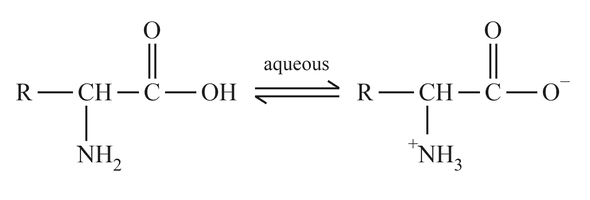
The above structure is an example of __________. If the side chain R is replaced by hydrogen, the amino acid is known as __________.
(ii) Janice notices that her gums bleed while brushing and eating food. Name the water soluble vitamin which she should consume to prevent bleeding of gums.
(iii) Which linkage holds two units of monosaccharides in a disaccharide?
Solve with AIWritten solution
Solution:
Key idea: An amino acid carries an acidic –COOH group and a basic –NH₂ group on the same molecule. In water a proton moves from –COOH to –NH₂, giving an ion with both charges.
Step 1 — Part (i): name the form on the right.
In the figure, the –COOH group has lost a proton and become –COO⁻, while the –NH₂ group has gained it and become –NH₃⁺. An ion carrying both a positive and a negative charge, but neutral overall, is called a dipolar ion or zwitter ion. So the structure is an example of a zwitter ion.
Step 2 — Part (i): the amino acid with R = H.
When R is a hydrogen atom, the amino acid is , the simplest amino acid, glycine.
Step 3 — Part (ii): bleeding gums.
Bleeding gums are a sign of scurvy, caused by a lack of vitamin C (ascorbic acid). Vitamin C is water soluble and is needed to make collagen, which keeps gums and blood vessels healthy. So Janice should consume vitamin C, for example from citrus fruits and amla.
Step 4 — Part (iii): the linkage in a disaccharide.
Two monosaccharide units join when the –OH of one unit and an –OH of the other lose a water molecule, leaving an oxygen bridge (C–O–C) between them. This oxide link is called a glycosidic linkage.
Therefore, (i) the structure is an example of a zwitter ion, and with R = H the amino acid is glycine, (ii) Janice should consume vitamin C, and (iii) a glycosidic linkage holds the two monosaccharide units together.
- 121 mark
Question 12
Select and write the correct alternative from the choices given below.
Which one of the following nitrogen bases is absent in RNA?
Solve with AIAnswer
(A) Adenine
(B) Guanine
(C) Uracil
- Correct
(D) Thymine
Answer: (D) Thymine
Key idea: DNA and RNA share the bases adenine, guanine and cytosine. They differ in one pyrimidine: DNA has thymine, while RNA has uracil in its place.
Step 1 — List the bases of RNA.
RNA contains adenine (A), guanine (G), cytosine (C) and uracil (U).
Step 2 — Find the missing one.
Thymine (T) is not in this list; it occurs in DNA, where it pairs with adenine. In RNA, uracil pairs with adenine instead.
Why the others are wrong:
- (A) Adenine is a purine present in both DNA and RNA.
- (B) Guanine is a purine present in both DNA and RNA.
- (C) Uracil is the pyrimidine found in RNA (in place of thymine), so it is present, not absent.
Therefore, thymine is the nitrogen base absent in RNA, option (D).
- 133 marks
Question 13
(i) Give one example each of fibrous protein and globular protein.
(ii) The structures of two amino acids, glycine and alanine, are given below. Draw the peptide linkage between these two amino acids.

(iii) Justify that glucose is an aldose form of sugar, with the help of a chemical reaction.
Solve with AIWritten solution
Solution:
Key idea: A peptide linkage (–CO–NH–) forms when the –COOH group of one amino acid and the –NH₂ group of another lose a water molecule. Glucose is shown to be an aldose by a reaction that only an aldehyde group gives.
Step 1 — Part (i): examples of fibrous and globular proteins.
Keratin (in hair, wool and nails) is a fibrous protein: its chains run side by side as long fibres. Insulin is a globular protein: its chains fold into a compact, roughly spherical shape, and it dissolves in water.
Step 2 — Part (ii): join the two amino acids.
We take the –COOH group of glycine and the –NH₂ group of alanine. The –OH of the acid group and one H of the amino group leave as water, and the carbon of the C=O group bonds to the nitrogen.
Step 3 — Part (ii): draw the dipeptide.
The product is the dipeptide glycylalanine (Gly–Ala). The shaded group, –CO–NH–, is the peptide linkage.
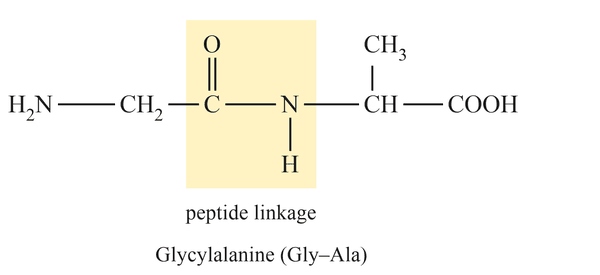
If the –COOH of alanine joins the –NH₂ of glycine instead, the other dipeptide, alanylglycine (Ala–Gly), forms; it has the same kind of peptide linkage.
Step 4 — Part (iii): show that glucose has an aldehyde group.
Bromine water is a mild oxidising agent that oxidises an aldehyde group to a carboxylic acid group but does not attack ketones. Glucose is oxidised by bromine water to gluconic acid, which has the same six carbon atoms:
Step 5 — Part (iii): draw the conclusion.
Since a carboxylic acid with the same number of carbon atoms is formed, the carbonyl group of glucose must be at the end of the chain, that is, an aldehyde group (–CHO). A sugar with an aldehyde group is an aldose, so glucose is an aldose (an aldohexose).
Therefore, (i) keratin is a fibrous protein and insulin a globular protein, (ii) glycine and alanine join through the peptide linkage –CO–NH– to give glycylalanine, H₂N–CH₂–CO–NH–CH(CH₃)–COOH, and (iii) oxidation of glucose by bromine water to gluconic acid shows that glucose has an aldehyde group, so it is an aldose.