Solution:
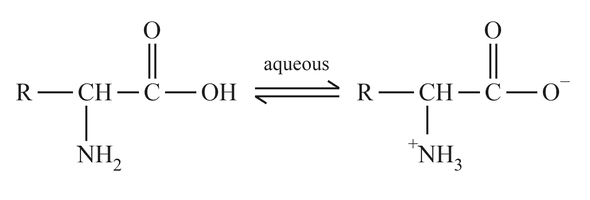
Key idea: An amino acid carries an acidic –COOH group and a basic –NH₂ group on the same molecule. In water a proton moves from –COOH to –NH₂, giving an ion with both charges.
Step 1 — Part (i): name the form on the right.
In the figure, the –COOH group has lost a proton and become –COO⁻, while the –NH₂ group has gained it and become –NH₃⁺. An ion carrying both a positive and a negative charge, but neutral overall, is called a dipolar ion or zwitter ion. So the structure is an example of a zwitter ion.
Step 2 — Part (i): the amino acid with R = H.
When R is a hydrogen atom, the amino acid is H2N−CH2−COOH, the simplest amino acid, glycine.
Step 3 — Part (ii): bleeding gums.
Bleeding gums are a sign of scurvy, caused by a lack of vitamin C (ascorbic acid). Vitamin C is water soluble and is needed to make collagen, which keeps gums and blood vessels healthy. So Janice should consume vitamin C, for example from citrus fruits and amla.
Step 4 — Part (iii): the linkage in a disaccharide.
Two monosaccharide units join when the –OH of one unit and an –OH of the other lose a water molecule, leaving an oxygen bridge (C–O–C) between them. This oxide link is called a glycosidic linkage.
Therefore, (i) the structure is an example of a zwitter ion, and with R = H the amino acid is glycine, (ii) Janice should consume vitamin C, and (iii) a glycosidic linkage holds the two monosaccharide units together.