Solution:
Key idea: A peptide linkage (–CO–NH–) forms when the –COOH group of one amino acid and the –NH₂ group of another lose a water molecule. Glucose is shown to be an aldose by a reaction that only an aldehyde group gives.
Step 1 — Part (i): examples of fibrous and globular proteins.
Keratin (in hair, wool and nails) is a fibrous protein: its chains run side by side as long fibres. Insulin is a globular protein: its chains fold into a compact, roughly spherical shape, and it dissolves in water.
Step 2 — Part (ii): join the two amino acids.
We take the –COOH group of glycine and the –NH₂ group of alanine. The –OH of the acid group and one H of the amino group leave as water, and the carbon of the C=O group bonds to the nitrogen.
H2NCH2COOH+H2NCH(CH3)COOH→H2NCH2CONHCH(CH3)COOH+H2O
Step 3 — Part (ii): draw the dipeptide.
The product is the dipeptide glycylalanine (Gly–Ala). The shaded group, –CO–NH–, is the peptide linkage.
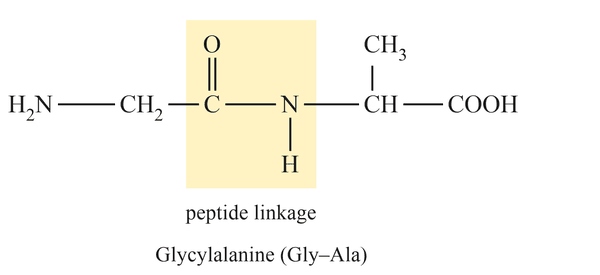
If the –COOH of alanine joins the –NH₂ of glycine instead, the other dipeptide, alanylglycine (Ala–Gly), forms; it has the same kind of peptide linkage.
Step 4 — Part (iii): show that glucose has an aldehyde group.
Bromine water is a mild oxidising agent that oxidises an aldehyde group to a carboxylic acid group but does not attack ketones. Glucose is oxidised by bromine water to gluconic acid, which has the same six carbon atoms:
HOCH2(CHOH)4CHO+Br2+H2O→HOCH2(CHOH)4COOH+2HBr
Step 5 — Part (iii): draw the conclusion.
Since a carboxylic acid with the same number of carbon atoms is formed, the carbonyl group of glucose must be at the end of the chain, that is, an aldehyde group (–CHO). A sugar with an aldehyde group is an aldose, so glucose is an aldose (an aldohexose).
Therefore, (i) keratin is a fibrous protein and insulin a globular protein, (ii) glycine and alanine join through the peptide linkage –CO–NH– to give glycylalanine, H₂N–CH₂–CO–NH–CH(CH₃)–COOH, and (iii) oxidation of glucose by bromine water to gluconic acid shows that glucose has an aldehyde group, so it is an aldose.

