Solution:
Concept: Ohm's law: the current in a conductor is directly proportional to the p.d. across its ends, provided its physical conditions (temperature) stay the same. So V = IR, where R is the resistance, measured in ohm (1 Ω = 1 V A⁻¹).
Step 1 — Recall the ohmic graph (part a).
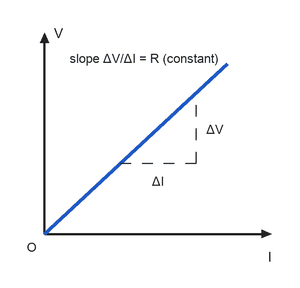
An ohmic resistor obeys V ∝ I at constant temperature, so its V–I graph is a straight line through the origin.
Step 2 — Check each graph (part a).
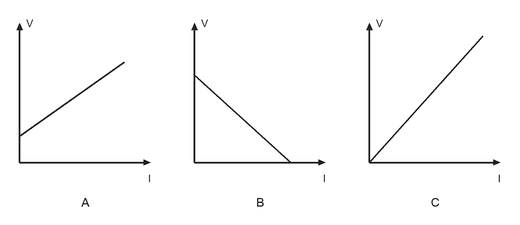
In graph C, V rises in direct proportion to I and the line passes through the origin, so V/I is constant. In graph A the line does not start at the origin, so V/I changes from point to point. In graph B, V falls as I rises, so V is not proportional to I.
Step 3 — Give an example (part b).
A nichrome wire (or a manganin wire, or any metal wire kept at a constant temperature) is an ohmic resistor.
Watch out: A straight line is not enough: it must pass through the origin.
Therefore, (a) graph C, because it is a straight line through the origin (V ∝ I); (b) a nichrome wire.