
Question 463 marksAsked 2026Medium
Observe the circuit diagram given below.
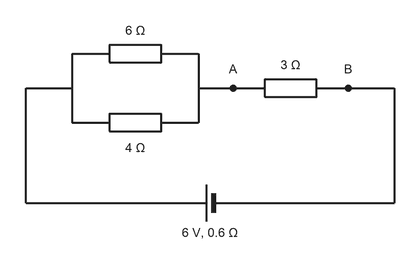
Calculate the current:
(a) through 3Ω resistor.
(b) drawn from the cell when the 3Ω resistance is replaced by a connecting wire of negligible resistance.
Confirming your payment
Sign up now and get 250 free tokens.
Previous Year Questions · Question 46 of 48
Observe the circuit diagram given below.
Calculate the current:
(a) through 3Ω resistor.
(b) drawn from the cell when the 3Ω resistance is replaced by a connecting wire of negligible resistance.
Solution:
Concept: The e.m.f. ε of a cell is the p.d. across its terminals when it sends no current (open circuit). When it sends a current I through an external resistance R, a part Ir of the e.m.f. is used up inside the cell (internal resistance r), so the terminal voltage is V = ε − Ir, and ε = I(R + r). In parallel the p.d. is the same across each resistor, the currents add up (I = I₁ + I₂ + …), and the equivalent resistance is given by 1/R = 1/R₁ + 1/R₂ + …, less than the smallest one. For two resistors, R = R₁R₂ ÷ (R₁ + R₂).
Given: ε = 6 V, r = 0.6 Ω; 6 Ω ∥ 4 Ω in series with 3 Ω.
Step 1 — Combine 6 Ω and 4 Ω.
The 6 Ω and 4 Ω are in parallel.
Step 2 — Find the total resistance (part a).
The pair, the 3 Ω between A and B, and the internal resistance 0.6 Ω are all in series.
Step 3 — Find the current in 3 Ω (part a).
The 3 Ω carries the full current from the cell.
Step 4 — Replace 3 Ω by a wire (part b).
A connecting wire of negligible resistance simply removes 3 Ω from the total.
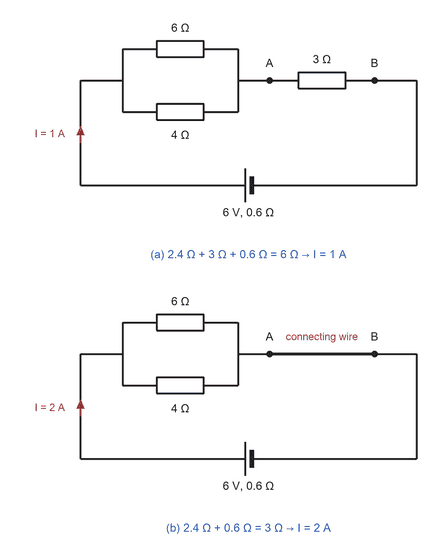
Removing 3 Ω halves the total resistance, so the current doubles.
Watch out: Keep the internal resistance 0.6 Ω in both totals.
Therefore, (a) the current through the 3 Ω resistor is 1 A; (b) the current drawn from the cell becomes 2 A.