Solution:
Concept: A rating such as '100 W, 220 V' means the appliance uses 100 W when connected to 220 V. From it, the resistance is R = V² ÷ P and the safe (normal working) current is I = P ÷ V. In series the same current flows through each resistor, the p.d.s add up (V = V₁ + V₂ + …), and the equivalent resistance is R = R₁ + R₂ + …, more than the largest one. In parallel the p.d. is the same across each resistor, the currents add up (I = I₁ + I₂ + …), and the equivalent resistance is given by 1/R = 1/R₁ + 1/R₂ + …, less than the smallest one. For two resistors, R = R₁R₂ ÷ (R₁ + R₂).
Step 1 — Find the resistance of a bulb (part a).
From the rating, R = V² ÷ P.
R=40122=40144=3.6 Ω
Step 2 — Trace the circuit with S₁ closed (part b1).
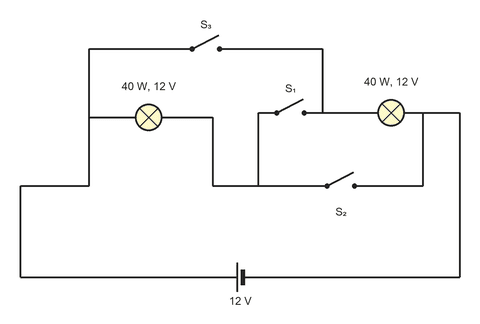
The current from the cell passes through the first bulb, then through S₁, then through the second bulb. There is only one path, so the bulbs are in series.
Rs=3.6+3.6=7.2 Ω
Step 3 — Find the power (part b1).
The whole 12 V is across the series pair.
P=RsV2=7.2144=20 W
Step 4 — Trace the circuit with S₂ and S₃ closed (part b2).
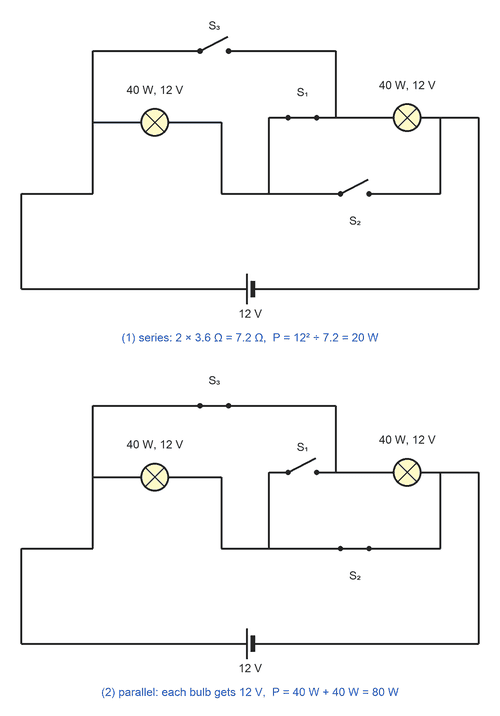
S₂ joins the end of the first bulb straight back to the cell, and S₃ joins the start of the second bulb straight to the cell. So each bulb is directly across the 12 V supply: they are in parallel, and each works at its rated 40 W.
Step 5 — Find the power (part b2).
The powers of parallel bulbs add.
P=40+40=80 W
In parallel each bulb gets the full 12 V, so the total power is four times that of the series connection.
Watch out: In series each bulb gets only half the voltage, so its power falls to a quarter, not to a half.
Therefore, (a) the resistance of a bulb is 3.6 Ω; (b)(1) the total power is 20 W; (b)(2) the total power is 80 W.