
Question 83 marksAsked 2018Medium
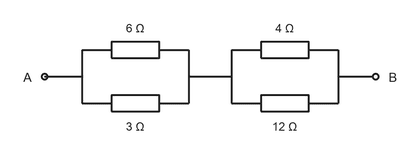
(i) Find the equivalent resistance between A and B.
(ii) State whether the resistivity of a wire changes with the change in the thickness of the wire.
Confirming your payment
Sign up now and get 250 free tokens.
Previous Year Questions · Question 8 of 48
(i) Find the equivalent resistance between A and B.
(ii) State whether the resistivity of a wire changes with the change in the thickness of the wire.
Solution:
Concept: In parallel the p.d. is the same across each resistor, the currents add up (I = I₁ + I₂ + …), and the equivalent resistance is given by 1/R = 1/R₁ + 1/R₂ + …, less than the smallest one. For two resistors, R = R₁R₂ ÷ (R₁ + R₂). Specific resistance ρ is the resistance of a wire of the material of unit length and unit area of cross-section; its S.I. unit is the ohm metre (Ω m). It depends only on the material and its temperature, not on the length or thickness of the sample.
(i)
Step 1 — Combine the first parallel pair.
The 6 Ω and 3 Ω are joined between the same two points, so they are in parallel.
Step 2 — Combine the second parallel pair.
The 4 Ω and 12 Ω are also in parallel.
Step 3 — Add the two groups.
The two groups are joined one after the other, in series.

(ii)
Step 4 — Decide about the resistivity.
No: the resistivity does not change with thickness. Resistivity depends only on the material and its temperature. A thicker wire has a smaller resistance (R = ρl ÷ a, with a larger a), but its resistivity ρ stays the same.
Watch out: Thickness changes the RESISTANCE of a wire, not its RESISTIVITY.
Therefore, (i) the equivalent resistance between A and B is 5 Ω; (ii) no, the resistivity does not change with the thickness of the wire.