
Question 94 marksAsked 2018Medium
An electric iron is rated 220V, 2 kW.
(i) If the iron is used for 2h daily, find the cost of running it for one week if it costs ₹4.25 per kWh.
(ii) Why is the fuse absolutely necessary in a power circuit?
Confirming your payment
Sign up now and get 250 free tokens.
Previous Year Questions · Question 9 of 48
An electric iron is rated 220V, 2 kW.
(i) If the iron is used for 2h daily, find the cost of running it for one week if it costs ₹4.25 per kWh.
(ii) Why is the fuse absolutely necessary in a power circuit?
Solution:
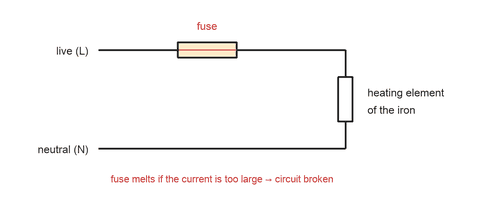
Concept: The household (commercial) unit of electrical energy is the kilowatt hour: the energy used by a 1 kW appliance in 1 hour. Since 1 kW is 1000 W and 1 h is 3600 s, 1 kWh = 3.6 × 10⁶ J. Energy in kWh is the power in kW multiplied by the time in hours. A fuse is a short wire of low melting point placed in the live wire. When the current exceeds its rating, it melts and breaks the circuit, so a fuse must be rated a little above the normal working current.
Given: 2 kW iron, used 2 h daily for 7 days; rate ₹ 4.25 per kWh.
(i)
Step 1 — Find the total time of use.
The iron is used 2 h a day for 7 days.
Step 2 — Find the energy used.
Energy in kWh is the power in kW times the time in hours.
Step 3 — Find the cost.
Each kWh costs ₹ 4.25, so we multiply the energy by the rate.
So the cost is ₹ 119.
(ii)
Step 4 — Explain why a fuse is needed.
A power circuit carries large currents for heavy appliances. If the current becomes too large because of a short circuit or an overload, the wires overheat, which can damage the appliances and even start a fire. The fuse in the live wire melts as soon as the current exceeds its rating and breaks the circuit at once, so it protects the wiring and the appliances.
Watch out: Use the time for the whole week, 14 h, not 2 h.
Therefore, (i) the cost of running the iron for one week is ₹ 119; (ii) a fuse is necessary because it melts and breaks the circuit when the current becomes too large, protecting the wiring and appliances from damage and fire.