
Question 72 marksAsked 2018Easy
You have three resistors of values 2 Ω, 3 Ω and 5 Ω. How will you join them so that the total resistance is more than 7 Ω?
(i) Draw a diagram for the arrangement.
(ii) Calculate the equivalent resistance.
Confirming your payment
Sign up now and get 250 free tokens.
Previous Year Questions · Question 7 of 48
You have three resistors of values 2 Ω, 3 Ω and 5 Ω. How will you join them so that the total resistance is more than 7 Ω?
(i) Draw a diagram for the arrangement.
(ii) Calculate the equivalent resistance.
Solution:
Concept: In series the same current flows through each resistor, the p.d.s add up (V = V₁ + V₂ + …), and the equivalent resistance is R = R₁ + R₂ + …, more than the largest one.
Step 1 — Choose the arrangement (part i).
In series the resistances add up, so the total is more than the largest one. Any arrangement with a parallel pair gives less. So join all three resistors in series, end to end, so that the same current passes through each.
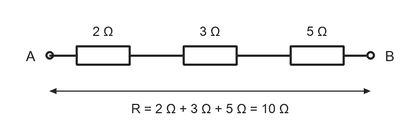
Step 2 — Find the equivalent resistance (part ii).
In series the equivalent resistance is the sum.
This is more than 7 Ω.
Step 3 — Check the other arrangements.
Every arrangement with a parallel pair is below 7 Ω; for example, 5 Ω in series with (2 Ω ∥ 3 Ω) gives 5 + 1.2 = 6.2 Ω.
Watch out: A parallel combination is always less than its smallest resistor, so it can never help to go above 7 Ω here.
Therefore, (i) the three resistors are joined in series; (ii) the equivalent resistance is 10 Ω.