
Question 62 marksAsked 2017Easy
An electric bulb of resistance 500 Ω, draws a current of 0.4 A. Calculate the power of the bulb and the potential difference at its end.
Confirming your payment
Sign up now and get 250 free tokens.
Previous Year Questions · Question 6 of 48
An electric bulb of resistance 500 Ω, draws a current of 0.4 A. Calculate the power of the bulb and the potential difference at its end.
Solution:
Concept: Ohm's law: the current in a conductor is directly proportional to the p.d. across its ends, provided its physical conditions (temperature) stay the same. So V = IR, where R is the resistance, measured in ohm (1 Ω = 1 V A⁻¹). Electrical power is the rate of spending electrical energy, P = W ÷ t; since W = VIt, this gives P = VI, which can also be written P = I²R or P = V² ÷ R. Its S.I. unit is the watt; one watt is one joule per second (1 V × 1 A).
Given: R = 500 Ω, I = 0.4 A.
Step 1 — Find the p.d.
Ohm's law gives the p.d. across the bulb.
Step 2 — Find the power.
The power of a resistor is P = I²R.
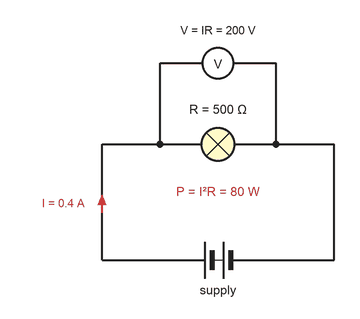
Step 3 — Check with P = VI.
The same power comes from the p.d. and the current.
Watch out: Square the current in P = I²R: (0.4)² is 0.16, not 0.8.
Therefore, the power of the bulb is 80 W and the potential difference at its ends is 200 V.