
Question 52 marksAsked 2017Easy
Define specific resistance and state its S.I. unit.
Confirming your payment
Sign up now and get 250 free tokens.
Previous Year Questions · Question 5 of 48
Define specific resistance and state its S.I. unit.
Solution:
Concept: The resistance of a wire is R = ρl ÷ a, where l is its length, a its area of cross-section and ρ the specific resistance (resistivity) of its material. So R ∝ l and R ∝ 1/a; for a wire of radius r, a = πr², so R ∝ 1/r². Specific resistance ρ is the resistance of a wire of the material of unit length and unit area of cross-section; its S.I. unit is the ohm metre (Ω m). It depends only on the material and its temperature, not on the length or thickness of the sample.
Step 1 — Define specific resistance.
The specific resistance (resistivity) of a material is the resistance of a wire of that material of unit length and unit area of cross-section.
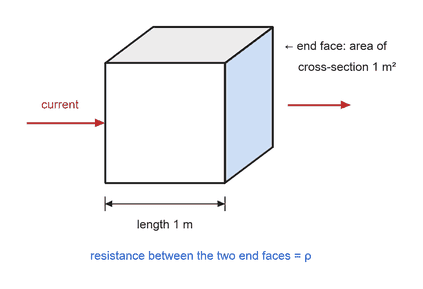
Step 2 — Write it as a formula.
From R = ρl ÷ a, we can make ρ the subject.
So if l = 1 m and a = 1 m², ρ is numerically equal to R.
Step 3 — Find the S.I. unit.
Putting the units into ρ = Ra ÷ l gives ohm × metre² ÷ metre, that is ohm metre.
Watch out: The unit is ohm metre (Ω m), not ohm per metre (Ω m⁻¹).
Therefore, specific resistance is the resistance of a wire of the material of unit length and unit area of cross-section; its S.I. unit is the ohm metre (Ω m).