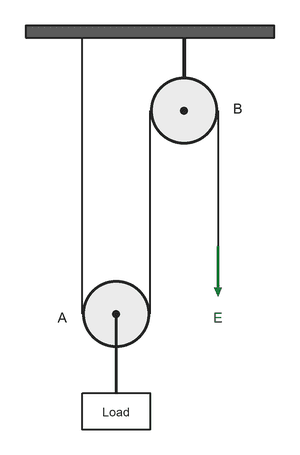
Solution:
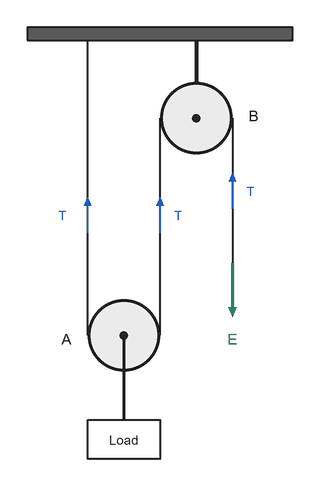
Concept: In an ideal pulley system the string is light and slides without friction, so the tension T is the same all along one string. Every strand that holds up a movable pulley pulls it up with T, and the effort pulls the free end with E = T. A fixed pulley only changes the direction of the force; a movable pulley hangs in two strands, so they share its load. Tension is a pull: in every strand it acts along the string, towards the pulley the strand runs to (Selina's convention), so it pulls the lower block up and also pulls back on the hand at the free end.
Given: Free end moves through a distance x.
Step 1 — Part (i): mark the tensions.
Pulley A moves with the load, so it is a movable pulley; B is fixed. The tension T acts along every strand, pointing towards the pulley the strand runs to: up on A in both strands holding it, and up on the free strand too, where it pulls back against the effort E, which acts downward.
Step 2 — Part (ii): velocity ratio.
Pulley A hangs in two strands. When the load rises by 1 unit, each strand becomes 1 unit shorter, so the free end must move 2 units:
V.R.=dLdE=12=2
Step 3 — Part (iii): relation between T and E.
The effort pulls the free end of the same string, and the tension is the same all along one string (friction neglected), so
T=E
For pulley A, the two strands together hold the load, so 2T=L.
Step 4 — Part (iv): distance moved by the load.
The load moves V.R. times less than the effort:
dL=V.R.dE=2x
Watch out: The tension in the free strand points up (towards pulley B), opposite to the effort, not along it.
Therefore, (i) T acts upward in both strands holding A and upward (towards B) in the free strand; (ii) V.R. = 2; (iii) T = E; (iv) the load is raised through x/2.